Most procurement leaders assume outsourcing their RFP process is a headcount play. It isn't. The real benefits of RFP management services have nothing to do with labor arbitrage and everything to do with analytical precision, market intelligence, and the kind of benchmarking data that most internal teams simply don't have access to.
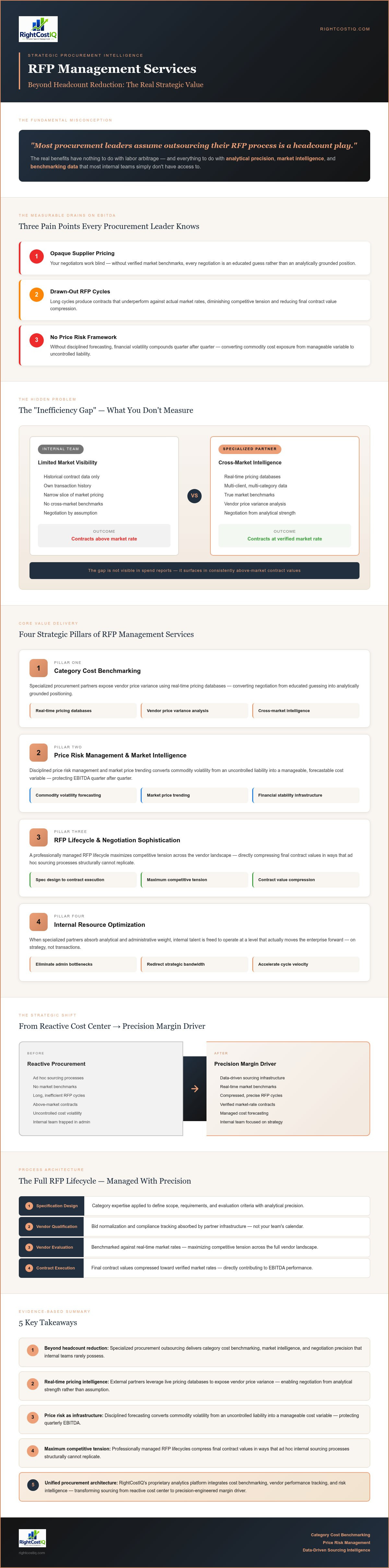
You already know the pain. Opaque supplier pricing leaves your negotiators working blind. Drawn-out RFP cycles produce contracts that underperform against actual market rates. And without a structured price risk management framework, financial volatility compounds quarter after quarter. These aren't operational inconveniences; they're measurable drains on EBITDA.
This article breaks down the strategic case for specialized procurement outsourcing, specifically how category cost benchmarking, data-driven sourcing infrastructure, and disciplined negotiation frameworks convert a historically reactive cost center into a precision-engineered value driver. If you're evaluating whether outsourced RFP management can deliver a measurable ROI beyond simple resource reduction, you'll find a clear, evidence-based answer here.
Key Takeaways
- The core benefits of RFP management services extend far beyond headcount reduction - specialized procurement outsourcing delivers category cost benchmarking, market intelligence, and negotiation precision that internal teams rarely possess.
- External procurement partners leverage real-time pricing databases to expose vendor price variance, giving enterprises the benchmarking data needed to negotiate from a position of analytical strength rather than assumption.
- Price risk management and market price trending are critical infrastructure for financial stability - disciplined forecasting converts commodity volatility from an uncontrolled liability into a manageable cost variable.
- A professionally managed RFP lifecycle maximizes competitive tension across the vendor landscape, directly compressing final contract values in ways that ad hoc sourcing processes structurally cannot replicate.
- RightCostIQ's proprietary analytics platform integrates cost benchmarking, vendor performance tracking, and risk intelligence into a unified procurement architecture - transforming sourcing from a reactive cost center into a precision-engineered margin driver.
The Strategic Evolution: Why Enterprises Outsource Procurement Functions
Procurement outsourcing has undergone a fundamental identity shift. What began as a cost-reduction tactic, offloading administrative burden to free up internal bandwidth, has matured into something categorically different: a strategic partnership that delivers specialized category expertise, real-time market intelligence, and negotiation infrastructure that generalist internal teams structurally cannot replicate. The distinction matters, because enterprises that still frame outsourcing as a headcount play are leaving measurable margin on the table.
The core problem with traditional in-house procurement models isn't effort; it's data asymmetry. Internal procurement teams typically operate within a narrow slice of market visibility, drawing on historical contract data and vendor relationships that reflect their own transaction history rather than true market benchmarks. That's a structural disadvantage. Specialized procurement partners, by contrast, operate across a broad portfolio of categories and clients simultaneously, generating the kind of cross-market pricing intelligence that transforms negotiation from an educated guess into an analytically grounded position.
This is the "Inefficiency Gap" most enterprises don't measure precisely because they don't know what they're missing. It's not visible in spend reports. It surfaces in contract values that are consistently above market rate, in RFP cycles that run long and produce diminishing competitive tension, and in commodity cost exposure that compounds without a disciplined price risk management framework in place.
From Tactical Support to Strategic Margin Expansion
The ROI of specialized procurement intelligence isn't theoretical. When category expertise is applied with clinical precision across the full RFP lifecycle, from specification design through vendor evaluation to final contract execution, the output is measurably different from what generalist in-house execution produces. The benefits of RFP management services at this level aren't administrative; they're financial. Sourcing cycles compress. Vendor pricing converges toward verified market rates. And procurement transitions from a reactive cost center into a disciplined margin driver that contributes directly to EBITDA performance.
Focusing Internal Resources on Core Competencies
There's a significant opportunity cost embedded in every hour an internal procurement team spends managing non-core spend categories. That time has an alternative use: product development, customer acquisition strategy, operational scaling. When specialized partners absorb the analytical and administrative weight of the sourcing lifecycle, internal talent is freed to operate at a level that actually moves the enterprise forward. The benefits of RFP management services extend beyond cost compression; they restructure how your organization allocates its highest-value human capital.
- Eliminating administrative bottlenecks: Vendor qualification, bid normalization, and compliance tracking are absorbed by the external partner's infrastructure, not your team's calendar.
- Redirecting strategic bandwidth: Internal procurement leaders shift from transaction management to category strategy and supplier relationship governance.
- Accelerating cycle velocity: Purpose-built sourcing processes reduce RFP cycle times without sacrificing competitive rigor or analytical depth.
The enterprises extracting the most value from outsourced RFP management aren't doing so because they're short-staffed. They're doing it because they've recognized that category-specific intelligence and benchmarking precision are competitive assets, and that building those assets in-house carries a cost and timeline that rarely justifies the investment.
Financial Optimization Through Category Cost Benchmarking
Generic cost savings claims are easy to make. Delivering them with analytical precision is a different discipline entirely. The distinction between vague procurement improvement and measurable financial optimization comes down to one capability most internal teams lack: access to real-time, cross-market category cost benchmarking data that converts vendor pricing from an opaque variable into a quantified, negotiable figure.
Specialized procurement partners maintain external pricing databases built from transaction data spanning multiple industries, geographies, and supplier tiers simultaneously. That breadth is the structural advantage. When a vendor submits a bid, it isn't evaluated against your last contract or your team's intuition; it's evaluated against verified market rates for that specific category, at that volume tier, in that supply environment. Price variance becomes visible immediately. Outliers get challenged. And negotiations begin from an analytically grounded position rather than an educated guess.
This is precisely where the benefits of RFP management services diverge sharply from what generalist sourcing execution produces. Cost transparency tools expose the hidden margin that vendors build into proposals when they're confident buyers lack comparative data. When that confidence is removed, pricing compresses toward actual market benchmarks, and the savings aren't theoretical; they're contractually locked in.
Unlocking Hidden Savings in Tail Spend Management
Tail spend is the procurement blind spot that quietly erodes margins across most mid-market and enterprise organizations. Broadly defined as the fragmented, low-value, high-frequency purchases that fall outside formal sourcing programs, tail spend typically represents a disproportionate share of total transaction volume while receiving minimal analytical attention. The financial impact accumulates precisely because no individual purchase seems significant enough to warrant structured oversight.
Automated tracking infrastructure changes that calculus. By applying spend analytics to fragmented categories, including facilities supplies, professional services, and indirect materials, procurement partners surface cumulative spend patterns that justify structured sourcing events. Categories that previously operated outside any benchmarking framework get pulled into the analytical architecture, and the savings opportunity embedded in that spend becomes actionable rather than invisible. Platforms like RightCostIQ's tail spend management tools are purpose-built to operationalize exactly this kind of systematic visibility.
Data-Driven Spend Analysis and Reporting
Anecdotal vendor reviews don't hold up in a C-suite conversation about EBITDA performance. Granular spend visibility does. Transitioning from relationship-based supplier assessments to empirical performance data gives procurement leadership the reporting infrastructure to set defensible KPIs, track variance against market benchmarks, and present sourcing outcomes in the financial language that executive stakeholders actually require.
- Benchmark-anchored KPI setting: Procurement targets are calibrated against verified market rates, not internal historical averages that may already reflect above-market pricing.
- Variance reporting by category: Spend analysis isolates which categories are drifting from benchmark, enabling targeted intervention before cost exposure compounds.
- Executive-ready reporting cadence: Structured dashboards translate procurement performance into margin impact metrics that map directly to financial planning cycles.
The benefits of RFP management services at this analytical depth aren't incremental. They restructure procurement from a function that reports spend into one that actively engineers it. If your current sourcing process can't answer what your category costs should be, that gap has a dollar value worth measuring.
Mitigating Volatility: Price Risk Management and Market Intelligence
Commodity prices don't move on your procurement calendar. Supply disruptions, currency shifts, and raw material cost swings operate on their own timeline, and organizations without a disciplined price risk management framework absorb those fluctuations as uncontrolled margin erosion. The difference between enterprises that manage this exposure and those that don't isn't luck; it's infrastructure.
This is the dimension of procurement outsourcing that competitors consistently underserve. Most discussions of enhanced risk management stop at the phrase itself, offering no analytical depth on what that actually means in practice. The real mechanism is access to proprietary market intelligence, specifically pricing trend data aggregated across categories, industries, and geographies simultaneously, that internal teams structurally cannot generate on their own. That data converts market volatility from an unquantified threat into a measurable, manageable cost variable.
Forecasting as a Defense Against Market Fluctuations
Price risk management, at its most precise, is a strategic procurement asset that translates forward-looking market data into contract structures designed to absorb volatility before it reaches the income statement. Specialized partners apply predictive trending models to category management, identifying cost inflection points early enough to act on them, whether that means locking in fixed-rate agreements ahead of projected price increases or structuring indexed pricing clauses that distribute risk across the contract term. This is one of the most underutilized benefits of RFP management services: the ability to use market trending data not just to evaluate current bids, but to engineer contract terms that protect financial performance over the full agreement lifecycle.
- Category-level trend modeling: Predictive analytics flag cost trajectories by category, enabling sourcing decisions that account for where prices are going, not just where they are today.
- Contract structure optimization: Market intelligence informs whether fixed, indexed, or hybrid pricing structures best protect against projected volatility in a given category.
- Timing-sensitive sourcing decisions: Knowing when to accelerate or delay a sourcing event based on market cycle data is a capability that requires external data depth most internal teams don't possess.
Enhancing Vendor Compliance and Performance Tracking
Negotiating favorable contract terms only creates value if those terms are enforced. Systematic vendor performance tracking closes the gap between what's contractually agreed and what's operationally delivered. Continuous monitoring of SLA adherence, pricing compliance, and delivery performance converts vendor relationships from assumption-based to evidence-based, surfacing deviations before they compound into supply chain disruptions or cost overruns.
For organizations operating across complex, multi-tier supply chains, this analytical layer also functions as a compliance safeguard. Regulatory requirements and global supply chain standards don't pause for manual review cycles; automated performance analytics provide the continuous visibility needed to maintain compliance without dedicating internal resources to perpetual oversight. The broader benefits of RFP management services, when vendor tracking is built into the engagement architecture, extend well beyond cost compression into operational resilience and contractual integrity. RightCostIQ's procurement analytics platform integrates this performance tracking infrastructure directly into the sourcing lifecycle, ensuring that post-award execution matches pre-award commitments.
Precision Execution: RFP Management and Negotiation Sophistication
Process efficiency is table stakes. What separates a professionally managed RFP lifecycle from an internally executed one isn't speed or administrative tidiness; it's the degree of competitive tension engineered into every stage of the sourcing event, and the analytical leverage applied at the negotiating table. Most competitors describe RFP management as a strategic service without ever explaining what strategic execution actually looks like under pressure. That gap is where measurable contract value is either captured or surrendered.
Optimizing the RFP Lifecycle for Enterprise Efficiency
A precision-engineered RFP framework isn't built around vendor convenience. It's built to maximize competitive pressure across the entire supplier landscape, from specification design through bid normalization to final award. Structured evaluation criteria, consistently applied, eliminate the subjective drift that allows above-market bids to survive on relationship capital alone. Purpose-built sourcing workflows compress time-to-contract without sacrificing analytical rigor, because cycle length and competitive depth aren't a trade-off when the process architecture is designed correctly from the outset.
- Vendor qualification discipline: Structured pre-qualification criteria ensure only genuinely competitive suppliers enter the bid pool, preventing dilution of competitive tension at the evaluation stage.
- Bid normalization protocols: Standardized response formats expose true cost comparisons across suppliers, eliminating the apples-to-oranges ambiguity vendors exploit in loosely structured RFPs.
- Auditability by design: Every evaluation decision is documented against objective criteria, creating a defensible sourcing record that satisfies compliance requirements without additional administrative overhead.
The Negotiation Coach: Leveraging Expert Benchmarks
Vendor pricing isn't set arbitrarily. It's calibrated to what the buyer is likely to accept. When suppliers sense that a buyer lacks comparative market data, proposals are structured accordingly, with margin built into every line item. Expert-led negotiation assistance disrupts that dynamic entirely.
The mechanism is empirical, not psychological. Should-Cost modeling constructs an independent estimate of what a product or service should cost based on raw material inputs, labor rates, overhead structures, and supplier margin norms. That figure becomes the negotiating anchor. When a vendor's bid deviates materially from the Should-Cost baseline, the deviation is quantified and challenged with documented evidence rather than countered with instinct. Vendors can argue against a buyer's preferences; they can't argue against their own cost structure.
This is one of the most consistently underutilized benefits of RFP management services at the enterprise level. The combination of benchmark-anchored bid evaluation and Should-Cost leverage routinely surfaces pricing concessions that generalist negotiation, operating without that analytical infrastructure, simply doesn't reach. The savings aren't recovered through pressure; they're recovered through precision.
Standardizing the sourcing framework compounds this advantage over time. Consistent process architecture produces consistent data, and consistent data builds the benchmarking depth that makes each successive negotiation sharper than the last. It's a compounding return on analytical infrastructure, and it's exactly what RightCostIQ's Should-Cost modeling tools are engineered to deliver.
If your current sourcing process can't quantify what a vendor's bid should cost before negotiations begin, that gap has a contractual value worth closing. Run a free diagnostic to see where your RFP execution is leaving margin on the table.
The RightCostIQ Advantage: Integrating Intelligence into Procurement
Most procurement platforms solve one problem well. RightCostIQ is engineered to solve the entire value chain, connecting market price trending, category cost benchmarking, vendor performance tracking, and RFP execution into a single analytical architecture. That integration isn't a feature distinction; it's a structural advantage that changes how procurement decisions get made at the highest levels of an organization.
The gap between software-only sourcing tools and a genuine procurement intelligence platform is significant. Software manages process. Intelligence drives outcomes. RightCostIQ's proprietary analytics layer bridges that gap, translating raw market data into decision-ready intelligence that procurement leaders and CFOs can act on with confidence rather than assumption.
Proprietary Analytics for High-Stakes Decision Making
Spend forecasting fails when it relies on historical averages that don't reflect where markets are heading. RightCostIQ's platform integrates market price trending and category cost benchmarking into a unified view, giving finance and procurement leadership the forward-looking visibility needed to forecast spend with clinical precision rather than extrapolating from contracts that may already be above market. Customized reporting surfaces vendor performance deviations and compliance gaps in real time, converting post-award contract management from a reactive audit function into a continuous control mechanism.
- Integrated market intelligence: Trending data and benchmark pricing are consolidated into a single analytical layer, eliminating the fragmentation that forces internal teams to reconcile data from disconnected sources.
- CFO-grade spend forecasting: Category cost projections are anchored to verified market trajectories, not internal averages, producing forecast inputs that hold up under financial planning scrutiny.
- Continuous compliance visibility: Vendor performance tracking monitors SLA adherence and pricing compliance against contractual commitments, surfacing deviations before they compound into operational or financial exposure.
Building a Scalable Procurement Infrastructure
Internal procurement expansion carries a fixed cost that scales linearly with organizational complexity. RightCostIQ's platform architecture doesn't. As enterprise operations grow across geographies, business units, or spend categories, the same analytical infrastructure scales to match without proportional overhead increases. Sourcing standards remain consistent across divisions because the process framework is embedded in the platform, not dependent on individual team members replicating methodology manually.
This is one of the most operationally significant benefits of RFP management services at the enterprise level: the ability to enforce rigorous sourcing discipline across a complex, distributed organization without building parallel procurement infrastructure in each unit. Consistency compounds. Each sourcing event adds to the benchmarking depth that makes the next negotiation sharper, the next forecast more precise, and the next contract more defensible.
The transition to a data-centric procurement model isn't a future-state aspiration; it's a current competitive requirement. Organizations that delay building this analytical infrastructure don't stay neutral; they fall further behind the market rate curve with every contract cycle that passes. Optimize your procurement outcomes with RightCostIQ's expert RFP and negotiation frameworks.
From Cost Center to Margin Engine: Your Next Move
The benefits of RFP management services aren't marginal improvements on an existing process. They represent a structural shift in how procurement contributes to financial performance. Category cost benchmarking replaces assumption with verified market data. Proprietary price risk management and market price trending models convert commodity volatility from an uncontrolled liability into a forecasted, manageable variable. And clinical precision in RFP execution and negotiation assistance ensures that competitive tension, not vendor confidence, determines final contract values.
Every sourcing cycle that runs without this analytical infrastructure is a cycle where margin stays on the table. The gap between what your contracts cost and what they should cost has a measurable dollar value, and it compounds with each renewal.
RightCostIQ integrates all of this into a single procurement architecture built for high-stakes decision-making. Secure your procurement margins with RightCostIQ's professional negotiation and RFP management services and find out exactly where your current sourcing process is leaving value uncaptured. The data already exists; you just need the platform to surface it.
Frequently Asked Questions
What are the primary benefits of outsourcing procurement for large enterprises?
The primary benefits extend well beyond headcount reduction. Large enterprises gain access to cross-market pricing intelligence, category-specific expertise, and sourcing infrastructure that generalist internal teams structurally can't replicate. The financial impact materializes through contracts that reflect verified market rates rather than above-market assumptions, compressed sourcing cycle times, and procurement leadership freed to focus on strategic priorities instead of transactional execution.
How does procurement outsourcing improve cost benchmarking and transparency?
Specialized procurement partners maintain external pricing databases built from transaction data spanning multiple industries, geographies, and supplier tiers. That breadth is the structural advantage internal teams don't have. When a vendor submits a bid, it's evaluated against verified market rates for that specific category and volume tier, not against your last contract or your team's intuition. Price variance becomes immediately visible, and negotiations begin from an analytically grounded position rather than assumption.
Can outsourcing procurement help in managing price risk and market volatility?
Yes, and it's one of the most underutilized benefits of RFP management services at the enterprise level. Specialized partners apply predictive category trending models to identify cost inflection points early enough to act on them, whether that means locking in fixed-rate agreements ahead of projected price increases or structuring indexed pricing clauses that distribute risk across the contract term. This converts commodity volatility from an uncontrolled margin exposure into a forecasted, manageable cost variable.
What is the difference between tactical and strategic procurement outsourcing?
Tactical outsourcing absorbs administrative burden: vendor qualification, bid collection, compliance tracking. Strategic outsourcing delivers something categorically different: category market intelligence, Should-Cost modeling, price risk frameworks, and negotiation infrastructure that directly engineer financial outcomes. The distinction matters because tactical execution frees up calendar time, while strategic execution compresses contract values and builds benchmarking depth that compounds across every successive sourcing cycle.
How does professional RFP management improve vendor selection outcomes?
Professional RFP management applies structured evaluation criteria consistently across the entire supplier landscape, eliminating the subjective drift that allows above-market bids to survive on relationship capital. Bid normalization protocols expose true cost comparisons by standardizing response formats, removing the apples-to-oranges ambiguity vendors exploit in loosely structured sourcing events. The result is a vendor selection process anchored in analytical evidence rather than familiarity or negotiating confidence.
What role does a 'negotiation coach' play in procurement outsourcing?
A negotiation coach introduces empirical leverage into what would otherwise be a subjective exchange. The mechanism is Should-Cost modeling: constructing an independent estimate of what a product or service should cost based on raw material inputs, labor rates, overhead structures, and supplier margin norms. That figure becomes the negotiating anchor. Vendors can dispute a buyer's preferences; they can't credibly argue against their own documented cost structure. That precision routinely surfaces concessions that instinct-based negotiation doesn't reach.
How does outsourcing help manage tail spend effectively?
Tail spend accumulates financial exposure precisely because no individual purchase appears significant enough to warrant structured oversight. Outsourced procurement partners apply automated spend analytics to fragmented, high-frequency categories, surfacing cumulative spend patterns that justify formal sourcing events. Categories that previously operated outside any benchmarking framework get pulled into the analytical architecture, and the savings embedded in that spend become actionable rather than invisible. It's a systematic approach that internal teams, stretched across higher-priority categories, rarely have the bandwidth to execute.
Will I lose control over my supplier relationships if I outsource procurement?
No. The engagement model is designed to augment your position, not replace it. Internal procurement leadership retains governance over supplier relationships and category strategy while the external partner absorbs the analytical and administrative weight of the sourcing lifecycle. Continuous vendor performance tracking and compliance monitoring actually strengthen your contractual position by converting assumption-based supplier management into an evidence-based discipline with documented SLA adherence and pricing compliance data.


