
Vendor negotiation isn't a conversation; it's a clinical exercise in data asymmetry where the party with superior market intelligence always dictates the final terms. You've likely experienced the frustration of opaque pricing models and the inevitable contract creep that shifts value toward the supplier over the lifecycle of an agreement. It's nearly impossible to secure a competitive edge when you're operating without granular benchmarking data or standardized frameworks to counter aggressive sales tactics.
This guide provides the precision vendor contract negotiation strategies required to reclaim leverage and transform procurement into a high-performance growth driver for 2026. You'll master the data-driven frameworks and clinical negotiation tactics necessary to optimize procurement outcomes and secure superior contract terms. We'll analyze how to implement rigorous cost benchmarking, optimize risk mitigation through surgical SLA construction, and deploy sourcing methodologies that force transparency from even the most sophisticated vendors. By the end of this analysis, your organization will possess a repeatable blueprint for quantifiable cost savings and operational efficiency.
Key Takeaways
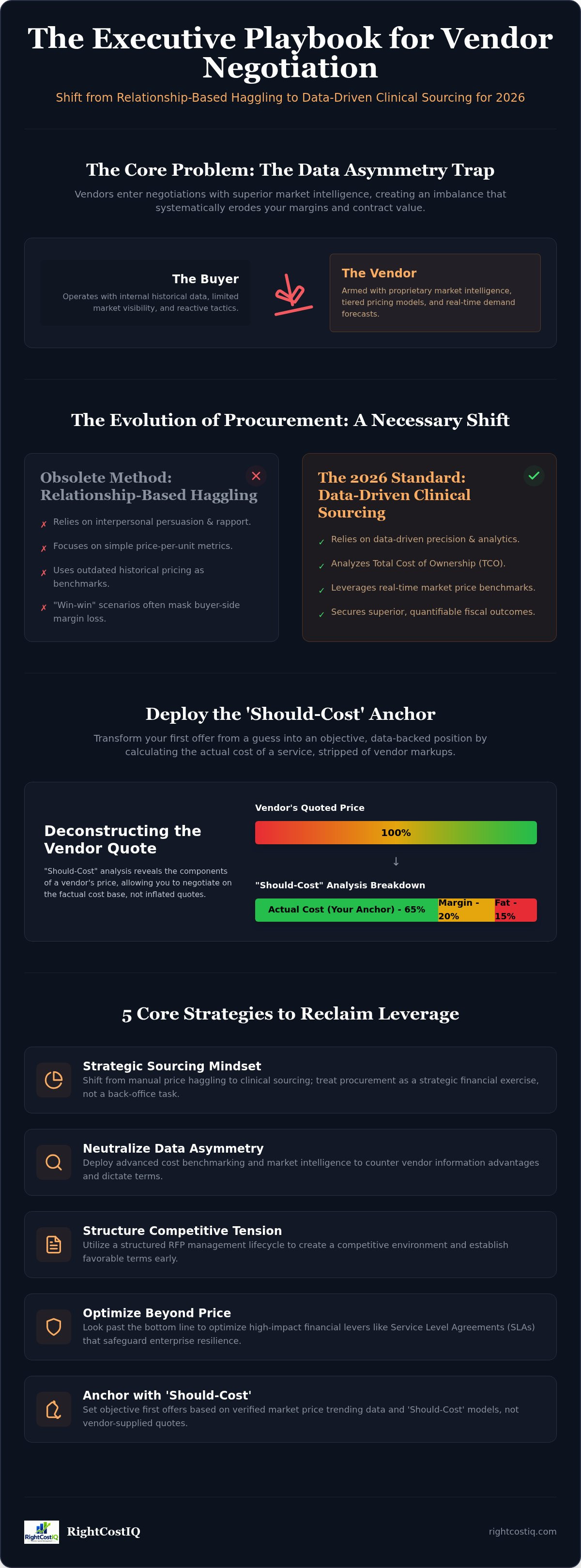
- Shift from manual price haggling to clinical sourcing by treating procurement as a strategic financial exercise rather than a back-office task.
- Neutralize the data asymmetry trap by deploying advanced vendor contract negotiation strategies that leverage cost benchmarking and market intelligence.
- Utilize a structured RFP management lifecycle to create competitive tension and establish foundational terms before final-stage negotiations begin.
- Look beyond the bottom-line price to optimize high-impact financial levers like Service Level Agreements (SLAs) that safeguard enterprise resilience.
- Implement the 'Should-Cost' anchor to set objective first offers based on verified market price trending data rather than vendor-supplied quotes.
The Shift to Clinical Sourcing: Why Traditional Negotiation Fails in 2026
Traditional procurement is a liability in 2026. Treating vendor negotiation as a soft-skill dialogue rather than a rigorous financial exercise leads to immediate margin erosion. High-volatility markets punish organizations that rely on passive procurement tactics. To maintain a competitive edge, elite decision-makers are pivoting toward clinical sourcing. This methodology replaces interpersonal persuasion with data-driven precision. It transforms every interaction into a calculated attempt to secure superior fiscal outcomes.
The primary obstacle to success is the Data Asymmetry Trap. Vendors enter discussions armed with proprietary market intelligence, tiered pricing models, and real-time demand forecasts. Buyers who rely solely on internal historical data are effectively blind. Implementing advanced vendor contract negotiation strategies is the only way to neutralize this advantage. By utilizing negotiation coach frameworks, procurement teams can bridge the intelligence gap and dictate terms based on objective market realities rather than vendor-supplied narratives.
The Obsolescence of Relationship-Based Haggling
The era of relationship-based haggling has ended. While competitors focus on building rapport, sophisticated partners recognize that "win-win" scenarios often mask significant buyer-side margin loss. Vendors bake hidden costs into complex agreements that favor the supplier over time. Relying on historical pricing is equally dangerous. In a fast-moving economy, last year's benchmarks are irrelevant. Clinical sourcing shifts the focus from simple price-per-unit metrics to a comprehensive Total Cost of Ownership (TCO) analysis. This analysis must account for:
- Direct acquisition costs and volume-based discounts.
- Operational integration and system compatibility expenses.
- Long-term maintenance and lifecycle support fees.
- Risk-adjusted costs related to service level failures.
This approach accounts for the entire contract management lifecycle, preventing the contract creep that erodes profitability.
Defining the New Procurement Standard
Modern procurement requires the integration of advanced analytics into every stage of the vendor lifecycle. Establishing professional authority isn't about being the loudest voice in the room. It's about possessing the most accurate cost transparency. When you present a vendor with undeniable market price trending data, the negotiation dynamic shifts instantly. You move from asking for discounts to demanding alignment with market standards.
The Data-Driven Architecture of High-Value Procurement Negotiations
High-stakes procurement demands a structural shift from reactive bargaining to architectural preparation. Successful vendor contract negotiation strategies are built on a foundation of information dominance. You don't enter a negotiation to see what the vendor offers. You enter to tell the vendor what you're willing to pay based on verified market price trending and cost analytics. This architectural approach requires a clinical framework that treats every data point as a tactical asset to be deployed during the sourcing cycle.
Procurement analytics allow teams to construct "should-cost" models. These models calculate the actual cost of goods or services by stripping away vendor margins, overhead, and hidden marketing fees. When you understand the underlying cost structure, the vendor's "standard rate" ceases to be a fixed point. It becomes a negotiable variable. This level of granularity transforms the buyer from a passive recipient of quotes into an active architect of the contract terms. It ensures that every dollar spent is tied to a specific, measurable value.
Phase 1: Pre-Negotiation Benchmarking and Analytics
Effective preparation begins with procurement category cost benchmarking. This process validates vendor quotes against real-world market data, ensuring you aren't overpaying for standard services. Analytics must also account for market price trending to forecast future cost fluctuations, allowing you to lock in rates before expected spikes. Additionally, identifying "tail spend" leakage, which refers to unmanaged, low-value transactions that bypass procurement controls, is critical. These fragmented purchases often account for a significant portion of total spend but consume disproportionate management time. Plugging these leaks before major contract renewals ensures you're negotiating from a position of total spend visibility.
Phase 2: RFP Precision as Negotiation Leverage
The Request for Proposal (RFP) process is the primary mechanism for forcing competitive transparency. A poorly structured RFP allows vendors to hide margins in vague line items. Utilizing professional RFP management eliminates these vendor-friendly loopholes by standardizing response formats and demanding granular pricing breakdowns. This sets the stage for contract terms that favor the buyer. For a deeper dive into optimizing this process, consider exploring strategic frameworks for RFP Management: Strategic Frameworks for AI-Led Procurement Optimization to ensure your sourcing cycles are as efficient as possible.
Transitioning to a data-first model requires the right tools to analyze complex pricing structures. If your current process lacks this level of clinical precision, deploying a negotiation coach framework can provide the market intelligence necessary to dominate your next sourcing event.
Beyond the Price Tag: Optimizing Contract Terms and SLAs
Unit price is a deceptive metric. While procurement teams often fixate on the bottom-line cost per item, the most impactful vendor contract negotiation strategies focus on the structural levers that dictate long-term financial risk. A narrow focus on price creates a vacuum where "contract creep" thrives, allowing vendors to claw back margin through aggressive service fees, rigid payment terms, and favorable liability caps. To secure a superior agreement, you must treat the contract as a comprehensive financial instrument where every clause has a quantifiable impact on the organization's enterprise resilience.
Clinical negotiation requires the integration of "Contractual Agility." This involves building mechanisms that allow for price adjustments based on recognized market indices rather than arbitrary vendor increases. It's a strategic hedge against inflation and market volatility. By anchoring price fluctuations to objective external data, you eliminate the need for constant, reactive renegotiations. This approach ensures that your agreement remains competitive throughout its lifecycle, regardless of shifting economic conditions.
Key Non-Price Levers in Modern Contracts
Optimizing non-price levers provides the operational flexibility necessary to navigate high-volatility markets. Payment terms are a primary example. Balancing cash flow requirements against early payment discounts can yield significant internal rate of return (IRR) improvements. Negotiation teams must also prioritize termination for convenience clauses. The ability to exit an agreement without prohibitive penalties is a critical safeguard against vendor stagnation or technological obsolescence. Finally, liability caps and indemnification terms must be scrutinized. These are not merely legal boilerplate; they represent the hidden costs of risk mismanagement that can bankrupt the value of even the most aggressively priced contract.
The ROI of Performance-Linked Incentives
Service Level Agreements (SLAs) should function as performance-linked financial incentives rather than static technical benchmarks. Sophisticated buyers structure tiered pricing models where the vendor's margin is directly tied to their ability to meet or exceed specific performance metrics. This creates a self-regulating ecosystem where the vendor is financially motivated to maintain high standards. Automating compliance tracking is essential to this process. It allows for the trigger of automatic rebates or penalties without the need for manual intervention or protracted disputes. Utilizing a dedicated vendor performance tracking service ensures that you maintain consistent leverage. This data becomes a powerful asset during future renewals, providing the clinical evidence needed to demand better terms based on documented historical performance.
7 Executive Strategies for Dominating Vendor Negotiations in 2026
Executing elite vendor contract negotiation strategies requires a transition from defensive bargaining to offensive market positioning. High-level decision-makers must move beyond the role of a buyer and adopt the persona of a strategic architect. This involves deploying specific, data-backed maneuvers that force vendors to justify every cent of their margin. In the 2026 procurement landscape, leverage is not found in the volume of spend alone; it's found in the clinical application of market intelligence and competitive tension.
- Strategy 1: The 'Should-Cost' Anchor. Use granular benchmarking data to establish the first objective offer. By setting the anchor based on real-world production and service costs, you force the vendor to defend their markup rather than you defending your request for a discount.
- Strategy 2: Multi-Round RFP Elimination. Narrow the field through successive rounds of technical and financial evaluation. This maximizes competitive tension and ensures that only the most efficient suppliers remain in the final negotiation phase.
- Strategy 3: Price Volatility Indexing. Link contract rates to recognized market trending indices. This mitigates risk by ensuring prices fluctuate in alignment with actual market shifts, preventing vendors from maintaining high rates when market costs drop.
- Strategy 4: Bundle Optimization. Aggregate spend across disparate categories to increase volume leverage. Consolidating fragmented purchases into a single, high-value agreement increases your strategic importance to the vendor.
- Strategy 5: The 'Coach' Method. Utilize external negotiation assistance for high-stakes sourcing cycles. Expert-led intervention provides the specialized intelligence needed to counter sophisticated vendor sales tactics.
- Strategy 6: Performance-Linked Clawbacks. Integrate financial penalties that trigger automatically when service levels fall below agreed benchmarks. This ensures the organization only pays for the value actually delivered.
- Strategy 7: Automated Benchmarking Refreshers. Build in mandatory, semi-annual price reviews based on real-time market data. This prevents contract stagnation and ensures terms remain competitive throughout the multi-year lifecycle.
Leveraging Market Intelligence and Trends
Modern procurement teams use market price trending to systematically debunk "inflationary" price hikes. When a vendor claims rising costs necessitate a rate increase, you must counter with objective data showing the actual trend in their specific category. This level of transparency identifies vendor distress or market shifts that can be exploited as a source of leverage. For a deeper understanding of these dynamics, review our Category Management in Procurement: A Clinical Framework for Margin Expansion (2026) to align your sourcing strategy with current market realities.
The Psychology of Data-Backed Assertiveness
Data-driven sourcing eliminates the emotional friction often found in the boardroom. When your position is supported by clinical analysis, the negotiation ceases to be a conflict of personalities and becomes a logical pursuit of financial alignment. Maintaining a "Strategic Architect" persona allows you to remain objective and relentless in your focus on the bottom line. Benchmarking neutralizes vendor sales tactics by replacing subjective value claims with objective, non-negotiable market cost data. To identify immediate margin recovery opportunities in your current agreements, access our procurement diagnostic tool.
Clinical Execution: Scaling Negotiation Success with RightCostIQ
Scaling negotiation success across an enterprise requires more than individual talent; it demands the implementation of a strategic infrastructure that replaces manual, reactive bargaining with automated, proactive sourcing. RightCostIQ serves as this infrastructure. We bridge the gap between high-level C-suite financial objectives and the granular realities of procurement execution. By standardizing vendor contract negotiation strategies through our clinical platform, organizations move beyond simple cost-containment. They achieve sustainable margin expansion that directly impacts the bottom line.
The transition to clinical execution ensures that every contract renewal is treated as a high-stakes financial event rather than a routine administrative task. This approach delivers a compounding ROI. As more agreements are brought under a data-driven framework, the organization's collective leverage increases. You aren't just saving money on a single category; you're building a repeatable engine for financial optimization. This systematic approach eliminates the inconsistencies of "best-effort" negotiations and replaces them with a methodology rooted in market intelligence and cost transparency.
The RightCostIQ Advantage: Analytics Meets Strategy
Our platform integrates sophisticated pricing analytics to uncover hidden savings opportunities that manual audits frequently overlook. We specialize in transforming tail spend from a source of leakage into a strategic asset. By applying the same clinical precision to low-value transactions as we do to high-value contracts, we ensure that no margin is left on the table. This holistic visibility allows procurement leaders to align their sourcing events with broader enterprise financial goals, ensuring that every vendor interaction serves a specific strategic purpose. We provide the technical descriptors and cost analysis tools required to challenge even the most opaque vendor pricing models.
Next Steps for Procurement Leaders
Dominating the 2026 procurement landscape starts with a clinical audit of your existing high-value vendor contracts. You must identify which agreements lack performance-linked incentives or market-indexed pricing mechanisms. Once these vulnerabilities are identified, implementing automated performance and risk tracking systems is essential to maintain the leverage gained during the initial negotiation phase. This ensures that the terms secured today don't erode through contract creep tomorrow.
To see these frameworks in action, contact RightCostIQ for a demonstration of our negotiation assistance platform. We provide the market intelligence and clinical execution tools necessary to ensure your vendor contract negotiation strategies deliver quantifiable, long-term results. Stop reacting to vendor demands and start dictating the terms of your financial growth. Our platform is the sophisticated partner you need to navigate high-volatility markets with absolute confidence.
Reclaiming the Strategic Advantage in 2026
The 2026 procurement landscape demands a total rejection of traditional, relationship-based haggling. Success now depends on your ability to deploy clinical vendor contract negotiation strategies that leverage information dominance over supplier sales tactics. By shifting focus toward total cost of ownership and performance-linked SLAs, organizations move beyond simple cost-containment. You must integrate data-driven "Should-Cost" modeling and professional RFP management frameworks to ensure every agreement remains architecturally sound throughout its lifecycle.
RightCostIQ provides the strategic infrastructure required to navigate high-volatility markets with precision. Our specialized healthcare category expertise ensures your sourcing events are backed by granular market intelligence that vendors can't ignore. Reclaiming your margin starts with a systematic audit of your existing agreements and the implementation of automated risk tracking. It's time to stop reacting to market shifts and start dictating the terms of your fiscal future.
Optimize your procurement outcomes with RightCostIQ's Negotiation Assistance and transform your department into a primary driver of financial growth. The tools for market dominance are within reach.
Frequently Asked Questions
What are the 5 stages of vendor contract negotiation?
The five stages consist of preparation, opening, bargaining, closing, and implementation. Success is determined in the preparation phase where "should-cost" models are constructed to establish a clinical baseline. During bargaining, teams deploy objective data to counter vendor-side information advantages. Closing must include a rigorous financial review to prevent contract creep. Finally, the implementation phase requires automated performance tracking to ensure the negotiated value is actually realized throughout the agreement's lifecycle.
How do I negotiate with a vendor who refuses to lower their price?
Pivot the discussion toward non-price financial levers when a vendor maintains a rigid price floor. You can optimize the total cost of ownership by negotiating for extended payment terms, reduced shipping costs, or higher service level guarantees. If price remains fixed, demand a tiered volume discount structure that triggers automatically as your spend increases. Utilizing advanced vendor contract negotiation strategies allows you to capture value even when the base unit price appears non-negotiable.
What is the most effective negotiation strategy for long-term vendor partnerships?
The most effective strategy for long-term partnerships is the implementation of market-indexed pricing mechanisms. This removes the emotional friction of annual price haggling by anchoring rates to objective external benchmarks. It ensures that both parties remain aligned with current economic realities without requiring constant manual intervention. Coupling this with performance-linked incentives creates a self-regulating ecosystem where the vendor is financially motivated to maintain high service standards over the multi-year agreement.
How can procurement analytics improve my negotiation leverage?
Procurement analytics improve leverage by neutralizing the data asymmetry typically held by vendors. When you possess granular category cost benchmarking and real-time market price trending data, you can debunk arbitrary price hikes with clinical precision. Analytics allow you to construct a "should-cost" model that identifies exactly where a vendor's margin is inflated. This information dominance forces the vendor to justify their pricing against objective market data rather than subjective value claims.
What are common mistakes to avoid in vendor contract negotiations?
Common mistakes include over-relying on historical pricing data and failing to define clear termination for convenience clauses. Many procurement teams ignore "tail spend" leakage, which fragments their leverage across too many suppliers. Another critical error is neglecting to automate performance tracking, which leads to unrecovered rebates and service failures. These oversights result in contract creep, where the agreement's value slowly shifts toward the supplier over time without the buyer noticing the erosion.
How often should vendor contracts be renegotiated for maximum efficiency?
High-value vendor contracts should undergo a clinical review every 18 to 24 months, or whenever market price trending indicates a significant shift in category costs. Static multi-year agreements are a primary source of margin erosion in volatile markets. By building in mandatory semi-annual price refreshers based on automated benchmarking, you ensure your terms remain competitive. This proactive approach prevents the organization from being locked into above-market rates while competitors capitalize on falling supply costs.
What is the difference between sourcing and procurement in a negotiation context?
Sourcing is the strategic phase involving market analysis and RFP management, while procurement encompasses the tactical execution and lifecycle management of the agreement. In a negotiation context, sourcing establishes the competitive tension and initial price ceiling. Procurement's role is to enforce the negotiated terms and track vendor performance to ensure no value is lost post-signature. Effective vendor contract negotiation strategies integrate both functions to maintain leverage from the initial quote through to the final renewal.
How do I handle price increases from a sole-source vendor?
Handling a sole-source vendor requires demanding an open-book cost breakdown to verify the drivers behind their price increase. If they refuse transparency, use market price trending data for adjacent categories to challenge their logic. You can also leverage the vendor's desire for future business or expansion into other departments as a bargaining chip. If no immediate alternatives exist, focus on securing long-term price caps or enhanced service levels to offset the financial impact of the hike.


