
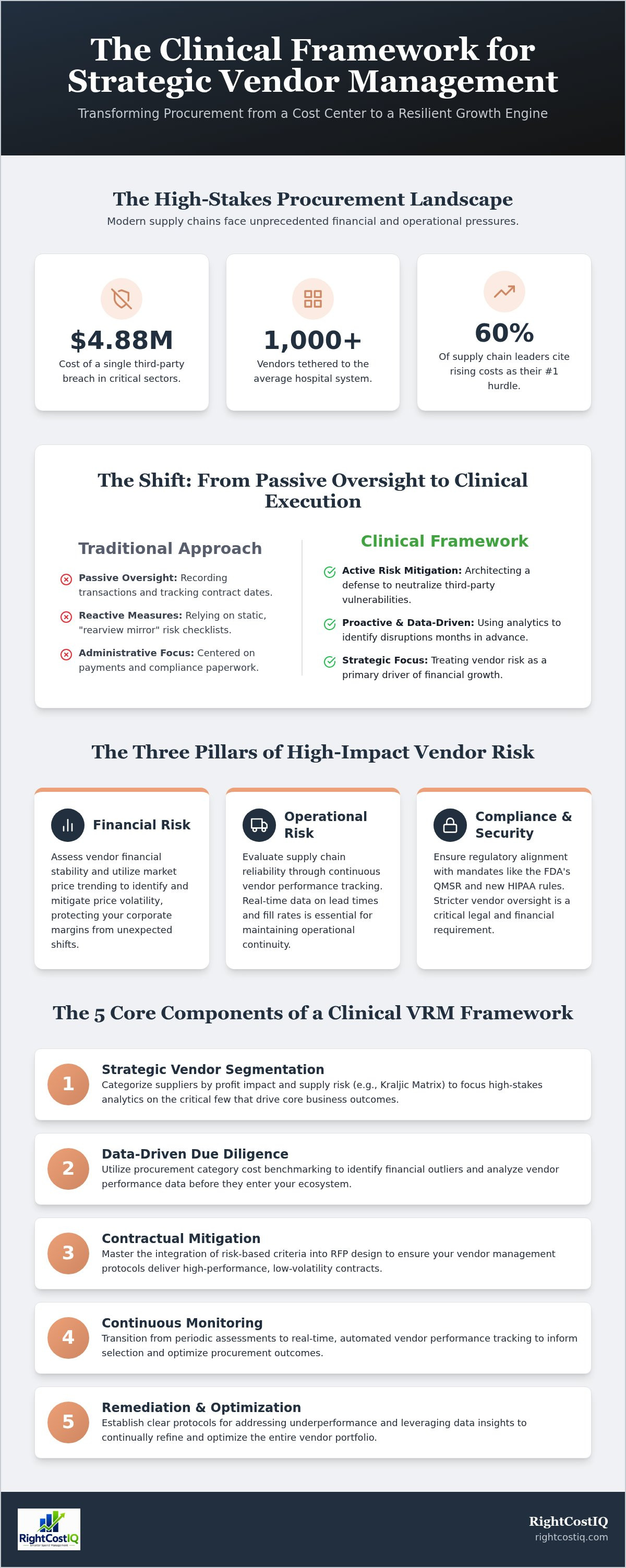
With the average hospital system now tethered to over 1,000 vendors, the cost of a single third-party breach has surged to $4.88 million. This financial exposure is compounded by a landscape where 60% of supply chain leaders identify rising costs as their primary operational hurdle in 2026. You likely recognize that traditional, reactive procurement methods are insufficient to stabilize margins against current market volatility. Effective strategic vendor management requires a shift from passive oversight to the clinical execution of risk mitigation and cost control.
This guide provides a data-driven framework to master price risk management and optimize vendor performance with surgical precision. You'll learn how to leverage procurement category cost benchmarking and automated performance tracking to eliminate hidden savings leaks and sub-optimal contract terms. We examine the transition from periodic assessments to continuous, real-time monitoring of supplier stability. By integrating market price trending and rigorous RFP management, your organization can transform its supply chain into a resilient engine for financial growth and operational continuity.
Key Takeaways
- Architect a clinical VRM framework that prioritizes third-party vulnerability identification over simple administrative oversight for enhanced resilience.
- Leverage procurement category cost benchmarking to move beyond basic due diligence and establish a data-driven baseline for all vendor partnerships.
- Quantify financial volatility using market price trending to forecast cost fluctuations and protect corporate margins from unpredictable supply chain shifts.
- Master the integration of risk-based criteria into RFP design to ensure your strategic vendor management protocols deliver high-performance, low-volatility contracts.
- Transition to clinical execution by utilizing automated vendor performance tracking to inform selection and optimize procurement outcomes.
The Architecture of a Strategic Vendor Risk Management Framework
A clinical Vendor Risk Management (VRM) framework operates as a diagnostic system designed to isolate and neutralize third-party vulnerabilities before they impact the bottom line. It's the difference between recording a transaction and architecting a defense. While transactional vendor tracking focuses on the administrative burden of payments and contract dates, a strategic risk architecture analyzes the underlying health of the entire supply chain. In 2026, healthcare procurement faces unprecedented pressure. With hospital supply expenses reaching $146.9 billion and 60% of supply chain leaders identifying rising costs as their primary hurdle, strategic vendor management must be assertive and data-driven.
The primary goals of this framework are margin protection, operational continuity, and financial compliance. Achieving these outcomes requires a shift away from passive oversight. Organizations must move beyond basic Supplier Relationship Management to implement a system that treats vendor risk as a primary driver of financial growth. This architecture ensures that every contract is not just a legal agreement but a risk-mitigated asset.
The Shift from Compliance to Clinical Execution
Traditional risk checklists act as a rearview mirror. They often fail because they're static and don't account for real-time market shifts or hidden financial instability. Clinical execution demands the use of procurement analytics to transform raw data into actionable intelligence. By moving toward a proactive architecture, procurement teams can identify potential disruptions months before they manifest. It's about replacing general assumptions with precise, data-backed strategies that dictate how and when to engage with specific partners.
Identifying High-Impact Risk Categories
To build a resilient framework, you must categorize risks based on their potential to disrupt financial and operational stability. Focus on these three critical pillars:
- Financial risk: This involves assessing vendor stability and utilizing market price trending to identify price volatility. If a vendor's financial health wavers, your margin is at risk.
- Operational risk: Evaluate supply chain reliability through continuous vendor performance tracking. Real-time data on lead times and fill rates is essential for maintaining continuity.
- Compliance and data security: With the FDA's QMSR effective as of February 2, 2026, and new HIPAA Security Rule requirements, regulatory alignment is non-negotiable. Stricter vendor oversight is now a legal and financial mandate.
Effective strategic vendor management integrates these categories into a unified dashboard. This allows decision-makers to view risk through a clinical lens, ensuring that every procurement choice supports long-term corporate objectives.
Core Components of a Clinical VRM Framework
A clinical VRM framework isn't a static document. It's a living system of operational protocols designed to protect your margin. Transitioning from generic governance to strategic vendor management requires five core pillars: identification, due diligence, contractual mitigation, continuous monitoring, and remediation. These elements ensure that procurement leaders aren't just reacting to failures but are actively engineering resilience. By treating vendor risk as a quantifiable financial metric, organizations can maintain stability even when supply chains become volatile.
Strategic Vendor Segmentation
Effective segmentation prevents the dilution of resources across a massive vendor pool. Utilizing the Kraljic Matrix allows organizations to categorize suppliers by profit impact and supply risk. This process differentiates non-critical vendors from strategic partners where a failure could halt operations. Integrating a category management procurement framework ensures that risk segmentation aligns with broader margin expansion goals. You can't manage 1,000 vendors with the same intensity. You must focus your high-stakes analytics on the critical few that drive your core business outcomes.
Data-Driven Due Diligence
Onboarding must be clinical. By utilizing procurement category cost benchmarking, you identify financial outliers before they enter your ecosystem. This process moves beyond basic background checks. It analyzes vendor performance history through the lens of clinical analytics. Incorporating market price trending into the selection process ensures that you aren't signing contracts that will become obsolete when market conditions shift. This level of scrutiny is particularly vital when considering FDA cybersecurity guidance for connected systems. Evaluating a vendor's security posture is as critical as assessing their financial solvency.
Contracts should serve as risk-aware blueprints for financial stability. They must include specific clauses that trigger remediation protocols when performance metrics dip below established benchmarks. In 2025, over 30% of supply chain disruptions resulted in direct costs exceeding $5 million. This highlights the necessity of real-time visibility achieved through automated performance tracking systems. These tools provide a rhythmic heartbeat of data, alerting procurement teams to vulnerabilities before they escalate into systemic failures. Establishing these clinical protocols allows for immediate risk remediation, maintaining operational continuity even in volatile markets. If you're ready to see how these analytics apply to your specific spend, you can explore a benchmarking diagnostic to identify immediate risk areas.
Quantifying Financial Volatility and Price Risk
Financial volatility isn't an inevitability; it's a data gap. For C-suite decision-makers, unpredictable supply chain costs represent a direct threat to margin stability and long-term corporate health. In 2026, some material prices have fluctuated by as much as 50%, making traditional fixed-price contracts a liability rather than a safeguard. Strategic vendor management must evolve to include a clinical approach to price risk management. This involves integrating cost analytics directly into the risk framework to transform market intelligence into a defensive shield for your bottom line.
By quantifying these risks, organizations move from reactive budgeting to proactive financial architecture. This transition requires a relentless focus on how market shifts impact contract viability. When price risk is managed with precision, it provides the transparency needed to justify procurement decisions to stakeholders and ensures that operational continuity isn't sacrificed for short-term savings.
Market Price Trending and Forecasting
Historical data serves as the foundation for predictive accuracy. Clinical forecasting models allow procurement teams to anticipate supply disruptions and inflationary spikes before they impact the ledger. By leveraging advanced procurement analytics, organizations can execute should-cost forecasting that accounts for real-time market variables. This data-driven foresight is essential for mitigating the impact of inflation. It enables teams to negotiate from a position of authority, armed with the intelligence to identify when a vendor's price increase is justified by market trends and when it's merely an attempt to expand their own margins at your expense.
Clinical Cost Benchmarking
Benchmarking is the diagnostic tool that exposes financial outliers within your vendor pool. Comparing vendor pricing against rigorous market standards identifies immediate savings opportunities that are often buried in complex, multi-layered proposals. This isn't just about finding the lowest price. It's about utilizing analytics to reveal hidden costs and sub-optimal terms that increase your total cost of ownership. The relationship between benchmarking and price risk mitigation is direct. A contract founded on accurate market standards is inherently more resilient to volatility. It establishes a fair baseline that protects both parties, ensuring that your strategic vendor management protocols deliver sustainable, risk-mitigated outcomes over the entire contract lifecycle.
Executing the Framework: RFP Management and Negotiation
Execution transforms a theoretical framework into a clinical instrument for margin protection. Strategic vendor management demands that risk-based criteria are embedded into the procurement lifecycle from the very first engagement. It's not enough to identify risks; you must build mechanisms that force vendors to prove their stability and pricing transparency before a contract is even drafted. This phase is about filtering out volatility at the source. By treating the RFP process as a clinical screening tool, organizations ensure that only resilient, high-performance partners enter their ecosystem.
- Step 1: Integrate risk-based criteria into the initial RFP design phase to ensure all bidders meet baseline financial and operational thresholds.
- Step 2: Use historical vendor performance tracking data to inform selection and shortlisting.
- Step 3: Deploy professional negotiation assistance to secure risk-mitigated terms that protect against market shifts.
- Step 4: Establish automated compliance and performance monitoring post-contract execution to maintain real-time visibility.
- Step 5: Conduct periodic category reviews to ensure ongoing strategic alignment with corporate financial goals.
Risk-Aware RFP Management
Drafting RFPs that prioritize vendor stability and pricing transparency is a prerequisite for success. Utilizing specialized RFP management platforms allows procurement teams to streamline clinical data collection and enforce transparency across the bid lifecycle. Proposals should be evaluated through a risk-focused lens. A low-cost bid that lacks robust financial backing or a proven track record is a high-risk liability that could cost millions in future disruptions. Clinical execution requires that you look past the initial price point to analyze the total risk profile of the proposing entity.
Negotiation as a Risk Mitigation Tool
Negotiation serves as a primary tool for risk mitigation rather than just a cost-reduction exercise. Securing favorable terms requires data-backed strategies that address potential price spikes and supply interruptions. Engaging a negotiation coach during high-stakes procurement cycles provides the expertise needed to balance immediate cost savings with long-term vendor resilience. This clinical approach ensures that contracts are not just signed but are engineered for durability.
Automated monitoring is essential after execution. Currently, 21% of procurement leaders report having no real-time visibility into supplier disruptions. Implementing clinical monitoring protocols closes this gap, ensuring that performance stays aligned with negotiated terms throughout the contract life. To identify specific vulnerabilities in your current vendor pool, access our clinical procurement diagnostic and begin architecting a more resilient supply chain.
Optimizing Procurement Outcomes with RightCostIQ
RightCostIQ acts as the strategic architect for clinical procurement execution, bridging the gap between theoretical risk frameworks and tangible margin protection. While previous sections outlined the necessity of identifying vulnerabilities and quantifying price risk, this platform provides the technical infrastructure to automate these critical processes. By integrating advanced technology into traditional sourcing functions, RightCostIQ ensures that strategic vendor management is no longer a manual administrative burden but a data-driven competitive advantage. It's a system built for decision-makers who prioritize results over process.
The ROI of professional RFP management and automated performance tracking is quantifiable through reduced price risk and optimized contract terms. In a market where supply disruptions result in significant direct costs, having real-time visibility into vendor health is essential. RightCostIQ provides this visibility, allowing decision-makers to move with confidence and speed. The platform replaces the administrative friction of traditional sourcing with a rhythmic flow of actionable intelligence, ensuring that every procurement event functions as a strategic win for the organization.
The RightCostIQ Advantage in Risk Management
Clinical precision in vendor performance tracking is the hallmark of the RightCostIQ ecosystem. The platform utilizes proprietary market intelligence to provide accurate price risk forecasting for 2026, ensuring your organization remains ahead of inflationary trends and material price spikes. This isn't just about software; it's about the seamless integration of procurement optimization and risk strategy. Every data point is filtered through a clinical lens to identify hidden savings and eliminate sub-optimal vendor terms that threaten your corporate margins. By leveraging automated analytics, the platform isolates financial outliers that generic tools miss, providing the depth required for high-stakes decision-making.
Next Steps for Strategic Procurement
Transitioning to a clinical procurement model begins with assessing your current framework maturity. Organizations often discover that while they have basic tracking in place, they lack the strategic architecture needed for true resilience in volatile markets. Implementing automated tracking provides immediate risk visibility across the entire supply chain, allowing for proactive remediation rather than reactive crisis management. Strategic vendor management requires a relentless focus on data integrity and execution to maintain a competitive edge.
To begin your transition, contact RightCostIQ for a comprehensive procurement assessment. This diagnostic identifies immediate opportunities for risk reduction and margin expansion within your specific spend categories. Don't leave your supply chain resilience to chance; architect your defense with clinical precision and ensure your procurement outcomes are optimized for the long term.
Architecting a Resilient Financial Future
Supply chain resilience isn't a byproduct of chance; it's the result of clinical architectural design. Transitioning from transactional oversight to strategic vendor management allows your organization to isolate vulnerabilities and neutralize financial volatility before it impacts the ledger. By quantifying price risk with market intelligence and executing RFPs through a risk-mitigated lens, you transform procurement into a primary driver of margin stability. This framework ensures that operational continuity remains intact even during periods of extreme market fluctuation.
RightCostIQ provides the specialized healthcare financial analytics needed to execute this shift with precision. Our data-driven price risk management architecture and automated vendor performance tracking offer the real-time visibility required for sophisticated decision-making. Benchmarking against market standards eliminates hidden costs and secures a competitive advantage. It's time to replace reactive protocols with a proactive defense system that prioritizes the bottom line.
Optimize your procurement outcomes with RightCostIQ’s free strategic diagnostic.
Take the first step toward a more stable and predictable financial future today.
Frequently Asked Questions
What are the essential components of a vendor risk management framework?
Essential components include vendor identification, segmentation, due diligence, contractual mitigation, and continuous monitoring. These pillars ensure that strategic vendor management protocols are proactive rather than reactive. By categorizing vendors based on spend and strategic importance, organizations can allocate analytical resources to high-impact areas. This architectural approach protects corporate margins by isolating vulnerabilities before they escalate into systemic supply chain failures.
How does price risk management differ from traditional vendor tracking?
Price risk management focuses on forecasting future financial volatility, while traditional tracking is largely administrative and historical. Traditional methods record past transactions and contract dates. In contrast, price risk management utilizes market intelligence to predict cost fluctuations and inflationary spikes. This clinical approach allows C-suite leaders to stabilize margins against unpredictable market shifts, transforming procurement from a cost center into a strategic planning tool.
Why is clinical execution important in procurement risk management?
Clinical execution is critical because it replaces subjective guesswork with data-driven precision in high-stakes procurement environments. It involves the rigorous application of procurement analytics to identify savings and mitigate risks. By treating vendor performance as a quantifiable metric, organizations ensure that every sourcing decision is backed by verifiable data. This level of accuracy is essential for maintaining operational continuity and achieving long-term financial growth targets.
Can a strategic VRM framework help reduce overall procurement costs?
Yes, a strategic VRM framework reduces overall costs by identifying hidden savings through procurement category cost benchmarking. It eliminates sub-optimal contract terms and prevents expensive supply chain disruptions. By mitigating price risk and optimizing vendor performance, organizations can lower their total cost of ownership. This systematic approach ensures that every dollar spent is aligned with market standards and clinical efficiency goals, directly impacting the bottom line.
How do RFP management and vendor risk management intersect?
RFP management and vendor risk management intersect during the initial screening and selection phase of the procurement lifecycle. Integrating risk-based criteria into the RFP design ensures that only stable, high-performance vendors are shortlisted. This proactive filtering prevents the onboarding of high-risk partners that could compromise financial stability. It's the first line of defense in a clinical strategic vendor management architecture, ensuring long-term contract viability and resilience.
What role does market price trending play in vendor risk assessment?
Market price trending provides the predictive data needed to forecast future cost fluctuations and evaluate vendor pricing accuracy. It acts as a benchmark to identify financial outliers during the negotiation phase. By analyzing historical trends and real-time market shifts, procurement teams can anticipate supply disruptions. This intelligence allows organizations to negotiate risk-mitigated terms that protect corporate margins from sudden inflationary spikes or material price volatility.
How can automated systems improve vendor performance tracking?
Automated systems improve vendor performance tracking by providing real-time visibility into fill rates, lead times, and compliance metrics. These tools eliminate the manual errors associated with traditional spreadsheeting and ensure consistent monitoring across the entire vendor pool. Automation triggers immediate alerts when performance dips below negotiated thresholds. This rhythmic heartbeat of data allows for rapid risk remediation and maintains the integrity of the supply chain architecture without manual friction.
What is the first step in implementing a strategic VRM framework?
The first step is conducting a comprehensive diagnostic to assess your current framework maturity and identify immediate vulnerabilities. This assessment involves analyzing existing spend categories and benchmarking them against market standards. By isolating high-risk areas and savings leaks, you establish a baseline for clinical improvement. Implementing a data-driven diagnostic ensures that your transition to a strategic architecture is methodical, results-oriented, and focused on immediate financial impact.


