

Subjective RFP evaluation isn't just a process flaw; it's a financial liability that erodes negotiation leverage before a contract is even signed. You've likely experienced the frustration of inefficient procurement cycles where hidden costs emerge only after the implementation begins. Relying on qualitative assessments often leads to poor vendor fit and missed opportunities for significant cost savings. It's a systemic risk that many organizations fail to mitigate effectively.
This article delivers a clinical framework on how to score rfp responses by utilizing data-driven scoring models that identify high-performance partners. You'll learn to master the objective methodologies required to engineer maximum negotiation leverage and align with the 2026 federal mandate prioritizing fixed-price contracting. We'll preview how to integrate cost benchmarking and performance tracking into your workflow to eliminate subjectivity. This approach transforms procurement from a back-office function into a primary driver of operational efficiency and financial growth.
Key Takeaways
- Redefine RFP scoring as a precision tool for margin expansion by transitioning from simple price comparisons to Total Cost of Ownership (TCO) evaluations.
- Master how to score rfp responses through a weighted matrix that assigns specific percentage values to category-critical data anchors.
- Utilize proprietary cost benchmarking to validate vendor pricing and identify outlier bids that signal hidden operational risks.
- Implement selection intelligence to assess vendor resilience against geopolitical volatility and price risk before final selection.
- Engineer maximum negotiation leverage by converting clinical scoring weaknesses into strategic levers during the final procurement phase.
The Strategic Architecture of RFP Scoring Models
Effective procurement starts with a fundamental shift in perspective. RFP scoring is not a mere administrative hurdle; it's a clinical exercise in margin protection. When organizations fail to define how to score rfp responses with mathematical rigor, they invite subjective bias that directly erodes supply chain profitability. Every percentage point of variance in vendor performance impacts enterprise-level EBITDA objectives. By treating the Request for Proposal (RFP) as a data-gathering instrument for financial modeling, procurement teams can transform cost centers into value drivers. This architecture demands a move away from qualitative "gut feelings" toward a structured, evidence-based selection engine.
The traditional reliance on the "lowest bid" model frequently masks deep-seated operational inefficiencies that manifest as hidden liabilities. This narrow focus ignores the cumulative impact of poor quality, delayed delivery, or vendor instability. Transitioning to a Total Cost of Ownership (TCO) evaluation allows for a more sophisticated analysis of long-term fiscal health. It ensures that the selected vendor aligns with strategic growth rather than offering a temporary, superficial discount that disappears once implementation begins. Objective scoring models act as a filter, removing vendors whose low-cost profiles actually represent high-risk variables for the enterprise.
Quantifying Total Cost of Ownership (TCO)
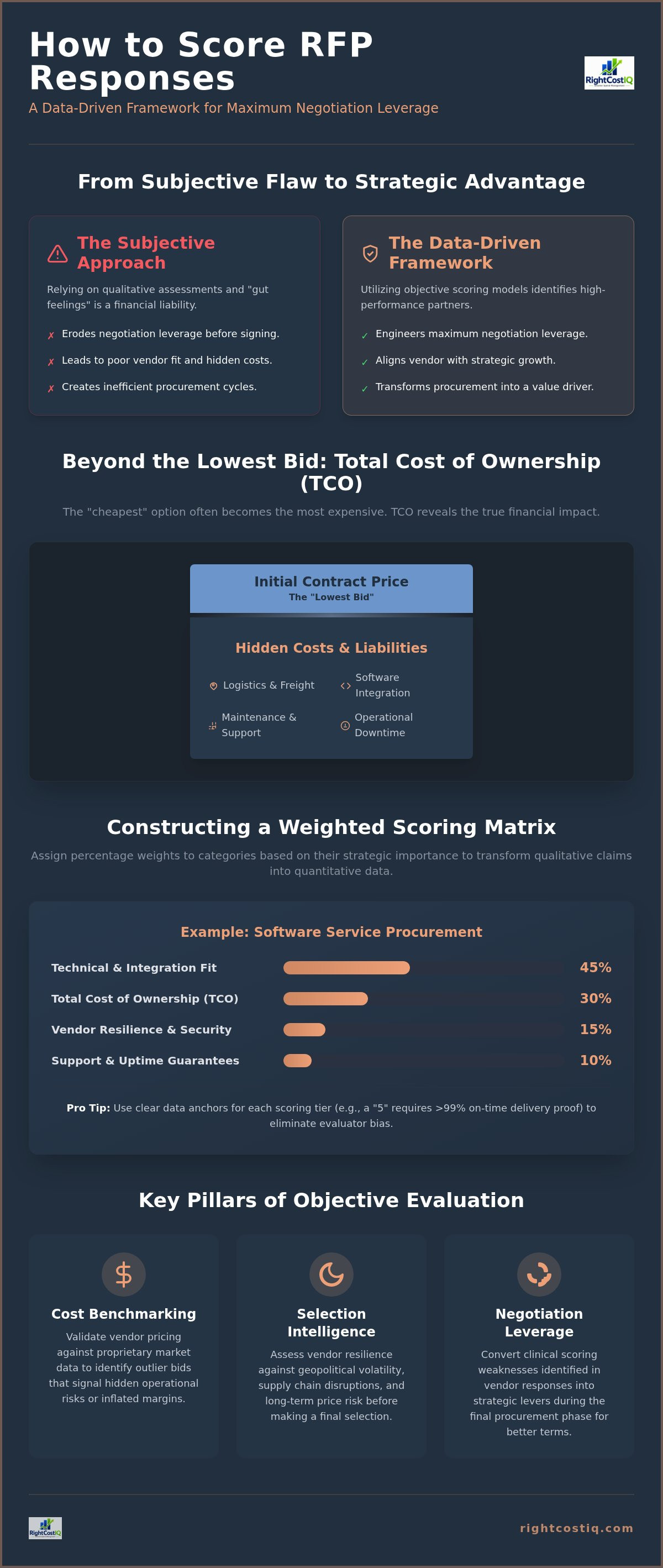
TCO is a multidimensional financial metric that aggregates all direct and indirect expenses associated with a procurement lifecycle. Beyond the initial contract price, strategic architects must account for hidden variables that compromise margins. These include:
- Logistics and freight overhead.
- Complex software or hardware integration requirements.
- Cyclical maintenance and support fees.
- Operational downtime during vendor transitions.
Identifying these costs during the scoring phase prevents post-contracting financial shocks. A high-performance scoring model weights these factors to ensure long-term procurement efficiency remains the primary selection driver. Without this granularity, the "cheapest" option often becomes the most expensive over a three-year contract horizon.
Integration with Clinical RFP Management
Precision in scoring requires foundational data integrity established during the initial RFP management phase. Criteria must be embedded into the solicitation document itself to ensure vendors provide structured, comparable data points. This proactive alignment eliminates the "apples-to-oranges" comparison trap that plagues manual evaluation cycles. For a deeper dive into modernizing these workflows, see our guide on RFP Management: Strategic Frameworks for AI-Led Procurement Optimization. Maintaining this clinical rigor throughout the vendor response period ensures that the final selection is based on verifiable performance metrics rather than polished sales presentations. It's about engineering a selection process that's as predictable and data-driven as the supply chains it supports.
Constructing a Weighted Scoring Matrix for Maximum Objectivity
Strategic procurement teams don't rely on intuition. They build rigid scoring architectures that transform qualitative vendor claims into quantitative data points. A weighted scoring matrix serves as the primary guardrail against cognitive bias and inconsistent evaluation. When determining how to score rfp responses, you must assign percentage weights to different categories based on their criticality to the specific procurement category. A high-stakes manufacturing contract requires a heavier weight on production capacity, while a software service might prioritize digital integration and uptime guarantees. This prioritization ensures that the final selection aligns with the enterprise's strategic growth objectives rather than just the lowest initial price point.
Objectivity is further reinforced through the use of clear data anchors for each scoring tier. Avoid vague 1-5 scales that lack definition. Instead, establish specific performance benchmarks for every score level. For instance, a "5" in delivery reliability should require documented proof of 99% on-time delivery over the last 24 months, whereas a "3" might represent 95%. This clinical approach forces evaluators to find evidence in the vendor's response, eliminating the "gut feeling" that often leads to poor vendor fit. Normalizing disparate vendor data is the final step in this process. You must convert varying units, such as lead times expressed in days versus weeks, into a standardized format to ensure a fair, side-by-side comparison. You can evaluate your current procurement framework to identify where these subjective gaps might be leaking margin.
Core Evaluation Pillars: Operational and Digital
Production scalability and digital maturity are the twin engines of modern vendor performance. Evaluators must look beyond current capacity to assess how a vendor handles sudden demand surges or supply chain shocks. Digital maturity is equally critical; vendors must demonstrate API compatibility and automated reporting capabilities to fit into a modern, tech-enabled supply chain. We evaluate quality management systems through the lens of ISO compliance and rigorous internal audit trails. This ensures the vendor's operational backbone is strong enough to support long-term partnership goals without constant oversight.
Financial and Compliance Rigor
Financial stability is a non-negotiable metric for high-stakes procurement. We analyze liquidity and leverage ratios to ensure the vendor isn't a bankruptcy risk mid-contract. Compliance scoring has evolved significantly in 2026, particularly with the shift in federal mandates regarding discrimination and the removal of specific DEI-related requirements. Scoring must now reflect these updated regulatory landscapes to protect the enterprise from legal exposure. Additionally, we weight a vendor's ability to support tail spend management, ensuring that even smaller, non-core purchases are handled with the same clinical efficiency as major contracts. This holistic view of compliance and financial health prevents post-contracting shocks and hidden administrative costs.
Integrating Cost Benchmarking into Response Evaluation
Internal budgets are often static and disconnected from real-time market volatility. Relying on them to evaluate vendor proposals creates a strategic blind spot. Sophisticated procurement leaders integrate cost benchmarking to validate every line item in a vendor's submission. This clinical approach allows teams to determine how to score rfp responses by comparing vendor quotes against live market data rather than historical averages. It provides an objective baseline to challenge inflated margins and ensure that the organization captures maximum value from the outset. Using external data anchors removes the guesswork from pricing evaluation, allowing for a strictly business-oriented selection process.
Identifying outlier bids is a critical component of this validation phase. A bid that sits significantly below the market benchmark often signals a lack of operational maturity, potential quality compromises, or a fundamental misunderstanding of the project scope. Conversely, bids that exceed the benchmark without clear justification indicate predatory pricing or inefficient cost structures. Clinical execution involves flagging these deviations as high-risk variables during the scoring process. Rigorous benchmarking ensures that enterprise procurement teams avoid significant overpayment on high-value contracts by establishing a market-aligned price ceiling before negotiations begin. It's about protecting the bottom line through evidentiary support.
The "Should-Cost" Analysis Filter
Developing internal "should-cost" models is the gold standard for challenging vendor quotes. These models break down a service or product into its constituent parts: raw materials, labor, overhead, and margin. By applying regional benchmarking data, you can normalize pricing across disparate geographies, ensuring that a bid from a high-cost region is evaluated fairly against one from a lower-cost area. This level of granularity helps detect hidden margins buried in complex service level agreements (SLAs). It allows you to strip away unnecessary costs before moving candidates to the shortlist, ensuring only the most efficient proposals survive the initial cut.
Shortlisting with Clinical Precision
The shortlisting process must be a filter for both performance and resilience. We utilize a multi-stage data validation process that discards vendors who fail to meet the "should-cost" threshold or demonstrate significant price risk. This ensures the final shortlist consists only of high-performance candidates who can maintain price stability throughout the contract lifecycle. Applying these filters early reduces the administrative burden on the selection committee and focuses resources on vendors with the highest probability of delivering long-term financial growth. This methodical approach ensures that the eventual winner is not just the best of a poor lot, but a verified partner capable of meeting specific business solutions.
Mitigating Risk through Selection Intelligence
Risk mitigation is often relegated to a binary compliance check. This approach is insufficient for high-stakes procurement. High-performance selection intelligence requires a deep dive into financial and operational resilience before a vendor is ever onboarded. When determining how to score rfp responses, evaluators must quantify a vendor's exposure to external shocks. This includes everything from supply chain disruptions to sudden price surges in raw materials. By integrating price risk management into the scoring matrix, you identify partners who possess the structural stability to maintain margins during market turbulence. This clinical evaluation prevents the selection of vendors who appear cost-effective on paper but lack the infrastructure to handle volatility.
Cybersecurity posture and data protection protocols have become non-negotiable scoring pillars in 2026. With the continued implementation of the Cybersecurity Maturity Model Certification (CMMC) program, federal contractors and enterprise partners must demonstrate rigorous handling of controlled unclassified information. Scoring models should weight these technical safeguards heavily, especially for critical infrastructure projects. A vendor's inability to provide verified audit trails or meet modern encryption standards represents a systemic risk that can lead to catastrophic post-contracting costs. Selection intelligence filters out these liabilities, ensuring that your supply chain remains secure and compliant with evolving federal regulations.
Price Volatility and Market Forecasting
Market forecasting is the primary defense against margin erosion. We evaluate a vendor's ability to manage commodity price fluctuations by analyzing their historical price stability and hedging strategies. Using market price trending allows procurement teams to forecast future contract adjustments based on real-time data rather than vendor estimates. This foresight enables you to mitigate financial risk before the contract is finalized. Vendors who lack clear protocols for managing price volatility should receive lower scores in the financial resilience category. This prevents mid-contract price hikes that often occur when vendors pass their operational inefficiencies onto the buyer.
Vendor Performance Tracking Architectures
Don't wait for the implementation phase to define success. We establish baseline metrics for delivery, quality, and compliance as a pre-selection requirement. This ensures that vendors have internal systems for performance reporting that align with your organizational goals. Linking the initial scoring to future vendor performance tracking creates a seamless transition from selection to management. If a vendor cannot demonstrate a robust internal tracking architecture during the RFP phase, they're unlikely to meet high-performance standards during the contract term. You can run a diagnostic on your current vendor risk profiles to identify where your scoring model might be overlooking critical performance gaps.
Clinical Execution: From Scoring to Negotiation Leverage
The final phase of the procurement lifecycle transforms raw data into financial advantage. Scoring is not a passive ranking exercise; it's the strategic foundation for negotiation assistance. By the time you've mastered how to score rfp responses, you possess a granular map of every vendor's operational and financial vulnerabilities. These identified weaknesses serve as clinical levers during the final selection phase. If a high-performing vendor scored poorly on digital integration or price risk resilience, these gaps become non-negotiable points for contract refinement. This approach ensures that the final agreement isn't just a signed document but a precision-engineered tool for margin expansion.
Clinical contract management formalizes these data-driven insights into binding performance incentives. In the context of the April 2026 Executive Order mandating fixed-price contracting as the federal default, this step is vital. You're no longer just buying a service; you're securing a performance-based outcome with capped financial exposure. The ROI of professional RFP management manifests here, where objective scoring prevents the scope creep and hidden costs typical of subjective selection. It's the difference between a vendor who meets a budget and a partner who drives EBITDA growth through operational excellence.
Negotiation as a Conclusion of Selection
Negotiation is the logical culmination of the scoring process. We utilize data-backed benchmarking to secure terms that reflect true market value rather than vendor-dictated pricing. By using the Negotiation Coach, procurement teams identify specific scoring gaps that can be traded for better payment terms or increased service levels. This methodology aligns with our broader framework on Category Management in Procurement: A Clinical Framework for Margin Expansion (2026). It ensures that every negotiation is rooted in the evidentiary support gathered during the evaluation phase, removing emotion from the boardroom and focusing strictly on the bottom line.
Optimizing the Procurement Lifecycle
Efficiency requires the seamless integration of selection data into a centralized procurement platform. This eliminates the friction between scoring and operational onboarding, ensuring that the performance benchmarks established during the RFP phase are tracked from day one. When selection intelligence flows directly into vendor performance tracking, the organization maintains a continuous loop of data-driven optimization. This holistic approach bridges the gap between high-level strategy and technical execution. You can Optimize your next RFP with RightCostIQ to ensure your scoring models are engineered for maximum negotiation leverage and long-term financial growth.
Engineering Strategic Advantage through Data-Driven Selection
Objective vendor selection serves as the primary defense against margin erosion and operational instability. By shifting from qualitative assessments to a clinical framework, procurement teams transform the RFP into a precision-engineered financial instrument. You now understand how to score rfp responses by utilizing weighted matrices and advanced cost benchmarking analytics to expose hidden liabilities. This data-driven approach doesn't just identify the best partner; it provides the specific levers required for high-stakes negotiation assistance and global price risk management. It's about replacing intuition with evidentiary support.
The transition from scoring to contract execution requires absolute data integrity and real-time market intelligence. Organizations that fail to modernize their selection architectures remain exposed to post-contracting shocks and inefficient supplier performance. You have the strategic tools to engineer a more resilient, profitable supply chain. Applying these clinical methodologies to your next procurement cycle will ensure long-term financial growth and operational efficiency. It's time to turn your evaluation process into a competitive advantage.
Maximize your procurement ROI with RightCostIQ’s free diagnostic to identify immediate cost-saving opportunities and refine your vendor selection strategy.
Frequently Asked Questions
What are the most important RFP scoring criteria in 2026?
In 2026, the most critical criteria include fixed-price contract feasibility, Cybersecurity Maturity Model Certification (CMMC) compliance, and updated global trade adherence. Following the April 2026 Executive Order, agencies and enterprises prioritize vendors capable of operating under fixed-price models to minimize cost-reimbursement liabilities. Cybersecurity is no longer a checklist but a core scoring pillar, requiring verified audit trails and data protection protocols to ensure supply chain security.
How do you calculate Total Cost of Ownership during vendor evaluation?
Total Cost of Ownership (TCO) is calculated by aggregating the initial contract price with all indirect lifecycle expenses. This includes freight overhead, software integration labor, cyclical maintenance fees, and estimated operational downtime during transition. A clinical TCO model ensures procurement teams identify hidden liabilities that frequently emerge post-contracting, allowing for a more accurate side-by-side comparison of vendor fiscal efficiency over a multi-year horizon.
What is a weighted scoring matrix in procurement?
A weighted scoring matrix is a quantitative evaluation tool that assigns specific percentage values to procurement categories based on their strategic importance. This framework defines how to score rfp responses by ensuring high-impact factors, such as production scalability or financial liquidity, carry more influence than secondary administrative requirements. It eliminates subjective bias by anchoring scores to documented performance data and objective benchmarks rather than qualitative impressions.
How does cost benchmarking improve the vendor scoring process?
Cost benchmarking improves scoring by providing a live market baseline to validate vendor pricing submissions. It allows procurement architects to detect outlier bids that signal either predatory margins or operational immaturity. By utilizing external data anchors, you can challenge inflated quotes with clinical precision. This ensures the final selection is rooted in market reality rather than vendor-supplied estimates, protecting the organization from significant overpayment.
What is the difference between RFP scoring and vendor evaluation?
RFP scoring is the quantitative measurement of a vendor's specific response to a solicitation document. In contrast, vendor evaluation is a broader strategic assessment that incorporates long-term risk management, cultural fit, and historical performance tracking. While scoring provides the data for shortlisting, evaluation synthesizes that data to determine the vendor's total alignment with enterprise-level EBITDA objectives and long-term supply chain resilience.
How can I mitigate price risk during the RFP scoring phase?
Mitigating price risk requires integrating market price trending and forecasting models directly into the scoring matrix. You must evaluate a vendor's structural ability to manage commodity volatility and their historical price stability. Partners who demonstrate robust hedging strategies or fixed-price resilience receive higher scores. This proactive approach protects the organization from mid-contract price hikes and margin erosion during periods of unpredictable market turbulence.
What role does digital maturity play in modern vendor selection?
Digital maturity is a primary indicator of a vendor's operational efficiency and ability to integrate with modern supply chain architectures. Scoring models prioritize vendors with API compatibility and automated performance reporting capabilities. A high digital maturity score suggests the vendor can support real-time data transparency and seamless integration. This reduces the administrative friction and manual oversight typically associated with legacy vendor relationships, driving long-term operational efficiency.


