
U.S. companies lose approximately $725,000 annually in potential revenue due to incomplete or poorly structured procurement responses. In a 2026 landscape defined by the Revolutionary FAR Overhaul and tightening domestic content thresholds, simple administrative compliance is a failing strategy. You recognize that high resource burn on unsuccessful bids and price volatility during contract execution are direct symptoms of a fractured sourcing model. It's clear that the inability to differentiate vendor value beyond base pricing remains a primary barrier to procurement efficiency.
This article provides a strategic framework to master the clinical execution of your procurement cycles by identifying the common rfp mistakes to avoid that compromise your organizational ROI. We will examine the technical, financial, and strategic errors that currently prevent you from achieving clinical precision in vendor selection. By integrating advanced cost benchmarking and market intelligence, you can transform the RFP process from a clerical burden into a primary driver for tangible margin expansion. This analysis moves beyond generic advice to provide the precise data-driven sourcing methodologies required for high-stakes negotiation and risk mitigation in the current fiscal year.
Key Takeaways
- Quantify the ratio of procurement outcomes to resource investment to eliminate financial losses caused by administrative friction.
- Implement a rigorous "Go/No-Go" framework to ensure all solicitation cycles align with C-suite financial objectives and strategic growth.
- Eliminate common rfp mistakes to avoid by replacing generic boilerplate with technical differentiation that highlights tangible business outcomes.
- Utilize "Should-Cost" modeling and market price forecasting to maintain data-backed leverage during high-stakes vendor negotiations.
- Transition from administrative management to strategic sourcing by integrating automated platforms for clinical precision in vendor performance tracking.
The Economic Impact of RFP Inefficiency and Strategic Misalignment
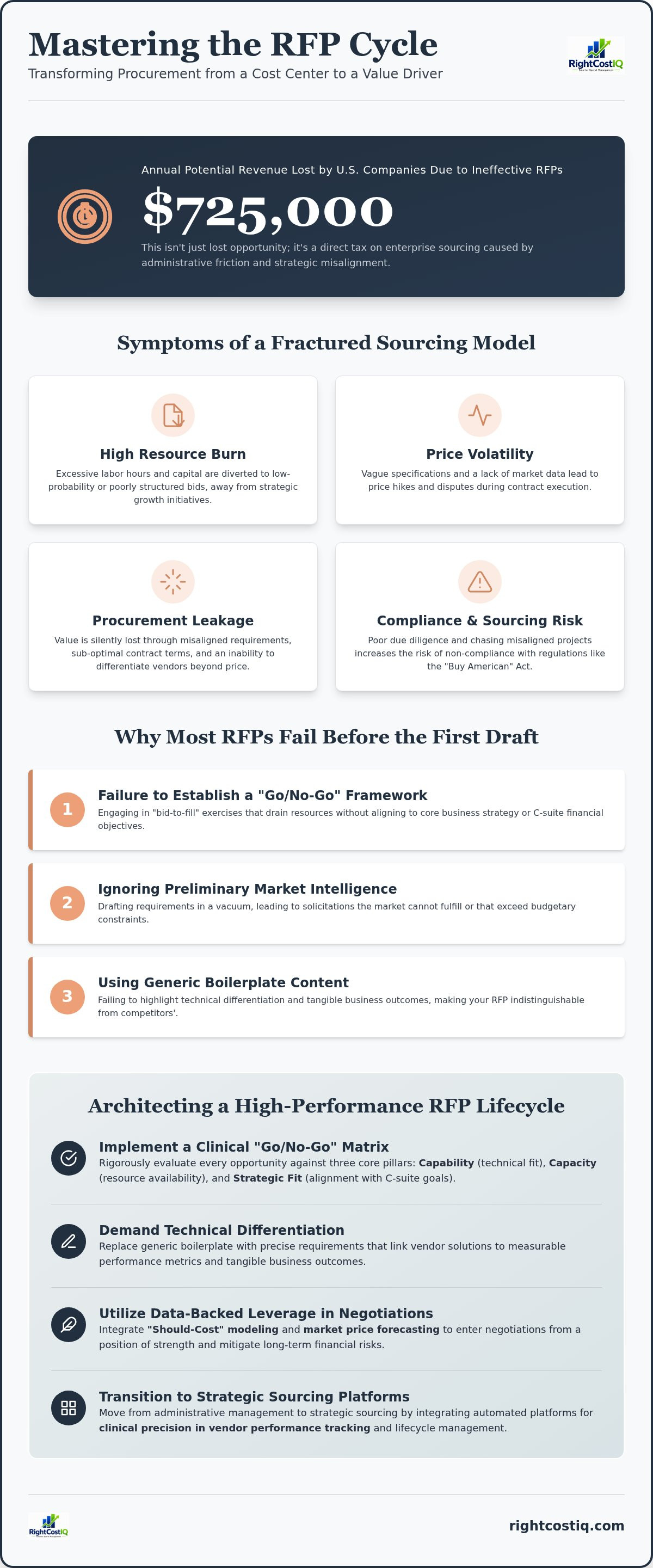
RFP efficiency is the clinical ratio of procurement outcomes to resource investment. When organizations fail to optimize this ratio, they succumb to administrative friction, which functions as a direct tax on enterprise sourcing. This friction manifests as excessive labor hours spent on manual data entry, uncoordinated communication, and the pursuit of misaligned vendor partnerships. Identifying common rfp mistakes to avoid starts with recognizing that every hour your team spends on a low-probability or poorly structured bid is capital diverted from strategic growth. Procurement leakage, the value lost due to misaligned requirements or sub-optimal contract terms, remains the silent killer of enterprise margins. RFP efficiency represents the clinical optimization of procurement outcomes relative to the total capital and human resource investment deployed during the solicitation cycle.
Quantifying the Cost of Failed Bids and Resource Burn
The opportunity cost of overextending internal procurement teams is often underestimated in traditional cost accounting. Research published in September 2025 indicates that U.S. companies lose approximately $725,000 annually in potential revenue due to incomplete or ineffective Request for Proposal (RFP) responses. This isn't just a loss of potential business; it's a massive drain on internal resources that could be utilized for high-value strategic planning. When teams chase projects that don't align with core organizational competencies, the resulting resource burn reduces the capacity to maintain supply chain compliance. As the "Buy American" domestic content threshold has increased to 65% for 2026, the cost of non-compliance and failed due diligence has never been higher. This strategic misalignment forces high-level decision-makers to manage administrative crises rather than architecting a resilient vendor ecosystem.
Margin Erosion Through Weak Sourcing Architectures
Vague specifications are the primary driver of scope creep and subsequent price hikes. Without a precise sourcing architecture, vendors often submit bids based on technical assumptions rather than hard data, leading to inevitable disputes during contract execution. This lack of precision makes effective vendor performance tracking nearly impossible. If you aren't integrating should-cost modeling and market price trending into your initial solicitation, you're entering negotiations with a significant data deficit. This deficit leads to long-term financial risks where contract costs outpace market realities. Ignoring market price forecasting results in static contracts that fail to account for the price volatility projected for the remainder of 2026. Strategic sourcing optimization requires a shift from administrative oversight to proactive financial management where every RFP specification is linked to a measurable performance metric and a tangible business outcome.
Strategic Planning Errors: Why Most RFPs Fail Before the First Draft
Most procurement failures are pre-ordained. They occur in the strategic vacuum that exists before the first draft of a solicitation is even authored. Failing to establish a rigorous "Go/No-Go" framework is one of the most common rfp mistakes to avoid in 2026. Without this clinical filter, departments often engage in "bid-to-fill" exercises that drain human capital without delivering strategic value. Successful procurement requires a meticulous assessment of whether a project aligns with long-term C-suite financial objectives or if it merely addresses a short-term operational gap. When you ignore preliminary market intelligence, you draft requirements in a vacuum. This often results in solicitations that the market cannot realistically fulfill or that exceed budgetary constraints. You must also account for internal milestones that trigger domino effects in complex sourcing cycles, such as fiscal year budget locks or the evolving compliance requirements of the Revolutionary FAR Overhaul.
The Clinical Go/No-Go Decision Matrix
A sophisticated decision matrix must evaluate three core pillars: capability, capacity, and strategic fit. You must determine if your internal team has the bandwidth to manage the solicitation and if the potential vendor pool possesses the technical maturity to execute. Integrating cost benchmarking at this stage is non-negotiable. It allows you to determine if a project is financially viable before committing resources to a full RFP cycle. By referencing documented common RFP mistakes, it becomes clear that rushing into the market without this data-driven foundation leads to immediate margin erosion. Strategic architects prioritize high-impact projects that offer tangible ROI rather than pursuing every available opportunity.
Stakeholder Misalignment and Requirement Fragmentation
Requirement fragmentation occurs when technical specifications are drafted in isolation from financial oversight. This siloed approach creates a disconnect between what the operations team needs and what the finance department can afford. To ensure procurement precision, you must unify cross-functional teams under a single strategic vision. This prevents technical "gold-plating" that drives up costs without adding proportional value. You can Optimize your sourcing with professional RFP management to bridge these internal gaps. Before launching your next solicitation, ensure your strategy is anchored in market reality to protect your organizational bottom line. You may find it beneficial to evaluate your current procurement framework for potential strategic gaps.
Content and Differentiation Flaws: Moving Beyond Generic Boilerplate
Generic boilerplate is a symptom of administrative laziness. When procurement teams rely on copy-paste templates, they signal to sophisticated vendors that the project lacks strategic priority. This kills vendor interest and invites low-quality, high-risk bids. One of the common rfp mistakes to avoid is the failure to translate technical features into tangible business outcomes. High-level decision-makers don't care about a tool's specifications in isolation; they care about how those specifications drive ROI and operational efficiency. Clinical precision in your language signals professional authority and forces vendors to provide data-backed proof points rather than marketing fluff. Identifying common rfp mistakes to avoid requires a shift in how you evaluate vendor proposals, moving from a checklist mentality to a strategic analysis of value. Jargon-heavy responses often obscure the core value proposition, making it difficult for stakeholders to verify the financial viability of a bid.
Outcome-Based Writing vs. Feature-Driven Lists
Frame your requirements around specific performance metrics rather than static feature lists. Instead of listing desired features, define the business problems that require resolution. This shift facilitates easier evaluation by technical committees because it provides a clear benchmark for success. Use quantitative data to differentiate your proposal from generic competitors. Proposals that focus on how a feature delivers value are significantly more likely to pass technical hurdles. Avoiding RFP mistakes that get you disqualified often comes down to the clarity and relevance of your technical responses. Structure your content to guide the evaluator through a logical progression from problem identification to technical solution and final financial impact.
The Pitfall of "Safe" but Suboptimal Requirements
Sticking to "standard" specifications is a defensive maneuver that often leads to missing innovative market solutions. In 2026, the procurement landscape is evolving too rapidly for stagnant requirements. Use market price trending to set realistic yet aggressive performance benchmarks that reflect current economic realities. This approach ensures you aren't overpaying for legacy technology or outdated service models. For a deeper dive into architecting these processes, review Category Management in Procurement: A Clinical Framework to see how strategic alignment drives margin expansion. By moving beyond "safe" specs, you position your organization to capture innovative value that competitors overlook. This requires a transition from being a passive buyer to a strategic architect who understands the intersection of technological innovation and financial optimization.
Technical Execution and Negotiation Missteps in High-Stakes Sourcing
Technical execution failures often stem from a fundamental misunderstanding of the RFP's purpose. It's not a final contract; it's a data-gathering exercise that builds the foundation for high-stakes negotiation. One of the common rfp mistakes to avoid is entering price discussions without a "Should-Cost" model. This model utilizes granular data to estimate what a product or service ought to cost based on raw material inputs, labor, and overhead. Without this clinical baseline, you're negotiating against the vendor's preferred profit margin rather than market reality. Furthermore, treating the RFP as a static document prevents you from capturing the value discovered during the solicitation cycle. Inadequate vendor performance tracking during the post-award phase ensures that any savings negotiated at the start are lost through operational drift and non-compliance.
Leveraging Market Price Trending as a Negotiation Lever
Sophisticated procurement teams use forecasting models to challenge vendor pricing during the active RFP cycle. By integrating market price trending into your analysis, you identify "hidden" costs that vendors often bake into their base pricing. Granular category cost benchmarking allows you to pinpoint exactly where a bid deviates from industry standards. This data-backed leverage transforms a defensive negotiation into an assertive pursuit of margin expansion. You can Master high-value negotiations with professional coaching to ensure your team effectively utilizes these technical benchmarks. Entering a negotiation without these data points is a tactical error that leads to immediate procurement leakage.
Price Risk Management and Financial Volatility Mitigation
Failing to include price adjustment clauses in long-term contracts is a catastrophic financial error. The 2026 economic environment remains characterized by price volatility, making static contracts a high-risk liability. You must use market intelligence to hedge against supply chain volatility by linking contract pricing to recognized market indices. Implementing automated tracking for vendor compliance ensures that negotiated terms are actually realized in the post-award phase. This technical precision mitigates the risk of price gouging during periods of market instability. To protect your organization from these risks, it's essential to Analyze your negotiation leverage now before finalizing your next major solicitation.
Strategic sourcing optimization requires a relentless focus on data-driven procurement outcomes. You must transition from administrative RFP management to a model where market price forecasting and risk mitigation are integrated into every sourcing decision. This shift ensures that your organization remains resilient in the face of supply chain disruptions and fiscal uncertainty.
Architecting a High-Performance RFP Lifecycle for 2026
The transition from administrative RFP management to strategic sourcing optimization is the hallmark of a mature procurement department. In 2026, simply standardizing workflows is insufficient. You must treat the procurement cycle as a continuous data loop that informs every subsequent financial decision. Relying on outdated, manual processes is one of the most common rfp mistakes to avoid because it introduces human error and data latency into high-stakes sourcing. High-performance organizations utilize automated platforms to ensure data-driven procurement outcomes, moving beyond clerical oversight to clinical execution. This shift positions the procurement department as the primary driver for enterprise financial growth rather than a mere cost center.
Integrating Analytics into the Sourcing Infrastructure
A robust sourcing infrastructure requires a closed feedback loop between vendor performance tracking and future solicitation requirements. When you analyze post-award data, you identify which technical specifications actually delivered the promised ROI. This intelligence must be fed back into your RFP drafts to refine vendor expectations. Increasing your "Spend Under Management" (SUM) provides the C-suite with the visibility required for accurate financial reporting and capital allocation. You can Explore RightCostIQ’s clinical procurement analytics to bridge the gap between raw data and actionable sourcing intelligence. This integration ensures that every dollar spent is optimized through rigorous benchmarking and category analysis.
The ROI of Professional RFP Management Services
Quantifying the savings achieved through expert-led negotiation and benchmarking is essential for justifying procurement overhead. While 68% of proposal teams have adopted AI tools by 2026, technology alone cannot replace professional negotiation assistance. Expert intervention reduces departmental burn while increasing the precision of vendor selection. Organizations that utilize professional services often see a reduction in the average time to respond to an RFP, which has dropped 17% from 30 hours to 25 hours globally. This increased efficiency translates directly to the bottom line by eliminating the $725,000 in annual revenue typically lost to incomplete or sub-optimal responses. To secure these outcomes, you should Optimize your procurement strategy with RightCostIQ today and eliminate the structural inefficiencies that compromise your sourcing ROI. Mastering the clinical execution of these cycles is the only path to tangible margin expansion in a volatile market.
Executing Strategic Procurement Precision for 2026
Transitioning from a clerical mindset to a strategic architect persona is the primary requirement for safeguarding enterprise margins. Organizations that successfully navigate the 2026 procurement landscape prioritize clinical data precision over simple administrative compliance. By implementing a rigorous Go/No-Go framework and utilizing Should-Cost modeling, you eliminate the common rfp mistakes to avoid that lead to significant procurement leakage and resource burn. Integrating market price trending and forecasting into your solicitation cycles ensures that your long-term contracts remain resilient against volatility and inflationary pressures. This data-driven foundation transforms the procurement function from a cost center into a strategic lever for organizational resilience.
High-stakes sourcing requires more than just standardized templates; it demands a sophisticated integration of technology and expert-led strategy. RightCostIQ provides the specialized price risk management and advanced market price forecasting necessary to drive tangible margin expansion through the clinical execution of high-stakes negotiations. You can Optimize your procurement outcomes with RightCostIQ’s RFP Management framework to ensure every solicitation cycle contributes to enterprise financial growth. Secure your organizational competitive advantage by transforming your procurement department into a primary engine for financial optimization and technical excellence.
Frequently Asked Questions
What is the most common mistake in RFP management?
The most frequent error is treating the solicitation as a clerical administrative task rather than a strategic financial lever. This is one of the common rfp mistakes to avoid to prevent mismanaged capital and departmental resource burn. When you fail to align procurement goals with C-suite financial objectives, the resulting solicitation lacks the clinical precision required to drive meaningful enterprise growth.
How does poor RFP planning impact procurement ROI?
Poor planning triggers procurement leakage by creating a disconnect between requirements and market reality. Vague specifications lead to scope creep and inevitable price hikes during contract execution, which erodes the ratio of procurement outcomes to resource investment. This administrative friction functions as a direct tax on your organizational margins, significantly reducing the total return on your sourcing efforts.
Can I use boilerplate content in my RFP responses?
Utilizing generic boilerplate content is a tactical failure that kills vendor interest and signals a lack of strategic priority. Sophisticated sourcing requires you to move beyond "copy-paste" procurement by translating technical features into tangible business outcomes. Clinical precision in your language forces vendors to provide data-backed proof points rather than marketing fluff, ensuring you capture innovative market solutions.
What is the "Go/No-Go" process in sourcing?
The "Go/No-Go" process is a clinical decision matrix used to evaluate a project's capability, capacity, and strategic fit before committing human capital. This filter eliminates the "bid-to-fill" mentality that drains departmental resources on low-probability outcomes. Integrating cost benchmarking at this stage ensures that only projects with verified financial viability proceed to a full, resource-intensive solicitation cycle.
How do I avoid price volatility in my procurement contracts?
You must integrate price adjustment clauses linked to recognized market indices to hedge against supply chain volatility. Utilizing market price forecasting allows you to architect contracts that adapt to the economic shifts projected for the remainder of 2026. This technical precision prevents static contracts from becoming high-risk liabilities, ensuring that your long-term sourcing remains resilient against unforeseen market fluctuations.
Why is vendor performance tracking essential after the RFP phase?
Tracking is critical to ensure that the savings and performance metrics negotiated during the RFP phase are actually realized in operations. Without automated tracking, negotiated value is lost through operational drift and vendor non-compliance. This data loop informs the requirements for future solicitations, creating a high-performance lifecycle that continuously optimizes the clinical execution of your vendor partnerships.
What role does market price trending play in RFP negotiations?
Market price trending provides the data-backed leverage required to challenge vendor pricing during the active solicitation cycle. By analyzing historical and projected costs, procurement teams identify "hidden" margins and negotiate from a position of professional authority. This clinical approach replaces defensive negotiation with assertive margin expansion, ensuring that your organization doesn't overpay for legacy technology or outdated service models.
How can professional negotiation assistance improve RFP outcomes?
Professional assistance bridges the gap between raw procurement analytics and the clinical execution of high-stakes contracts. Expert negotiators utilize Should-Cost modeling and category cost benchmarking to maximize contract value while reducing departmental overhead. This specialized support increases procurement precision, ensuring that your organization secures the most competitive terms and robust risk mitigation strategies available in the 2026 market.


