

What makes a vendor recommendation defensible: the final score, or the evidence behind it? An rfp vendor evaluation matrix makes proposals easier to compare when evaluators use the same criteria, scoring definitions, and evidence standards. A polished scorecard cannot resolve inconsistent judgments or explain why a higher-priced proposal offers stronger value unless it records the reasoning behind each score.
Build the process around the RFP’s actual requirements, balancing price with technical capability, risk, and other priorities that matter to the decision. This guide explains how to define weighted criteria, compare proposals consistently, and document scores so the recommendation is traceable and useful in negotiation. A structured RFP workflow can organize proposal communications, while cost analysis can add context to price evaluations without replacing the matrix. The result is a clear path from requirements to decision, and from decision to focused negotiation.
Key Takeaways
- Build criteria from the RFP’s actual requirements, then separate eligibility gates from weighted priorities.
- Use an rfp vendor evaluation matrix with clear scoring anchors so evaluators apply the same standards to every proposal.
- Record the evidence behind scores, clarifications, exceptions, and consensus decisions to support a traceable recommendation.
- Turn the completed scorecard into focused clarification questions and negotiation priorities; use cost analysis to add context to price comparisons.
What Is an RFP Vendor Evaluation Matrix, and What Should It Make Clear?
An rfp vendor evaluation matrix is a structured scorecard for comparing supplier responses against shared criteria. The RFP sets out what the organization needs and how vendors should respond; the matrix provides a consistent way to assess those responses. For background on the request itself, see Request for Proposal (RFP) on Wikipedia.
An RFP evaluation matrix connects each requirement to defined criteria, supporting evidence, and scores so decision-makers can explain a reasoned vendor choice. Its value goes beyond ranking proposals. A well-designed matrix shows where responses differ, which trade-offs affected the result, and how the evidence supports the recommendation. It gives stakeholders a shared basis for review and carries useful context into the next sourcing step.
What belongs in an RFP vendor evaluation matrix?
Build the scorecard to preserve the path from requirement to conclusion. A practical structure includes:
- Criteria and definitions: State what is being evaluated and what evidence counts.
- Vendors: Give every proposal the same space for comparison.
- Evidence references: Point to the relevant proposal section, attachment, or clarification.
- Scores and weights: Record each evaluator’s rating and the criterion’s relative importance.
- Rationale: Explain each score in a concise, evidence-based note.
Choose criteria for this RFP, not from a generic vendor checklist. If the requirement concerns implementation approach, define what the proposal must demonstrate instead of scoring a vague category such as “quality.” Use the same rows and vendor columns throughout the scorecard. A consistent layout makes gaps, strengths, and trade-offs easier to review, while helping evaluators distinguish a missing response from a weak one.
Keep supporting communications organized with evaluation records. A structured RFP management workflow can manage RFP communications in a single data-driven environment, helping evaluators trace clarifications to the relevant response.
When does a matrix improve an RFP decision?
A shared matrix is particularly useful when several vendors submit proposals or stakeholders assess different areas, such as technical fit, service delivery, or commercial terms. It gives evaluators a common structure for applying the stated criteria and helps decision-makers see where assessments align or differ. The broader RFP management framework connects evaluation to the wider sourcing process.
A matrix organizes judgment; it does not make subjective criteria automatically objective. If evaluators interpret “strong support” differently, a shared score field will not resolve the inconsistency. Define the criterion, identify acceptable evidence, and record the reason for each rating. That turns the scorecard into a decision trail, not just a calculation.
How to Design RFP Criteria, Weights, and Pass/Fail Requirements
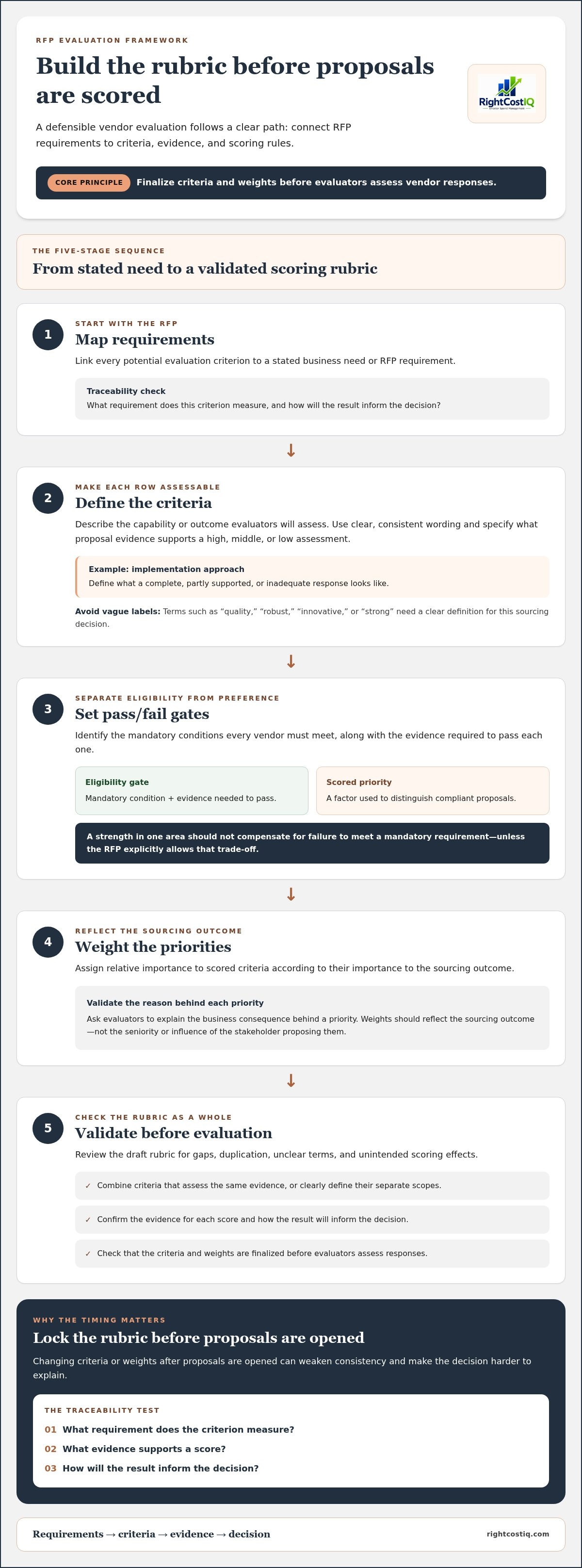
A defensible rfp vendor evaluation matrix takes shape before proposals are scored. Build its rubric from the needs and requirements stated in the RFP, then distinguish conditions every vendor must meet from factors that separate compliant proposals. This prevents a strength in one area from compensating for a failure to meet a mandatory requirement, unless the RFP explicitly allows that trade-off.
Use a consistent sequence:
- Map requirements: Link each potential criterion to a business need or RFP requirement.
- Define criteria: Describe the capability or outcome evaluators will assess, using clear, consistent wording.
- Set eligibility gates: Identify mandatory conditions and the evidence required to pass each one.
- Weight priorities: Assign relative importance to scored criteria based on the sourcing outcome.
- Validate the rubric: Look for gaps, duplication, unclear terms, and unintended scoring effects before evaluation begins.
Finalize criteria and weights before evaluators assess vendor responses. Changing the rubric after proposals are opened can weaken consistency and make the decision harder to explain. For public-sector sourcing, consult the Federal Acquisition Regulation (FAR) on RFPs for the applicable solicitation framework. Follow the rules governing your procurement rather than treating a general scorecard as a substitute.
How should teams turn RFP requirements into evaluation criteria?
Trace every criterion to a stated requirement or decision need. For each row, record what proposal evidence would support a high, middle, or low assessment. For example, if the RFP asks vendors to explain their implementation approach, define what a complete, partly supported, or inadequate response looks like. Avoid broad labels such as “quality” unless the rubric explains what quality means for this sourcing decision.
Review the criteria together. If “implementation capability” and “delivery readiness” assess the same evidence, combine them or clearly define their separate scopes. Flag terms such as “robust,” “innovative,” or “strong” if evaluators might interpret them differently. A traceability check should answer three questions: what requirement does the criterion measure, what evidence supports a score, and how will the result inform the decision?
How should a team assign and validate weights?
Weight criteria according to their importance to the sourcing outcome, not the seniority or influence of the stakeholder proposing them. Ask evaluators to explain the business consequence behind each priority. Then test the draft rubric against realistic proposal trade-offs. For example, would the result reflect the organization’s stated priorities if one vendor excelled technically but offered a weaker commercial proposal?
Treat price as a comparative criterion with a defined method, not as an informal adjustment made after scoring. When price evaluation needs additional context, should-cost analysis can provide data-backed insights for assessing price proposals and challenging unjustified increases. It complements the agreed criteria; it does not replace them.
Before releasing the RFP, check that every criterion has a defined evidence basis, every gate has a clear pass/fail rule, and the weighting reflects documented priorities. Remove criteria that cannot be tied to the RFP or scored consistently. This validation gives evaluators a stable rubric and connects the final recommendation to the original requirements.
How to Score Vendor Proposals Consistently and Compare the Results
Once the rubric is set, evaluators need to assess proposal evidence, not impressions or assumptions. In an rfp vendor evaluation matrix, record each score alongside an evidence reference and a short rationale. A score is interpretable only when its evidence and rubric are visible. Without both, reviewers cannot tell whether a rating reflects the vendor’s response or an evaluator’s unstated expectations.
Use the same comparison structure for every criterion. The entries below are illustrative; replace them with evidence and criteria specific to your RFP.
Criterion: Implementation approach
- Vendor A: Illustrative score: Meets. Evidence: proposal section describes the sequence of implementation activities. Rationale: addresses the stated requirement, with one detail requiring clarification.
- Vendor B: Illustrative score: Partially meets. Evidence: proposal section provides a high-level approach but omits a required detail. Rationale: relevant response, but less complete against the criterion.
Criterion: Price proposal
- Vendor A: Illustrative score: Meets. Evidence: pricing schedule reference. Rationale: required pricing information is present and assessed using the defined method.
- Vendor B: Illustrative score: Meets. Evidence: pricing schedule reference. Rationale: required information is present; comparative value is assessed separately under the agreed rubric.
Make evidence references precise enough for another reviewer to find the relevant passage. If a score has no supporting proposal citation, clarification record, or other permitted evidence, flag it as unsupported rather than treating it as established. Record missing details as gaps or clarification needs; do not fill them with an evaluator’s guess.
What scoring scale should an RFP matrix use?
A simple ordinal scale, such as “does not meet,” “partially meets,” and “meets,” can be easier to apply and explain. A more granular scale may capture meaningful differences, but only if evaluators can distinguish adjacent scores using observable evidence. Neither format is right for every RFP. Keep pass/fail eligibility results separate from weighted scores so a mandatory gate is not confused with a comparative strength.
Write an anchor for every score on every criterion. For an implementation plan, a high rating might require a complete response to all specified elements; a middle rating might reflect partial coverage; and a low rating might indicate a material omission. Define the evidence threshold before evaluation begins. Labels such as “excellent” are not enough on their own because they do not tell evaluators what to look for.
How can evaluators reconcile different scores?
Ask evaluators to score independently before discussing material differences. During a facilitated review, compare the cited evidence, the criterion’s definition, and each evaluator’s rationale. Resolve disagreement against the rubric rather than automatically averaging scores or deferring to the most senior participant.
Record initial scores, agreed changes, and the reason for each change in the evaluation record. If the group retains different interpretations or the evidence is inconclusive, document that as well. This preserves how the final rating was reached and gives decision-makers a traceable basis for comparing proposals.
How to Reduce Bias and Make the Vendor Recommendation Defensible
A consistent scorecard is only one safeguard. The evaluation process should also limit unequal access to information, undisclosed conflicts, and informal changes that could favor a proposal. Use the same criteria, rubric, and evidence expectations for every vendor, and provide evaluators with consistent access to proposal materials and approved clarifications. Assign criterion reviews according to relevant expertise, and require evaluators to disclose potential conflicts before scoring begins.
Keep criteria and weights stable once proposal review starts. If a process exception is necessary, document what changed, why it was approved, and how it was applied across vendors. Calibration before independent scoring can reveal different interpretations of rubric language early, while the team can still align on the stated definitions. Preserve this governance trail alongside scores and supporting evidence.
How can teams control bias during vendor evaluation?
Use a consistent protocol: give each assigned evaluator the same version of each proposal and relevant clarification, apply the pre-set rubric, and keep evaluation discussions tied to documented evidence. Explain scores by referring to proposal content, not reputation, familiarity, or assumptions outside the stated criteria. Record approved exceptions and their impact in the evaluation record instead of making undocumented adjustments during consensus.
What should the final vendor recommendation document?
The recommendation should make the decision understandable to someone who did not attend the scoring meetings. Summarize the selected vendor’s strengths and limitations against the criteria, cite evidence for material findings, and explain significant trade-offs. The highest numerical score and the final recommendation may differ, but the rationale should explain why, using the pre-established priorities and documented evaluation record rather than a new criterion.
Keep a concise log of clarifications, scoring exceptions, consensus decisions, and tie-break rationale. For each clarification, capture the question, response, and affected criterion. For a tie, state which pre-defined consideration resolved it. If consensus changes an individual score, retain the original rating and record the evidence or rubric interpretation supporting the agreed result. These details connect the final choice to the original requirements and make the decision trail reviewable.
Translate unresolved price questions into specific negotiation topics, such as an assumption that needs clarification or a price position that warrants discussion. Evidence-based cost analysis can inform those questions without rewriting the evaluation criteria. RightCostIQ’s Negotiation Coaching supports role-play and strategy testing as the team prepares for those discussions.
A structured process makes the rationale easier to review and carry into negotiation. Explore RightCostIQ’s procurement support to consider how your sourcing process can better connect evaluation and negotiation.
Turn the Evaluation Matrix into an Actionable RFP Decision
A completed matrix should lead to a decision and a clear handoff, not sit as a ranked spreadsheet. Turn the findings into a concise recommendation that identifies the preferred option, the supporting evidence, and material trade-offs. Then prepare two working outputs: a clarification list for unresolved proposal details and negotiation priorities grounded in the evaluation record.
Keep the recommendation focused on what decision-makers need to act:
- Decision rationale: Explain how the selected proposal meets the RFP’s priorities and where it has limitations or trade-offs.
- Open questions: List assumptions or response gaps to resolve before shaping an agreement.
- Negotiation priorities: Identify commercial or delivery points to address, with the relevant proposal evidence attached.
Price scores are comparative inputs, not a complete view of cost or value. Use the method agreed in the RFP to compare pricing, then add cost analysis where it provides useful context. That analysis can inform negotiation, but it should not replace the criteria or retroactively change the evaluation result.
How should evaluation findings shape the next negotiation?
Carry documented proposal strengths, open questions, and assumptions into negotiation preparation. If a vendor’s price proposal includes an assumption that affects the comparison, turn it into a specific clarification or discussion topic. Should-cost insights can provide data-backed context for evaluating price proposals and challenging unjustified increases. Keep negotiation decisions distinct from evaluation scores, and record the rationale for any changes agreed after selection.
This separation preserves the integrity of the scorecard while allowing the team to test assumptions and refine commercial terms. It creates a practical bridge from the evaluation record to focused negotiation preparation.
How can an RFP workflow support a consistent evaluation?
Proposal scoring depends on more than the matrix. Evaluators also need an organized record of communications, including vendor questions, clarifications, and responses that inform their review. RightCost IQ’s RFP Workflow manages RFP communications in a single data-driven environment, keeping that communication stream organized alongside the evaluation process.
Use the completed scorecard and communication record together when preparing the recommendation. This preserves the connection between what the RFP asked, what vendors submitted, what was clarified, and what the team proposes to negotiate. The workflow organizes the process; evaluators remain responsible for applying the established criteria and making the sourcing decision.
Explore the RFP Workflow to bring structured RFP management and negotiation preparation into your sourcing process.
Make Your Next Sourcing Decision Easier to Act On
Use the rfp vendor evaluation matrix as a decision asset that remains useful after selection. Preserve how the team reached its choice, then turn remaining assumptions into specific negotiation questions, owners, and next actions. Disciplined evaluation creates value when the recommendation establishes a controlled starting point for supplier alignment and commercial discussion.
RightCost IQ’s RFP Workflow manages communications in a single data-driven environment, while its data-backed should-cost models can support price proposal analysis and negotiation preparation. These capabilities complement the agreed scorecard, keeping evidence connected without replacing the criteria used to evaluate vendors.
If your sourcing process needs a clearer route from proposal evidence to defensible decisions and focused negotiations, explore RightCost IQ’s procurement support. Identify where workflow, evaluation records, or cost analysis could better support your next RFP, then carry a clear decision trail into negotiation.
Frequently Asked Questions
What is an RFP vendor evaluation matrix?
An rfp vendor evaluation matrix is a controlled record connecting supplier responses to the team’s decision. Beyond ranking proposals, it can capture the proposal version reviewed, locations of supporting details, reviewer notes, and approval status. This helps stakeholders revisit the decision later or check a negotiated term against what the supplier originally proposed.
How do you create an RFP evaluation matrix?
Set up the evaluation record before proposals arrive. Decide who maintains the master version, how reviewers will submit assessments, and where they will record proposal references. Make sure the matrix distinguishes missing information from a negative assessment, then test it against a sample response or past proposal. This can reveal unclear fields or calculation issues before they affect an active sourcing decision.
What criteria should be included in a vendor evaluation matrix?
Include criteria that distinguish supplier responses against the sourcing need. Depending on the RFP, relevant areas might include technical fit, implementation approach, service delivery, risk, sustainability, or commercial terms. A service-focused RFP could assess how clearly a supplier explains its delivery model, while a technology purchase might emphasize compatibility with stated requirements. Each criterion should capture a distinct decision factor.
How should criteria be weighted in an RFP evaluation matrix?
Weight criteria according to the consequences of supplier performance for the sourcing outcome. Test the draft by comparing hypothetical proposals: if one excels in a high-priority area but is weaker elsewhere, would stakeholders be able to defend the result? Review the weighting with business owners before scoring begins. If price dominates the total, confirm that this reflects the intended procurement decision rather than ease of measurement.
Should mandatory requirements be scored in a vendor evaluation matrix?
Usually, treat a genuine mandatory requirement as a separate pass/fail gate rather than awarding points for meeting it. This prevents a supplier from offsetting an unmet condition with strengths in unrelated areas. State what evidence demonstrates compliance and decide in advance how incomplete or ambiguous responses will be handled. Call a requirement mandatory only when the RFP clearly establishes it as an eligibility condition.
How can an evaluation matrix reduce bias in vendor selection?
A matrix can reduce the influence of personal preference by directing attention to the same decision factors for every proposal, but it cannot eliminate bias on its own. Where practical, evaluators can review standardized extracts focused on the relevant response, rather than letting brand familiarity shape first impressions. After scoring, review unusually large differences between evaluators and vendors to identify criteria that may be unclear or applied unevenly.


