

A stable purchase plan can still produce an unstable cost base. Managing price volatility in direct materials means understanding how changes in raw material prices affect procurement costs, margins, and budgets, then choosing how much of that exposure to absorb or manage. McKinsey reports that annualized commodity price volatility averaged 10 to 20 percent over the past four years.
Price volatility isn’t driven by a single market signal. Supply disruptions, demand shifts, geopolitical events, and economic uncertainty can all move prices, sometimes in opposite directions. The practical challenge is balancing cost visibility with flexibility: fixed prices can make costs more predictable, while spot purchases leave you exposed to market swings.
This article explains commodity price risk, why raw material prices fluctuate, and how fixed-price agreements, spot purchases, and hedging affect cost exposure. It also shows how to connect market movements to procurement decisions so you can assess risk and make sourcing choices that support financial and operational objectives.
Key Takeaways
- Separate market price movements from your business’s exposure by mapping material needs, purchase timing, and contract terms.
- Compare fixed-price agreements, spot buying, and hedging based on the balance of cost visibility and flexibility your operation needs.
- Trace raw material costs through production, pricing, margins, and working capital to identify where volatility creates the greatest pressure.
- Assess how supply disruptions, demand shifts, and geopolitical or economic uncertainty can move material prices in either direction.
- Evaluate futures and options alongside their financial and operational risks before building them into a manufacturer’s risk strategy.
1. What is commodity price risk?
Commodity price risk is the possibility that changing prices for raw or semi-processed materials will alter a company’s costs and financial results. McKinsey reports that annualized commodity price volatility averaged 10 to 20 percent over the past four years. In procurement, that movement matters because a material bought for production can become more expensive before the next purchase, or lose value after inventory is acquired.
The effects can extend beyond the purchase price. A material cost increase may raise production expenses, compress margins, affect product pricing, and put pressure on earnings or credit availability. This shows why a budget based on one market snapshot may be unreliable across a longer buying cycle.
Supplier diversification can reduce dependence on a single source, region, or pricing arrangement, limiting exposure when a disruption affects a particular supply route. Alternative materials may also change the cost base, but substitutions require product-design approval and checks for performance, long-term effects, and regulatory compliance. Weigh these trade-offs before changing specifications or supplier allocations.
Build mitigation strategies around your exposure, not price forecasts alone. Map each material to purchase timing, contract terms, and its share of production costs. Then assess how price movements could affect budgets, bids, and margins. Procurement should work with Finance and Treasury to align sourcing decisions with overall business risk. For example, a steel fabricator can test whether a price increase before a purchase would erase the expected profit on a project bid.
Use key performance indicators to connect market movement with business impact. A 1-day Value-at-Risk measure can support operational control, while monthly Value-at-Risk can inform budget planning. Conditional Value-at-Risk adds a view of extreme scenarios beyond a typical loss estimate. Track these measures alongside purchase-price variance, forecast accuracy, and the share of demand exposed to variable pricing to assess whether risk controls protect cost competitiveness.
Stress testing helps teams determine whether their strategies can withstand disruptions rather than relying on a single expected-price case. Model a sharp price rise, a rapid decline, and a supply interruption, then trace each scenario through inventory, production, cash flow, and customer commitments. The 1973 oil crisis provides a historical scenario for testing broad energy shocks. Review assumptions with Finance and Treasury, document decision thresholds, and update the model when supply or demand conditions change.
2. Fixed prices, spot prices, and hedging
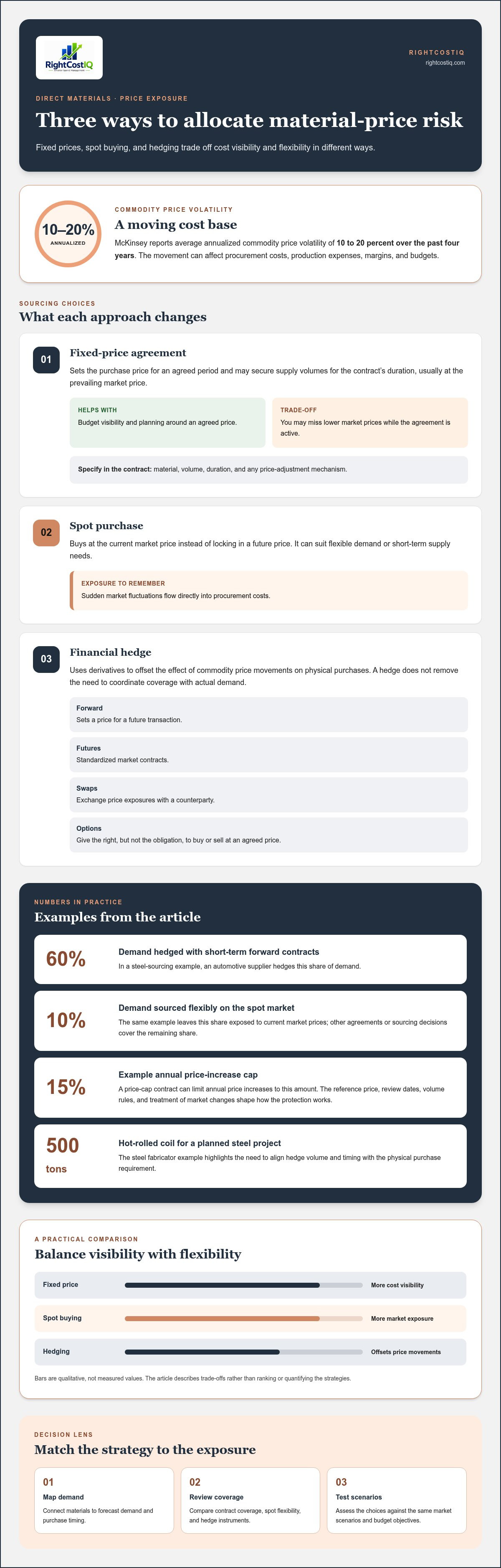
Fixed-price agreements, spot purchases, and financial hedges allocate commodity price uncertainty differently. A fixed-price agreement sets the purchase price for an agreed period and may secure supply volumes for the contract’s duration, usually at the prevailing market price. It improves budget visibility, but the buyer may miss lower prices while the agreement is active. Contract terms should specify the material, volume, duration, and any price-adjustment mechanism. For manufacturers, managing price volatility in direct materials starts with matching these terms to planned demand.
Spot buying means purchasing at the current market price rather than locking in a future price. It can suit flexible demand or short-term supply needs, but sudden fluctuations flow directly into procurement costs. A mixed sourcing plan can balance these trade-offs. In a steel-sourcing example, an automotive supplier uses short-term forward contracts to hedge 60% of demand and sources 10% flexibly on the spot market. The remaining share can be covered through other agreements or sourcing decisions.
Price limits can also manage exposure without fixing every purchase at one level. A collar establishes maximum and minimum prices, limiting large upward or downward movements. A price-cap contract example limits annual price increases to 15%. These structures can make forecasting more predictable, but the contract’s reference price, review dates, volume rules, and treatment of market changes determine how protection works in practice.
Financial hedging uses derivatives to offset the effect of commodity price movements on physical purchases. Companies can use forwards, futures, swaps, and options. A forward sets a price for a future transaction; futures are standardized market contracts; swaps exchange price exposures with a counterparty; and options provide the right, but not the obligation, to buy or sell at an agreed price. Options offer flexibility, while swaps can share price risk with partners. Choose instruments that match the material, purchasing schedule, and exposure being managed.
Consider a steel fabricator planning a project requiring 500 tons of hot-rolled coil. That gain can offset part of the higher physical purchase price. It does not remove the need to coordinate hedge volume and timing with actual demand.
To implement a strategy, procurement should map forecast demand against contract coverage and purchase timing. Then compare fixed agreements, spot flexibility, and hedge instruments under the same market scenarios. A sound process for managing price volatility in direct materials also tracks exposure against supply-chain needs and budget objectives. Teams can use a price risk management approach to support that alignment.
Raw material costs as a share of manufacturing costs
Raw materials typically account for between 10% and 50% of a manufactured product’s manufacturing cost. That range makes material exposure highly dependent on product design, production methods, and the purchased inputs in each bill of materials. A metals-intensive product may react sharply to a metal price change, while a product with more labor or processing content may feel a smaller direct effect. Map material spend by category and product to determine where price movements can affect margin most.
Price changes affect more than unit cost. If a manufacturer absorbs higher input costs, gross margin contracts unless efficiency gains or other savings offset the increase. Passing costs on to customers can protect margin but may affect demand and customer relationships. Falling raw material prices can improve margins, although the benefit depends on inventory bought at earlier prices and when lower-cost inputs reach production. For each major material, compare purchase costs, finished-product pricing, and inventory valuation over the same period.
In the United States, track the market benchmark specified in a material’s supplier pricing formula, alongside supplier quotations and purchase invoices. The World Bank’s metals and minerals price index offers a broad comparison: it rose 6% in October 2025 and 4% in the third quarter of 2025. Compare such broad indicators with the specific material and contract basis used for purchasing, since a general index may not mirror a particular grade or delivery arrangement.
Cash flow can tighten even when production continues. Metal buyers may wait 60 or 90 days for customer payments after buying materials at high prices, creating a working-capital gap. Inventory decisions can reduce or intensify that pressure. For a brief natural-disaster disruption, existing reserves may help a business avoid buying at elevated prices. However, holding more stock ties up cash and adds storage requirements, so set replenishment decisions against demand, lead times, and the cost of carrying inventory.
Material volatility can also affect research and development priorities. If a key input becomes more expensive, a design team may assess whether another material or production process can meet product requirements. This requires testing performance, long-term effects, and regulatory compliance, so it is not a quick purchasing adjustment. Build a cross-functional review into cost planning: procurement identifies exposure, finance models margin and cash-flow effects, and product teams assess design options. The process may reveal a competitive advantage if a product can use materials more efficiently without compromising its intended function.
4. Causes of raw material price volatility
Raw material prices move when supply and demand change faster than producers and buyers can adjust. A disruption can restrict available production, while a demand shift can redirect materials toward other markets. The COVID-19 pandemic ushered in a period of extreme raw material price volatility. Shifts in both supply and demand caused upward and downward price pressures between 2020 and 2022. The World Bank warned that the global economy would experience its largest commodity shock since the 1970s in 2022 and beyond.
Natural disasters can interrupt extraction, processing, transport, or refining. Hurricane Katrina severely disrupted oil production in 2005 and caused gasoline prices to rise by 20%. The impact depends on which facilities stop operating and how quickly production can resume. Long-term damage to global production can leave a material persistently scarce, rather than creating only a temporary price spike. Buyers can identify this risk by tracking supplier locations, key transport routes, and the production stages their materials depend on.
Geopolitical events can create sudden supply shocks across connected markets. In 2019, attacks on Saudi Arabia’s Abqaiq oil processing facility and Khurais oil field halted over half of daily national exports, representing approximately 5 per cent of global crude oil production. Brent and West Texas Intermediate crude oil futures then increased by approximately 15 per cent. The 2014 platinum mining strike in South Africa reduced supply by around 1.2 million ounces, equivalent to 25 per cent of global supply. Such events show how concentrated production can amplify market reactions.
Demand conditions also shape price direction. China consumes between 50% and 60% of worldwide metal production, so changes in its industrial demand can affect metals markets globally. J.P. Morgan Research found that base metal prices decrease by approximately 30% during recession periods. Emerging technologies can work in the opposite direction by increasing demand for materials used in new products. Procurement teams should assess economic signals alongside sector-specific demand, then distinguish temporary fluctuations from changes that may affect long-term sourcing decisions.
Production capacity takes time to expand, which can prolong a supply-demand imbalance. The average lead time from discovery to production of new copper mines was 17 years for production that started between 2010 and 2019. Unplanned mine outages caused the loss of nearly 929,000 tons of copper production in 2025. Together, slow development and unexpected outages limit the market’s ability to respond quickly. Tracking mine output, supplier performance, and material demand can help buyers identify exposure and evaluate sourcing opportunities before conditions tighten.
5. What are the risks of commodity futures and options hedging for manufacturers?
Futures and options can reduce exposure to price changes, but hedging introduces risks of its own. One is basis risk: a derivative’s reference price may not match the manufacturer’s actual material, grade, location, or supplier formula. For example, a buyer hedging a broad metals benchmark may still face a different price movement for a specific alloy. The hedge may offset some of the change, but not necessarily the full invoice impact.
Volume and timing mismatches create another exposure. A manufacturer may hedge forecast demand, then produce less after a customer changes an order. The derivative position can exceed physical requirements, leaving the company exposed to losses if prices move against it. The reverse can also happen: higher production demand may exceed the hedged volume. Align hedge quantities with purchasing forecasts and update them when production plans change.
Options involve a different trade-off. A buyer pays a premium for the right, but not the obligation, to buy or sell at an agreed price. If market prices move favorably, the option may expire unused, and the premium remains a cost. If prices move sharply against the buyer, the option may offer protection, depending on contract terms and market conditions. Compare the premium with the price exposure being managed.
Futures can create cash-flow pressure before a manufacturer buys physical material. Adverse price movements may trigger margin requirements, requiring funds to support the position. This cash demand can arise while the company is also paying suppliers, financing inventory, and waiting for customer receipts. Treasury should model hedge-related cash needs alongside procurement payments, rather than judging performance only by the final purchase price.
Counterparty and execution risks need attention, particularly with customized over-the-counter contracts. A contract may depend on the other party meeting its obligations, while complex terms can make exposure harder to monitor. Before entering an agreement, document the reference price, quantity, settlement method, expiry, and responsible decision-makers. Clear records help procurement, finance, and treasury identify mismatches before they build up.
A manufacturer can manage these risks with a governed hedge plan. Define approved instruments, exposure limits, forecast updates, escalation thresholds, and reporting responsibilities. Track physical and derivative positions together, including basis differences, forecast changes, and cash requirements. Stress-test an adverse market move and a sudden demand reduction, as both can reveal weaknesses that a stable-price scenario may miss. A hedge should support the purchasing strategy, not become a separate speculative position.
RightCostIQ: Request For Proposal (RFP) Management and Negotiation Assistance
RightCostIQ provides Request For Proposal (RFP) Management and Negotiation Assistance to help procurement teams structure supplier bids and negotiations around material requirements, pricing terms, and risk allocation. This support is useful when market movements make current agreements difficult to assess or upcoming sourcing decisions call for a clearer view of supplier proposals.
Procurement Category Cost benchmarking and Analytics helps teams evaluate category pricing, while the Price Risk Management and Tracking Service focuses on monitoring material price exposure. Together, these services support informed sourcing and negotiation without replacing a manufacturer’s internal financial controls or risk governance.
Visit rightcostiq.com to discuss your procurement needs and take the next step.
Turn material exposure into a sourcing decision
A disciplined approach to managing price volatility in direct materials starts with understanding where exposure enters the business, then connecting that insight to sourcing, negotiation, and financial planning. Translate market signals into decisions that procurement and finance can monitor together: which supplier terms need review, where category benchmarks can inform negotiations, and how vendor performance affects supply continuity.
RightCostIQ supports this work through Request For Proposal (RFP) Management and Negotiation Assistance, Procurement Category Cost benchmarking and Analytics, and Procurement and Vendor Performance Tracking Service. These services help teams structure supplier decisions around cost visibility, commercial terms, and performance information.
If your material costs are complicating sourcing plans or budget decisions, contact RightCostIQ to discuss your material costs. Use the conversation to clarify the exposure you want to address and the procurement decisions that matter most. A more deliberate view of cost and supplier performance can help your team move forward with greater control.
Frequently Asked Questions
What Is Raw Materials Price Volatility?
Raw material price volatility describes how much and how quickly production-input prices change over time. Prices may rise, fall, or move sharply in both directions. For example, a procurement team can compare a current supplier quotation with recent purchase history to determine whether a price shift is specific to a material or part of a broader market movement. That distinction helps teams adjust forecasts and purchasing plans.
What is commodity price risk?
Commodity price risk is the financial exposure a business faces when material prices change before it buys or uses materials, or sells products made with them. Exposure depends on purchase volumes, timing, contract terms, and the material’s share of product costs. Two manufacturers can face the same market movement but experience different consequences. Estimate exposure by mapping upcoming purchases against production needs and agreed pricing terms.
What causes price volatility in direct materials?
Price volatility can result from changes in supply, demand, production capacity, and market expectations. A mine outage, natural disaster, or geopolitical disruption can restrict supply, while shifts in industrial demand can move prices in either direction. Procurement teams can assess whether a supplier depends on a single production region or route. Tracking these dependencies alongside demand forecasts helps distinguish a temporary interruption from a more persistent market shift.
How can companies forecast direct material price changes?
Companies can build forecasts using relevant market indexes, supplier quotations, internal purchase history, and expected production demand. Match each material to the benchmark or pricing reference in its supplier agreement. Then compare historical purchase prices with current market indicators and update assumptions as supply conditions change. Use multiple scenarios, such as stable supply and a disruption, so budget decisions don’t rely on a single price prediction.
What are common strategies for hedging direct material costs?
Common hedging strategies include forwards, futures, swaps, and options, selected to match the exposure a manufacturer needs to manage. A buyer can use a forward to set a future purchase price or an option to retain the right to buy at an agreed price. Before choosing an instrument, align its reference price, quantity, and timing with expected physical purchases. Monitor forecast changes to ensure a hedge doesn’t exceed actual material requirements.
How do fixed-price contracts compare with index-based pricing for materials?
A fixed-price contract holds the agreed price for its specified terms, supporting more predictable budgeting during that period. Index-based pricing adjusts the purchase price according to a chosen market reference and contract formula, passing changes through to the buyer. Compare the reference index with the material’s actual grade, delivery basis, and supplier quotation. The right structure depends on whether the priority is price certainty or a closer link to market movements.
How can procurement teams use supplier contracts to manage price volatility?
Procurement teams can negotiate terms that clarify how material prices change and how both parties respond. Define the pricing reference, adjustment triggers, review process, covered volumes, and notice requirements. For example, a contract may use an agreed index and scheduled reviews rather than leave adjustments open to interpretation. Teams can also compare supplier proposals using consistent assumptions, then track invoices against contract terms to flag pricing differences promptly.
How do inventory buffers and strategic purchasing reduce exposure to material price swings?
An inventory buffer can keep materials available for production during a brief supply interruption, reducing pressure to buy immediately at an elevated price. Strategic purchasing can also spread buying across planned windows instead of concentrating demand in one purchase. Balance this flexibility against cash tied up in stock, storage needs, material shelf life, and forecast demand. Review buffer levels as production schedules and supplier lead times change, rather than treating inventory as a fixed hedge.


