

What if the lowest quote is the most expensive offer? When negotiating with Chinese suppliers, a low unit price can conceal differences in freight, payment terms, lead times, or other commercial commitments. And when a supplier proposes a price increase, pushing back without evidence can weaken the discussion rather than improve the offer. Strong negotiations start with comparable facts, not guesswork.
You need a clear view of your priorities and the trade-offs that matter before the conversation begins. This guide shows you how to prepare evidence, use should-cost analysis to assess price claims, and compare supplier offers across total commercial value. It also explains how to negotiate measurable commitments without turning a working relationship into a contest. You’ll learn how to set targets, document agreed terms, and track results against your sourcing objective, with negotiation coaching and savings tracking as tools for making the process more structured and verifiable.
Key Takeaways
- Set the commercial outcome first, then distinguish purchase requirements from preferences and acceptable trade-offs.
- Make negotiating with Chinese suppliers a structured process: clarify terms, request evidence, assess it, propose changes, and document agreements.
- Use a like-for-like comparison to assess quoted price alongside scope, specifications, quantities, and applicable commercial terms.
- Stay firm without making the discussion adversarial by linking each request to a specific business requirement and supporting evidence.
- Record agreed terms as a baseline, then track performance separately from savings that have been verified.
How to prepare for negotiating with Chinese suppliers
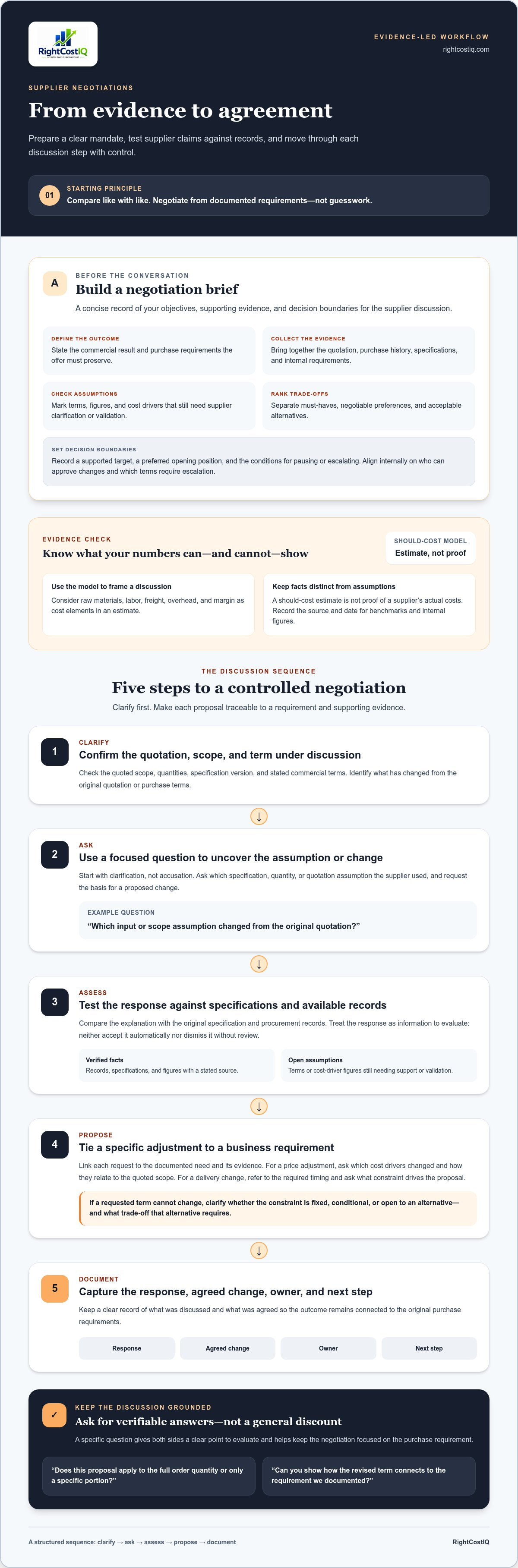
Before contacting a supplier, decide what this purchase must achieve. Is the priority a defensible total cost, a required specification, a delivery window, or a combination? Set the outcome first, then separate non-negotiable requirements from preferences you can exchange for better terms. This prevents a discussion from drifting toward a lower unit price that fails the actual business need.
A negotiation brief is a record of your documented objectives, supporting evidence, and decision boundaries for a supplier discussion. Use this concise checklist to build one:
- Define the outcome. State the commercial result and the purchase requirements it must preserve.
- Collect the evidence. Assemble the quotation, purchase history, specifications, and internal requirements.
- Check the assumptions. Mark terms, figures, and cost drivers that need supplier clarification or validation.
- Rank the trade-offs. Separate must-haves, negotiable preferences, and acceptable alternatives.
- Set boundaries. Record a supported target, a preferred opening position, and the conditions for pausing or escalating.
Build a negotiation brief from internal procurement evidence
Anchor the brief in records, not memory. Compare the current quotation with prior purchase terms and the approved specifications, then note what has changed. A should-cost model can help frame a price discussion, but treat it as an estimate based on raw materials, labor, freight, overhead, and margin, not as proof of a supplier’s actual costs. RightCostIQ’s should-cost analysis supports evidence-led assessment of proposed pricing.
- Capture the quoted scope, quantities, specification version, and stated commercial terms.
- Separate verified facts from assumptions, including any cost-driver figures that still need support.
- Record the source and date for each benchmark or internal figure so the team can explain its basis.
Set priorities, alternatives, and decision boundaries
Rank the terms that matter for this purchase. Price may lead, but quality requirements, delivery expectations, order quantities, or other documented terms may be equally decisive. Identify realistic alternatives and the operational consequences of switching, such as qualification work or transition effort, where those apply. Relationship context also matters: the concept of guanxi describes reciprocal connections and obligations in Chinese social and business settings.
- Must-haves: requirements the offer must meet for the purchase to proceed.
- Negotiable preferences: terms that can move if the overall value improves.
- Acceptable trade-offs: specific concessions you can make without undermining the sourcing objective.
Keep your evidence-backed target distinct from your opening position. The target should follow from the available data and purchase requirements; the opening position is the proposal you choose to put forward. Before negotiating with Chinese suppliers, align internal stakeholders on who can approve changes and which terms require escalation. That gives the discussion a clear mandate without treating every preference as a deal-breaker.
How to conduct a supplier negotiation with evidence and control
Run the discussion as a controlled sequence, not a series of improvised counters. In negotiating with Chinese suppliers, clarity and evidence help keep the conversation focused on the purchase requirements while allowing both sides to explain their positions. Use this five-step framework:
- Clarify the quotation, scope, and term under discussion.
- Ask a focused question about the assumption or change.
- Assess the response against specifications and available records.
- Propose a specific adjustment tied to a business requirement.
- Document the response, agreed change, owner, and next step.
Keep each request traceable. If the supplier’s revised offer changes a delivery expectation, refer to the required timing and ask what constraint drives the proposal. If the supplier requests a price adjustment, ask which cost drivers changed and how those changes relate to the quoted scope. This is more productive than asking for a general discount or challenging a claim without a factual basis.
Ask focused questions and test assumptions
Start with clarification, not accusation. Ask which specification, quantity, or quotation assumption the supplier used, and request the basis for any proposed change. Then compare the explanation with the original specification and procurement records. Treat the response as information to evaluate: neither accept it automatically nor dismiss it without review. The Harvard Business Review's study on Chinese negotiations offers additional context for approaching cross-cultural discussions with preparation and care.
Use questions that invite a verifiable answer, such as:
- “Which input or scope assumption changed from the original quotation?”
- “Does this proposal apply to the full order quantity or only a specific portion?”
- “Can you show how the revised term connects to the requirement we documented?”
When a supplier says a requested term cannot change, clarify whether the constraint is fixed, conditional, or open to an alternative. Ask what adjustment is possible and what trade-off it would require. If a delivery term cannot be met, for example, explore whether a different schedule or partial quantity addresses the business need. Record the option and assess it against the purchase priorities before responding.
Manage concessions without losing the negotiation objective
Concessions should be conditional, not automatic. If you can adjust order timing or volume, connect that flexibility to a specific reciprocal change, such as a revised quoted term. Pause before agreeing: measure the impact against the sourcing objective, required specifications, and internal approval limits. The Negotiation Coaching page describes a way to role-play and test strategy before a supplier conversation.
Close each discussion by summarizing what remains open, what evidence is pending, and who will provide it by the agreed follow-up point. Keep a written record of proposals and responses so a new assumption doesn’t quietly become an accepted term. For a structured review of procurement opportunities before discussions, consider the free procurement diagnostic.
How to compare Chinese supplier offers beyond unit price
A quoted price is comparable only when it covers the same purchase. A lower figure may reflect a different specification, quantity, scope, or commercial assumption, not a more competitive offer. Supplier comparisons are meaningful only when each quotation is measured against the same documented scope and requirements.
Build the comparison from the terms that appear in the quotations and matter to this purchase. Don’t add rows simply because they’re common in other sourcing projects. Keep confirmed quotation details separate from estimates and unresolved questions, so the comparison shows both what you know and what still needs clarification.
Normalize quotations before comparing them
Start with the requested specification, quantity, and scope. Check each offer against these same reference points, including any stated inclusions or exclusions. If one supplier describes a term differently or leaves an assumption unstated, flag the gap for clarification rather than filling it with a guess. Cost-based evaluation, including should-cost analysis, can provide an estimate to inform review, not a substitute for aligned quotations.
For example, imagine one quotation covers the full requested scope while another omits a listed requirement. Comparing their headline prices would create a false ranking. Mark the second offer as incomplete or unresolved until its scope is clarified; don’t treat the missing item as having no cost.
Assess trade-offs across commercial terms
Once scope is aligned, compare each documented term against operational needs and sourcing priorities. A term that matters for one purchase may have little relevance to another. The Harvard Program on Negotiation's guide to dealmaking in China provides context for balancing clear commercial terms with relationship-building. Keep the evaluation specific to the transaction rather than treating any single factor as decisive.
Quoted price: Record the offered amount and its stated basis, such as unit or order quantity. Flag any unclear basis.
Scope and specification: Note whether the offer matches the requested requirements. Identify exclusions or deviations.
Quantity: Compare the quoted quantity with the requested order and note any different volume assumptions.
Other quoted terms: Include purchase-specific details such as delivery expectations or payment terms only when documented and relevant.
Status: Label each entry as confirmed, estimated, or unresolved. Add a concise note explaining what must be clarified.
Use the notes to show the consequence of each difference. If one offer has a lower quoted price but a different delivery term, assess that term against the operation’s actual requirements instead of assigning it an automatic penalty. If the difference remains unclear, keep it open rather than scoring it as an advantage or disadvantage.
This disciplined comparison gives teams negotiating with Chinese suppliers a defensible basis for follow-up: clarify gaps, assess trade-offs, and compare offers on like-for-like terms before deciding which proposal best supports the purchase objective.
How to negotiate firmly while protecting the supplier relationship
A firm position can be professional. The distinction is how you present it: make requests specific, connect them to documented purchase requirements, and give the supplier a clear opportunity to explain constraints or propose an alternative. Respectful communication doesn’t require accepting terms that fail those requirements.
For teams negotiating with Chinese suppliers, avoid treating culture as a script. Each supplier’s priorities and constraints are individual. Focus on the facts in the discussion, use neutral language, and keep the decision tied to the business need rather than assumptions about how a supplier might respond.
Respond to resistance without escalating the discussion
When a supplier says a term can’t change, acknowledge the response and ask what constraint drives it. Then restate the requirement and invite a workable alternative. This keeps the exchange focused on solving the issue, not assigning blame or applying pressure without a clear basis.
- Ask: “Could you clarify which constraint prevents this term from changing?”
- Explain: “This requirement supports our documented production schedule, so we need an option that meets it.”
- Propose: “If the original term isn’t workable, what alternative would meet the requirement?”
For example, if a proposed delivery schedule doesn’t meet the operational requirement, ask whether another schedule or arrangement could. Evaluate any alternative against the same requirement before accepting it. A constructive tone keeps the discussion open; it doesn’t mean lowering a must-have without authorization.
Keep decisions and commitments clear
After each discussion, send a concise written summary using the parties’ confirmed wording. Separate agreed changes from open questions, and record the responsible contact and next decision point for each unresolved item. Structured supplier communications through RFP management can help keep requests, responses, and clarifications organized across the sourcing process.
Before treating a proposal as settled, compare the summary with the supplier’s written confirmation. Capture the exact agreed terms and note any items still subject to approval or follow-up. This creates a shared record and gives procurement a reliable reference for checking whether the final arrangement still meets the purchase objective.
General negotiation guidance isn’t legal advice and doesn’t replace contract review. Route proposed contractual changes through your organization’s established review process, and don’t treat an informal discussion as approval to change binding terms.
Firmness is most effective when it’s consistent: explain the requirement, listen to the supplier’s response, assess alternatives, and document the decision. To assess your negotiation process and identify areas for improvement, request a free procurement diagnostic.
Turn supplier negotiations into measurable procurement outcomes
A negotiated concession is a proposed benefit until procurement can compare it with an agreed baseline and confirm the result. Close the loop by translating accepted terms into a record that can be tracked against the sourcing objective. This makes future reviews more reliable and helps distinguish a headline improvement from a realized outcome.
Set the baseline before implementation. Record the approved terms, the prior or reference terms used for comparison, and the source of each figure. Keep the scope consistent: specification, quantity, and other relevant conditions should match. If the comparison relies on an estimate or an assumption, label it clearly rather than presenting it as a confirmed saving.
Track commitments and verify savings
Separate negotiated savings from verified savings. Negotiated savings describe the value implied by an agreed change against a defined baseline. Verified savings require evidence that the agreed terms were implemented and that the resulting outcome can be measured against that baseline. A revised quote alone doesn’t establish that the benefit was realized.
- Document the baseline: capture the reference terms, comparison source, scope, and measurement period used by your organization.
- Record the commitment: save the supplier’s confirmed terms and note any conditions attached to them.
- Review actual results: compare realized purchasing outcomes with the baseline and agreed terms.
- Explain variances: identify differences in quantity, scope, timing, or other relevant conditions before attributing a result to negotiation.
For example, if an approved quotation reflects a changed unit price, but the subsequent purchase uses a different quantity or scope, don’t treat the full difference as a verified saving without accounting for those changes. Savings Tracking and Verification provides a structured way to connect negotiated commitments with evidence of realized outcomes.
Use procurement tools to strengthen the next negotiation
Make the next sourcing cycle more informed by retaining the evidence and decisions from this one. An integrated RFP portal keeps supplier communications in one data-driven environment, making it easier to refer to the proposal, clarification, and confirmed terms together. An AI-powered negotiation coach supports role-play and strategy testing before supplier discussions.
Market price trends and should-cost insights can also inform preparation. A should-cost model is an estimate based on drivers such as raw materials, labor, freight, overhead, and margin. Use it to frame questions and assess a price claim, not as proof of the supplier’s actual costs or a promise of a particular negotiation result. In this way, negotiating with Chinese suppliers becomes a repeatable procurement process: prepare with evidence, record decisions, then verify outcomes.
RightCostIQ supports procurement teams with negotiation assistance, cost benchmarking, market price trending, and savings tracking. Start the free procurement diagnostic to assess your procurement approach and identify areas for structured review.
Build a stronger starting point for your next negotiation
The value of negotiating with Chinese suppliers extends beyond a single agreement. Each sourcing cycle can sharpen the next one when teams preserve what they learned: which assumptions held, which terms mattered in practice, and where the evidence needs to improve. That learning turns negotiation from a one-off event into a repeatable procurement capability.
RightCostIQ supports that process with data-backed should-cost insights for evaluating price increases, an AI-powered negotiation coach for role-play and strategy testing, and Savings Tracking and Verification to help connect commitments with measured outcomes. These tools support more disciplined decisions without replacing the judgment your procurement team brings to each supplier relationship.
Make your next step a clear-eyed review of where your process can become more evidence-led and measurable. Start your free diagnostic and build a stronger foundation for the negotiations ahead.
Frequently Asked Questions
Is the lowest quotation from a Chinese supplier always the best option?
No. A lower quotation isn’t automatically the best option. If one offer excludes packaging or assumes a different order quantity, its apparent advantage may disappear once the purchase is aligned. Compare each documented offer against what operations actually needs. For example, a cheaper quote that omits a required specification isn’t equivalent. Treat missing or unclear details as questions to resolve, not as savings or proof of value.
Can I negotiate a supplier's minimum order quantity?
Yes, you can ask whether the quoted minimum order quantity is flexible, but don’t assume the supplier can reduce it. Explain your demand pattern and inventory considerations, then assess how any quantity change affects the full offer. A smaller order could alter other quoted terms, so compare the revised proposal with your purchasing requirements before deciding. The right quantity depends on the product, supplier terms, and your organization’s needs.
How should I respond when a Chinese supplier says a requested term is not possible?
Ask what constraint is behind the response and whether another option could meet the same business requirement. For example, if a requested schedule isn’t workable, clarify which part creates the constraint and consider alternatives that still support operations. Assess any proposal against your priorities, then record what both sides have agreed. Don’t assume the answer reflects a cultural rule or accept it without understanding the supplier’s specific explanation.
What should I prepare before negotiating with a Chinese supplier?
Prepare the quotation, purchase specification, relevant purchasing history, and a ranked list of priorities. Mark assumptions that need clarification and terms that could be flexible. Set an evidence-based target and a decision boundary before the meeting. If you use a should-cost estimate, treat it as an estimate based on raw materials, labor, freight, overhead, and margin, not as a guaranteed market price. This gives your negotiating position a clear factual basis.
How can I compare supplier quotes when their terms are different?
Identify differences in scope, specifications, quantities, and documented commercial terms before comparing the quotations. If a detail is missing, request clarification rather than inserting an unsupported estimate. Then organize the offers around the same purchase requirements, marking what’s confirmed and what remains unresolved. This helps decision-makers see whether a difference reflects a genuine advantage, a change in the offer, or simply information that isn’t available yet.
Does negotiating firmly damage a supplier relationship?
Not necessarily. Firm negotiation can remain professional when requests are specific and tied to business needs. Explain why a term matters, invite the supplier to clarify constraints, and consider alternatives without abandoning essential requirements. No approach can guarantee a particular relationship outcome. Keep the discussion focused on the supplier’s actual responses and proposals rather than relying on assumptions about culture or treating respectful communication as a reason to accept unsuitable terms.
How do I know whether negotiated savings were actually achieved?
Define a comparison baseline and keep the source records before measuring the result. Then compare realized purchasing outcomes with the agreed terms, accounting for any differences in scope, quantity, or requirements. Preserve the evidence behind each calculation and distinguish a negotiated target from a verified saving. If the purchase conditions changed, explain how that affects the comparison. Without consistent records, a lower figure alone may not demonstrate that the negotiation created the claimed benefit.


