

Maverick spend is a visibility and control problem, not just a purchasing problem. It includes purchases made without required approval or outside an organization’s approved contracts and suppliers. To understand how to manage maverick spend, make compliant buying clear and practical, set proportionate approval steps, and track purchases against contracts and policy.
Small, unplanned purchases can seem harmless on their own, but fragmented buying can hide total demand and weaken the value of negotiated agreements. The answer isn’t to add friction to every transaction. Give employees usable guidance and workflows, while giving procurement and finance a reliable view of what is being bought, from whom, and under what terms.
This article explains how to define maverick spending, educate employees, document purchasing policies, streamline approvals, and improve spend visibility. Regular analysis can reveal where buying is drifting from policy and whether the pattern points to a contract or process that needs attention.
Key Takeaways
- Make purchasing guidance practical: explain approved suppliers, contract terms, and how off-policy buying affects total cost.
- Set clear approval paths that match purchase risk, and remove unnecessary steps that encourage employees to bypass the process.
- Define which purchases count as noncompliant, then compare orders, invoices, and supplier records to find patterns.
- Review spend regularly to spot contract leakage, duplicate suppliers, and policy gaps before they become recurring issues.
- Use category cost benchmarking and analytics to assess pricing and identify where procurement controls or agreements may need attention.
1. Employee education and communication
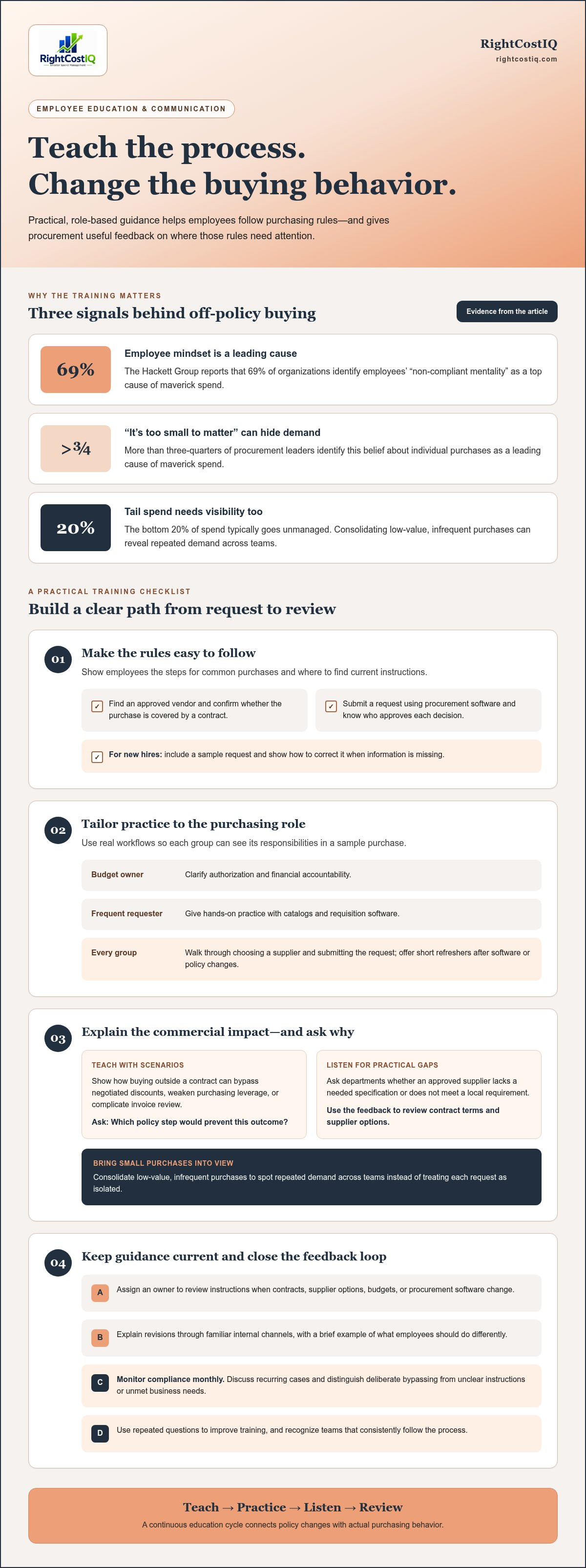
Role-based training helps employees follow procurement policies by showing them the steps for common purchases. Teach them how to find an approved vendor, confirm contract coverage, submit a request, and use procurement software. Explain who approves each decision and where to find current instructions. For new hires, include a sample request and show how to correct it when information is missing.
Training works better when it explains the commercial reason behind each control. According to The Hackett Group, 69% of organizations identify employees’ “non-compliant mentality” as a top cause of maverick spend. Use practical scenarios to show how buying outside a contract can bypass negotiated discounts, weaken purchasing leverage, or complicate invoice review. Ask employees to identify the policy step that would prevent each outcome.
Tailor training to purchasing responsibilities. A budget owner needs clarity on authorization and financial accountability; a frequent requester needs hands-on practice with catalogs and requisition software. Walk each group through a sample purchase, from choosing a supplier to submitting the request. Short refreshers can help employees apply revised procedures after software or policy changes.
For teams asking how to manage maverick spend, training should also uncover why employees turn to outside vendors. More than three-quarters of procurement leaders identify the belief that individual purchases are too small to matter as a leading cause. Ask departments about practical gaps, such as an approved supplier lacking a needed specification or failing to meet a local requirement. Procurement can use that feedback to review contract terms and supplier options.
That feedback is especially useful for tail spend, the bottom 20% of spend that typically goes unmanaged. Consolidating low-value, infrequent purchases can reveal repeated demand across teams. A clear tail-spend management approach helps procurement assess those purchases together instead of treating each request as isolated.
Keep policies current and training ongoing. Assign an owner to review instructions when contracts, supplier options, budgets, or procurement software change. Explain revisions through familiar internal channels, using a brief example to show what employees should do differently. Training is central to how to manage maverick spend because it connects policy changes with actual purchasing behavior.
Monitor compliance monthly and close the feedback loop. Discuss recurring cases directly, distinguishing deliberate bypassing from unclear instructions or unmet business needs. Use repeated questions to improve training, and recognize teams that consistently follow the process. This ongoing cycle clarifies expectations and gives procurement practical insight into where communication needs to improve.
2. What Is Maverick Spending?
Maverick spending means buying outside required approvals, approved suppliers, or negotiated contracts. It can happen when an employee bypasses a purchase order, exceeds an authorized budget, or buys from a vendor without checking existing terms. The issue isn’t simply that a purchase is small or unexpected. The key test is whether it follows the organization’s purchasing rules.
Set budgets and approval routes before employees make purchases. A manager can approve routine, budgeted requests, while procurement reviews new suppliers, contract exceptions, or higher-risk commitments. A $40 software tool and a $40,000 vendor contract may need different approval levels. Matching review to purchase risk helps keep controls proportionate and clarifies who owns each decision.
Procurement software can make those controls visible at the point of purchase. P2P automation and eProcurement tools can guide employees toward catalog-based orders from approved suppliers. P2P systems connect purchasing steps, while eProcurement catalogs focus on choosing approved items and vendors. The best fit depends on whether the gap is workflow control, supplier choice, or both.
Make supplier and contract details available where employees submit requests. A current preferred-vendor list should identify covered goods or services, applicable contract terms, and the process for exceptions. For example, an office manager buying supplies should be able to compare the approved catalog with an existing agreement before creating a purchase order. Involving business units in supplier selection can build shared ownership.
Off-contract purchases can increase costs by missing negotiated pricing or discounts. They can also fragment demand across suppliers, weaken sourcing leverage, and create extra invoice-reconciliation work. The Hackett Group reports that nearly 30% of indirect spend is off-contract. Rogue spend can therefore affect both financial performance and day-to-day procurement operations.
Use spend analysis to identify where this buying occurs. Compare purchase orders and invoices with approved supplier lists and contract records, then group transactions by category and vendor. Multiple suppliers providing the same service may signal fragmented buying. An invoice without a matching purchase order can indicate a purchase that bypassed the usual process.
Track the results against a consistent definition. If an organization records $5 million in total spend and $250,000 in noncompliant spend, its maverick spend rate is 5%. Reviewing vendor activity over 12 months can expose recurring exceptions and show whether contract implementation is working. Pair that review with supplier performance data, so procurement can distinguish a policy breach from a service issue that needs attention.
When an off-contract purchase reveals a better price or specification, treat it as useful information, not just a violation. Procurement can assess whether the contract needs renegotiation or another supplier should be considered. This feedback loop connects budgets, approvals, supplier performance, and spend visibility, making purchasing controls responsive to employee and business needs.
3. Definition of maverick spending
Maverick spend means payments for goods or services procured without proper approval or authorization. The definition depends on the organization’s purchasing rules, not the purchase’s size or the employee’s intent. A department might classify buying from an unapproved supplier as maverick spend, even when the item is routine. Another organization may focus on purchases above approval thresholds or orders placed outside active contracts.
Common causes include unclear policies, decentralized buying, missing approval workflows, and outdated supplier catalogs. An employee may not know that a preferred vendor already covers the required service. A rushed team may also use spot buying, an immediate, short-term purchase made without formal planning or predefined agreements. Each cause calls for a different response, from clearer guidance to faster approvals.
Tail spend and maverick spend are related, but they are not interchangeable. Tail spend describes low-value, infrequent purchases that collectively create substantial transaction volume. An approved $75 purchase from a preferred office supplier may count as tail spend without being maverick spend. The same purchase becomes maverick spend if it violates an approval rule or bypasses the organization’s approved purchasing route.
Intent doesn’t determine whether buying is compliant. An employee might find a new vendor offering a price 30% lower than the approved supplier. If the employee buys without required approval, the purchase is still maverick spend, even if the price appears attractive. Procurement can review the offer, compare specifications and terms, then decide whether to approve an exception or consider changing the contract.
Define the category before measuring it. Specify whether it includes unapproved vendors, off-contract purchases, orders above approval thresholds, missing receipts, or expenses charged to the wrong budget. For example, a purchase from a contracted supplier can still be noncompliant if it exceeds the employee’s authority. Clear criteria help finance and procurement classify the same transaction consistently.
Use spend analysis to test those criteria against actual purchasing records. Consolidate invoices, purchase orders, card statements, and contract data, then match suppliers and transactions to policy. Purchase Price Variance can show the difference between an off-contract amount and the price under an approved agreement. This analysis helps distinguish isolated exceptions from recurring patterns, such as departments purchasing the same service independently.
A useful definition supports action rather than labeling every unusual purchase as misconduct. When an exception appears, identify whether the cause was an approval bypass, a catalog gap, or a contract that failed to meet operational needs. That distinction guides the response: reinforce a policy, improve the procurement process, or reassess supplier terms. Consistent definitions also make later compliance reviews more meaningful.
4. Documenting purchasing policies and approval processes
A written purchasing policy turns broad expectations into specific actions. Define which suppliers are approved, when a purchase order is required, who can authorize exceptions, and how employees should document one-off purchases. Include practical examples: a routine catalog order follows the standard workflow, while a new vendor requires procurement review. Clear rules make compliance measurable and reduce disagreements about what counts as an exception.
Build approval routes around risk and budget ownership. A low-risk purchase can follow a streamlined approval path, while a new contract or strategic supplier receives closer review. Complex or slow processes can encourage employees to bypass purchasing controls. Remove redundant approval layers, clarify approver responsibilities, and let requesters see each requisition’s status so delays don’t push them toward off-process buying.
Document a separate process for legitimate one-off purchases. Specify when employees can use a purchasing card, what records they must provide, and how the expense connects to a budget or business need. A purchasing card can capture an unplanned purchase while preserving visibility; it shouldn’t become a way around supplier or approval rules. Define permitted use and review transactions against receipts and policy.
Policies should also explain how to handle off-contract discoveries. A department may find a local vendor with better pricing, a useful specification, or stronger service than the preferred supplier. Treat that purchase as a signal for review, not automatic proof of misconduct. Procurement can compare the offer with contract terms and supplier performance, then decide whether to renegotiate, add a supplier, or retain the existing agreement.
Use spend analytics to assess both compliance and purchasing behavior. Track the share of spend on-contract, purchases from unapproved suppliers, missing purchase orders, policy exceptions, and approval cycle time. These KPIs show whether controls are being followed and whether slow processes are creating friction. Review procurement compliance monthly, then investigate recurring exceptions by department, supplier, and purchase category.
Compare purchasing patterns with contract records and approved supplier lists. About 60% of organizations with centralized procurement always cross-check purchase orders against existing contracts to curb maverick spend. That comparison can reveal duplicate suppliers, recurring off-contract buying, and agreements employees cannot readily use. Record findings and assign an owner to each corrective action, such as updating a catalog or clarifying an approval rule.
Measure progress using consistent definitions and periods. Top-performing procurement teams achieve compliance rates above 90%, providing a useful reference point rather than a substitute for your baseline. Pair compliance with savings realization and exception trends: a higher on-contract rate matters most when negotiated terms are used and operational needs remain met. Monthly analysis helps distinguish improved behavior from purchases merely shifting into another category.
5. Spend visibility and transparency
Spend visibility starts with a dependable view of purchasing activity. Combine purchase orders, invoices, purchasing-card transactions, reimbursements, contracts, and accounting records. Match supplier names and transaction details across systems, then resolve duplicates and missing fields. Without this data foundation, a report may mistake a renamed vendor for a new supplier or miss purchases recorded outside procurement.
Establish shared categories before measuring compliance. Classify transactions by supplier, department, purchase type, contract status, budget, and approval path. Use the same definitions across finance and procurement, so each team interprets “off-contract” consistently. For example, a software subscription billed to a card should still be linked to its supplier, contract, and responsible department.
Next, calculate the maverick spend rate using a consistent formula: noncompliant spend divided by total spend, multiplied by 100. An example organization with $750,000 in noncompliant spend and $5,000,000 in total spend has a 15% rate. Keep contracted spend visible beside the result; the example organization records $4,250,000 in contracted spend.
A useful report explains where a rate comes from, not just whether it rose or fell. Show spend by category, supplier, department, and purchase channel, then flag missing purchase orders and vendors outside approved agreements. A spike in one category may reflect a contract gap, while repeated transactions across departments may reveal fragmented demand. Assign each finding to an owner for follow-up.
Review procurement compliance monthly. Compare each report with the previous period, examine new suppliers and subscriptions, and investigate recurring exceptions before they happen again. Monthly reviews also help distinguish a one-off operational need from a persistent process problem. Record the reason, corrective action, and responsible owner so the next review can show whether behavior changed.
Transparency should support decisions, not just audits. Share role-appropriate dashboards with budget owners, procurement, and finance, giving each group the fields it needs to act. A department manager may need category trends and open requests, while procurement needs contract utilization and supplier concentration. Clear links between transactions, budgets, and agreements make it easier to prioritize sourcing or policy changes.
Teams deciding how to manage maverick spend can use analytics to turn visibility into commercial insight. Compare off-contract transactions with negotiated terms, supplier performance, and category demand. An unexpected price or specification may point to a useful supplier or a contract that no longer fits business needs. Category cost benchmarking and analytics can support this assessment with category-level cost comparisons.
Strong reporting connects each purchase to its business context: who bought it, what they bought, which supplier fulfilled it, and whether an agreement applied. This traceable view helps organizations determine how to manage maverick spend by targeting the right response, from correcting data gaps to revising sourcing decisions. Start with reconciled records, consistent categories, and a monthly report that assigns specific follow-up actions.
RightCostIQ: Request For Proposal (RFP) Management and Negotiation Assistance
RightCostIQ helps organizations turn spend findings into stronger sourcing decisions through Request For Proposal (RFP) Management and Negotiation Assistance. When analysis reveals fragmented purchasing, weak contract adoption, or supplier terms that no longer fit operational needs, structured RFP support can help compare proposals and negotiate agreements aligned with requirements.
Procurement Category Cost benchmarking and Analytics can clarify how category costs compare with market pricing. Procurement and Vendor Performance Tracking Service supports ongoing supplier-performance reviews, while Price Risk Management and Tracking Service helps organizations assess exposure to price changes. These offerings are relevant when off-contract patterns point to sourcing or supplier-management issues rather than a need for employee training alone.
For support connecting spend analysis with sourcing and negotiation decisions, contact RightCostIQ or visit rightcostiq.com.
Make the next purchasing decision more visible
The next step is to turn spend visibility into a focused improvement plan. Select a category where purchasing data shows recurring exceptions, then determine whether the root cause lies in supplier terms, sourcing decisions, or contract performance. This focus helps procurement direct effort toward the issue with the clearest operational relevance.
When analysis points to sourcing or supplier-management needs, RightCostIQ offers Request For Proposal (RFP) Management and Negotiation Assistance, Procurement Category Cost benchmarking and Analytics, and Procurement and Vendor Performance Tracking Service. These capabilities can support a closer assessment of category costs, proposals, and supplier performance as you refine purchasing controls.
To discuss where additional procurement analysis may support your priorities, contact RightCostIQ about your spend management needs. A clear next step can help your team move from identifying purchasing gaps to making more informed sourcing decisions.
Frequently Asked Questions
What Is Maverick Spending?
Maverick spending is purchasing that bypasses an organization’s required approval or authorized buying arrangements. For example, an employee could renew software directly with a supplier even though policy requires procurement review before renewal. The defining issue is whether the purchase followed internal rules, not whether the employee had good intentions. The company’s written criteria determine which purchases count as noncompliant.
What is a maverick policy?
A maverick policy defines which purchasing actions are compliant and how exceptions are handled. It should name the policy owner, explain which purchases need review, and tell employees where to submit requests. For example, a department can route a renewal to procurement before agreeing to new terms. A useful policy also records how decisions are documented, so later reviews can distinguish an approved exception from an unauthorized purchase.
What are the main causes and risks of maverick spending?
Common causes include decentralized buying, unclear guidance, hard-to-access supplier information, and workflows employees find difficult to use. Seventy-five percent of organizations report a lack of self-service or guided buying tools as a leading cause. Risks include missed negotiated terms, fragmented supplier relationships, and weaker sourcing leverage. A pattern of purchases outside contracts may also indicate that approved suppliers or procurement processes aren’t meeting operational needs.
How can companies identify and measure maverick spend?
Start by defining which transactions count as noncompliant, then use the same scope for every reporting period. Calculate the rate as noncompliant spend divided by total spend, multiplied by 100. Compare records across purchasing channels and categorize transactions consistently. A 12-month review can reveal recurring patterns that a single-period snapshot might miss. Purchase Price Variance can also show the difference between off-contract prices and approved agreement prices.
What policies and approval thresholds reduce maverick spend?
Set approval thresholds according to purchase risk, budget authority, and commitment length. A routine reorder may need a simpler route than a new supplier relationship or a contract renewal with changed terms. Specify who can approve each decision and how exceptions are recorded. Also review cumulative commitments: several small orders to one supplier may create a larger obligation that warrants procurement oversight.
How can procurement improve preferred-supplier adoption?
Make preferred suppliers easy to find when employees begin buying. Put current catalogs, contract coverage, and ordering instructions in the purchasing workflow, and remove outdated supplier entries. Ask departments why they choose other vendors; recurring feedback about unavailable specifications or service gaps can guide contract changes. Procurement can then assess whether to improve the agreement, add a supplier, or clarify which needs the existing contract covers.
How should organizations handle exceptions and urgent purchases?
Create a defined exception route for urgent needs, with a named approver and a record of the business reason. If an emergency purchase uses a purchasing card, capture the supplier, category, receipt, and budget allocation for later review. Procurement can then determine whether the exception was isolated or signals a recurring coverage gap. This approach preserves an audit trail without treating every time-sensitive request as routine buying.
What are the costs and savings of reducing maverick spend?
Companies can lose 10 to 20% of their savings through maverick spending, as off-contract purchases bypass negotiated value. Bringing tail spend under management can yield savings of 5-15%. Actual opportunity depends on how much spending is unmanaged, how fragmented supplier demand is, and whether negotiated agreements fit operational requirements. Measure recovered contract value alongside compliance, so reported savings reflect purchasing behavior rather than a paper-only change.


