

What if the lowest vendor quote isn’t the best value, or even the most competitive? When suppliers price different scopes, units, service levels, and commercial terms, a headline comparison can hide the real cost. Learning how to benchmark vendor pricing starts with making those differences visible, not simply ranking the quoted totals.
It’s reasonable to want a clear answer about whether a price is fair. But market data can be outdated or poorly matched, and a gap between quotes doesn’t explain itself. A defensible benchmark gives procurement teams evidence to investigate the right differences, negotiate with focus, and explain decisions to stakeholders.
This guide lays out a practical method for building an apples-to-apples comparison: define the scope, normalize pricing and terms, choose relevant market references, and assess what the remaining gaps mean. You’ll also learn how should-cost analysis can help test whether a quote is reasonable, and how to document findings as part of a sourcing and negotiation decision.
Key Takeaways
- Learn how to benchmark vendor pricing by aligning scope, units, and commercial terms before comparing quoted totals.
- Choose reference data based on relevance, recency, comparability, and transparency. Treat price gaps as signals to investigate, not proof.
- Use validated variances to decide whether to accept, clarify, negotiate, or reopen sourcing, prioritizing the strongest evidence.
- Document benchmark assumptions, quote records, and sourcing decisions so comparisons can be reviewed and refreshed consistently.
- Use should-cost analysis to assess whether a quote is reasonable, then connect findings to negotiation and savings tracking.
What Vendor Pricing Benchmarking Reveals, and What It Cannot Prove
Vendor pricing benchmarking compares a supplier’s quoted price with reference data relevant to the purchase and comparable in scope and terms. The reference might be a competing quote, a prior purchase, market information, or a cost estimate. The comparison helps procurement teams decide whether to accept a quote, investigate a variance, renegotiate, or seek alternatives. It does not make that decision automatically, and it doesn’t establish that a supplier has overcharged.
A reliable vendor price benchmark compares a quote with relevant reference data on a like-for-like basis and makes the limits of that comparison clear. Benchmarking describes a price in relation to a reference point, not in isolation. A quote above an internal historical price may warrant review, but differences in scope, timing, or commercial conditions could explain the gap.
Price benchmarking also differs from supplier performance measurement, total procurement performance, and cost estimation. A price comparison doesn’t show whether a supplier meets delivery expectations or provides dependable service. Nor does one quote establish whether the wider sourcing process achieved its objectives. Benchmarking in procurement can cover broader comparisons of business practices and performance; this section focuses specifically on the evidence behind vendor prices.
Price benchmarking versus should-cost analysis
Price benchmarking compares observed prices with relevant reference prices, such as comparable quotes or historical transactions. A should-cost model takes a different route: it estimates a reasonable price using raw materials, labor, freight, overhead, and margin. The first asks how a quote compares with prices observed elsewhere; the second estimates what those cost components could support.
Use both perspectives to frame questions, not to declare a verdict. If a quote is higher than a relevant market reference and a should-cost estimate, procurement has grounds to examine the assumptions and cost drivers. Neither comparison alone proves the supplier’s actual costs or establishes a universal fair price.
When a vendor price comparison is decision-ready
A comparison becomes more useful when the quotes align on scope, units, timing, and commercial conditions. For example, two service quotes may cover the same deliverable but differ in included support or contract duration. Until those differences are accounted for, the price gap is a preliminary signal, not negotiation-ready evidence.
Before acting, assess whether the reference matches the purchase, whether its date is relevant, and whether its underlying assumptions are transparent. Record unresolved differences instead of hiding them in an adjusted total. That gives stakeholders a clear basis for deciding whether to accept, clarify, negotiate, or reopen sourcing, while preserving uncertainty where the evidence is incomplete.
Benchmark quality also shapes how confidently a team can act. A comparison built from weakly matched data can still identify a question worth investigating, but it shouldn’t be presented as proof of a savings opportunity or supplier misconduct. Teams reviewing procurement intelligence options can refer to RightCostIQ’s pricing page.
How to Normalize Vendor Quotes Before Comparing Prices
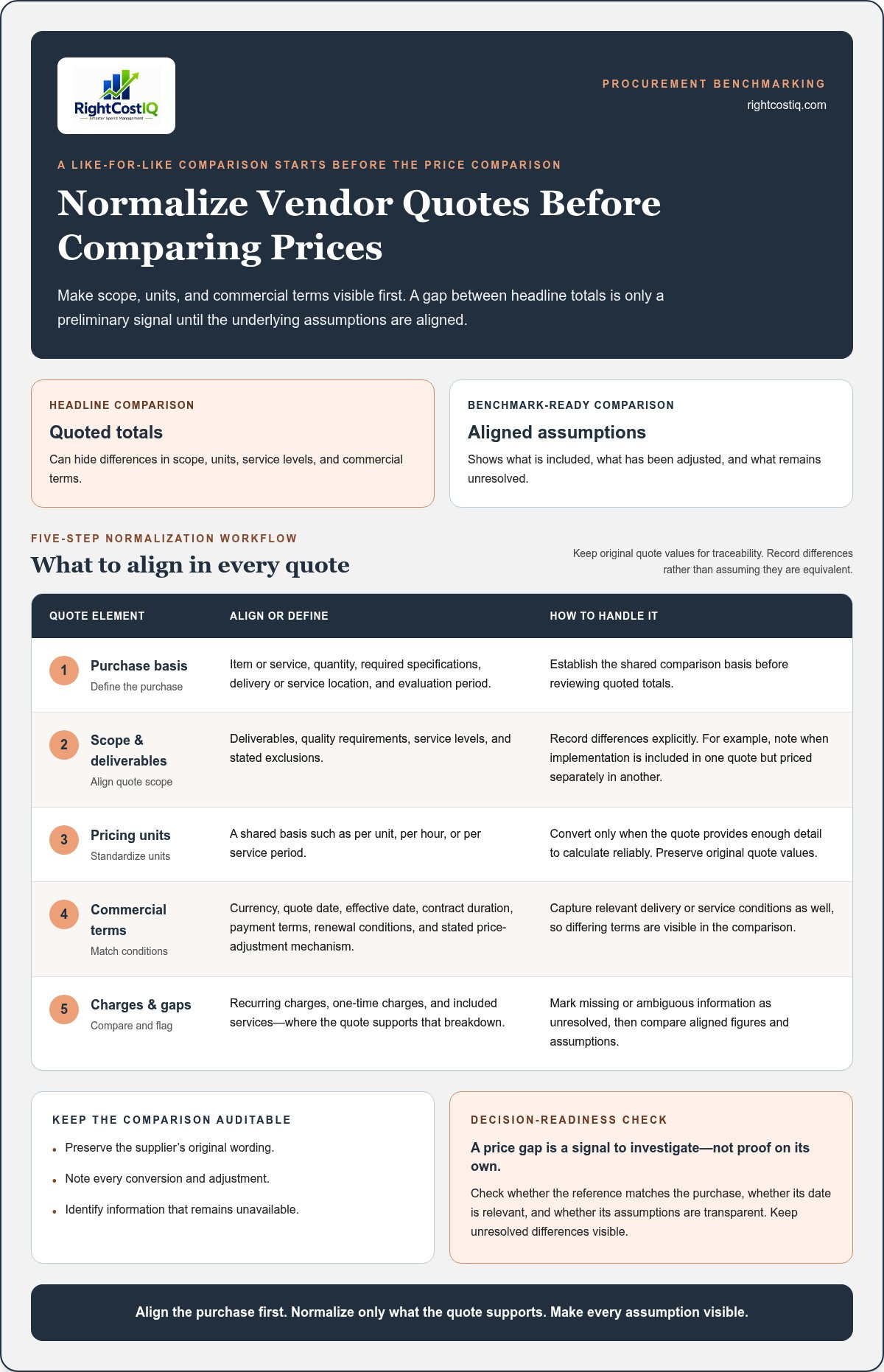
Before deciding which quote is more competitive, convert each proposal into a comparison built on the same purchase assumptions. This workflow makes differences visible and helps you learn how to benchmark vendor pricing without treating missing details as equivalent terms.
- Define the purchase. Specify the item or service, quantity, required specifications, delivery or service location, and evaluation period. This establishes the comparison basis before reviewing the quoted totals.
- Align quote scope. Match deliverables, quality requirements, service levels, and stated exclusions. If one vendor includes implementation and another prices it separately, record that difference instead of comparing headline totals.
- Standardize units. Convert prices to a shared basis, such as per unit, per hour, or per service period, only when the quote provides enough detail to calculate the conversion reliably. Keep the original quote values for traceability.
- Match commercial terms. Record currency, quote date, effective date, contract duration, payment terms, renewal conditions, and any stated price-adjustment mechanism. Capture relevant delivery or service conditions as well.
- Compare and flag gaps. Separate recurring charges, one-time charges, and included services only where the quote supports that breakdown. Mark missing or ambiguous information as unresolved, then compare the aligned figures and assumptions.
Align scope, units, and included deliverables
A shared unit is useful only if the underlying scope is comparable. For example, converting two service proposals to a monthly rate won’t make them equivalent if one includes ongoing support and the other doesn’t. Document the quantity, specification, service level, included work, exclusions, and assumptions used in each adjustment. The World Bank's perspective on price benchmarking also underscores why normalization matters when using price data to support procurement decisions.
Keep a clear audit trail: preserve the supplier’s original wording, note every conversion, and identify information that remains unavailable. This lets stakeholders reproduce the comparison and distinguish verified differences from assumptions. Don’t fill gaps by assigning a zero value or assuming a service is included.
Match timing and commercial conditions
Prices from different periods may reflect different contract windows or market conditions. Capture when each quote was issued, when pricing takes effect, and how long the quoted terms apply. Compare payment schedules, renewal provisions, and adjustment terms only when the supplier has disclosed them. If a material condition is unclear, label the comparison provisional until it can be resolved.
Once quotes are normalized, use a Should Cost Analysis approach as a separate reasonableness cross-check. Its model estimates a reasonable price using raw materials, labor, freight, overhead, and margin. Treat that estimate as an additional analytical view, not a substitute for quote details or a reason to silently alter them.
The output should be more than a ranking. Preserve the normalized comparison alongside its source quotes, assumptions, and unresolved questions. That record gives the next review a consistent basis and helps procurement focus follow-up on differences that could change the decision.
How to Judge Benchmark Quality and Interpret Vendor Price Gaps
A price gap is only as useful as the reference behind it. Benchmark quality depends on source relevance and a like-for-like comparison. Before treating a variance as negotiation evidence, assess whether the source matches the purchase, how current it is, whether its sample is comparable, and whether its assumptions are transparent. This is central to how to benchmark vendor pricing without mistaking a rough signal for a proven savings opportunity.
Choose a reference source that fits the purchase
Start with the closest reliable reference, not the most convenient one. Internal history can be strong evidence when the earlier purchase had similar scope and commercial conditions. Competing quotes are useful only after their included scope is aligned. Market information provides broader context, but it isn’t automatically a definitive target for a specific transaction.
Use a should-cost estimate as another perspective, not as a replacement for observed prices. The model estimates a reasonable price using raw materials, labor, freight, overhead, and margin. Consider whether its assumptions fit the purchase before using the estimate to question a quote.
Use a compact comparison record to make each reference’s strengths and limits visible:
Quote value: The supplier’s price as quoted, with its currency and applicable period.
Comparability: How closely the source matches the purchase scope, unit, timing, and commercial conditions.
Unresolved caveats: Missing details, assumptions, source limitations, or differences that could affect the comparison.
Separate a price signal from its possible causes
A higher price doesn’t automatically indicate an unjustified premium. It may reflect additional deliverables, a different service level, contract duration, delivery conditions, or a quote issued under different market conditions. Test the variance against those factors before drawing conclusions. If the available evidence can’t explain the gap, record that uncertainty rather than presenting a guess as fact.
For example, if a current quote exceeds a prior purchase, first establish whether the earlier transaction covered the same requirements and period. If the scope differs, the price gap is a prompt for further analysis, not yet a valid measure of overpricing. If scope is comparable but the historical price is old, its age limits how strongly it can support negotiation.
Distinguish the observed variance from the decision that follows. A price above a relevant reference can justify clarification or investigation, but a demonstrated savings opportunity requires evidence that the compared offers are genuinely equivalent and that a feasible alternative exists. A lower quote with different inclusions may not represent equivalent value.
Rank the evidence before acting: close, current comparisons support stronger questions; older or less transparent references should carry less weight. Document both the explanation and the remaining unknowns. That record gives stakeholders a defensible basis for deciding whether to negotiate, seek clarification, or gather better market evidence.
Turn Vendor Pricing Benchmarks into Negotiation Decisions
A validated price variance is an input to a decision, not a negotiation demand by itself. Match the response to the evidence: accept a defensible quote, clarify an unexplained difference, negotiate a supported gap, or reopen sourcing when the current offer no longer meets the requirement. Prioritize issues by evidence strength, business relevance, and unresolved commercial differences. This turns how to benchmark vendor pricing into a practical path from analysis to action.
- Accept when the quote is supportable against relevant evidence and meets the business requirement.
- Clarify when a material variance or commercial term remains unexplained.
- Negotiate when comparable evidence supports a focused request for a price or term review.
- Reopen sourcing when the offer is materially misaligned or alternatives need to be tested.
Build a concise case for each discussion point: identify the quoted item or service, state the comparison basis, show the benchmark and its date, and disclose assumptions or limitations. Be specific about the response you want, such as an explanation of a price adjustment, a revised quote for aligned scope, or clarification of an included deliverable. RightCost IQ’s Negotiation Coaching includes an AI-powered negotiation coach for role-play and strategy testing.
Build a negotiation case from benchmark evidence
Lead with facts the supplier can assess. State what the quote covers, which reference you used, and where the comparison may not be exact. If a should-cost model indicates that a price increase merits review, use its estimate to frame questions about the cost drivers included in the model. Don’t present the estimate as a guaranteed market price or as proof of the supplier’s costs or obligations.
Keep the request proportionate to the evidence. A strong, like-for-like reference can support a direct request to revisit pricing. A weaker or incomplete comparison is better used to seek an explanation or additional detail. This distinction keeps the discussion credible and focused on resolving the variance, rather than defending assumptions the data cannot support.
Document decisions and verify outcomes
After the discussion, record the outcome, decision rationale, accountable owner, and any contract or sourcing action. Preserve the original benchmark and quote so the team can compare the result against the same scope and assumptions. A revised offer is not a realized saving by itself. Verify the agreed terms against the executed agreement and, where applicable, purchasing or invoice records before recording savings.
If the evidence points to competitive sourcing, connect the benchmark to a defined RFP process, with comparable requirements and evaluation criteria. RightCost IQ’s RFP Workflow provides an integrated RFP portal that manages communications in a single data-driven environment. Tracking the baseline, decision, owner, and verified result creates a defensible record for future negotiations and review.
For a structured starting point for a pricing review, review the procurement pricing diagnostic.
Make Vendor Pricing Benchmarking a Repeatable Procurement Control
A benchmark creates lasting value when the team can reproduce it, explain its assumptions, and review what happened after a sourcing decision. Assign an owner for quote records, benchmark inputs, and decision documentation. Define who refreshes the comparison when a new sourcing event begins, a contract approaches renewal, or relevant market conditions change. That turns how to benchmark vendor pricing from a one-time exercise into a consistent procurement control.
Create a traceable benchmark record
Keep the evidence and the decision together. For each comparison, retain the quote date, scope, units, currency, commercial assumptions, reference source, and decision. Preserve caveats, such as incomplete terms or differences in included services, so a later reviewer can understand what the benchmark could and couldn’t establish. Assign an accountable owner and record when the comparison should be revisited.
Close the loop after action. Savings Tracking and Verification connects a documented sourcing or negotiation decision with outcome review. Compare results with the original baseline on a consistent scope, and distinguish an agreed price change from a verified result. The record then supports future renewals and helps the team assess whether previous assumptions remain relevant.
Apply procurement intelligence to the workflow
Repeatable benchmarking depends on organized spend information as well as disciplined records. AI-driven spend classification analyzes supplier names, item descriptions, invoice data, and purchase history to organize spend into categories, sub-categories, and supplier groups. This turns spend data into structured procurement intelligence and savings recommendations. Should Cost Analysis provides a model-based estimate using raw materials, labor, freight, overhead, and margin. Its data-backed insights can help procurement review vendor price increases, with assumptions documented rather than treated as a definitive market price.
RFP Workflow can connect benchmark evidence to a structured sourcing process. Market Shift Alerts use cost-driver thresholds to flag relevant market changes for review, while category-level price-impact sensitivity analysis supports evaluation of cost changes. These capabilities help teams identify when a comparison needs refreshing and where a price movement could affect category decisions. A category management framework can help teams place vendor comparisons in the wider context of category priorities.
To make the workflow useful, establish clear review triggers and ownership rather than relying on an informal spreadsheet update. A benchmark should be refreshed when its source data, purchase requirements, or commercial context no longer supports the decision it informs. That discipline keeps older reference points from silently becoming current targets and gives stakeholders a documented basis for action.
For teams assessing how to strengthen procurement benchmarking, review the free diagnostic as a starting point for identifying a practical next step.
Make Your Next Pricing Decision More Defensible
Use your next sourcing or renewal event to establish a benchmark process the team can repeat. A clear owner, documented assumptions, and a scheduled outcome review turn procurement analysis into organizational knowledge, so future decisions start with a stronger evidence base. The goal of learning how to benchmark vendor pricing is not to chase the lowest quote; it’s to make a decision you can explain and improve.
RightCost IQ connects that work across the procurement cycle. Should Cost Analysis uses data-backed models to estimate reasonable prices. Negotiation Coaching provides an AI-powered coach for role-play and strategy testing, while Savings Tracking and Verification connects procurement actions with outcome review. These capabilities help teams move from assessing a variance to acting on it and evaluating the result.
Choose one upcoming vendor decision and map the evidence, decision owner, and verification step before negotiations begin. Start your free diagnostic to identify a practical next step for your procurement process. A repeatable method gives your team a clearer basis for the next pricing decision.
Frequently Asked Questions
How often should vendor pricing benchmarks be updated?
Update a benchmark when a sourcing event, renewal, quote change, or relevant market shift makes its reference less representative. Set the cadence around the category’s purchasing cycle and the availability of usable data, rather than applying a universal interval. For a category with infrequent purchases, a trigger-based review may be more useful than a calendar reminder. Keep the original date and assumptions so teams can distinguish current evidence from historical context.
Can I benchmark vendor pricing without access to industry data?
Yes. Comparable internal purchase records and supplier quotes can provide a useful starting point. For example, a buyer can compare recent quotes for the same service using its own sourcing files, while clearly identifying the result as an internal comparison rather than a broad market benchmark. If you’re learning how to benchmark vendor pricing without industry data, document gaps in the evidence and use the comparison to guide questions, not to claim a definitive market rate.
What should I do if a vendor will not provide a detailed price breakdown?
Work with the details provided, but don’t invent a breakdown or treat unclear items as equivalent. Identify which requested deliverables, terms, or charges can’t be evaluated from the quote, then raise focused clarification questions through the sourcing discussion. For example, if a proposal lists a combined service fee, note that individual components can’t be compared separately. Record that limitation and decide whether clarification, a revised request, or another response is needed.
How do I benchmark a renewal quote against an existing contract?
Use the current contract as your baseline, then check whether the renewal retains the same deliverables, quantities, service levels, and pricing basis. A renewal that adds support or changes a service period shouldn’t be assessed as a simple price increase. Review the relevant contract records and any suitable external reference, and make scope changes visible in your analysis. This helps stakeholders understand which portion of the movement reflects changed requirements rather than price alone.
What happens if two credible benchmarks show different prices?
Keep both references visible while you investigate why they diverge. One may reflect a different purchasing period, supplier group, or set of assumptions. For example, a market dataset may cover a broader category than your specific requirement, while an internal quote reflects a narrower scope. Assess which source best represents the transaction and explain your selection. If neither is a close match, state that the available evidence doesn’t support one definitive benchmark.
Should I always choose the vendor with the lowest benchmarked price?
No. A low price is meaningful only if the offer meets the required specification and commercial conditions. Consider a lower quote that excludes a required deliverable: selecting it may not meet the business need, even if its headline price looks favorable. Use the benchmark to frame the trade-offs and document the rationale for the selected offer. Don’t claim that a lower price represents better overall value unless the comparison supports that conclusion.
How can I explain a vendor price benchmark to non-procurement stakeholders?
Explain the finding as a short decision brief: what purchase was assessed, what reference informed the comparison, and what action you recommend. Use a small table or a concise visual to show the quote beside the reference, then call out any assumption that could change the interpretation. Separate the observed difference from your conclusion. This format helps stakeholders understand the evidence and approve a next step without needing to review every source document.


