

A lower total doesn’t always mean a better deal. When a vendor quote bundles labor, materials, overhead, and risk into one figure, procurement teams can’t see what drives the price or whether competing bids are truly comparable. Vendor cost breakdown analysis turns that total into evidence, but only when teams assess assumptions consistently rather than treating every variance as a negotiation target.
If you’ve received quotes with different labels, levels of detail, or cost assumptions, the challenge is familiar: compare like with like without undermining a supplier relationship. A structured review helps separate explainable market movement from items that need clarification, validation, or a sourcing response.
This guide shows how to build a consistent breakdown framework, examine cost elements against relevant benchmarks, and identify assumptions that merit follow-up. You’ll also learn how to translate findings into targeted negotiations, sourcing choices, or ongoing price monitoring. The goal isn’t to demand an arbitrary discount. It’s to connect cost drivers to decisions, using should-cost analysis, category benchmarking, and RFP workflows when they add useful evidence.
Key Takeaways
- Tailor cost categories to the purchase, using materials, labor, overhead, freight, and margin only where they apply.
- Use a comparison table to record scope, units, exclusions, assumptions, and evidence status before comparing vendor quotes.
- Apply vendor cost breakdown analysis through a repeatable workflow, from defining the decision to choosing a sourcing or monitoring action.
- Connect validated cost details to should-cost models and category benchmarks to support ongoing procurement decisions.
Vendor Cost Breakdown Analysis: What It Reveals Beyond a Quote Total
Vendor cost breakdown analysis separates a quoted total into relevant cost elements. This view helps procurement understand what the price covers, how the supplier has grouped its costs, and which assumptions shape the offer.
A total can conceal differences that make bids difficult to compare. One quote may include freight and installation, while another excludes them. Suppliers may also use different units, service levels, or time periods. Without checking these details, a lower total can look more attractive even when it covers less. A disciplined approach to cost analysis principles starts by defining what each price includes before drawing conclusions.
Transparency is evidence, not a verdict. A breakdown doesn’t prove that a supplier is overcharging, and it can’t guarantee savings. It gives procurement a clearer basis for deciding whether to validate an assumption, request clarification, compare equivalent offers, or leave the price unchanged. That distinction keeps supplier discussions focused on facts rather than arbitrary discount demands.
What questions should a vendor cost breakdown answer?
Start with three questions: What does the quoted price cover? How are the price elements grouped? Which assumptions materially affect the total? Procurement can assess information already documented, such as quantities, units, inclusions, and exclusions. If a cost basis or scope detail is missing, mark it as unresolved and seek supplier clarification rather than treating an estimate as verified evidence.
The answers can inform a benchmark, sourcing decision, or negotiation, but they don’t dictate a predetermined outcome. A supported cost increase may warrant monitoring or acceptance; an unexplained assumption may call for a targeted question.
Cost breakdown analysis and should-cost analysis are related, not identical
A breakdown presents the vendor’s stated price components. A should-cost model estimates what a product or service should reasonably cost based on raw materials, labor, freight, overhead, and margin. The two views answer different questions: one shows how the supplier has presented its price, while the other provides a reference point for assessing reasonable cost.
Use them together carefully. If categories or assumptions don’t align, a direct comparison can create false precision. First identify where the views differ, then determine whether the gap comes from scope, evidence, or a modeling assumption. Data-backed should-cost analysis can provide a reference for evaluating supplier pricing alongside the vendor’s own cost detail.
For example, if a service quote lists labor as a single line, confirm the quoted scope and units, then identify which labor assumptions remain unanswered. That doesn’t establish that the charge is unreasonable. It defines the next useful step: clarify the basis, compare it with a like-for-like benchmark, or document why the quote is acceptable.
The result is a decision record, not just a spreadsheet of prices. Separating stated components from assumptions and unanswered questions gives teams a consistent foundation for comparison and action.
Which Cost Drivers Belong in a Vendor Cost Breakdown?
A useful template creates consistency without forcing every purchase into the same cost model. Include only categories relevant to the transaction and supported by the quote or other evidence. A physical product may show materials and freight; a service may show labor and allocated overhead. In each case, record the scope, unit, pricing period, exclusions, and assumptions beside the component. These fields preserve context and distinguish a stated figure from an unverified basis.
Category labels are comparable only when the underlying scope, units, period, and assumptions align. This prevents a familiar label from creating false equivalence. For example, “labor” could refer to different roles, quantities, or service levels across two bids. In a vendor cost breakdown analysis, preserve those distinctions instead of treating matching labels as proof that the costs represent the same thing.
- Materials: Record the items or inputs covered and the associated quantity or unit, if stated.
- Labor: Capture the work or roles included, along with the units or period used in the quote.
- Overhead: Note whether it’s separately stated, allocated, or included in a bundled charge.
- Freight and margin: Include these as distinct components when the vendor identifies them.
- Quote boundaries: Track taxes, optional services, exclusions, and assumptions separately.
Separate direct inputs from allocated or bundled costs
Direct materials and labor relate to identifiable inputs or work described in the offer. Overhead is an allocation, and suppliers may present its basis differently. Preserve the vendor’s own description rather than reclassifying an amount as a direct cost. If the quote states an allocation method, record it. If several costs appear as one bundled line, flag the lower visibility and note what the line includes or leaves unclear. A bundle isn’t automatically unreasonable or incorrect; it simply limits component-level comparison until its basis is understood.
Document freight, margin, and quote boundaries
Freight can be a separate charge, included in another line, or treated differently across offers. Record only what the quote identifies; don’t assume a standard treatment. If margin is stated or requested, capture it as presented without imposing a universal acceptable percentage. Keep taxes, optional services, and exclusions distinct from the core quoted scope so reviewers can see which differences affect the comparison.
For a shipment-based purchase, one quote might show freight separately while another includes it in a bundled price. Record both presentations and identify the unanswered question: does each offer cover the same delivery scope? Don’t estimate a missing freight amount or silently move it into another category. Mark the evidence status and clarify the basis before comparing totals.
This evidence-first structure aligns with the general discipline of reviewing cost elements described in the Federal Acquisition Regulation on Cost Analysis. The federal guidance applies to federal procurement, but its focus on examining cost elements can inform a broader review framework. A consistent template makes assumptions visible, supports defensible comparisons, and clarifies what to validate next.
How to Compare Vendor Cost Breakdowns Without False Equivalence
A disciplined comparison starts with the basis of each offer, not its headline total. Build a comparison matrix that keeps commercial scope and evidence quality visible alongside cost components. For each vendor, record the same fields:
- Scope: Deliverables, specifications, service coverage, and delivery terms included.
- Units and period: Quantities, pricing units, and the time period covered.
- Cost elements: Components stated by the vendor and any bundled lines.
- Assumptions: Conditions or allocation bases that shape the quoted amount.
- Exclusions: Items, services, or charges outside the offer.
- Evidence status: Whether a detail is documented, derived through a supported conversion, missing, or awaiting clarification.
A lower headline quote may not represent equivalent value if it covers a narrower scope, different units, or unpriced exclusions. Keep observed differences separate from explanations that still need supplier clarification. For example, note that a quote excludes a service if the document says so. If the quote is silent, mark coverage as unclear rather than assuming it is excluded or included.
Normalize scope, units, and time periods before comparing
Check quantities, specifications, delivery terms, and service coverage side by side. Convert units or periods only when the source information supports a reliable calculation and the underlying scope matches. If a quote uses a different unit or leaves a key quantity unstated, preserve the original figure and flag the mismatch. Don’t fill gaps with estimates, since that can make an uncertain comparison look precise.
After these checks, classify each comparison as aligned, conditionally comparable, or not comparable. That status makes the limits of the analysis explicit. A conversion may align units while leaving differences in service levels unresolved, so document both the adjustment and any remaining gap.
Use should-cost and market context as reference points
Where the category supports it, compare stated cost drivers with a documented should-cost estimate and relevant category-level benchmarks. These references add context, but they don’t replace quote validation. A variance is a prompt to investigate the inputs, assumptions, and timing behind the comparison, not automatic proof that a vendor’s price is unreasonable.
For instance, if a component differs from a benchmark, check whether the offers share a comparable specification, volume basis, and period. If they do, the variance may support a focused clarification or negotiation question. If they don’t, record the limitation and avoid presenting the benchmark as a like-for-like target. Data-backed should-cost analysis can help establish a reference point, while category benchmarking can frame broader sourcing decisions.
In vendor cost breakdown analysis, a useful comparison isn’t the one with the most normalized figures. It’s the one that shows which conclusions are supported, which depend on assumptions, and which need more evidence before procurement acts.
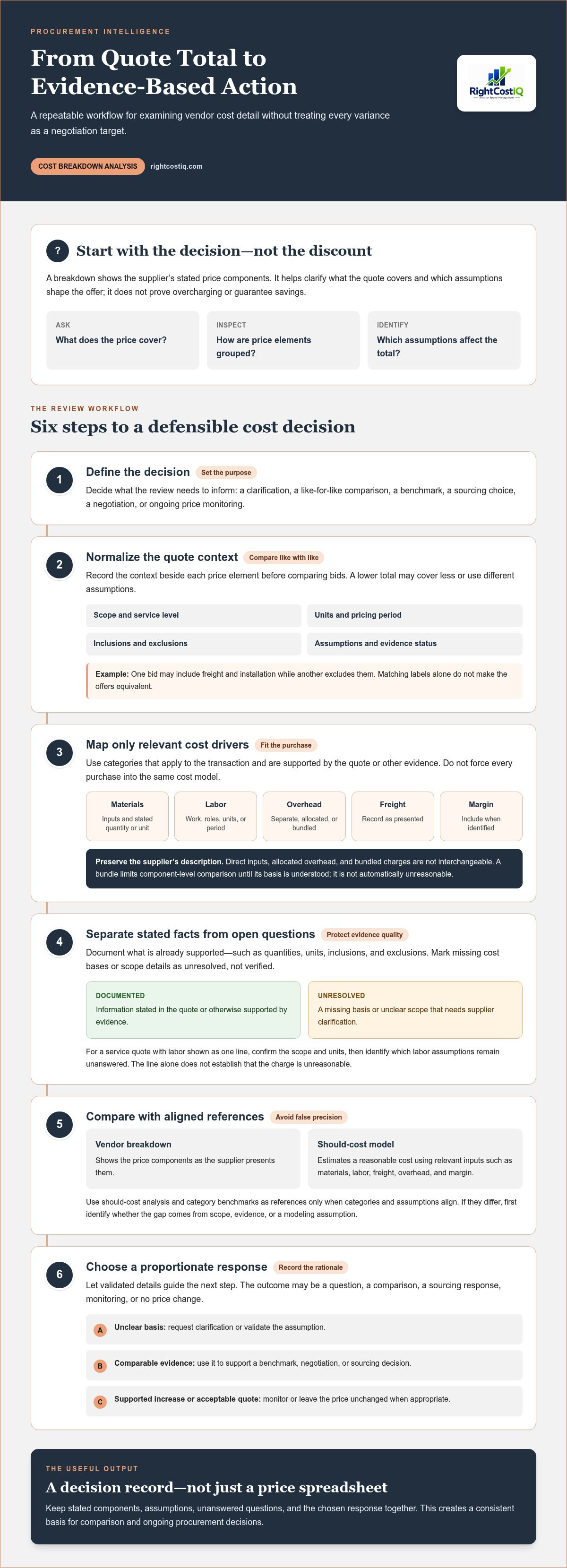
A Repeatable Workflow for Requesting and Using Vendor Cost Detail
A repeatable workflow makes cost review easier to explain, audit, and apply. It also gives suppliers a clear reason for each information request. In vendor cost breakdown analysis, request only the detail needed for the decision, record how evidence is assessed, and preserve communications and revisions throughout the sourcing process.
- Define the decision. Identify whether the review will support a renewal, bid comparison, price-change assessment, or sourcing decision. Set the scope and criteria before requesting additional detail.
- Request structured information. Specify the relevant items, units, period, and cost categories. Explain how procurement will use the information, such as comparing equivalent offers or evaluating a stated price change.
- Validate the evidence. Classify each input as documented, supplier-explained, assumed, or unresolved. Keep the source and date of each clarification with the record.
- Compare on a consistent basis. Align scope and units where evidence supports it. Preserve mismatches and open questions rather than filling gaps with estimates.
- Select an action. Choose clarification, benchmarking, negotiation, or a broader sourcing review based on what the evidence supports. Record the rationale and next owner.
Request structured information with clear scope
Make the request specific to the purchase: identify the items or services, units, relevant period, and cost categories needed to evaluate the decision. Invite the supplier to identify bundled charges, assumptions, and exclusions in a format they can support. This creates useful detail without demanding a breakdown that misrepresents how the supplier calculates its offer. For an RFP, an integrated RFP portal can keep supplier communications in a data-driven workflow.
Validate, assign owners, and convert findings into action
Classify each input as documented, supplier-explained, assumed, or unresolved. Then assign each open question to the procurement lead or relevant subject-matter owner, such as an engineering or operations stakeholder. Keep the question, response, supporting evidence, and any revised quote together so the review remains traceable. Once gaps are assessed, choose an action that fits the evidence, not a preset savings target.
For example, documented scope differences may call for a corrected comparison, while an unexplained cost assumption may warrant a focused supplier question. A supported variance could inform negotiation or benchmarking; persistent uncertainty may justify a sourcing review. Close each action by recording the decision, its evidence basis, and any monitoring required. This helps later reviewers distinguish changed market conditions from changed assumptions.
To assess where a structured procurement review could strengthen your current process, explore procurement opportunities.
Turn Vendor Cost Breakdown Analysis into Procurement Intelligence
A vendor cost breakdown becomes more valuable when it informs decisions beyond a single quote. A one-off discrepancy may need supplier clarification; recurring cost patterns across a category may warrant benchmarking, cost modeling, or a sourcing strategy review. This distinction helps procurement focus effort where it can improve decision quality, without treating every variance as a savings target.
Use verified cost details to build category context over time. Compare consistent purchase information, document differences in coverage or assumptions, and identify which cost drivers deserve monitoring. Category-level price-impact sensitivity analysis can help teams examine exposure to changes in relevant drivers. It supports scenario assessment, not a guaranteed forecast or outcome. These findings can inform category management, including where to direct analysis and sourcing attention.
Use analysis to prioritize the next procurement decision
Separate a question about one supplier’s quote from a pattern across multiple purchases or vendors. The first may call for clarification; the second may point to a category-level issue worth examining through market context or a sourcing review. Category benchmarking can frame the decision, while a documented should-cost estimate provides a separate reference for evaluating stated inputs. Keep evidence limits visible so a trend or variance prompts investigation rather than an automatic conclusion.
What RightCostIQ contributes to cost intelligence
RightCostIQ connects cost detail to broader procurement intelligence through Should Cost Analysis and category cost benchmarking. Data-backed should-cost insights help teams challenge unjustified price increases, while category-level benchmarking provides context for evaluating supplier and purchase data. AI-driven spend classification analyzes supplier names, item descriptions, invoice data, and purchase history to organize information into categories, sub-categories, and supplier groups.
Where the evidence supports action, RightCostIQ also provides one-click actionable savings opportunities and category-level price-impact sensitivity analysis. These capabilities help teams identify potential next steps and examine category exposure without presuming that every finding will produce savings. A cost breakdown remains one input: procurement still needs to assess scope, evidence, and business priorities before deciding whether to clarify, negotiate, benchmark, or monitor.
For a practical next step, use Should Cost Analysis to connect vendor-stated costs with a should-cost reference. To explore procurement opportunities and consider where further analysis may help, view the diagnostic.
Make Your Next Procurement Decision More Evidence-Led
Better procurement decisions depend not on collecting more detail for its own sake, but on connecting verified cost evidence to a defined action. Treat vendor cost breakdown analysis as an ongoing input: revisit assumptions when scope or market conditions change, and use category patterns to decide where closer review can matter. Assign an owner to track open questions and review findings at relevant sourcing milestones. This keeps supplier discussions grounded in evidence while supporting constructive commercial relationships.
RightCostIQ brings cost evidence into a wider procurement intelligence process. Data-backed should-cost insights can help evaluate price increases; one-click actionable savings opportunities support prioritization; and the integrated RFP portal centralizes supplier communications in a data-driven environment. These capabilities inform decisions, but they don’t guarantee a specific savings result.
Identify where your procurement data could support stronger sourcing, benchmarking, or price reviews. Explore procurement opportunities and take a practical next step. With clearer evidence and focused follow-through, your team can move forward with confidence.
Frequently Asked Questions
What is vendor cost breakdown analysis?
Vendor cost breakdown analysis examines the components and conditions behind a supplier’s quoted price. It can help answer practical questions such as whether a service fee includes implementation or whether a quoted item covers the required specification. The analysis gives procurement a clearer basis for review, but it doesn’t establish that a price is unfair or guarantee savings. Use the findings to decide what needs clarification before approving, negotiating, or comparing an offer.
Is vendor cost breakdown analysis the same as should-cost analysis?
No. A vendor breakdown records how a supplier presents its price, while a should-cost model develops an estimate from relevant cost drivers. For example, if a supplier groups several inputs into one charge, a should-cost estimate can provide a separate reference for assessing that category. The comparison is most useful when assumptions and scope are aligned. A difference signals a question to investigate, not automatic evidence of overpricing.
How do you request a cost breakdown from a vendor?
Explain the procurement decision the information will support, then request detail tailored to that purchase. For a renewal, you might ask the vendor to identify which quoted components changed and what assumptions shaped the revision. Use consistent request fields across suppliers where practical, but allow vendors to describe their own cost groupings. Save the request and response with the sourcing record so reviewers can trace how the information informed the decision.
What should be included in a vendor cost breakdown?
Include only cost categories that apply to the purchase and can be supported by the quote or supplier explanation. A goods purchase might identify materials and freight, while a service quote may emphasize labor and overhead. Preserve context such as deliverables, units, pricing period, bundled services, and exclusions. If the supplier groups costs differently from your template, record the original presentation and note what each line covers rather than forcing a misleading classification.
What if a supplier will not provide a cost breakdown?
Limited disclosure restricts the analysis, but it doesn’t prove that the quoted price is unfair. Record which information is unavailable and narrow follow-up requests to decision-critical details, such as a scope assumption or the contents of a bundled charge. Procurement can still assess documented terms, prior purchases, and relevant category benchmarks, while marking the conclusion as limited by available evidence. This record helps decision-makers distinguish verified facts from unresolved uncertainty.
How can procurement compare vendor quotes with different cost structures?
First identify differences that affect the offer, such as delivery coverage, quantities, specifications, or service levels. Then create a side-by-side view that preserves each supplier’s original categories and highlights unmatched, bundled, or missing items. Convert units only when the source data supports a reliable calculation. For example, an annual service quote and a per-transaction quote shouldn’t be treated as directly comparable until the service volume and coverage are understood.


