

The lowest bid can become the most expensive choice if quality, delivery, or service suffers. So, what is a reverse auction in procurement, and when does it make sense? It is a competitive sourcing event in which qualified suppliers submit lower bids for a defined requirement. The price matters, but it should not be the only measure of value.
Whether an auction creates useful competition or simply pressures suppliers to cut corners depends on how it is designed. Clear specifications, appropriate supplier qualification, and evaluation criteria established before bidding help keep the event focused on the outcomes that matter.
This guide explains how reverse auctions work, from supplier qualification through award review. It covers which purchases may suit the format, where quality or delivery risks can arise, and how to set defensible criteria before suppliers bid. It also explains how cost analysis and structured RFP communications can add context when evaluating offers. The goal is not just a low bid, but a sourcing decision that balances competition with performance.
Key Takeaways
- Understand what is a reverse auction in procurement and how suppliers compete for a buyer’s business through lower bids.
- See how qualification, clear requirements, and advance communication shape the process from supplier selection to award review.
- Assess whether a purchase is a strong, conditional, or poor fit by testing comparability, supplier competition, and measurable quality.
- Use a pre-event checklist to set scope, bidding rules, and evaluation criteria before suppliers enter the auction.
- Learn how cost analysis, structured RFP communications, and savings tracking add decision context beyond the auction’s lowest bid.
What Is a Reverse Auction in Procurement?
What is a reverse auction in procurement? It is a competitive event where suppliers bid to meet a buyer’s stated requirements, often by lowering their prices. The “reverse” describes the direction of competition: suppliers compete for the buyer’s business, rather than buyers bidding against one another to purchase an item from a seller.
A reverse auction is one sourcing method, not a complete procurement strategy. The buyer defines the requirement and event conditions, suppliers submit bids under those rules, and the buyer evaluates offers against the announced award criteria. The lowest bid does not automatically win unless price is the sole deciding factor under the disclosed criteria.
Meaningful comparison depends on suppliers bidding against the same scope. Specifications, eligibility conditions, bid structure, and event rules establish a consistent basis for competition. For more context on how requirements and supplier communications fit into sourcing, see this RFP management framework. The What is a Reverse Auction? overview also explains the format’s history and how it differs from traditional auctions.
How does a procurement reverse auction differ from a traditional auction?
In a traditional auction, potential buyers compete by offering higher prices to a seller for an item. In a reverse auction, one buyer invites multiple suppliers to compete for a contract, commonly by submitting lower prices for the same defined requirement. The seller sets the terms in the first case; the procurement buyer sets the event conditions in the second.
For example, a buyer seeking a specified quantity of standard packaging could invite eligible suppliers to bid on the same material, dimensions, delivery terms, and submission rules. Suppliers compete on their offers, but the award remains subject to the buyer’s announced evaluation criteria, not simply the closing price.
What does the buyer control in a reverse auction?
The buyer controls the requirement, supplier eligibility, bid structure, and event rules. Clear specifications tell suppliers what to price and deliver. Consistent information gives each participant the same basis for responding. If the scope or terms are ambiguous, suppliers may make different assumptions, making their bids harder to compare. Communicate participation conditions and rules before bidding starts.
The buyer sets the conditions of competition; suppliers compete within them. Event design is central to decision quality. A well-defined auction can produce comparable offers, while a poorly scoped one can produce a low bid that does not meet the actual need.
How Does a Reverse Auction Work from Qualification to Award?
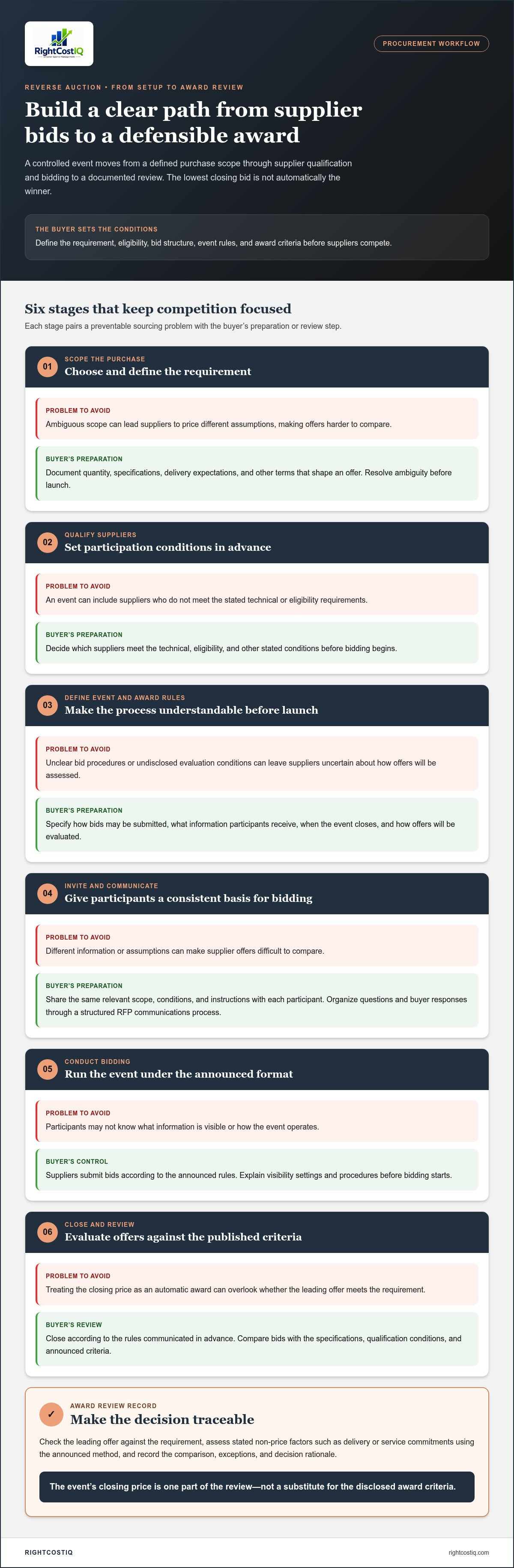
Understanding what is a reverse auction in procurement is only the starting point. A controlled event moves from a defined purchase scope to supplier qualification, live bidding, and a documented award review. Establish the conditions before bidding so suppliers can prepare comparable offers and the procurement team can evaluate them consistently.
What happens before suppliers begin bidding?
Before launch, the buyer defines the requirement, confirms which suppliers can participate, and sets the event schedule, bidding rules, and award criteria. Suppliers need the same relevant specifications and participation conditions, including details that affect pricing. A clear request for proposal process can organize requirements and communications before the event.
- Select and scope the purchase. Choose a category with a sufficiently defined need. Document the quantity, specifications, delivery expectations, and other terms that shape an offer. Resolve ambiguities that could lead suppliers to price different assumptions.
- Set qualification conditions. Decide which suppliers meet the technical, eligibility, and other stated requirements. Qualifying suppliers before bidding focuses the event on participants able to meet the need.
- Define the event and award rules. Specify how bids may be submitted, what information participants will receive, when the event closes, and how offers will be evaluated. Federal buyers can consult the Federal Acquisition Regulation on Reverse Auctions for policy context applicable to federal acquisitions.
- Invite suppliers and communicate consistently. Share the same relevant scope, conditions, and instructions with each participant. A structured RFP communications process helps organize supplier questions and buyer responses.
- Conduct bidding under the chosen format. Suppliers submit bids according to the announced rules. The event may display different information or operate differently depending on its format, so explain visibility settings and procedures in advance.
How should the buyer close and evaluate the event?
Close the event according to the rules communicated in advance, such as a stated closing time or another defined endpoint. Then compare bids with the published specifications, qualification conditions, and evaluation criteria. Closure begins the decision stage; it does not automatically award the contract to the lowest bidder.
Check that the leading offer meets the requirement. Assess stated non-price factors, such as delivery or service commitments, using the announced method. Record the comparison, exceptions, and decision rationale. This creates a clear basis for the award review and transition to contracting or another sourcing step.
Event completion does not remove the need for follow-through. If bids reveal a specification gap or an unexpected cost assumption, document the issue and determine whether to seek clarification, continue negotiation, or revise the event. Teams can use a procurement diagnostic to identify where sourcing preparation and evaluation need more structure.
When Is a Reverse Auction Suitable, and When Can It Backfire?
A reverse auction is a stronger fit when suppliers can price the same clearly defined requirement and enough qualified participants can compete. The key question is not simply whether suppliers can lower bids. It is whether the buyer can compare offers fairly without overlooking performance factors that determine total value. The University of Tennessee’s How Reverse Auctions Work resource describes sellers competing to lower prices for a buyer’s purchase. Whether that competition suits a category depends on the conditions below.
| Fit | Category conditions | Why it matters |
|---|---|---|
| Stronger fit | Standardized goods or services, stable specifications, comparable offers, and multiple qualified suppliers. | Suppliers can compete on a common basis, making price differences easier to interpret. |
| Conditional fit | Requirements include measurable service, delivery, or performance factors, or supplier options differ in meaningful ways. | An auction may work if the buyer can define and evaluate those differences consistently alongside price. |
| Poor fit | Complex, customized, or relationship-dependent work where quality is difficult to specify or compare. | A bid ranking may conceal material differences in approach, capability, or long-term value. |
Which procurement categories are stronger candidates?
Look for categories where the buyer can describe the purchase in measurable terms, including quantities, specifications, and delivery conditions. Then assess the supplier field: meaningful competition requires qualified participants capable of meeting the same requirement. A category may appear standardized on paper but remain a weak candidate if only a limited set of suppliers can deliver it. A plausible fit creates an opportunity for competition, not a guarantee of savings or a better outcome.
Which risks should buyers weigh before choosing this format?
Price pressure can undermine value if quality, service, delivery, or compliance are left out of the evaluation framework. Incomplete specifications can lead suppliers to price against different assumptions, and an aggressive price can be difficult to assess without clear performance expectations. Limited participation also weakens competition, particularly when capable suppliers are excluded or the supplier pool is narrow. Include relevant non-price criteria in the announced evaluation method and make them assessable before bidding starts.
Complex consulting, design, or other differentiated services often require broader evaluation than bid ranking alone. Buyers may need to compare methods, expertise, service models, or working relationships that cannot be reduced to a single price field. If these factors are difficult to specify and score consistently, another sourcing approach may give decision-makers a more complete basis for award.
Reverse-auction fit depends on comparable requirements, meaningful supplier competition, and clearly defined evaluation criteria. If any condition is weak, refine the scope or choose a process that gives quality and delivery the weight they require.
How Can Procurement Teams Prepare a Reverse Auction Without Losing Value?
Preparation determines whether the event tests supplier competitiveness or simply rewards the lowest number. For teams asking what is a reverse auction in procurement, the practical next question is how to protect requirements and decision quality before bids arrive. Define the purchase, set measurable criteria, and establish the evaluation method before inviting suppliers.
What should the buyer define before inviting suppliers?
Use a pre-event checklist to turn the sourcing objective into instructions suppliers can interpret consistently:
- Scope: Document what is being purchased, expected quantities, delivery needs, and relevant service conditions.
- Specifications: State measurable requirements, acceptable alternatives, and any quality or compliance thresholds that offers must meet.
- Supplier qualification: Set eligibility and capability criteria before bidding so the event includes suppliers able to fulfil the requirement.
- Event rules: Communicate timing, bid structure, submission conditions, and how the event will close.
- Evaluation: Explain how price and non-price factors affect the decision, including minimum standards or unacceptable bid conditions.
Keep information consistent throughout the event. Give participants the same relevant details, route supplier questions through a defined process, and share clarifications or updates with all eligible bidders. A structured RFP workflow can organize communications in a single data-driven environment. Keep a record of instructions and responses so the team can evaluate bids against the same information suppliers received.
Set decision boundaries before the auction, not after a low offer appears. Define what makes a bid compliant, how missing information will be handled, and which service, quality, or compliance factors remain part of the award review. If delivery reliability matters, establish how it will be assessed instead of assuming a lower price compensates for uncertainty.
How can cost context strengthen bid evaluation?
A low bid is a signal to assess, not proof that the offer represents sound value. Compare it with the stated scope and a reasonable cost expectation, then investigate material differences without changing the announced evaluation rules. A should-cost model estimates what a product or service should reasonably cost based on raw materials, labor, freight, overhead, and margin. It provides context for bid analysis, but does not replace supplier qualification or performance criteria. Should-cost analysis can give the team a structured cost reference.
Before launch, test the event against the buyer’s priorities: can suppliers price the same requirement, can the evaluation distinguish a compliant offer from a low but unsuitable one, and can the team explain its decision? If sourcing priorities or cost assumptions need review, run a free procurement diagnostic to assess where preparation can be strengthened.
How Can Procurement Intelligence Complement a Reverse Auction?
A reverse auction creates competitive bids for a defined purchase, but it does not replace the broader work of managing costs, supplier relationships, and sourcing decisions. Understanding what is a reverse auction in procurement also means recognizing the work beyond the event: preparation, award evaluation, and performance follow-up all affect whether a sourcing decision delivers value. A structured RFP management framework can connect the auction to that wider sourcing lifecycle.
What should teams do with auction results after the event?
Compare the selected offer with the requirements and award criteria communicated before bidding. Record why the chosen supplier met those conditions, including relevant non-price factors. This creates a decision trail and a reference point for reviewing performance against expectations.
Next, track realized savings against the organization’s chosen baseline and verification approach. A lower auction bid and a realized saving are not automatically the same measure. Changes in scope, delivery, or other agreed terms can affect the comparison, so use a consistent basis when reporting results.
Then connect the award to supplier performance information. Monitor relevant delivery, quality, and service outcomes, and use the findings in future procurement decisions. Strong performance can inform future sourcing plans; performance gaps can show where requirements or evaluation measures need refinement. The auction result is an input to supplier management, not its endpoint.
Where can RightCostIQ support the wider sourcing decision?
RightCostIQ provides procurement intelligence and support that can complement event design and post-event review. Its integrated RFP portal manages communications in a single data-driven environment, helping teams organize supplier exchanges across sourcing activity. That record can support consistent information handling and later review.
Cost context adds another decision input. RightCostIQ’s should-cost models estimate what a product or service should reasonably cost based on raw materials, labor, freight, overhead, and margin. Teams can use the estimate to examine a bid in relation to cost assumptions while still evaluating it against the event’s requirements and award criteria. The model informs analysis; it does not determine which supplier should win.
For preparation beyond the auction, RightCostIQ’s AI-powered negotiation coach supports role-play and strategy testing. After award, its savings tracking and verification capability helps teams assess outcomes against their selected baseline. These capabilities support decision quality, but they do not replace clear specifications, supplier qualification, or disciplined evaluation.
To connect auction planning with cost and sourcing priorities, start a free procurement diagnostic.
Make Your Next Sourcing Decision More Deliberate
The practical question is not only what is a reverse auction in procurement, but whether your next sourcing event is designed to protect the value your organization needs. Align category strategy, supplier evaluation, and cost expectations before choosing the sourcing method.
RightCost IQ supports procurement teams with intelligence and tools for this work, including a 5-day free trial. A diagnostic can help identify where sourcing priorities and evaluation methods need greater clarity before the next event.
Start a free procurement diagnostic and take a focused next step toward more informed sourcing decisions.
Frequently Asked Questions
Is a reverse auction always awarded to the lowest bidder?
No. The buyer’s published award criteria govern the decision, and a low-priced offer may be rejected if it fails a stated requirement. For teams asking what is a reverse auction in procurement, the key distinction is that bidding creates competition, but the buyer’s evaluation method determines the award. For example, if a bid omits a required service component, assess it according to the disclosed rules rather than treating its price as decisive.
Can reverse auctions be used for services?
Yes, when the service scope and expected outcomes are clear enough for suppliers to prepare comparable offers. A defined facilities-maintenance task, for example, may be easier to compare than a transformation project where each supplier proposes a different approach. Set service levels, quality expectations, and compliance conditions before bidding. If proposals rely on substantially different methods or expertise, evaluate the broader proposal rather than relying mainly on bid movement.
Are reverse auctions anonymous?
Not always. The format and event rules determine whether participants see competing prices, rankings, or bidder identities. A buyer might disclose supplier rank while keeping company names private, or use a different information-sharing model. State exactly what bidders can view before the event starts. This helps suppliers understand the competitive environment and reduces disputes based on assumptions about anonymity or what other participants can see.
What happens if no supplier submits a bid?
A no-bid result calls for a review, not an assumption about the cause. Check whether the scope was difficult to price, eligibility conditions narrowed participation, timing created a barrier, or event rules were unclear. Record the findings and decide whether to revise the event or use another sourcing route. Any changes should follow the organization’s procurement governance and preserve a clear rationale for the next step.
Can suppliers change their bids during a reverse auction?
That depends on the event format and announced rules. Before launch, specify whether revised bids are allowed, how submissions are recorded, and what conditions determine the closing time. For instance, suppliers may be permitted to submit lower offers until a stated close, or the buyer may set a different bid process. Communicate the rules consistently so participants know how to submit and what counts as a valid revision.
How does a reverse auction differ from an RFP?
An RFP is a broader method for requesting and evaluating supplier proposals, which may include technical approaches, service plans, and commercial terms. A reverse auction is a bidding event that can be used within sourcing when offers are comparable under set conditions. For example, an RFP may first assess supplier capability, with an auction used later to compete on a defined price component. Choose the method based on the purchase and decision criteria.


