

What if the lowest-priced proposal is also the weakest choice for your business? RFP evaluation criteria should connect each proposal to the outcomes the sourcing decision must deliver. When criteria are vague or overlap, evaluators can interpret them differently, and a low bid can distract from evidence of fit, delivery capability, and cost.
A fair evaluation doesn’t depend on judgment alone. It gives evaluators clear standards, weighted priorities, and a consistent way to explain each score. This article shows you how to define criteria around the RFP’s objectives, assign weights that reflect business priorities, and apply a scoring model that supports a defensible decision.
You’ll also learn how to assess cost evidence without letting the headline price dominate, document evaluator reasoning, and use should-cost analysis as an input rather than a substitute for agreed criteria. The result is a transparent process that helps your team identify the best-fit proposal and explain the decision.
Key Takeaways
- Translate RFP requirements into criteria that distinguish proposal quality, while keeping eligibility checks separate from scored factors.
- Choose a scoring method that fits the decision, and weight each criterion according to its contribution to business outcomes.
- Apply rfp evaluation criteria consistently by having evaluators record proposal evidence before discussing scores.
- Reconcile score differences through evidence-based discussion, then document the reasoning behind final ratings.
- Use criterion-level results, trade-offs, and supporting evidence to build a clear rationale for the selected proposal.
What RFP evaluation criteria do, and how they protect decision quality
RFP evaluation criteria are the standards used to assess and compare proposals. They turn the requesting team’s business needs into a shared basis for judgment, so evaluators compare suppliers against the same priorities instead of relying on general impressions. Strong criteria also make the final decision explainable: each score can be connected to a stated need and evidence in a proposal.
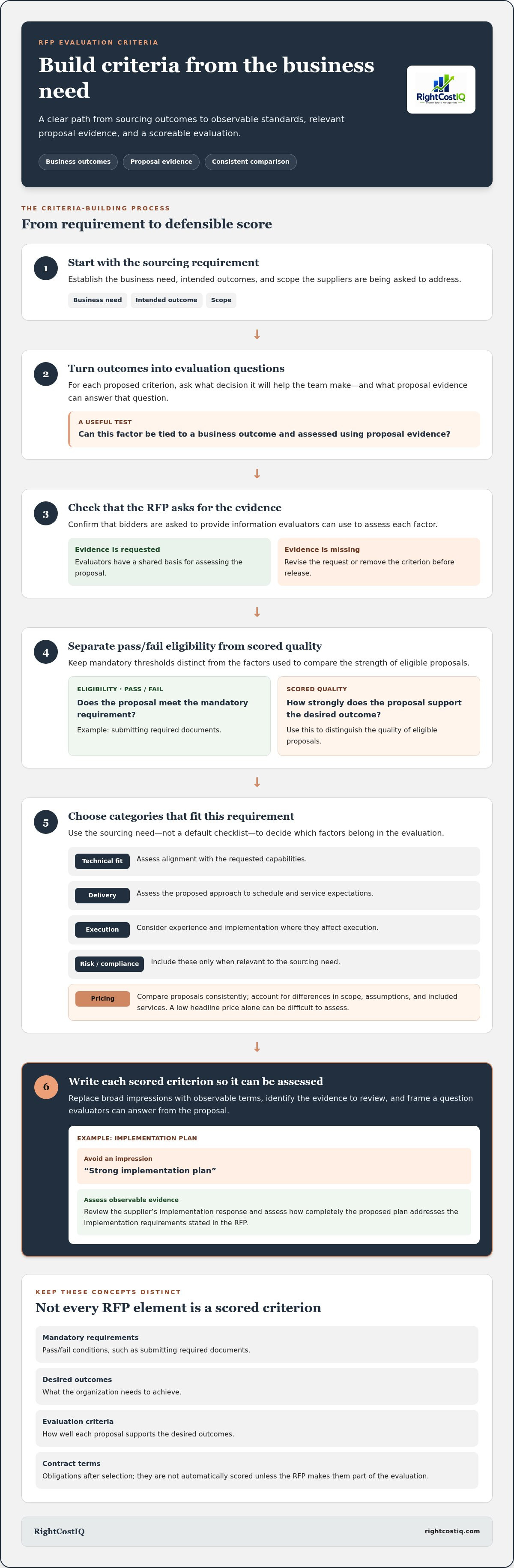
Keep four concepts distinct. Mandatory requirements are pass/fail conditions, such as submitting required documents. Desired outcomes describe what the organization needs to achieve. Evaluation criteria measure how well each proposal supports those outcomes. Contract terms define obligations after selection; they aren’t automatically scored unless the RFP makes them part of the evaluation.
A transparent process still depends on relevant criteria and consistent application. Publishing a scoring method won’t protect decision quality if the factors are disconnected from the requirement or evaluators interpret the same factor differently. A general overview of RFP purpose and typical components is available in Request for Proposal (RFP) on Wikipedia.
How evaluation criteria connect the RFP to business outcomes
Start with the problem, intended outcome, and scope established by the requesting team. Then ask what proposal evidence would demonstrate a supplier’s ability to support each outcome. For example, if the goal is to improve delivery reliability, a criterion should assess the supplier’s proposed approach to meeting delivery expectations, using evidence the RFP asks bidders to provide. “Strong supplier” is an impression, not a testable standard.
Check each criterion against the requested response. If evaluators can’t assess a factor from the information bidders are asked to submit, the RFP has an evidence gap. Revise the request or remove the criterion before release. RightCostIQ’s RFP Workflow can organize communications in a single data-driven environment alongside this process. Learn more about the data-driven RFP workflow.
Why vague or disconnected criteria weaken comparisons
Words such as “innovative,” “high quality,” or “good value” invite different interpretations unless the RFP explains what evidence supports a strong rating. One evaluator may reward a polished presentation; another may look for a practical delivery plan. Define observable indicators in advance, such as whether a proposal addresses specified requirements and explains how it will meet them.
Irrelevant factors create another distortion: they can reward presentation or familiarity rather than proposal fit. Before including a criterion, test its connection to a business outcome and confirm that the RFP requests evidence to assess it. Remove factors that fail either test. RFP evaluation criteria convert business outcomes into evidence-based standards for comparing proposals and supporting a defensible selection.
That connection is the foundation of useful rfp evaluation criteria. It gives evaluators a common reference point and keeps the comparison anchored to the organization’s sourcing priorities.
How to define RFP criteria that evaluate fit, delivery, and cost
Build the criteria from the sourcing requirement, not from a reusable checklist. Start with the business need, the outcomes the project must support, and the scope suppliers are being asked to address. For every proposed criterion, ask: What decision will this help us make, and what proposal evidence will answer that question? If the connection is unclear, the factor may not belong in the evaluation.
Separate eligibility from scored quality. Pass/fail conditions determine whether a proposal meets a mandatory requirement, such as submitting a required response or meeting a stated minimum. Scored criteria then distinguish the strength of eligible proposals. This prevents a basic qualification from receiving points that blur the difference between meeting the threshold and offering a stronger solution.
Which RFP evaluation categories should be considered?
Choose categories that reflect the specific requirement. Technical fit can assess alignment with requested capabilities; delivery approach can assess how the supplier proposes to meet schedule and service expectations. Experience and implementation may matter where they affect execution. Include risk or compliance only when those factors are relevant to the sourcing need, rather than adding them as default checklist items.
Pricing belongs in the framework, but it shouldn’t automatically determine the winner. Compare proposals on a consistent basis and account for the cost information relevant to the decision. A low headline price is difficult to assess if proposals differ in scope, assumptions, or included services.
How to write criteria evaluators can actually score
Write each scored criterion in observable terms. Instead of “strong implementation plan,” specify what the response should demonstrate, such as how the proposed plan addresses the implementation requirements stated in the RFP. Then identify the evidence evaluators should use, such as the supplier’s implementation response, and frame an evaluation question: “How completely does the proposed plan address the stated requirements?”
Every scored criterion should map to an RFP objective, so evaluators can connect proposal evidence to the business outcome the sourcing decision is meant to support. This keeps the scorecard focused and gives reviewers a common reference point.
- Technical fit: Does the proposal address the specified functional or technical requirements?
- Delivery approach: Does the response explain how the supplier will meet the stated delivery expectations?
- Experience: Does the submitted evidence demonstrate relevant experience for this requirement?
- Cost: Are proposed costs presented in a way that supports a like-for-like comparison?
For cost evaluation, define the information needed to compare bids before proposals arrive. Apply the same scope assumptions and review cost evidence against the RFP’s requirements. Should-cost analysis can provide a data-backed estimate for assessing proposed costs and price increases. Use it as a supporting input, not a replacement for the cost criteria established in the RFP.
Before release, check that every criterion has a clear objective, an evidence source, and a scoring question. Explore RightCost IQ’s procurement tools through the procurement resource.
How to weight and score RFP evaluation criteria consistently
Scoring turns the criteria into a decision method. A simple scoring approach rates each proposal against the same scale, then compares results without assigning different importance to each factor. It’s straightforward, but it treats every scored criterion as equally important. Weighted scoring gives higher-priority outcomes more influence on the total. Pass/fail scoring determines whether a proposal meets a mandatory condition, not how strong it is relative to others. These methods serve different purposes, and a well-designed evaluation can combine them.
When to use pass/fail criteria versus weighted scoring
Use pass/fail for essential conditions a proposal must satisfy to proceed. Use scored criteria to compare the relative strength of proposals that meet those conditions. Keeping the stages separate prevents a high score on other factors from disguising a failure to meet a mandatory requirement. Decide how each condition will be assessed before proposals arrive, then apply the rule consistently.
How to build a transparent scoring matrix
Set weights according to the relative importance of the sourcing outcomes, not the strongest stakeholder preference. Ask which outcomes carry the greatest operational or business significance, and check that the combined weights reflect those priorities. Define a rating scale in plain terms before evaluation. For example, on a 1-to-5 scale, a low rating could mean the evidence addresses few stated needs, while a high rating means it addresses them thoroughly with relevant support.
Record the criterion, weight, rating scale, requested evidence, evaluator rating, and evidence notes. State the calculation in advance: multiply each rating by its weight, then add the results. If using a 1-to-5 scale, a normalized calculation is (rating ÷ 5) × weight. Set a rule for incomplete or unsupported responses before scoring begins. For instance, assign the lowest rating when required evidence is absent, and document the gap rather than filling it with assumptions.
Illustrative matrix only: The values below are hypothetical, not recommended or universal weights. Weights total 100 points; ratings use a 1-to-5 scale. Weighted points equal rating divided by 5, multiplied by weight.
Criteria and evaluator fields
Delivery approach | Weight: 50 | Evidence: proposed plan | Supplier A rating: 4 | Supplier B rating: 3
Technical fit | Weight: 30 | Evidence: response to requirements | Supplier A rating: 3 | Supplier B rating: 5
Cost approach | Weight: 20 | Evidence: pricing response | Supplier A rating: 5 | Supplier B rating: 3
Hypothetical weighted totals: Supplier A: 3.9 out of 5. Supplier B: 3.6 out of 5.
The total helps structure comparison, but it doesn’t replace review of criterion-level evidence. An evaluator should be able to explain each rating by pointing to the response. If evidence is unclear, record that limitation and follow the stated scoring rule. Don’t adjust weights or standards after seeing which proposal benefits.
A transparent matrix makes rfp evaluation criteria easier to apply consistently and gives the team a traceable basis for comparing proposals. Keep the scoring instructions, evidence notes, and calculation method together so the result can be reviewed without relying on memory or informal impressions.
How to run evaluator reviews and resolve inconsistent RFP scores
Even well-defined rfp evaluation criteria can produce inconsistent scores if evaluators use different standards or rely on overall impressions. A disciplined review sequence surfaces those differences before they shape the recommendation. Keep the discussion anchored to the published criteria, the agreed scoring definitions, and evidence in each proposal. The goal isn’t to force identical opinions; it’s to make sure each final rating has a clear, supportable rationale.
A practical sequence for evaluator calibration
Before review begins, brief evaluators on the criteria, rating anchors, evidence expectations, their roles, and how differences will be resolved. Then collect independent assessments before holding a group discussion. This preserves each reviewer’s initial judgment and makes interpretation gaps visible, rather than allowing the first speaker to set the group’s view.
- Confirm the process. Review the evaluation rules, proposal materials, roles, and any organizational procurement policies that govern the review.
- Score independently. Each evaluator records a rating and the specific proposal evidence that supports it, criterion by criterion.
- Identify material differences. Compare ratings and flag disagreements that could affect the ranking or recommendation.
- Discuss the evidence. Ask evaluators to point to the relevant response and explain how it meets, partly meets, or fails to address the criterion.
- Reconcile and record. Agree on a final rating where the evidence supports one, or document the differing views and follow the established process for unresolved issues.
For example, if reviewers disagree on a delivery approach score, first identify the response passage each person relied on. Then compare that evidence with the published criterion and rating anchors. Don’t resolve the difference by averaging scores automatically or deferring to the most senior evaluator. Reconciliation should clarify how the standard applies, not introduce a new standard after proposals have been submitted.
How to document an objective evaluation record
A useful record allows someone who wasn’t in the discussion to understand how the team reached its assessment. Capture the evidence and rationale for each final score, plus any material changes made during reconciliation. Keep criterion-level assessments separate from broad comments about a supplier, such as familiarity or general confidence, unless those impressions relate to a stated criterion and are supported by the proposal.
- Evidence reference: Note the proposal section or response detail that supports the rating.
- Score rationale: Explain how that evidence aligns with the published criterion and rating definition.
- Discussion record: Capture material disagreements, the basis for resolution, and any dissent that remains.
- Information gaps: Record missing or ambiguous evidence as a limitation; don’t fill gaps with assumptions about supplier capability.
Follow organizational procurement policies for evaluation records, meeting notes, and retention. A structured RFP workflow can keep communications organized alongside the review process. Explore RightCost IQ’s procurement resources to consider how a more structured approach could support an evidence-based evaluation: view procurement tools.
Turn RFP evaluation results into a defensible sourcing decision
A score is an input to the sourcing decision, not the decision itself. Review criterion-level results against the business priorities stated in the RFP, then confirm that the recommended proposal performs strongly on the outcomes that matter most. If the highest total comes from strength in lower-priority areas while a critical objective remains weak, explain that tension rather than letting the aggregate score decide by default.
What the evaluation record should support
The record should allow decision-makers to trace the recommendation from published criteria to proposal evidence. Summarize how the selected proposal performed against each material factor, and describe trade-offs in terms of the sourcing objectives. For example, if one proposal rates higher on delivery but lower on cost, explain why that balance does or doesn’t fit the stated priorities, citing the relevant evidence.
Retain the final scores, supporting rationale, material discussion points, and decision outcome in line with organizational procurement policies. Make clear whether the recommendation follows the scoring results or reflects a documented factor allowed by the RFP. Don’t add a new criterion after evaluation or treat an undocumented impression as evidence. A concise rationale helps readers understand both the selection and the limits of the comparison.
- Criterion-level results: Show the selected proposal’s assessment against each published factor.
- Material trade-offs: Explain the benefits and limitations that influenced the recommendation.
- Decision basis: Connect the final outcome to the evidence, scores, and stated business priorities.
Where procurement intelligence fits after scoring
Cost evidence deserves the same discipline. Should-cost insight can provide a data-backed reference for assessing proposed costs or price increases, but it doesn’t replace the cost criteria, assumptions, or scoring rules established for the RFP. Keep the distinction clear: the evaluation determines how proposals compare under the published method; cost analysis informs interpretation of the proposal’s pricing evidence.
After the sourcing decision, contract negotiation and supplier performance monitoring are related but separate activities. The evaluation record captures the basis for selection. Negotiation addresses contract terms, while performance tracking assesses delivery against the resulting agreement. Keeping these records distinct preserves a clear line between what was promised in a proposal, what was agreed in a contract, and what happens during performance.
Centralized communications can support this continuity. RightCost IQ’s RFP Workflow manages RFP communications in a single data-driven environment alongside the evaluation process. For broader lifecycle context, explore strategic RFP management frameworks. Clear rfp evaluation criteria, traceable evidence, and structured communication help procurement teams make decisions they can explain and carry forward.
Use your next sourcing review to check whether each recommendation connects back to the RFP’s objectives and documented evidence. Explore RightCost IQ’s procurement resources to consider where stronger alignment can support decision quality: learn more.
Make your next sourcing decision more actionable
Treat each sourcing decision as an opportunity to strengthen the next one. After award, compare the outcomes the team intended to achieve with what the evaluation prioritized, then use that learning to sharpen future rfp evaluation criteria. This creates a more disciplined link between procurement decisions and business performance over time.
RightCost IQ’s integrated RFP portal manages communications in a data-driven environment, supporting a structured workflow. A 5-day free trial is available to explore the platform. Start with the RFP Workflow and see how it can support your sourcing process.
Clearer sourcing decisions begin with a process your team can apply and explain. Take the next step by exploring the RFP Workflow.
Frequently Asked Questions
What are RFP evaluation criteria?
RFP evaluation criteria are the factors an organization uses to judge how well supplier proposals meet a sourcing need. They can address technical requirements, delivery plans, relevant experience, or pricing, depending on the project. For example, a team buying a service might assess whether a proposal covers the requested scope and explains its delivery approach. Clear rfp evaluation criteria help connect the recommendation to the needs stated in the solicitation.
Who should define RFP evaluation criteria?
The requesting team and procurement should define criteria together, with input from subject-matter experts who understand the requirement. Procurement can help structure the evaluation method, while operational, technical, or finance stakeholders can identify what proposal evidence matters to their area. Assign someone to coordinate the process and resolve questions before the RFP is issued. This collaboration helps prevent one function’s priorities from outweighing the organization’s sourcing objectives.
Should RFP evaluation criteria be included in the RFP?
Yes. State the evaluation factors and explain their relative importance or scoring approach to the extent required by your procurement process. This gives suppliers a clear basis for preparing relevant responses and gives evaluators a defined framework for review. For example, if implementation approach will affect selection, describe what information suppliers should provide. Align the published evaluation method with the internal scorecard before release, so both documents support the same decision process.
Can RFP evaluation criteria be changed after proposals are submitted?
Changing criteria after submission can undermine fairness because suppliers responded to the original requirements and evaluators may have already begun scoring. Treat the published criteria and method as fixed for the evaluation. If a material correction is needed, pause and follow the organization’s procurement policies and any applicable solicitation process rather than making an informal adjustment. Record the issue, decision, and communication so the handling is transparent and consistently applied.
How many criteria should an RFP evaluation use?
There’s no universal number. Use enough criteria to distinguish proposals on the outcomes that matter, but remove factors that duplicate one another or don’t affect the sourcing decision. A practical review is to ask whether each factor has a distinct purpose, can be assessed from requested evidence, and could reasonably change the comparison. If two criteria measure the same capability, combine or clarify them to reduce double-counting and evaluator workload.
How should price be scored in an RFP?
Score price using a method defined before the RFP is released, and compare proposals on a consistent scope and set of assumptions. Check whether quoted prices cover the same requirements and identify exclusions or conditional charges in the submitted response. If the procurement calls for total-cost assessment, include relevant cost information in the requested response. Use cost analysis as supporting evidence, while keeping the published price-scoring method unchanged throughout evaluation.
What is the difference between pass/fail and weighted RFP criteria?
Pass/fail criteria test whether a proposal meets a mandatory condition. Weighted criteria assign points to compare the relative strength of proposals that meet the required conditions. For example, a mandatory submission requirement could be assessed as pass or fail, while the quality of a proposed delivery plan could receive a weighted score. Keep the two functions distinct so a strong score elsewhere can’t conceal failure to satisfy an essential condition.
How can an evaluation team reduce bias when scoring RFP responses?
Reduce bias by setting common scoring definitions, using the same proposal materials and evaluation sequence, and requiring reviewers to connect ratings to response evidence. Have each evaluator submit an initial assessment independently before group discussion. Where practical, manage conflicts of interest according to organizational policy, and avoid allowing supplier familiarity or presentation style to influence ratings unless those factors are explicitly relevant. Record why material score differences were resolved as they were.


