

What if the largest gap in your procurement benchmark reflects mismatched inputs, not a better price? Supplier quotes and internal spend can differ in scope, specifications, volumes, freight, or timing. Without clear alignment, even a polished analysis can be challenged. A defensible procurement cost benchmarking methodology starts by making those differences visible.
That concern is justified: a benchmark is only as credible as the assumptions behind it. The goal isn’t to force every price into one comparison, but to identify which costs are genuinely comparable and explain where they aren’t. A clear, repeatable process gives procurement teams a stronger basis for decisions and stakeholder review.
This practical framework shows how to define scope, normalize inputs, document assumptions, and interpret cost gaps without overstating what they mean. It also explains how to turn findings into a sourcing next step, from validating a supplier quote to prioritizing an opportunity for negotiation. Organized spend data and should-cost insights can support the analysis, while savings tracking helps connect decisions to outcomes.
Key Takeaways
- Use a procurement cost benchmarking methodology that starts with the decision you need to make, then defines the category, period, units, and comparison basis.
- Test whether inputs are comparable before calculating variance; record scope differences and unresolved limitations alongside the figures.
- Separate quoted price from comparable cost so a price gap isn’t mistaken for a verified savings opportunity.
- Translate validated findings into a defined response, such as further investigation, negotiation, an RFP, or ongoing monitoring.
- Assign each proposed action an owner, decision date, and evidence requirement to make follow-through measurable.
What Procurement Cost Benchmarking Methodology Measures, and Why Comparability Matters
A benchmark can look precise and still lead to the wrong decision if the inputs describe different purchases. A procurement cost benchmarking methodology establishes a consistent basis for comparing a defined cost, using aligned scope, units, time periods, and documented assumptions. Comparable inputs make a cost comparison meaningful because they show whether a measured difference reflects price or a difference in what was purchased.
Start with the decision, not the spreadsheet. Are you validating a supplier quote, assessing costs across a category, or deciding which category deserves a sourcing review? Each purpose calls for a different comparison boundary. A quote review may focus on an item and its delivery terms; a category assessment may group purchases only when their specifications and buying conditions are sufficiently similar.
A benchmark is a reference point, not automatically a target. It can indicate how a defined cost compares with historical internal spend or supplier proposals, but it doesn’t prove that a lower figure is achievable for your requirements. Treating a reference as a guaranteed cost can undermine the analysis and create unrealistic expectations. A decision-grade benchmark makes its purpose and limitations visible.
What counts as a procurement cost benchmark?
A useful benchmark identifies exactly what’s being compared: the item or category, the included purchases, the relevant period, the unit of measure, and the source of the reference. That source might be your organization’s historical transactions or comparable supplier proposals. The comparison should also state assumptions such as purchase volume, specification, delivery basis, and included services. For an overview of the underlying concept, see Cost Benchmarking on Wikipedia. Internal records and proposals may not reflect identical market conditions, so document what the available evidence can and cannot support.
Scope determines the benchmark’s usefulness. If historical spend combines different product specifications or service levels, the category average may conceal meaningful variation. Define inclusion rules before calculating an average or variance, and retain enough detail to trace the benchmark back to its source inputs. A should-cost estimate can add context by estimating reasonable cost from raw materials, labor, freight, overhead, and margin, but it remains one input, not a substitute for comparable evidence. Should-cost insights can inform that assessment.
Why a lower quoted price may not mean lower cost
A supplier’s lower unit price may reflect a different specification, a larger committed volume, a shorter service scope, or a different delivery date. For example, comparing a quote for a basic configuration with historical purchases of a more capable specification can make the new offer appear more competitive than it is. Timing can matter too: quotes from different periods may reflect different input-cost conditions.
Separate unit price from other purchase considerations, including freight, included services, and the requirements needed to use or support the purchase. Don’t assume every category needs the same boundary. For one purchase, delivery terms may be central; for another, service scope or specification may drive comparability. Record exclusions and unresolved differences rather than forcing a single adjusted figure. That discipline makes the benchmark easier to explain and gives the next sourcing decision a sounder basis.
Build a Comparable Baseline for Procurement Cost Benchmarking
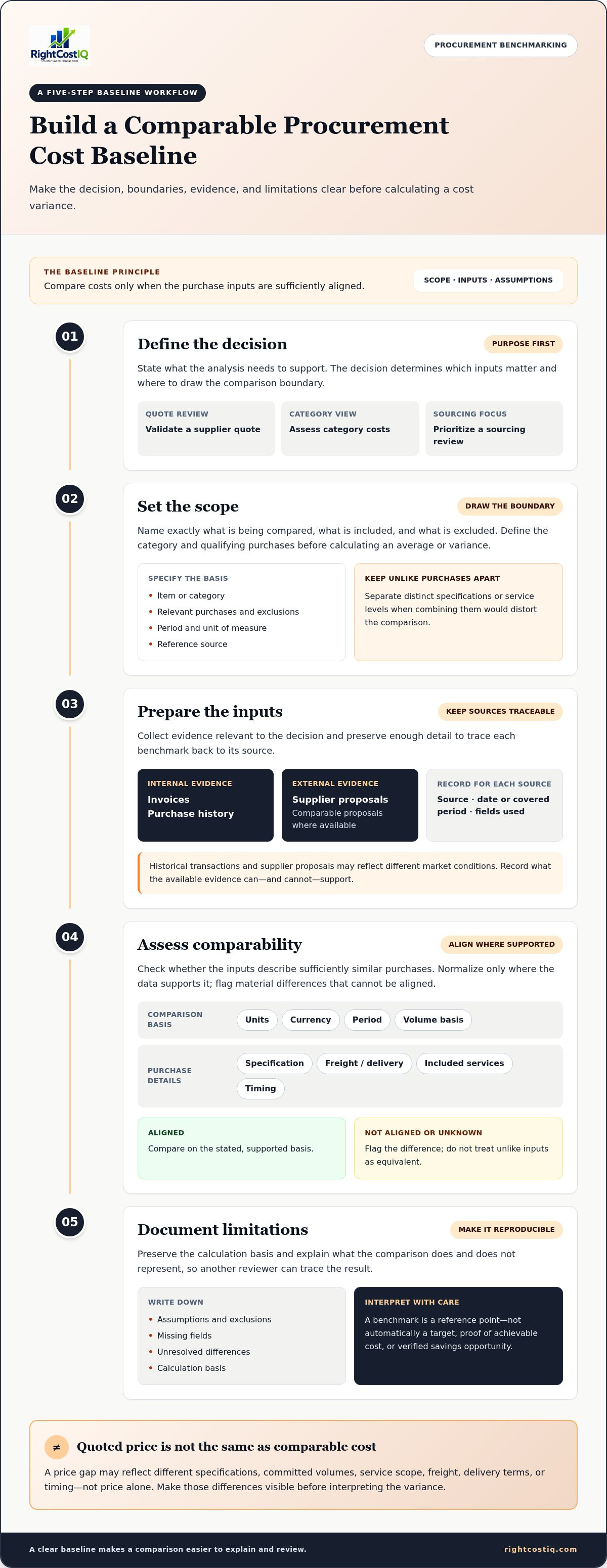
Build a defensible baseline before calculating a variance. This procurement cost benchmarking methodology makes the comparison reproducible by defining the decision, input boundaries, data sources, and assumptions in sequence. Every benchmark should disclose its scope, data period, and comparison basis. With those details recorded, another reviewer can trace the result and understand what it does and doesn’t represent.
Use this workflow to establish the baseline:
- Define the decision. State whether the analysis will validate a quote, assess category costs, or prioritize a sourcing review. This determines which inputs matter.
- Set the scope. Name the category, goods or services included, relevant purchases, and explicit exclusions. Keep distinct specifications or service levels separate if combining them would distort the comparison.
- Prepare the inputs. Gather the relevant invoices, purchase history, and supplier proposals. Record each source, its date or covered period, and the fields used in the analysis.
- Assess comparability. Align units, currency, period, volume basis, and specification where the data supports it. Flag material differences that can’t be normalized rather than treating unlike inputs as equivalent.
- Document limitations. Note missing fields, exclusions, assumptions, and unresolved differences. Preserve the calculation basis so a reviewer can reproduce the comparison.
Set scope and normalize the comparison
Make the boundary concrete. For a defined service category, specify which service components are included, which purchases qualify, and whether the comparison covers the same delivery or support scope. For goods, align the unit of measure and relevant specification. Set the time period and volume basis consistently, and state the currency used. If records span currencies or periods that can’t be reconciled reliably, disclose the issue and avoid implying a like-for-like result.
Normalization isn’t permission to erase differences. Keep a note of each adjustment and its rationale, then separate inputs that remain materially different. This creates a transparent baseline without overstating precision.
Assess data quality before drawing conclusions
Trace every figure to its source and inspect the underlying records before using it. Inconsistent item descriptions may refer to different specifications; duplicate invoice lines can skew totals; incomplete category assignments may leave relevant purchases out. Check how units, supplier names, and purchase periods are represented, and log any corrections. Where a field is missing, record that limitation rather than silently filling it with an assumption.
AI spend classification can help organize supplier names, item descriptions, invoice data, and purchase history into categories, sub-categories, and supplier groups. This supports data organization, while the analyst still needs to confirm that the resulting group matches the benchmark’s scope. A structured spend classification workflow can provide a clearer starting point for review.
Keep a compact baseline record with the decision, scope, period, units, source data, comparison basis, exclusions, and assumptions. That record turns the benchmark from a one-off calculation into an analysis that can be reviewed, challenged, and repeated on the same terms.
Interpret Procurement Cost Variance Without Mistaking It for Savings
A variance is a signal to investigate, not proof of savings. Before labeling a gap as an opportunity, test it against the baseline: do the compared inputs share the same specification, volume basis, period, and scope? If a difference remains after those checks, determine whether it reflects a price issue, a purchase requirement, or an evidence gap. A sound procurement cost benchmarking methodology distinguishes what the data shows from what the team can reasonably conclude.
Keep the comparison visible. The table separates the supplier’s offer from the cost basis used for analysis and makes scope differences and unresolved limitations explicit.
| Comparison element | What to record | How to interpret it |
|---|---|---|
| Quoted price | The supplier’s stated price and the offer’s documented basis | A starting figure, not necessarily a like-for-like cost |
| Comparable cost | The cost used in the benchmark after applicable, documented adjustments | Compare only when the adjustment basis and inputs are transparent |
| Scope differences | Specification, volume, service scope, or timing differences | Assess whether the difference explains some or all of the variance |
| Unresolved limitations | Missing information or differences that can’t be normalized | Disclose the limitation and qualify the conclusion |
Price comparison versus broader cost evaluation
If the decision concerns a quoted unit price, compare unit prices only after confirming the units and purchase basis match. If it concerns a broader purchase evaluation, include only relevant, available cost inputs and keep the boundary consistent. A lower price may not be favorable if the offer changes the specification or service scope. Supplier performance or quality may also matter to the decision, but don’t imply those factors are included in a cost calculation unless the analysis has evidence for them.
For category-level prioritization, a category management framework can help connect an identified variance to category decisions. It doesn’t remove the need to validate the underlying comparison first.
Use should-cost analysis as a reasonableness check
A should-cost model estimates a reasonable cost using raw materials, labor, freight, overhead, and margin. It can help procurement teams examine a proposed increase: if the supplier’s explanation points to a change in one of these components, the estimate gives the team a structured reference for discussion. The model is decision support, not a supplier quote, verified market price, or guaranteed achievable cost. Its usefulness depends on the inputs and assumptions being documented.
Should Cost Analysis can provide this additional reference alongside a comparable benchmark. Use the combined evidence to frame questions, identify what needs validation, and decide whether to investigate, negotiate, or gather stronger inputs before claiming savings.
Turn Benchmark Findings Into a Repeatable Procurement Action Plan
A validated variance still needs an owner and a decision. Without both, benchmark findings remain analysis rather than procurement action. A benchmark becomes operational when each finding has an accountable owner, a decision date, and defined verification criteria. This closes the loop between the comparison and the sourcing response, while keeping modeled opportunities separate from outcomes that have actually been achieved.
Prioritize opportunities using evidence and context
Rank findings by relevance to the decision, confidence in the underlying data, and potential procurement impact. A well-supported variance tied to an upcoming sourcing decision may warrant immediate review. A gap based on incomplete supplier or internal information is a hypothesis first. Assign it to an investigation rather than presenting it as a confirmed opportunity or realized savings.
Choose a response that matches the evidence:
- Investigate when a scope difference, data gap, or supplier explanation could account for the variance.
- Negotiate when the comparison is sufficiently aligned and provides a fact-based point for discussion.
- Run an RFP when competitive proposals are an appropriate way to test the defined requirement.
- Monitor when the evidence is not yet strong enough to act or the relevant market conditions may change.
For each action, record the accountable owner, target decision date, evidence needed, and next review point. This makes follow-through visible and helps prevent a preliminary estimate from being reported as a committed result.
Connect analysis to sourcing and savings verification
Benchmark evidence can shape an RFP by clarifying the requirement, comparison basis, and questions that proposals need to answer. Use an RFP when the requirement is clear and competitive proposals can support the decision, not simply because a benchmark shows a gap. RightCostIQ’s RFP Workflow supports a structured sourcing process around the requirement and evidence collected.
Before action begins, preserve the original baseline and write down how the result will be evaluated. If a negotiation or sourcing event changes the agreed price, compare the outcome with the same purchase scope and assumptions where possible. Record changes to volume, specification, timing, or service scope so the reported result reflects the actual comparison. Savings tracking and verification can support this follow-through; a modeled gap alone isn’t realized savings.
Review open actions on their decision dates. Close each one with its evidence, outcome, and any revised assumptions, or assign a new review point if it remains unresolved. This turns the procurement cost benchmarking methodology into a repeatable cycle: findings inform action, and verified outcomes improve the next review. Structure benchmark-led RFP work around the requirement and evidence your team needs.
Assess your procurement benchmark findings and define a practical next step.
How RightCostIQ Supports Procurement Cost Benchmarking
A repeatable benchmark depends on organized inputs, a documented comparison, and follow-through after the analysis. RightCost IQ connects these stages with procurement intelligence capabilities that support category-level review. They don’t replace the need to define scope or assess comparability. They help teams organize spend, add cost context, and track outcomes against a stated baseline.
From spend data to usable procurement intelligence
Intelligent Spend Management uses AI to analyze supplier names, item descriptions, invoice data, and purchase history, organizing spend into categories, sub-categories, and supplier groups. That structure can help procurement teams examine category costs and identify areas for further review. It doesn’t itself establish that purchases are comparable, so teams should still assess the category boundaries and underlying inputs before drawing conclusions.
Should Cost Analysis adds a data-backed reference for evaluating a cost. Should-cost models estimate reasonable cost using raw materials, labor, freight, overhead, and margin. Use the estimate alongside documented benchmark evidence, not as a supplier quote or guaranteed market price. This distinction helps keep analysis grounded: organized spend supports comparison, while should-cost insights provide another perspective on the figures.
For categories exposed to changing prices, Market Shift Alerts can help teams monitor relevant cost changes. Category-level price-impact sensitivity analysis supports evaluation of how cost changes may affect a category. These capabilities inform review and prioritization; they don’t guarantee a particular price movement or savings outcome. Procurement teams still need to interpret signals in the context of their benchmark scope and assumptions.
Move from analysis to verified follow-through
When a benchmark identifies a potential opportunity, the next step depends on the evidence and sourcing decision. Negotiation Coaching can support supplier discussions informed by the comparison. RFP Workflow can support a sourcing process when competitive proposals are appropriate for the defined requirement. In either case, benchmark findings should guide the questions and evaluation basis, not predetermine the outcome.
Savings Tracking and Verification helps teams track and verify savings after action is taken. Preserve the original benchmark, record any changes to scope or assumptions, and compare outcomes on a consistent basis. This separates a modeled opportunity from a result supported by follow-up evidence. It also gives procurement a clearer record for future category reviews.
Used together, spend classification, should-cost insights, market monitoring, and savings verification can support a more continuous benchmarking process. The procurement cost benchmarking methodology remains the foundation: align the inputs, document what the comparison means, and connect findings to an accountable next step. Start with the 5-day free trial to apply these capabilities to your procurement analysis.
Make Your Next Benchmark a Decision, Not Just a Report
Apply the procurement cost benchmarking methodology to one defined category and use the result to guide a specific decision. Set a review point, record what evidence would change your view, and revisit the benchmark when purchasing conditions or requirements shift. That discipline helps procurement turn analysis into a repeatable operating practice.
RightCost IQ supports this process with AI-driven spend classification that organizes supplier and purchase data into categories and supplier groups, should-cost models using raw materials, labor, freight, overhead, and margin, and Savings Tracking and Verification to track outcomes. Use these capabilities to strengthen the analysis and follow-through, not to replace sound judgment or documented assumptions.
Start the 5-day free trial and put a practical benchmarking workflow into motion. Each well-supported decision gives your team a stronger foundation for the next one.
Frequently Asked Questions
What is procurement cost benchmarking methodology?
A procurement cost benchmarking methodology is a structured way to compare a defined procurement cost with a relevant reference, such as prior purchases or supplier proposals. Its value is in clarifying what the comparison can support, not simply producing a variance. For example, a team reviewing a renewal can use the benchmark to identify which assumptions need validation before deciding whether to discuss the quote, seek new proposals, or accept the current terms.
How do you benchmark procurement costs?
Begin with the decision the analysis needs to support, then choose inputs that relate to that decision. For example, a quote review may compare the supplier’s offer with purchases of the same specification, while a category review may examine several purchase groups separately. Record how each input was selected and what remains uncertain. Then assign a next step, such as requesting missing details or preparing a sourcing event, with a named owner.
What data is needed for procurement cost benchmarking?
The data depends on the category and the question being answered. Relevant records may include invoice lines, purchase history, supplier proposals, item descriptions, and details that identify the purchase specification or service scope. A practical check is to trace a sample of records back to their source and confirm that category labels describe what was actually bought. If descriptions are too broad to distinguish materially different purchases, narrow the comparison or disclose the limitation.
What is the difference between cost benchmarking and should-cost analysis?
Cost benchmarking evaluates a defined cost against a reference, while should-cost analysis estimates a reasonable cost using raw materials, labor, freight, overhead, and margin. A team might use the benchmark to see how a supplier proposal compares with relevant purchasing evidence, then use a should-cost estimate to examine the supplier’s explanation for an increase. Treat both as decision inputs. Neither alone establishes a final market price or confirms savings.
Should procurement benchmarking focus only on price?
No. The comparison should match the decision. If you’re checking a unit-price change, price may be the primary measure; if you’re comparing proposals for a service, differences in included work or supplier performance may affect the decision. Make clear which dimensions the analysis evaluates and which it leaves out. This helps stakeholders avoid treating a lower price as a stronger offer when the underlying scope or delivery expectations differ.
How often should a procurement cost benchmark be updated?
Set a review cadence based on how the benchmark will be used and how quickly its reference data can become less relevant. A quote being evaluated for an upcoming decision may need a timely review, while a category analysis may be revisited when purchasing requirements or market conditions change. Record the benchmark’s preparation date and define a review trigger, such as a material specification change, a new sourcing event, or a shift in relevant cost conditions.
How can procurement teams avoid misleading benchmark results?
Make the comparison auditable. Keep source records, calculation logic, and the decision context together so a reviewer can see how the result was produced. Separate observed prices from estimates, and label uncertain findings as hypotheses that need validation. For example, if one supplier proposal omits a service component, flag that gap rather than treating the offer as equivalent. Close the review by documenting the decision and what evidence would justify revisiting it.


