
What if you could challenge a supplier’s price increase with more than a general request for justification? Procurement teams often need to respond before cost evidence, RFP communications, and internal knowledge have been brought together. Negotiation Assistance can help close that preparation gap through cost analysis, coaching, and process support. Understanding what each approach does helps your team choose support that strengthens its decisions while keeping commercial accountability clear.
This article explains what procurement-focused negotiation assistance can cover, when it adds value, and what evidence to prepare before a supplier discussion. You’ll see how should-cost analysis can provide a fact base for price challenges, how structured RFP communications can keep sourcing context accessible, and how AI-powered coaching can help teams rehearse strategy and test their approach. The aim is a connected process: cost evidence informs the discussion, practice sharpens the response, and procurement leaders retain control of supplier decisions.
Key Takeaways
- Negotiation Assistance can include analysis, coaching, and process support. These approaches help prepare the team, while the buyers retain responsibility for supplier decisions.
- Use a should-cost estimate based on raw materials, labor, freight, overhead, and margin to inform your response to a supplier price increase.
- Compare preparation options by the need they address, the evidence they require, and how your team will participate.
- Separate confirmed facts, internal objectives, open questions, and assumptions in your negotiation notes to clarify what is known and what still needs discussion.
- AI-powered role-play and strategy testing can complement procurement intelligence as you prepare for supplier discussions.
When Does Procurement Negotiation Assistance Add Strategic Value?
Procurement negotiation assistance is structured support that helps a buying team prepare supplier discussions and make better-informed commercial decisions. Unlike general negotiation training, which develops transferable skills, this support is tied to a procurement issue, supplier relationship, and the evidence needed for a specific decision. It can involve analytical preparation, coaching, or process support, with the procurement team retaining ownership of its decisions.
Negotiation draws on different approaches, from claiming value to finding terms that work for both parties. Understanding Negotiation Principles can help frame those dynamics, but procurement teams also need to connect them to cost drivers, sourcing requirements, and commercial priorities. Effective preparation makes that connection actionable.
Which procurement situations benefit from additional support?
A supplier price increase is a clear trigger. The team needs to understand what changed, assess whether available cost evidence supports the requested adjustment, and decide what response fits the contract and relationship. Without preparation, buyers may challenge a number without explaining the basis for their position, or accept an increase without examining its components.
Sourcing events create a different preparation challenge. Procurement, finance, and technical stakeholders may have distinct priorities, while suppliers need consistent criteria and communications. A structured RFP process helps organize those exchanges. RightCostIQ’s RFP workflow and communications manage supplier communications in a single data-driven environment. For the broader framework, see RFP Management: Strategic Frameworks for AI-Led Procurement Optimization.
Additional preparation can also help with renewals, supplier transitions, or discussions where service, quality, continuity, and commercial terms intersect. The greater the decision’s impact or complexity, the more important it is to clarify who owns each decision, what evidence supports the position, and which trade-offs are acceptable. This improves decision discipline without promising a particular negotiation outcome.
What assistance can mean in a procurement context
Support generally falls into distinct models. Analytical preparation examines procurement information to establish a fact base. Coaching helps the team develop its strategy and rehearse how to communicate it. Process support organizes activities such as RFP communications and stakeholder input. Direct representation is a separate model in which an outside party participates in the negotiation. These approaches serve different needs, so identify the support required before choosing a method.
Choose based on the gap and stage. If the core issue is an unsupported price request, analysis may come first. If the evidence is ready but the team needs to test its opening position or responses, coaching may be more useful. If sourcing communications are inconsistent, process support may address the bottleneck. A team can combine approaches while retaining accountability for its commercial decisions. Effective Negotiation Assistance is procurement-specific: it aligns the evidence, people, and process with the supplier decision at hand.
How Evidence and Coaching Strengthen Negotiation Preparation
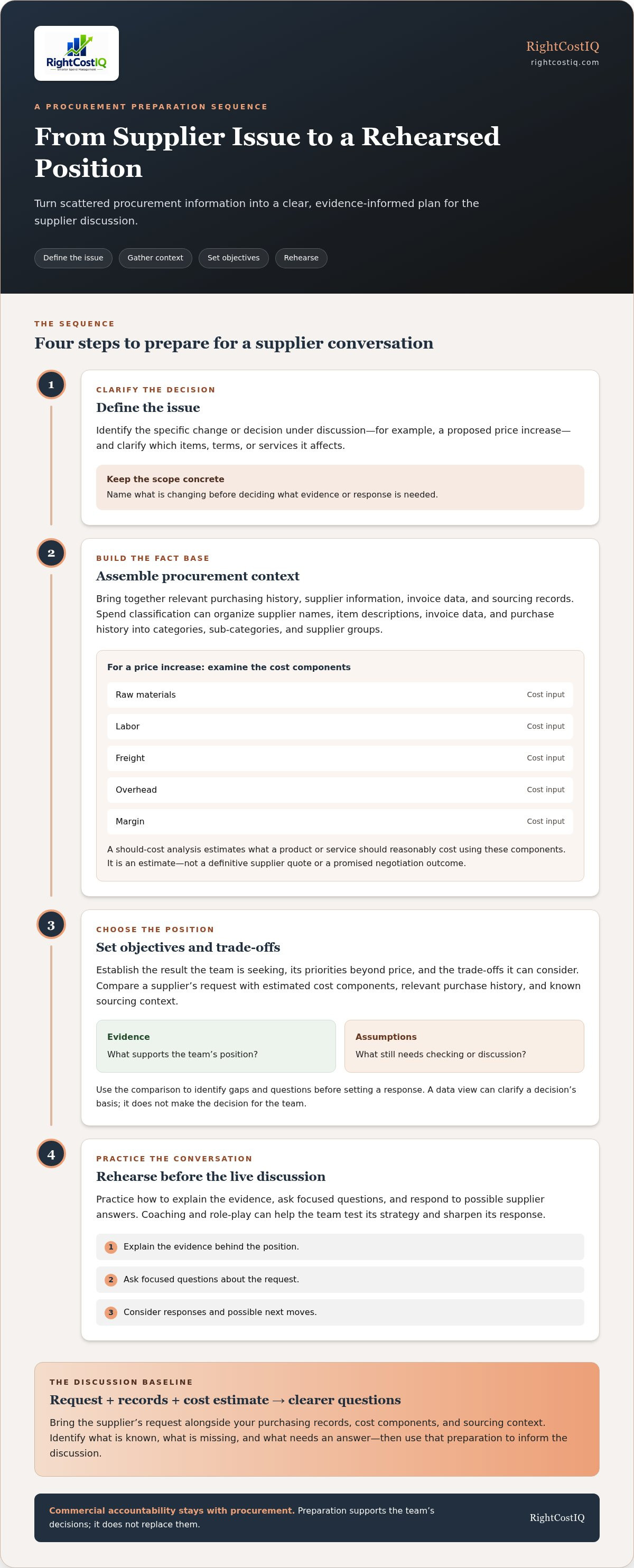
Supplier discussions are more productive when the team can connect its position to procurement evidence and has practiced how to present it. A repeatable preparation sequence turns scattered records into a clear plan: define the supplier issue, assemble relevant procurement context, set objectives, then rehearse. This keeps the conversation anchored in what the team knows, what it needs to learn, and which decisions it can make.
- Define the issue. Identify the specific change or decision under discussion, such as a proposed price increase, and clarify which items, terms, or services it affects.
- Assemble procurement context. Gather relevant purchasing history, supplier information, invoice data, and sourcing records. AI spend classification analyzes supplier names, item descriptions, invoice data, and purchase history to organize spend into categories, sub-categories, and supplier groups.
- Set objectives. Establish the result the team is seeking, its priorities beyond price, and the trade-offs it can consider. Separate evidence from assumptions so the opening position is defensible.
- Rehearse. Practice how to explain the evidence, ask focused questions, and respond to possible supplier answers before the live discussion.
Use procurement intelligence to establish the discussion baseline
Organized spend categories and supplier groups make relevant purchasing information easier to review together. A team can compare the supplier’s request with its own purchasing records, identify gaps, and determine which questions need answers before setting a response. The goal isn’t to treat a data view as a decision, but to make the basis for that decision clearer.
A should-cost analysis estimates what a product or service should reasonably cost based on raw materials, labor, freight, overhead, and margin. It is an estimate, not a definitive supplier quote or a promise of a particular negotiation outcome. To assess a proposed price increase, compare the request with estimated cost components, relevant purchase history, and known sourcing context. Identify the assumptions or changes that need explanation. For federal acquisitions, Government Contract Negotiation Guidelines provide a reference point for documenting price negotiation analysis in that specific setting.
Rehearse the negotiation before engaging the supplier
An AI-powered negotiation coach supports role-play and strategy testing. Build rehearsal scenarios around the team’s objectives and available cost evidence: practice presenting the analysis, asking the supplier to explain a cost driver, or responding if the supplier offers a different commercial term. Coaching makes preparation more deliberate, while the team applies its own judgment, relationship context, and accountability to decisions.
Use each practice round to refine the message, not to script a rigid exchange. If the evidence changes or a supplier provides new information, reassess the position. This is the practical value of Negotiation Assistance: it connects procurement intelligence to preparation, so buyers enter supplier discussions with a clearer baseline and a tested strategy.
How to Compare Negotiation Assistance Approaches for Procurement
No single support model fits every supplier discussion. The right choice depends on the gap: a team may need clearer cost evidence, more practice, a coordinated sourcing process, or direct representation. Compare approaches by what they enable and what procurement must still own.
| Approach | Primary need | Evidence requirements | Team involvement | Role in negotiation |
|---|---|---|---|---|
| Internal preparation | Use existing expertise and align stakeholders | Internal spend, supplier, contract, and sourcing records | High; the team gathers evidence, sets objectives, and leads the discussion | Builds the position and conducts the negotiation |
| Specialist coaching | Strengthen strategy, communication, and practice | Issue summary, objectives, and relevant supplier context | High; buyers rehearse and make decisions | Prepares the team to lead the conversation |
| Analytical tools | Organize procurement information and examine cost assumptions | Relevant spend, item, invoice, or cost inputs | Moderate to high; the team interprets outputs and applies context | Informs the position with structured analysis |
| External representation | Add direct negotiating capacity or an outside participant | Commercial objectives, authority, and detailed supplier context | Shared; the team sets direction and coordinates with the representative | An external party participates directly in supplier discussions |
Choose support according to the procurement gap
Start with the bottleneck, not the label attached to a service. If buyers know the facts but need negotiation practice, coaching and role-play can help them test how they’ll present their case. If supplier spend or price assumptions are unclear, relevant analysis can establish a more informed baseline. If sourcing messages, criteria, or stakeholder input are fragmented, a structured RFP workflow can organize the process and keep communications accessible.
These needs can overlap. A sourcing team, for example, may use analysis to understand a supplier’s proposal, then rehearse its questions before a clarification or negotiation meeting. Match support to the work: identify the gap, select the capability that addresses it, and clarify who owns the commercial decision.
Assess what the assistance enables and what remains with the team
Separate four functions when comparing options: analysis organizes or interprets evidence; rehearsal helps buyers practice strategy; workflow structures procurement activity; representation places an outside party directly in the negotiation. A tool that supports one function shouldn’t be assumed to provide the others.
RightCost IQ’s Negotiation Coaching supports role-play and strategy testing. Buyers can use negotiation coaching and strategy practice to prepare for supplier conversations, while applying their own context, judgment, and decision authority. Negotiation skill-building develops capability across discussions, while deal-specific procurement decision support applies evidence and preparation to a particular sourcing choice.
A Practical Checklist for Preparing a Supplier Negotiation
A concise negotiation brief helps the team distinguish evidence from interpretation and arrive with a shared plan. Use this checklist before a price discussion, renewal, or sourcing meeting. Keep confirmed facts, internal objectives, open questions, and assumptions in separate sections so the group can see what is established and what still needs validation.
Assemble the negotiation brief
- Define the decision. Summarize the supplier issue, the items or services affected, and the commercial decision the team needs to make. State the desired meeting outcome, such as understanding a proposed change or agreeing on next steps.
- Collect the relevant record. Bring together supplier details, invoice data, item descriptions, purchase history, and related sourcing or contract information where available. Keep the scope specific to the issue under discussion.
- Separate facts from assumptions. Record confirmed terms and data as facts. Label estimates, including any should-cost estimate, as estimates rather than confirmed supplier pricing. List open questions separately, such as which cost components changed and what evidence supports the supplier’s request.
- Set internal objectives. Agree on the team’s priorities, acceptable trade-offs, decision authority, and topics that require internal approval. Include non-price considerations relevant to the supplier relationship and business need.
- Plan the discussion process. Set the agenda, identify who will lead each topic, and decide how the team will capture answers and follow-up actions. For sourcing events, structured RFP communications can help keep supplier exchanges and evaluation criteria organized.
Set objectives and rehearse likely discussion paths
- Prepare focused questions. Tie each question to a fact gap or decision. For a requested price adjustment, ask which inputs have changed, the period the change covers, and how it relates to the items being purchased. Avoid presenting an assumption as a settled conclusion.
- Practice plausible responses. Rehearse how the team will present its position if the supplier provides supporting detail, disputes an assumption, or proposes a different term. Role-play helps test whether the message is clear and whether the team knows what information it needs next.
- Confirm ownership and follow-up. Decide who can make commitments, who records the discussion, and how unresolved questions will be tracked. Close the brief with the next decision point, not an assumed outcome.
This preparation turns Negotiation Assistance into a practical decision aid: the team can see the evidence, identify uncertainty, and enter the conversation with clear priorities. Review your procurement priorities as a starting point for identifying where preparation can be strengthened.
How RightCost IQ Connects Negotiation Coaching with Procurement Intelligence
Strong procurement preparation combines two disciplines: understanding the commercial context and deciding how to act on it. RightCost IQ offers procurement intelligence capabilities alongside Negotiation Coaching, an AI-powered tool for role-play and strategy testing. Coaching helps buyers practice a negotiation approach, while procurement analysis can help them assess the facts behind a supplier decision. These capabilities can inform the same preparation effort, but each serves a distinct purpose.
Connect negotiation practice with relevant cost and sourcing context
For a supplier price increase, Should Cost Analysis estimates what a product or service should reasonably cost based on raw materials, labor, freight, overhead, and margin. The estimate can inform questions about the supplier’s proposal, while the procurement team evaluates the assumptions and decides how to respond.
Negotiation Coaching adds a practice layer. Buyers can role-play how to present their position, test questions, and consider possible supplier responses before a live conversation. To make the exercise relevant, use the team’s actual objectives and available cost or sourcing evidence. Practice should sharpen judgment, not turn an estimate into a fixed demand or script every exchange.
For sourcing events, RightCost IQ’s RFP portal manages communications in a single data-driven environment. That capability organizes supplier communications, while coaching focuses on preparation and strategy testing. Teams can use AI-powered coaching when rehearsal is the priority and procurement intelligence to inform other parts of the decision. The capabilities are distinct, so teams can focus on the specific gap they need to address.
Move from evaluation to a focused next step
Start by naming the procurement challenge. Is the team responding to a supplier price increase, preparing for a sourcing event, or looking to practice a high-stakes discussion? Then identify what would help most: stronger cost context, a more organized RFP communication process, or rehearsal of the team’s strategy. This keeps the evaluation anchored to a practical need instead of a general desire to add technology.
RightCost IQ offers a 5-day free trial for teams evaluating its capabilities. Use the trial to consider how the available tools relate to your procurement priorities, without assuming a particular result. Negotiation Assistance is most useful when it supports a defined decision and gives the team a clearer basis for preparation.
To assess which procurement challenge to address first, review your procurement priorities.
Build a Stronger Foundation for the Next Supplier Decision
Each supplier discussion can sharpen the next one. After a negotiation, capture which assumptions held, what new information emerged, where internal priorities differed, and which questions remain unresolved. Record commitments and follow-up owners while the discussion is fresh. Reviewing these notes before the next supplier decision helps the team learn from its process instead of treating every conversation as a one-off.
That discipline turns Negotiation Assistance into a repeatable procurement capability. Start with one upcoming decision and pinpoint the gap most likely to constrain it: insufficient evidence, fragmented coordination, or a need to test the team’s strategy. Then focus preparation on that gap and assess what changed after the discussion. The goal is not to force every negotiation into the same playbook, but to build a process that adapts to the supplier, decision, and information available.
Use the procurement diagnostic to assess your priorities and identify a practical next step. A clear starting point can help your team prepare with greater purpose for supplier conversations.
Frequently Asked Questions
What does negotiation assistance mean in procurement?
In procurement, Negotiation Assistance is support tied to a specific supplier decision, rather than a general discussion of negotiation skills. It can help a team clarify what it needs to decide, organize relevant commercial context, and prepare questions or responses. For example, a renewal involving both pricing and service terms may require buyers to coordinate input from finance and operations before agreeing on a position.
When should a procurement team use negotiation assistance?
Use it when a supplier discussion presents a decision your team isn’t prepared to handle with its current information or capabilities. Signals can include unclear ownership of commercial terms, stakeholders working from different versions of supplier information, or a negotiation involving several connected priorities. First identify the decision at stake and the kind of support that would address the preparation gap.
Can AI help with supplier negotiation preparation?
Yes. An AI-powered negotiation coach supports role-play and strategy testing before buyers engage a supplier. For example, a buyer can practice explaining a position, refine a question, or test how a proposed response aligns with internal objectives. Treat the exercise as preparation, not a prediction of what a supplier will say. The procurement team still applies relationship context and human judgment to the actual discussion.
What information should buyers prepare before a supplier negotiation?
Prepare a concise record of the decision, the products or services involved, relevant supplier communications, and purchasing or invoice records that explain the context. Mark each point as confirmed, estimated, unresolved, or assumed. That distinction matters if a stakeholder’s recollection conflicts with a document or if an estimate is mistaken for an agreed commercial term. Also identify who can approve commitments during the discussion.
Is negotiation assistance the same as negotiation training?
No. Negotiation training develops skills that can apply across different discussions, while assistance is usually connected to a particular procurement decision or preparation need. A buyer may learn general techniques in training, then need help applying them to a supplier’s proposal, internal objectives, and available evidence. Coaching can bridge those needs through practice, while analysis and RFP workflow address different parts of procurement preparation.
What is a should-cost model in supplier negotiations?
A should-cost model estimates what a product or service should reasonably cost based on raw materials, labor, freight, overhead, and margin. Buyers can use the estimate as a reference when evaluating a supplier’s proposed price or preparing questions about an increase. It isn’t a supplier quote or proof that a particular price is correct. Teams should consider the assumptions behind the estimate before using it in a discussion.
Does negotiation assistance guarantee procurement savings?
No. Preparation and analysis can help buyers make informed decisions, but they can’t guarantee savings or dictate a supplier’s response. Outcomes depend on the proposal, evidence, commercial terms, and choices made by both parties. Set clear objectives beyond a target price, such as resolving open questions or agreeing on a review process. Evaluate the quality of the decision and the clarity of the agreed next steps, not savings alone.
Does RightCost IQ negotiate directly with suppliers?
RightCost IQ’s Negotiation Coaching is an AI-powered tool for role-play and strategy testing. It helps procurement teams prepare to conduct their own supplier discussions. Buyers apply the available context, make decisions, and communicate with suppliers. This distinguishes coaching and preparation from direct participation in a supplier negotiation.


