

What if stakeholder alignment depended less on sending more updates and more on making decision rights explicit? Managing stakeholder expectations in procurement is a governance process, not just a communications exercise. When teams submit conflicting requirements, revise them late, or expect savings, speed, and quality without agreeing on trade-offs, sourcing slows and commercial outcomes come under pressure.
Unclear ownership creates rework, and stakeholders can lose confidence when priorities or timelines shift without explanation. The solution is to establish shared expectations before sourcing begins, then make decisions and changes visible throughout the process.
This guide shows you how to map stakeholder priorities, define requirements and decision rights, and set a predictable rhythm for updates. You’ll also learn how to resolve trade-offs transparently while keeping procurement accountable for value, risk, and process discipline. Procurement analytics can ground discussions in evidence, while structured RFP management and negotiation assistance help turn aligned priorities into sourcing decisions. The result is a practical framework for securing business alignment without losing sight of commercial outcomes.
Key Takeaways
- Managing stakeholder expectations in procurement starts with separating mandatory requirements from preferences and negotiable specifications.
- Map each stakeholder’s priorities and decision role before sourcing to reduce late changes and approval bottlenecks.
- Choose an alignment approach that fits sourcing complexity, balancing speed with traceability and clear decision ownership.
- Use defined workflow gates to clarify who owns each decision, what evidence is needed, and when updates are due.
- Track decision delays, requirement changes, and approval rework alongside stakeholder feedback and sourcing outcomes.
Why Managing Stakeholder Expectations in Procurement Determines Sourcing Success
Procurement decisions affect budgets, operations, risk exposure, and the experience of the people who rely on a supplier. Managing stakeholder expectations in procurement means aligning those groups on business needs, constraints, decision rights, and measures of success before sourcing choices are made. Without that alignment, a sourcing process can follow its steps correctly and still be judged a failure because participants expected different outcomes.
Expectation alignment is the governance discipline that improves decision quality by making priorities, trade-offs, authority, and success measures explicit, so sourcing outcomes can be assessed against agreed objectives. Stakeholder satisfaction matters, but it is not a substitute for procurement performance. A popular choice may not meet cost, risk, or operational objectives; a commercially sound outcome may still require careful explanation if it does not satisfy every preference. Clear objectives and controls provide the basis for evaluating both.
Which stakeholders shape procurement expectations?
Stakeholder management involves identifying relevant groups, understanding their influence, and choosing how to engage them. These Stakeholder Management Principles apply directly to procurement, where people contribute different expertise and authority. Map each person by role rather than assuming everyone involved has the same decision power.
- Executive sponsors set strategic direction, establish the business case, and may approve major decisions.
- Procurement owns the sourcing process, market engagement, commercial evaluation, and negotiation discipline.
- Finance tests budget fit, cost assumptions, and the financial measures used to assess value.
- Legal advises on contractual terms, obligations, and risk considerations.
- Operations and technical teams define delivery needs, functional requirements, and practical constraints.
- End users describe day-to-day needs and help assess whether a proposed solution will work in practice.
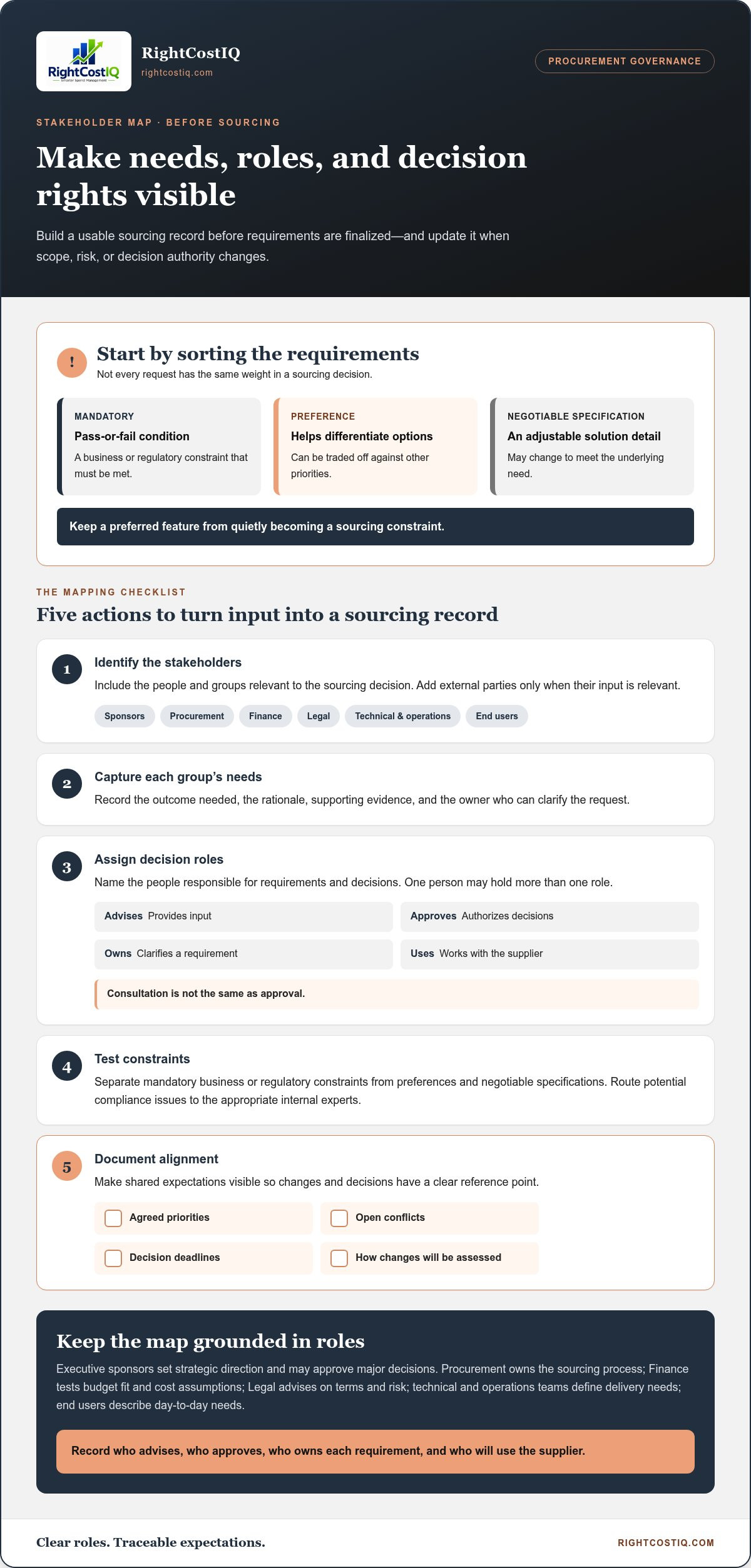
Record who advises, who approves, who owns each requirement, and who will use the supplier. One person may fill more than one role, but making those roles visible prevents consultation from being mistaken for approval.
What goes wrong when expectations remain implicit?
Unstated success measures create competing definitions of value. Finance may focus on cost control, operations on continuity, and users on functionality. If the team hasn’t agreed how to balance these priorities, supplier proposals may be assessed against shifting criteria, and the final choice can prompt disputes even when the evaluation was carefully conducted.
Late requirements and changing priorities are usually process signals, not grounds for blame. A new technical need may emerge as users review the scope; a budget constraint may become clear during approval. Friction grows when changes have no recorded owner, impact assessment, or decision path. Teams then repeat analysis, delay approvals, or reopen decisions because participants cannot see what changed or why.
Early alignment makes trade-offs visible; it doesn’t guarantee consensus. It gives the accountable decision-maker a clear basis to resolve disagreements, document the rationale, and communicate the implications. Procurement analytics, including category cost benchmarking, can help ground commercial discussions in evidence rather than assumptions. That discipline protects sourcing objectives while giving stakeholders a transparent view of how their priorities shaped the outcome.
How to Map Procurement Stakeholders, Priorities, and Decision Rights
A stakeholder map turns broad input into a usable sourcing record. Build it before requirements are finalized, then update it when scope, risk, or decision authority changes. This sequence gives procurement a consistent basis for managing stakeholder expectations in procurement without treating every request as equally binding:
- Identify stakeholders: Include sponsors, procurement, finance, legal, technical and operational teams, and end users. Add external parties only when their input is relevant to the sourcing decision.
- Capture needs: Record the outcome each group needs, its rationale, supporting evidence, and the owner who can clarify the request.
- Assign decision roles: Name requirement owners, advisers, approvers, and the person accountable for the final decision.
- Test constraints: Separate mandatory business or regulatory constraints from preferences and negotiable specifications. Route potential compliance issues to the appropriate internal experts.
- Document alignment: Record agreed priorities, open conflicts, decision deadlines, and how changes will be assessed.
Classify each requirement clearly. A mandatory requirement is a pass-or-fail condition; a preference helps differentiate options but can be traded off; a negotiable specification describes a solution that may be adjusted to meet the underlying need. This prevents a preferred feature from quietly becoming a sourcing constraint.
How do you uncover the needs behind stakeholder requests?
Ask what business outcome each requirement supports, then record its rationale, evidence, owner, and consequence if omitted. For example, a request for a specific service level may reflect a real operational dependency or simply a familiar specification. Those situations lead to different sourcing criteria. Surface conflicting needs early, then distinguish essential criteria from preferences before they enter the RFP. A structured RFP management framework helps govern how these inputs become approved requirements.
Use a stakeholder-priority matrix to compare influence, impact, urgency, and position on key outcomes such as cost, continuity, functionality, and risk. Score each dimension using a consistent internal scale, and note the evidence behind each assessment. The matrix is a discussion aid, not an automatic ranking: a lower-influence group may still own critical user requirements, while a high-influence stakeholder may have limited technical expertise.
How should procurement clarify decision rights?
Use a RACI-style model to define shared responsibilities: identify who is responsible for the work, accountable for the decision, consulted for expertise, and informed of the result. Assign one accountable approver for each material decision where possible. Record escalation authority and deadlines before approvals are due, so unresolved disagreements have a defined route rather than stalling sourcing.
Keep the map practical: use one record for roles, priorities, requirement classifications, evidence, and pending decisions. Review it at sourcing gates and log changes with their owner and rationale. Procurement analytics can help test commercial assumptions and make trade-offs more evidence-based. A procurement process diagnostic can help identify where stakeholder inputs and decision controls need improvement.
Compare Alignment Approaches for Conflicting Procurement Expectations
The right alignment cadence depends on decision risk and stakeholder interdependence. Routine updates can move through written channels, while high-impact choices involving several functions often need explicit governance. The goal isn’t to hold a meeting for every question or seek universal agreement. It’s to match the level of discussion and documentation to the decision being made.
| Approach | Speed | Traceability | Decision clarity | Best suited to |
|---|---|---|---|---|
| Informal, ad hoc updates | Fast for simple questions | Low unless decisions are recorded | Can be unclear if ownership is informal | Routine coordination and low-complexity sourcing |
| Scheduled stakeholder forums | Depends on meeting cadence | Moderate, strengthened by notes and action logs | Good when the right decision-makers attend | Conflicting requirements and shared trade-offs |
| Documented decision governance | Structured, with defined gates | High when evidence and rationale are retained | High when roles and escalation routes are explicit | Complex, higher-risk, or cross-functional sourcing |
Consensus-seeking can surface important concerns, but it can also prolong decisions when every preference is treated as a veto. A procurement-led decision can preserve commercial discipline, yet it may miss operational realities if subject-matter input is limited. Use consultation to improve the evidence and identify consequences; keep decision authority with the named accountable owner. The appropriate balance depends on the sourcing context, not a fixed rule.
When is a working session better than asynchronous updates?
Use a facilitated working session when requirements conflict, assumptions need testing, or a trade-off affects several teams. Send written updates for routine status, evidence distribution, and decisions already covered by governance. Keep meetings focused: circulate the unresolved choices, identify the decision owner, and specify the evidence participants need to assess each option. End with recorded decisions, actions, owners, and deadlines.
How can teams make trade-offs transparent?
Compare each viable option against agreed priorities, including cost, service, quality, risk, timing, and operational impact. Make trade-offs explicit rather than implying that one option can maximize every outcome. For example, a faster delivery schedule may narrow the available options or change the cost profile. Procurement analytics, such as category cost benchmarking, can help test commercial assumptions and give stakeholders a common evidence base.
For each decision, document the options considered, evidence reviewed, decision owner, and rationale. This record helps stakeholders understand why a choice was made, including when their preferred option wasn’t selected. If supplier discussions require coordinated positions, negotiation assistance can support disciplined preparation. Teams reviewing broader process gaps can also use a procurement process diagnostic as a practical starting point.
A Practical Workflow for Managing Procurement Expectations from Intake to Decision
A repeatable workflow makes expectations actionable at each sourcing gate. For every stage, record four items: the accountable owner, evidence required, decision deadline, and people who need the outcome. This gives stakeholders a clear view of progress and gives procurement a controlled way to manage changes without losing the commercial objective.
- Intake: The business sponsor owns the request. Capture the business outcome, scope boundaries, constraints, stakeholders, assumptions, and unresolved questions. Set an intake review date and send the summary to requirement owners and decision-makers.
- Requirements approval: Requirement owners provide specifications and supporting rationale; procurement consolidates them into supplier-facing criteria. The accountable approver signs off against agreed success measures by a defined deadline. Share the approved baseline with contributors and approvers.
- Sourcing launch and updates: Procurement owns the sourcing plan and status communication. Use the approved requirements, evaluation method, and schedule as the baseline. Send updates to the agreed stakeholder group, highlighting decisions needed, evidence available, and deadlines.
- Evaluation: Procurement coordinates the assessment; technical, operational, finance, and other relevant contributors evaluate their assigned criteria. Retain evaluation evidence and open issues. Set a deadline for each input and communicate consolidated findings to the decision-maker.
- Final decision: The named decision-maker reviews the recommendation, trade-offs, and supporting record. Document the rationale, approvals, conditions, and next steps, then communicate the outcome to affected stakeholders.
How should procurement set expectations at intake?
Confirm the outcome before converting the request into supplier criteria. Define what’s in scope, what’s excluded, the key constraints, who will contribute or approve, and the decision timetable. Agree how success will be evaluated, then record assumptions and unanswered questions with an owner and resolution date. Structured RFP management can carry approved inputs into a disciplined sourcing process.
Keep the intake record active. If a question remains open, show its status rather than treating an assumption as settled. Procurement can use category cost benchmarking and analytics to test commercial assumptions and clarify trade-offs before requirements are finalized. Evidence at this stage helps prevent a preference or untested expectation from becoming a supplier criterion by default.
What should teams communicate when requirements change?
Use change control: log the requested change, its rationale, owner, and impact on scope, evaluation, timing, and risk. Identify which prior decisions it affects and who must approve it. Don’t revise supplier criteria or the sourcing baseline until the required approval is recorded. Then update the decision record and notify affected stakeholders through the agreed channel, stating what changed and what action is needed.
This process keeps managing stakeholder expectations in procurement tied to documented decisions, not informal assumptions. It also makes the consequences of a change visible before teams commit to a new direction. A concise change notice should identify the revised requirement, approval status, impact assessment, and any resulting deadline or decision update.
Measure Alignment and Improve Procurement Stakeholder Governance
Measurement shows whether agreed expectations are being followed in practice, not just documented. Track a small set of indicators across sourcing stages, then interpret them alongside stakeholder feedback and procurement outcomes. A rise in requirement changes, for example, may reflect weak intake, but it could also reflect a genuine change in business need. Context matters.
Which indicators reveal expectation misalignment?
Monitor leading indicators that expose friction while teams can still respond. Define each measure consistently so comparisons across sourcing events are meaningful.
- Decision latency: Time between a request for a decision and the recorded response, including overdue approvals.
- Requirement changes: Changes after requirements approval, with the stage, rationale, and impact recorded.
- Unresolved actions: Open stakeholder actions past their agreed due dates.
- Approval rework: Submissions returned for clarification, missing evidence, or changed criteria.
- Clarification volume: Repeated questions that may indicate ambiguous requirements or inconsistent understanding.
Compare planned and actual stakeholder involvement at intake, requirements approval, evaluation, and final decision. Pair the process data with stakeholder feedback and sourcing outcomes, such as whether the selected option met the agreed objectives. No single measure proves success or failure. Establish a baseline before changing the process, then assess later results against comparable sourcing activity rather than assuming an improvement.
How can procurement turn alignment into a sustained capability?
After each sourcing decision, review where delays, scope changes, unresolved actions, or approval friction occurred. Identify the underlying process gap, assign an owner, and set a date to review the corrective action. For example, recurring late technical input may call for earlier subject-matter involvement at a defined sourcing gate, not simply more status emails.
Standardize the controls that make alignment repeatable: intake questions, decision records, escalation routes, and communication expectations. Keep them proportionate to sourcing complexity, and refine them when retrospectives show that a control creates work without improving clarity. This keeps stakeholder governance operational rather than turning it into documentation for its own sake.
Evidence can sharpen the commercial discussion. Procurement category cost benchmarking and analytics help teams assess cost assumptions and compare trade-offs; vendor performance tracking provides relevant performance insight. RightCostIQ’s RFP management and negotiation assistance, cost benchmarking and analytics, and vendor performance tracking can support teams seeking more structured sourcing execution, commercial insight, and performance visibility.
Use a diagnostic to identify where your procurement process can improve its alignment controls and decision flow. Assess your procurement process.
Make Stakeholder Alignment a Procurement Advantage
The next sourcing cycle is an opportunity to turn stakeholder alignment into a durable operating capability. Managing stakeholder expectations in procurement works best when teams treat governance as part of how decisions are made, not as a one-time communication task. Choose one recurring friction point, assign an owner to improve it, and carry the learning into the next sourcing event.
RightCostIQ’s RFP management and negotiation assistance, procurement category cost benchmarking and analytics, and vendor performance tracking and price risk management can support disciplined sourcing decisions with commercial and supplier-performance insight. Use these capabilities to strengthen the link between stakeholder priorities and procurement outcomes while keeping accountability for decisions clear.
Ready to identify where your process can improve? Start your free procurement diagnostic to assess opportunities for stronger alignment and more effective procurement governance. Take this focused next step to build momentum toward better-informed sourcing decisions.
Frequently Asked Questions
Who is responsible for managing stakeholder expectations in procurement?
Procurement typically coordinates the process, while the business sponsor remains accountable for the business need and the designated approver owns the final decision. Responsibility is shared in practice: technical specialists validate feasibility, finance assesses budget implications, and end users explain operational needs. For a cross-functional purchase, name one decision owner and a procurement lead who manages the process record. This prevents stakeholder input from being mistaken for approval.
How do you handle unrealistic stakeholder expectations in procurement?
Translate the expectation into a testable outcome, then compare it with available evidence, constraints, and alternatives. If a stakeholder expects a lower price, faster delivery, and expanded service at once, show which combinations the market evidence supports and what each option may require the business to trade. Ask the sponsor to rank priorities. This makes the discussion objective and gives decision-makers a basis for resetting expectations without dismissing the underlying need.
How often should procurement update stakeholders during a sourcing process?
Set update frequency according to sourcing pace and decision risk, then keep it predictable. A defined update after each major milestone may be enough for a stable, low-complexity purchase; active sourcing with pending approvals may need more frequent status notes. Also communicate promptly when a decision is overdue, a material issue emerges, or the schedule changes. Each update should distinguish information for awareness from actions requiring a response.
What should a procurement stakeholder expectation document include?
Include the business objective, scope boundaries, evaluation principles, decision authority, key assumptions, open questions, and a record of approved changes. Add a version date and change log so readers can identify the current baseline and see what was revised. Use plain labels such as “required” and “preferred” consistently. For example, note whether a service feature is essential to operations or simply desirable, and identify who owns that classification.
What happens if stakeholders change procurement requirements after approval?
Treat the request as a change, not an automatic amendment. Assess its effect on supplier criteria, evaluation comparability, schedule, budget assumptions, and risk, then obtain approval from the authorized decision-maker. If suppliers have already received the original requirements, communicate any approved revision consistently to the affected participants and preserve the updated record. Depending on the change, the team may need to revisit evaluations or timelines before proceeding.
How can procurement balance stakeholder priorities with cost objectives?
Compare options against agreed business outcomes rather than selecting the lowest quoted price by default. Consider lifecycle cost assumptions, service requirements, implementation effort, and relevant risks alongside the initial commercial offer. Category cost benchmarking can help test whether pricing assumptions are realistic, while stakeholders clarify which benefits justify a cost premium. Make the trade-off explicit: document what the selected option optimizes and which preferences it does not meet.
How can procurement measure whether stakeholder expectations are aligned?
Look for consistent understanding as well as process results. Ask key participants to independently state the objective, decision owner, and criteria before a major approval; gaps between answers can reveal misalignment early. Compare that feedback with indicators such as late changes, repeated clarifications, and delayed approvals. Review the results across comparable sourcing events and against a baseline. A single smooth project is not enough to show that governance has improved.


