
In 2026, 60% of health system supply chain leaders identified rising costs as their primary challenge, according to Advisory Board. Yet reducing spend without accounting for clinical requirements, operational continuity, and supplier performance can create new risks. Effective healthcare purchasing optimization connects cost evidence with the needs of the people who deliver and support care.
Limited category-level visibility makes that alignment difficult. Procurement teams may not know how costs compare across suppliers, while clinical, finance, and operational stakeholders may use different criteria to assess the same decision. Market data is useful when it leads to practical sourcing and negotiation actions.
This guide offers a framework for identifying purchasing opportunities, aligning stakeholders on decision criteria, and strengthening supplier oversight. You’ll learn how to use category cost benchmarking and analytics to inform strategy, turn market evidence into RFP requirements and negotiation priorities, and track supplier performance over time. The goal is disciplined purchasing decisions that balance cost evidence with clinical and operational needs.
Key Takeaways
- Define purchasing success across clinical fit, operational continuity, financial performance, and supply requirements, not price alone.
- Bring demand, specifications, utilization, contract terms, supplier performance, and market context into a shared decision process.
- Use a structured comparison to assess savings opportunities. Treat benchmark gaps as prompts for investigation, not proof of overpricing.
- Prioritize healthcare purchasing optimization opportunities by evidence quality, addressability, stakeholder readiness, and business relevance.
- Connect category analysis to practical next steps, from RFP development and negotiation preparation to ongoing supplier performance review.
What Healthcare Purchasing Optimization Means for Provider Organizations
Healthcare purchasing optimization is the disciplined use of cost, demand, specification, and supplier evidence to make sourcing decisions that support clinical requirements, operational continuity, financial objectives, and supply needs. It applies to how hospitals, health systems, and other provider organizations plan and manage organizational purchasing. It does not mean selecting an insurance plan or choosing healthcare services as a patient.
Purchasing optimization is evidence-led sourcing that balances financial value with clinical suitability, operational fit, and dependable supply. A lower quoted price may look attractive in isolation, but it does not show whether the proposed option meets the needs of the people who use or manage it.
Fragmented spending makes that assessment harder. Similar requirements may be sourced by different teams using inconsistent specifications or contract terms, which makes comparisons less meaningful. When category costs and supplier performance are not visible together, leaders can struggle to distinguish a genuine opportunity from a difference in scope, service, or operating context. Benchmarking can help frame the investigation, but local evidence and clinical judgment remain essential.
The concept also connects to value-based decision-making. Value-based health care links costs with outcomes, a useful perspective for purchasing teams assessing whether a financial decision supports broader care priorities. Procurement analysis informs the decision; it does not determine clinical suitability or replace regulatory decision-making.
Which healthcare purchasing decisions fall within scope?
The scope is organizational sourcing, not the delivery of medical care or the sale of medical goods. Procurement teams can develop category strategies, structure RFP requirements, prepare for supplier negotiations, and review supplier performance against agreed expectations. An RFP, for example, can make requirements and evaluation criteria explicit before responses are compared. Clinical teams retain authority over clinical suitability and care requirements, while procurement coordinates the sourcing evidence and process.
- Category strategy: Define the purchasing area, spending context, and decision criteria.
- RFP design: Translate organizational requirements into consistent supplier questions and evaluation measures.
- Negotiation preparation: Use relevant cost and market evidence to set discussion priorities.
- Supplier review: Assess performance against the organization’s expectations and sourcing objectives.
Why cost reduction alone is an incomplete objective
Price is only one part of a purchasing decision. An evaluation may also account for specification fit, implementation demands, service requirements, continuity, and performance over the purchasing period. A narrow savings target can hide these trade-offs, especially when teams compare offers built on different assumptions or overlook the work needed to adopt a change. Use current, credible sources for any quantified healthcare cost claim, and do not treat a benchmark gap as proof that a supplier is overpriced.
Optimization improves decision discipline rather than prescribing the cheapest option. It gives procurement, finance, operations, and clinical stakeholders a shared basis for examining trade-offs, documenting requirements, and identifying what evidence is still needed before a sourcing decision advances.
How Clinical Demand and Procurement Data Shape Better Decisions
A sourcing decision is only as reliable as the evidence behind it. For healthcare purchasing optimization, that evidence should connect what an organization buys with why it buys it, how demand changes, and how suppliers perform. A category view is more useful than a price file alone because it puts commercial conditions alongside operational and clinical requirements.
Comparable category data turns purchasing comparisons into decisions teams can explain, test, and act on. Build that view by bringing together:
- Demand and utilization: What is needed, where it is needed, and how patterns vary over time.
- Specifications: Which requirements are essential and which allow alternatives.
- Contract terms: Scope, pricing structure, renewal timing, and service commitments.
- Supplier performance: Whether delivery, service, and other agreed expectations are being met.
- Market context: Relevant price trends and conditions that may affect sourcing timing or negotiation priorities.
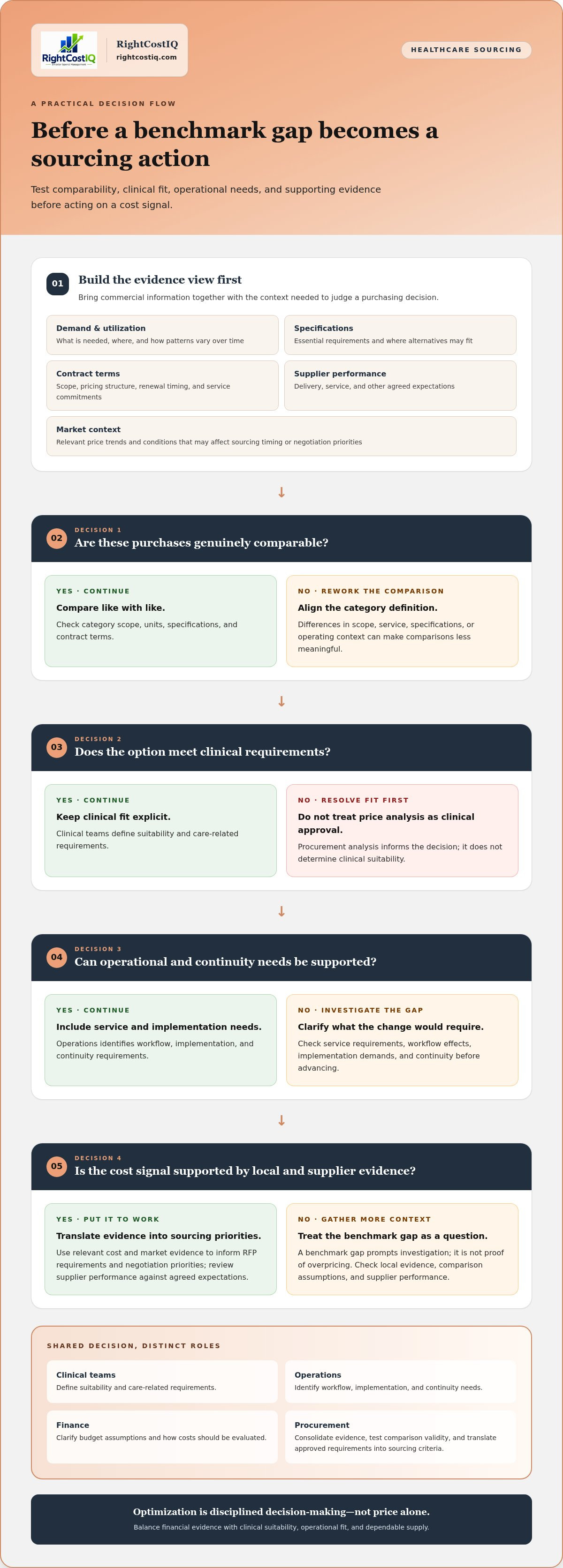
Each stakeholder contributes a different perspective. Clinical teams define suitability and care-related requirements. Operations identifies workflow, implementation, and continuity needs. Finance clarifies budget assumptions and how costs should be evaluated. Procurement consolidates the evidence, tests whether comparisons are valid, and turns approved requirements into sourcing criteria. Name these roles early to reduce late-stage disagreements about what a proposal must satisfy.
Build a usable healthcare category baseline
Start by grouping purchases that are genuinely comparable, not merely those with similar descriptions. Document the category scope, units of measure, included services, contract conditions, and relevant time period. Two records with similar labels, for example, may cover different service levels or purchasing terms, making a direct price comparison misleading. Flag missing fields and inconsistent descriptions before interpreting differences. Category benchmarking and analytics can then help identify where further investigation may be useful.
A baseline should also distinguish observed spend from addressable opportunity. Recorded spend describes what has been purchased; it does not show automatically what can be changed. Existing commitments, fixed requirements, demand patterns, and stakeholder readiness may limit or delay action. Classify findings as addressable, conditionally addressable, or not yet actionable, and record the assumptions behind each classification. This gives category strategy a more credible starting point than treating every dollar as immediately negotiable.
Bring clinical requirements into sourcing criteria
Before issuing an RFP, turn stakeholder input into clear, measurable requirements. Separate mandatory clinical criteria from operational preferences and commercial evaluation factors. This helps suppliers respond consistently and makes proposal reviews more transparent. Document who approves each requirement, who evaluates responses, and how exceptions will be assessed. Clinical approvers retain authority over suitability; procurement applies the agreed process to compare commercial and operational responses.
For example, a team might identify a required performance standard, a preferred implementation approach, and a commercial term to evaluate. Recording each separately helps prevent a preference from being mistaken for a clinical necessity, or a low price from overriding an essential requirement. The result is a sourcing baseline that supports informed decisions and gives negotiation teams a clear record of the criteria behind them.
How to Evaluate Savings Opportunities Without Sacrificing Fit
A lower quote is a reason to investigate, not an automatic reason to switch suppliers. In healthcare purchasing optimization, clinical suitability and continuity should be decision gates: if an option fails an essential requirement, it should not advance to commercial scoring or negotiation. Once those gates are met, compare the full offer, including implementation effort, service dependencies, and performance expectations.
A benchmark signal points to a question; a validated savings opportunity stands up to checks for comparability, fit, and operational feasibility. Use a consistent scorecard to keep teams focused on the same decision factors:
| Evaluation area | What to assess |
|---|---|
| Price | Quoted rates, included scope, pricing structure, and relevant contract terms. |
| Specification fit | Whether the offer satisfies approved clinical and technical requirements. |
| Service requirements | Included support, service responsibilities, and dependencies on internal teams. |
| Continuity | Transition considerations, supply reliability, and the effect of a change on operations. |
| Total cost considerations | Implementation demands, ongoing support, and other costs within the evaluation scope. |
Interpret benchmarks in context
Before treating a price difference as actionable, align the comparison on scope, purchasing volume, timing, contract terms, and service assumptions. A quote for a different level of support or volume commitment may not be comparable, even if both entries share a category label. Check the underlying data and document adjustments or exclusions so reviewers can understand how the comparison was constructed.
An outlier is a prompt to investigate. It may point to a data-quality issue, a different commercial arrangement, or a genuine opportunity for discussion. Should-cost analysis can add structure by examining the components and assumptions behind a cost estimate. Healthcare cost benchmarking can support category analysis, but interpret any benchmark within its scope and context. Do not present third-party figures as universal targets or guaranteed savings.
Balance commercial terms with operational risk
Price comparisons are incomplete without supplier performance and change requirements. Review relevant delivery and service history, transition effort, operational dependencies, and the organization’s resilience needs. A commercial improvement may be less attractive if it requires a transition the organization cannot support or weakens an important continuity requirement.
Make trade-offs explicit. Record which criteria are mandatory, which can be scored, who accepts each risk, and what evidence supports that judgment. Clinical stakeholders should confirm suitability; operations should assess workflow and continuity; finance and procurement can evaluate commercial terms and assumptions. If a proposal misses an essential requirement, document why it stops. If it meets the gates but involves a trade-off, agree on the acceptable threshold and approval owner before negotiation.
This process separates an appealing price from a defensible sourcing decision. It also gives negotiation teams specific issues to address, such as unclear scope, a service assumption, or a price component that differs from the comparison basis.
A Practical Roadmap for Healthcare Purchasing Optimization
A repeatable process turns a promising category finding into a managed sourcing decision. Healthcare purchasing optimization works best when teams establish the evidence, requirements, ownership, and review measures before approaching suppliers. This keeps the initiative grounded in organizational priorities instead of letting a savings target drive the process alone.
- Select and prioritize the opportunity. Assess addressability, evidence quality, stakeholder readiness, and business relevance. A category with clear spend data but unresolved requirements may need more groundwork than a smaller opportunity with strong evidence and aligned stakeholders. Record why the category is under consideration and what would make it actionable.
- Validate the baseline and requirements. Review purchasing data with finance, procurement, operations, and clinical stakeholders. Confirm what the figures include, define the required scope, and document essential requirements before setting targets. Treat the initial analysis as a working baseline, not a promise of a particular outcome.
- Choose the sourcing path. Decide whether to negotiate under existing terms, review market evidence, or invite competitive proposals. An RFP is useful when requirements are defined and supplier responses can be compared against consistent criteria. RFP management support can help structure the process and connect proposal evaluation with negotiation preparation.
- Set decision gates and measures. Assign an accountable owner, identify who approves requirements, and establish gates for clinical suitability, operational feasibility, and commercial evaluation. Define how the team will assess proposals and which measures it will review after implementation.
- Review execution and supplier performance. Compare results with the agreed baseline and record deviations, including changes in scope, demand, or supplier performance. Use the findings to refine future requirements, category strategy, and supplier discussions.
Move from opportunity to structured sourcing
Validate an opportunity with stakeholders and baseline data before setting targets. Confirm that the purchasing scope is understood and the evidence supports a sourcing action. If competitive proposals can address the requirements, use an RFP to make those requirements explicit and create a consistent basis for evaluation. If key evidence is incomplete, resolve the gaps before comparing suppliers or setting commercial expectations.
Governance matters as much as the sourcing method. Name the initiative lead, requirement approvers, evaluators, and final decision owner. Establish the evidence required at each gate, such as approved specifications before release or documented evaluation criteria before proposal review. Clear accountability reduces rework and keeps clinical, operational, and commercial decisions with the appropriate stakeholders.
Track execution and supplier performance
A sourcing decision is not complete when terms are agreed. Assign owners to commercial commitments, operational measures, and the review cadence. Compare post-decision results with the baseline using consistent definitions, and document deviations rather than attributing every change to the sourcing action. Supplier performance tracking can surface issues for follow-up and inform the next category review.
Use the completed review to update assumptions, sourcing criteria, and negotiation priorities. To structure your organization’s next category assessment, start a free procurement diagnostic.
How RightCostIQ Supports Healthcare Purchasing Optimization
RightCostIQ supports healthcare purchasing optimization by connecting procurement evidence to sourcing and execution. Category cost benchmarking and analytics help teams examine sourcing questions and inform category priorities. RFP management and negotiation assistance help turn defined requirements and market evidence into structured supplier engagement. Procurement and vendor performance tracking keep attention on execution after an award decision.
This work supports, rather than replaces, internal decision-making. Clinical stakeholders determine clinical suitability and care requirements. Finance, operations, and procurement contribute budget, workflow, and sourcing considerations. RightCostIQ’s procurement support helps organize commercial analysis and sourcing activity around those inputs, without making clinical or regulatory decisions.
Connect category evidence to sourcing and negotiation
Category cost benchmarking gives teams a basis for examining pricing differences, reviewing assumptions, and preparing negotiation priorities. It can help identify questions for supplier discussions, but it does not prove a supplier is overpriced or establish guaranteed savings. The analysis is most useful when its scope and comparison conditions are clear.
When competitive proposals can address defined requirements, structured RFP management helps make the process more consistent. Clear requirements and evaluation criteria give stakeholders a common basis for reviewing responses and identifying terms to negotiate. A practical RFP framework connects requirements, proposal assessment, and sourcing decisions instead of treating the RFP as a standalone document.
Negotiation assistance helps procurement teams use category findings to organize discussion points, clarify assumptions, and focus on relevant commercial terms. The goal is better-prepared sourcing decisions, not a predetermined outcome. Clinical and operational criteria remain part of the organization’s evaluation throughout.
Maintain visibility after award decisions
An award establishes a decision; ongoing review shows how execution compares with expectations. Procurement and vendor performance tracking can help teams monitor agreed commercial and operational measures, record deviations, and determine which issues need follow-up. Clear owners for commitments and review activities make that oversight actionable.
Market price trending and forecasting can inform planning by helping teams consider potential price movement when reviewing timing, budgets, and sourcing priorities. Trends are inputs for risk planning, not predictions with guaranteed accuracy. Interpret them alongside contract conditions, category evidence, and organizational requirements.
RightCostIQ connects benchmarking, RFP management, negotiation preparation, price-risk analysis, and supplier oversight to support healthcare procurement strategy and execution. Clinical, finance, and operational leaders retain their respective decision roles.
To assess procurement opportunities and identify potential next steps, start your free procurement diagnostic.
Turn the Next Opportunity Into a Clear Action Plan
The next step in healthcare purchasing optimization is to select one category where better evidence could clarify a real decision. Define the question, identify who needs to contribute, and agree on what a useful outcome would look like before starting. A focused starting point helps teams build a repeatable approach without assuming every opportunity is ready for sourcing.
RightCostIQ provides procurement category cost benchmarking and analytics, along with RFP management, negotiation assistance, and vendor performance tracking. These services connect analysis with sourcing execution and ongoing review. Clinical leaders retain authority over care requirements, while procurement, finance, and operations apply their expertise to commercial and operational choices.
Build momentum with a next step your team can own: clarify the category, the evidence needed, and the decision-makers to involve. Start your free procurement diagnostic to assess potential procurement opportunities and identify a practical path forward.
Frequently Asked Questions
Is healthcare purchasing optimization the same as cutting costs?
No. Healthcare purchasing optimization improves the quality and discipline of purchasing decisions, while cost cutting focuses narrowly on reducing expenditure. An organization might optimize a category by simplifying purchasing channels or correcting mismatched contract terms, even if its immediate budget does not fall. The practical test is whether the decision improves value and supports provider requirements, not whether it produces the lowest short-term spend.
Can a small healthcare organization optimize purchasing without a large procurement team?
Yes. A small organization can start with one purchasing category and a defined review process rather than building a large procurement function. Assign an accountable lead, involve staff who understand day-to-day use, and review purchasing records and contract terms. A focused effort can reveal practical process changes, such as aligning order practices with existing agreements, before the organization takes on a broader sourcing initiative.
How do group purchasing organizations fit into healthcare purchasing optimization?
Group purchasing organizations can provide a contracting route for participating healthcare organizations, but access to a contract does not establish that it fits a provider’s needs. Review the agreement’s scope, terms, and applicability alongside actual purchasing patterns and internal requirements. That review can help teams decide whether to use an available contract, gather more information, or pursue another sourcing path that better matches the organization’s situation.
Does healthcare purchasing optimization require switching suppliers?
No. A supplier change is only one possible outcome. Teams can first examine whether purchasing follows contract terms, whether ordering is fragmented, or whether negotiations could address a specific concern. For example, improving compliance with an existing agreement may be more practical than transitioning to a new supplier. Any proposed change should account for approval requirements, transition capacity, and effects on established workflows.
What data is useful for healthcare purchasing optimization?
Useful records include purchase orders, invoices, contract versions, amendments, credits, and transaction-level descriptions. These details can help explain why recorded spend differs from the terms teams expect to apply. Keep the time period and category definitions consistent, and flag missing or duplicated records before drawing conclusions. A short data dictionary for units, item descriptions, and contract references can make recurring reviews easier to interpret.
How can healthcare leaders tell whether a purchasing opportunity is actionable?
An opportunity is actionable when leaders can identify a decision owner, establish a credible baseline, and describe a feasible next step. Check whether required approvals are in place, whether the organization can act within the relevant contract or planning window, and whether the expected change can be monitored. If a key assumption remains unresolved, assign someone to investigate it before moving the opportunity into a sourcing or negotiation plan.


