

A polished RFP can still be a poor investment. Before committing proposal hours, teams need to know whether an opportunity is winnable, deliverable, and commercially viable. A rigorous rfp fit assessment turns that decision from instinct into an evidence-based investment choice by weighing strategic alignment, delivery capability, commercial value, and execution risk.
Pressure to pursue a promising opportunity can build quickly, especially when stakeholders disagree about its value. But unclear requirements, limited capacity, compliance gaps, or untested pricing assumptions can turn a bid into wasted effort or an unprofitable contract. Consistent criteria help teams identify those issues before proposal work begins.
This article sets out a practical bid-or-no-bid framework to help you focus resources on opportunities that fit your strategy and capabilities. You’ll learn how to assess win potential and commercial value, identify risks and information gaps early, and assign clear decision ownership. Cost benchmarks and market context can strengthen commercial analysis, while structured RFP management helps carry a sound decision into response planning.
Key Takeaways
- Use an rfp fit assessment to make bid-or-no-bid decisions consistent, evidence-based, and aligned with business priorities.
- Separate mandatory eligibility and delivery requirements from strategic and commercial scoring to expose deal-breakers early.
- Score evidence quality alongside opportunity fit so assumptions and information gaps are visible before resources are committed.
- Assign clear decision owners across relevant teams and document approval from initial screening through the final bid decision.
- Use cost benchmarks, market context, and structured RFP management to strengthen commercial judgment and prepare for negotiation.
What Is an RFP Fit Assessment, and Why Does It Matter?
An RFP fit assessment is a supplier-side process for deciding whether a request for proposal merits the time, expertise, and commercial commitment required to bid. It tests the opportunity against strategic priorities, customer needs, solution capability, delivery capacity, and risk before substantial response work begins. In short, it helps a team decide where to compete, not just how to respond.
This differs from the buyer’s evaluation. The buyer develops criteria to compare submitted proposals; a potential bidder qualifies the opportunity before deciding whether to submit one. A useful starting point is understanding What is a Request for Proposal (RFP)? and what the document asks suppliers to provide. The supplier’s assessment then tests whether meeting those requirements makes business sense.
A large contract or familiar customer can look attractive while concealing poor strategic alignment, difficult delivery obligations, or weak commercial rationale. A disciplined screen directs proposal resources toward opportunities the organization can credibly serve and has a reason to pursue. It supports judgment, but cannot guarantee buyer selection, predict every competitor’s actions, or eliminate uncertainty about scope, pricing, or execution.
What Does RFP Fit Mean for a Potential Bidder?
Fit is the degree of alignment among the customer’s needs, the bidder’s strategy, and its relevant capabilities. An opportunity that suits one supplier may be unsuitable for another. One team may have the required expertise and capacity, while another would need to stretch delivery resources or divert them from higher-priority work. Contract value alone doesn’t establish fit.
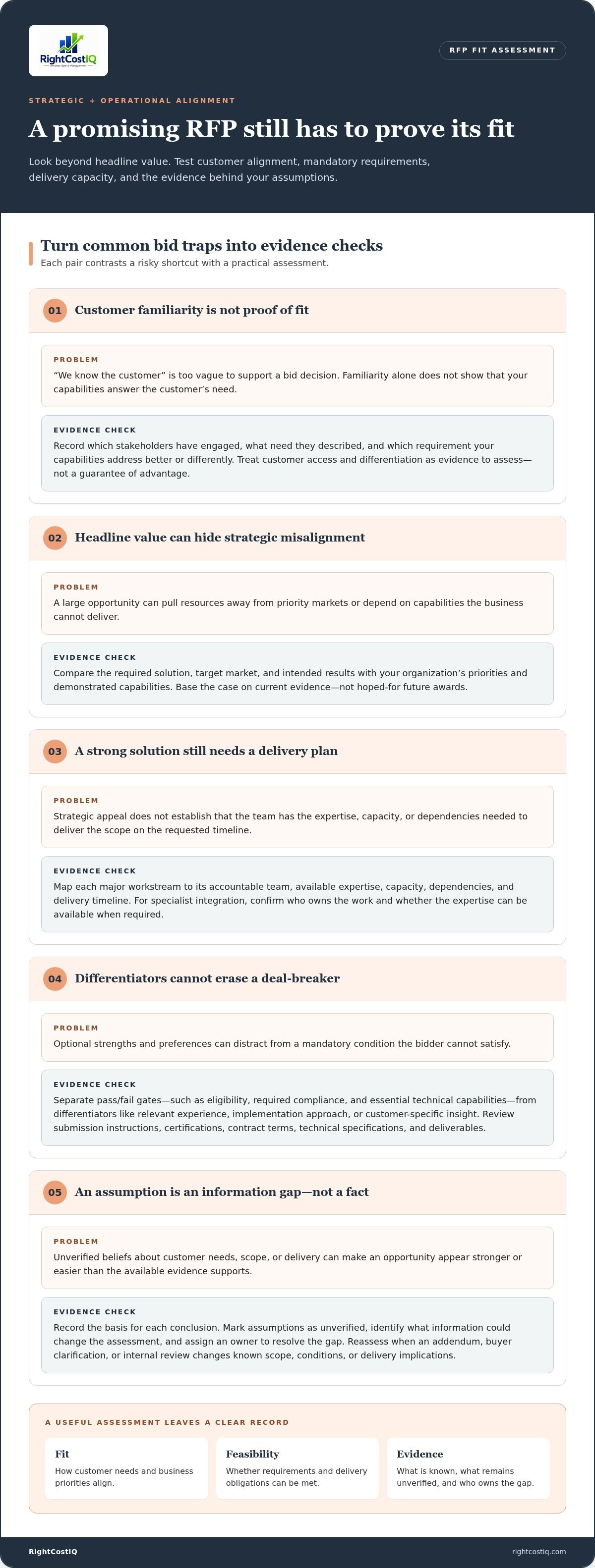
Separate mandatory conditions from differentiators. Eligibility, required compliance, and essential technical capabilities can act as pass/fail gates. Relevant experience, a stronger implementation approach, or customer-specific insight may improve competitiveness. Preferences can add value without being mandatory. Keeping these categories distinct prevents optional strengths from obscuring a disqualifying requirement.
When Should a Team Assess an RFP?
Run an initial screen as soon as the opportunity is available, before extensive drafting or commitments from specialist teams. At intake, identify deadlines, mandatory conditions, unclear requirements, and the people needed to judge feasibility. If the decision hinges on missing information, record the gap and assign an owner instead of treating an assumption as confirmed.
Reassess when an addendum, buyer clarification, or internal review changes the known scope, conditions, or delivery implications. A practical definition is: An RFP fit assessment is a structured supplier-side evaluation of an RFP’s strategic, operational, and commercial alignment to decide whether to pursue it. Structured RFP management helps carry that decision into response planning. The outcome is a documented bid-or-no-bid judgment, not a promise of an award.
Which RFP Fit Criteria Reveal Strategic and Operational Alignment?
Evaluate alignment before letting headline contract value drive the decision. An opportunity can pull resources away from priority markets, depend on capabilities the business can’t deliver, or hinge on requirements it cannot meet. A disciplined rfp fit assessment separates these questions and tests them against evidence, so a promising story doesn’t conceal a practical disqualifier.
Does the Opportunity Fit Your Strategy and Customer Priorities?
Start with the customer’s stated outcomes. Compare the required solution, target market, and intended results with your organization’s priorities and demonstrated capabilities. Assess the relationship based on current evidence, not hoped-for future awards. Existing access to relevant stakeholders, knowledge of customer needs, and a credible point of differentiation can strengthen the case, but none guarantees a competitive advantage.
Record the basis for each conclusion. “We know the customer” is too vague to support a decision. Note which stakeholders have engaged, what need they’ve described, and which requirement your capabilities address better or differently. If the rationale depends on an assumption, mark it as unverified and identify what information could change the assessment.
For federal acquisitions, compare the solicitation’s stated requirements and evaluation factors with your strengths. The Federal Acquisition Regulation (FAR) guidelines on RFPs provide relevant context for that process. Treat buyer priorities as evidence to analyze, not proof that your solution will be selected.
Can Your Team Deliver the Scope and Meet the Requirements?
Test compliance and delivery separately from strategic appeal. Review mandatory eligibility conditions, submission instructions, requested certifications, contract terms, technical specifications, and required deliverables. A missed mandatory condition may make a proposal nonresponsive or the work infeasible. A strong relationship or impressive solution should not offset a requirement the team cannot satisfy.
Translate the scope into an operational check. Map each major workstream to the accountable team, available expertise, capacity, dependencies, and delivery timeline. For example, if an implementation requires specialist integration, confirm who owns that work and whether the expertise can be available within the requested schedule. Flag unresolved dependencies before committing proposal resources.
- Pass/fail gates: Eligibility, mandatory compliance, required qualifications, and essential technical capabilities.
- Weighted factors: Strategic alignment, customer insight, differentiation, stakeholder access, and delivery confidence.
- Evidence and gaps: The source supporting each judgment, its reliability, and any owner or mitigation needed to close a gap.
Keep gates separate from weighted strengths. A high score for customer access must not hide a failed eligibility test. Give each unresolved requirement an owner, a next action, and a decision point. This makes trade-offs visible and supports consistent review across sales, technical, legal, and delivery stakeholders. Structured RFP management helps organize requirements and decision records as the team evaluates an opportunity.
How Should You Score RFP Win Potential, Economics, and Risk?
A useful scorecard makes trade-offs visible without creating false precision. Keep mandatory gates separate from weighted factors: a strong commercial score must never compensate for a failed eligibility condition. For factors that pass the gates, use a consistent scale, such as 1 to 5, and define what each score means before stakeholders rate the opportunity.
The structure below is a starting point, not a universal weighting model. Set weights to reflect your organization’s priorities, and record the evidence supporting each rating.
- Pass/fail gates: Eligibility, mandatory compliance, essential technical requirements, and feasible contract conditions. Record “pass,” “fail,” or “unresolved.” A failed gate normally stops the bid; an unresolved gate needs an owner and a deadline for resolution.
- Weighted factors: Strategic alignment, customer engagement, requirement fit, differentiation, delivery capacity, and commercial attractiveness. Rate each consistently, then apply an agreed weight to reflect its importance.
- Evidence quality: Mark each rating as supported, partially supported, or assumed. Identify the source, date, and owner so reviewers can distinguish verified customer input from internal opinion.
- Risk and action: Capture the risk, potential effect, mitigation, accountable owner, and remaining exposure after mitigation.
Score evidence as carefully as fit. Direct discussion with a relevant stakeholder, for example, may support a customer-need rating more strongly than an inference based on the RFP alone. Avoid turning limited signals into a precise win probability. Use a confidence label such as high, medium, or low, and explain what would raise or lower it.
How Can You Estimate Win Potential Without False Precision?
Assess observable indicators: customer engagement, alignment with stated requirements, knowledge of the incumbent, and credible competitor signals. Separate what the team knows from what it suspects. Then test alternative scenarios. Would the opportunity still merit a bid if stakeholder access were weaker than assumed, the incumbent had a stronger position, or a competitor offered a closer technical match? If the decision changes sharply, identify the assumptions that need validation.
How Do Commercial Value and Risk Change the Decision?
Revenue is only one part of the commercial case. Compare anticipated value with proposal and delivery effort, pricing constraints, margin sensitivity, and the opportunity cost of committing scarce specialists. A bid may look attractive at the top line but become less viable if scope expands, inputs fluctuate, or pricing leaves little room to manage delivery changes.
Use category benchmarks and market price trends to frame assumptions, not to replace analysis of the specific scope, contract terms, and delivery model. Procurement cost benchmarking can provide category context for testing cost assumptions. For each material contract, compliance, capacity, or supplier-dependency risk, name an owner and a mitigation action. Base the final decision on both the weighted score and unresolved exposure, rather than a total that hides either.
How Do You Run a Consistent RFP Fit Assessment?
A repeatable workflow prevents bid decisions from depending on who happens to review an opportunity first. Set decision gates, minimum evidence standards, and accountable owners before proposal work expands. The rfp fit assessment should produce a clear outcome, a documented rationale, and a defined point for reconsideration if key facts change.
- Log the opportunity. Capture the RFP, buyer, submission deadline, scope, expected response effort, and internal review date. Assign a coordinator to maintain the working record.
- Screen eligibility. Review mandatory qualifications, submission rules, contract conditions, and other pass/fail requirements. Stop or escalate a potential disqualifier before committing specialist resources.
- Gather decision evidence. Collect addenda, evaluation criteria, customer intelligence, delivery capacity, cost inputs, and relevant market context. Mark unknowns and assumptions clearly.
- Assess fit and exposure. Have relevant stakeholders evaluate strategic alignment, win evidence, commercial rationale, operational feasibility, and material risks against shared criteria.
- Hold a cross-functional review. Bring together sales, procurement, finance, legal, and delivery as applicable. Challenge unsupported assumptions, resolve conflicting ratings, and assign owners to outstanding questions or mitigations.
- Approve and document. Record the bid-or-no-bid decision, approver, evidence, conditions, risk actions, and revisit triggers. Release substantial proposal resources only after the required decision gate is passed.
What Evidence Should the Assessment Team Gather?
Use the current RFP and every addendum, including submission instructions, scope, evaluation criteria, and contract requirements. Add customer and stakeholder intelligence, delivery capacity, cost assumptions, and relevant market context. Structured RFP management support helps organize requirements, responsibilities, and decision records so the qualification rationale carries into response execution.
Set minimum evidence standards for each decision area. A delivery rating, for example, should identify the team or capability behind it, while a commercial rating should cite its cost inputs and assumptions. Certainty isn’t required, but reviewers should be able to distinguish verified information, informed judgment, and unresolved questions.
How Should Teams Reach and Record the Bid-or-No-Bid Decision?
Ask each function to submit its assessment before the review, then focus discussion on disagreements, failed gates, and assumptions that could change the outcome. The decision record should name the approver, rationale, evidence, risk owners, mitigations, and conditions for reassessment, such as a scope change or new buyer information.
Close the loop after submission or withdrawal. Compare the original assumptions with what the team learned, including buyer feedback or changes in delivery understanding, and update future qualification guidance. To structure your review around the opportunity’s requirements and decision evidence, request an RFP fit assessment.
How Can RFP Management and Negotiation Support Improve the Decision?
A bid decision creates value only if its rationale carries into the response and, if selected, commercial execution. RFP management connects qualification findings to proposal priorities, assigned responsibilities, and pricing inputs. It gives stakeholders a shared reference for what the team chose to pursue and why, reducing the risk that early assumptions disappear once drafting begins.
For a rigorous rfp fit assessment, treat the approved bid rationale as an operating brief. Identify the customer outcomes that matter, the requirements that carry the most weight, unresolved questions, delivery constraints, and commercial assumptions to validate. As new information arrives, assess whether it changes the response plan or the original decision.
How Does RFP Management Carry the Decision Into Execution?
Translate each priority requirement into a response owner, evidence source, due date, and review point. Track clarifications, addenda, risks, and commercial inputs against that plan so the proposal remains aligned with the qualification rationale. If a key requirement changes, escalate it for review instead of allowing scope or effort to drift. RightCostIQ’s RFP management supports a structured sourcing process and connects qualification decisions with procurement planning.
Disciplined coordination also keeps sales, procurement, finance, legal, and delivery working from consistent assumptions. For example, a clarification that changes a delivery obligation should reach the owners assessing scope and cost, not only the proposal writer. RightCostIQ provides RFP management and negotiation assistance to support structured sourcing, response planning, and stakeholder coordination.
When Can Negotiation Assistance and Cost Analytics Add Value?
Commercial assumptions need context. Procurement category cost benchmarks and market trends help teams test whether expected costs and pricing assumptions are reasonable for an opportunity. They don’t replace analysis of the specific scope, contract terms, or delivery model. Negotiation preparation can then focus on assumptions and terms that materially affect value instead of relying on broad benchmarks alone.
Price risk visibility matters when market movements could affect inputs during the contract period. Market price trending and forecasting can inform scenarios, while price risk management helps teams identify exposure that may affect pricing decisions. These analytical inputs strengthen judgment but cannot guarantee selection or a particular commercial result. Outcomes still depend on the opportunity, the buyer’s evaluation, and the team’s execution.
RightCostIQ combines RFP management and negotiation assistance with cost benchmarking, market context, and price risk management to support evidence-led sourcing decisions. Explore RightCostIQ’s RFP management support.
Make Every Bid Decision More Deliberate
Make qualification part of how your organization allocates attention, not a one-off review before a deadline. Treat each rfp fit assessment as a decision record that can inform future choices. Revisit the assumptions after the outcome, note what changed, and use those lessons to sharpen how your team evaluates the next opportunity.
RightCostIQ supports evidence-led sourcing with RFP management and negotiation assistance, procurement category cost benchmarking and analytics, and market price trending and forecasting. These services help teams examine commercial assumptions and carry sourcing priorities into execution, while keeping the decision grounded in the specifics of each opportunity.
For a more structured approach to your next bid decision, explore RightCostIQ’s RFP management support.
Frequently Asked Questions
What is an RFP fit assessment, and how is it different from proposal evaluation?
An RFP fit assessment is a supplier-side checkpoint for deciding whether to invest in a response. The buyer’s proposal evaluation happens later, after submissions arrive, and compares them against the buyer’s criteria. For example, a bidder may decide not to respond because a delivery dependency remains unresolved; the buyer can evaluate only the proposals it receives. The processes have different decision owners and happen at different stages.
How do you decide whether to bid on an RFP?
Bid when the opportunity clears essential eligibility requirements, supports business priorities, and has a credible delivery and commercial case. Before approval, ask what evidence would change the decision. If the case depends on an unanswered scope question or unconfirmed resource availability, assign someone to resolve it by a defined decision date. This prevents enthusiasm or sunk proposal effort from becoming the reason to proceed.
What criteria should a bid-or-no-bid assessment include?
An rfp fit assessment should cover eligibility, customer need, strategic relevance, technical match, delivery capacity, win evidence, commercial value, and material risk. Tailor the emphasis to the contract: a service-intensive engagement may warrant close scrutiny of staffing and dependencies, while a price-sensitive category may require deeper cost analysis. Define each criterion in advance so reviewers use the same standard rather than scoring from personal preference.
How do you estimate your chances of winning an RFP?
Use evidence from comparable past bids and the current opportunity, not intuition presented as a precise forecast. Review the strength of customer engagement, requirement alignment, incumbent knowledge, and available competitor signals. If historical comparisons are limited or important information is missing, state that confidence is low. A scenario check can reveal whether the decision still holds if access weakens or the competition proves stronger than expected.
Can a company pursue an RFP if it does not meet every requirement?
Possibly, if the unmet item is a preference rather than a stated mandatory condition and the response can address it transparently. First determine how the solicitation classifies the requirement; don’t assume a qualification is optional. If a mandatory condition cannot be met, pause the bid decision and assess whether an explicitly permitted approach, such as an eligible teaming arrangement, addresses the gap. Never imply capability or compliance the company cannot substantiate.
Who should be involved in an RFP fit assessment?
Include the people who can validate the main assumptions, not every department by default. Sales can provide customer and stakeholder context; procurement can assess sourcing and market inputs; finance can test commercial assumptions; legal can review contract exposure; and delivery leads can validate scope and resources. Name one decision owner to reconcile input and document approval. For a narrow opportunity, some roles may be unnecessary, but relevant risks still need an accountable reviewer.
When should a team complete an RFP fit assessment?
Start as soon as the RFP is received, while there is still time to resolve critical questions and preserve proposal capacity. Set an internal decision deadline that leaves adequate time for a quality response if the team proceeds. Reopen the decision if an addendum, clarification, or internal capacity change materially alters the assumptions. A fixed review point helps prevent late-stage commitment from replacing an evidence-based choice.


