

A supplier can look financially stable on paper while cash pressure, late deliveries, or changing payment behavior point to rising exposure. That’s why evaluating supplier financial risk can’t be a one-time credit check. The goal is to spot deterioration early enough to protect procurement and operations without mistaking short-term volatility for sustained distress.
Financial data is often incomplete, delayed, or difficult to compare, and no single ratio tells the full story. A sound assessment brings credible financial evidence together with payment patterns, supplier performance, and the business impact of a potential disruption.
This guide sets out a repeatable process for identifying warning signs, assessing their significance, and choosing proportionate procurement actions. You’ll learn how to interpret liquidity, debt, and profitability signals in context, prioritize suppliers by criticality and exposure, and set monitoring or mitigation steps that fit the level of risk. Cost benchmarks and market trends add procurement context, while vendor performance tracking connects financial concerns to operational signals. Together, these inputs provide a clearer basis for decisions, even when information is incomplete.
Key Takeaways
- Assess supplier exposure by criticality and potential business impact before deciding how closely to monitor it.
- When evaluating supplier financial risk, combine dated, relevant evidence from multiple sources rather than relying on a single ratio or warning sign.
- Distinguish persistent deterioration across independent indicators from temporary cash-flow pressure or ordinary market volatility.
- Turn material findings into a response plan with a named owner, review date, evidence requirement, and proportionate action.
- Use cost benchmarks and market-price trends to add procurement context, while keeping them separate from conclusions about a supplier’s creditworthiness.
Why evaluating supplier financial risk matters to procurement
Supplier financial risk is the possibility that a supplier’s financial weakness will disrupt the supply, service, or contract performance your organization depends on. Evaluating supplier financial risk helps procurement distinguish emerging distress from normal business fluctuations, then focus on the consequences that matter to continuity and value.
A price increase, one late payment, or a quarter of lower profitability does not prove that a supplier is failing. Market volatility can affect otherwise viable businesses, while temporary cash-flow pressure may reflect timing differences between receivables and obligations. Concern rises when adverse signals persist, appear across independent sources, or coincide with operational deterioration. A risk flag is a reason to investigate, not evidence of failure or misconduct.
This measured approach reflects the broader discipline of Financial Risk Management: identify the exposure, assess the evidence, and align the response with potential impact. Procurement’s focus is the business consequence, not a standalone judgment about a supplier’s financial condition.
Which procurement exposures can financial distress create?
Liquidity pressure can constrain a supplier’s ability to buy inputs, pay workers, or maintain capacity. Procurement may see the effects as delayed deliveries, reduced output, service gaps, or requests to change payment terms. Insolvency risk creates different concerns: deposits may be harder to recover, warranties may be difficult to rely on, and replacing the supplier or transitioning work may take time.
Map both direct exposure and dependencies beyond the contracted supplier. A supplier may rely on a financially strained subcontractor, while a single-source arrangement can leave procurement with few immediate alternatives. Assess exposure by asking:
- Criticality: How directly would disruption affect essential operations?
- Substitutability: Can another qualified source take over, and what would the transition involve?
- Concentration: Do multiple sites, products, or services rely on the same supplier or upstream dependency?
- Recovery time: How long would it take to restore supply or transition work?
These factors help determine whether a financial concern warrants routine review or closer attention.
Why a one-time financial check is not enough
A financial snapshot captures one reporting period. A supplier’s condition can change as trading conditions shift, debt obligations come due, or cash takes longer to move through the business. Even a credible assessment can become stale if the supplier’s operating environment changes or your procurement exposure grows.
Set review frequency according to criticality and the pace of change. A hard-to-replace supplier supporting essential operations may warrant closer monitoring than a readily substitutable vendor with limited business impact. Reassess sooner when new evidence emerges, such as repeated delivery issues alongside worsening payment behavior. Treat each indicator as a prompt to verify and investigate. Judge it in context rather than treating it as a verdict.
How to assess supplier financial risk using evidence, not assumptions
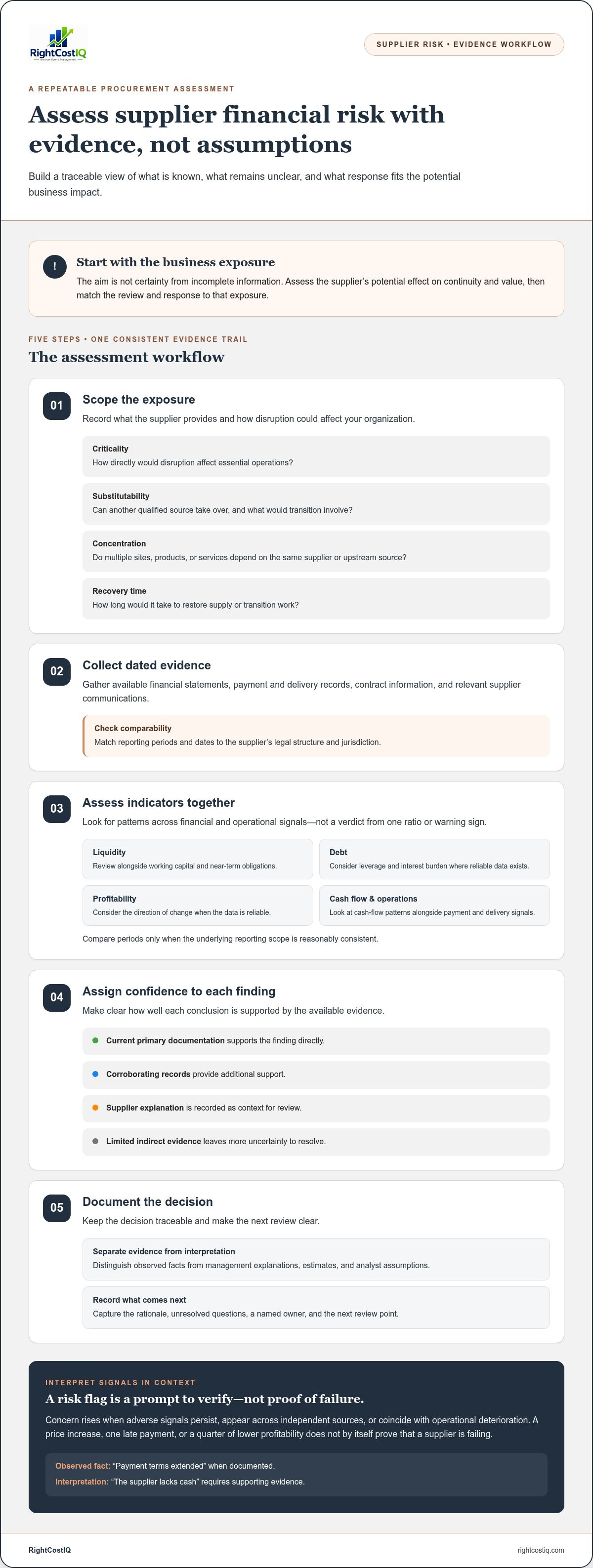
A financial risk assessment combines multiple financial indicators with supplier context to judge the likelihood and potential procurement impact of disruption. The goal isn’t to produce certainty from incomplete information. It’s to create a traceable view of what is known, what remains unclear, and what action is proportionate.
Use a consistent workflow so different teams can reach and review decisions using the same evidence base:
- Scope the exposure. Record what the supplier provides, its business criticality, available alternatives, concentration, and the time required to transition.
- Collect dated evidence. Gather available financial statements, payment and delivery records, contract information, and relevant supplier communications. Match reporting periods and dates to the supplier’s legal structure and jurisdiction.
- Assess indicators together. Look for patterns across liquidity, debt, profitability, cash flow, and operational signals. Compare periods only when the underlying reporting scope is reasonably consistent.
- Assign confidence. State whether each finding is supported by current primary documentation, corroborating records, a supplier explanation, or limited indirect evidence.
- Document the decision. Separate observed facts from management explanations, estimates, and analyst assumptions. Record the rationale, unresolved questions, owner, and next review point.
This structure makes evaluating supplier financial risk more consistent and easier to reproduce. For example, “payment terms extended” is an observed fact if documented. “The supplier lacks cash” is an interpretation that requires supporting evidence.
Which financial indicators should teams examine?
Review liquidity and working capital alongside near-term obligations and cash-flow patterns. Then consider leverage, interest burden, profitability, and the direction of change where reliable data exists. A current ratio or debt-to-equity measure can help frame questions, but neither provides a standalone verdict. Accounting treatments, reporting periods, and industry economics affect comparisons, so avoid applying universal thresholds across suppliers.
Check whether apparent deterioration persists across periods and aligns with other evidence. A falling margin may reflect higher input costs. Its significance changes if cash generation weakens at the same time or the supplier reports difficulty meeting obligations. Note the reporting date and basis for each comparison.
What to do when financial statements are unavailable
Missing statements create an information gap, not proof of distress. Record which documents are unavailable, the period they would cover, and how their absence limits confidence. Build a partial view from credible business records, such as your own invoice and delivery history, contract notices, and dated supplier-provided explanations. Treat explanations as evidence to assess, not as independently verified facts.
For every source, log its date, scope, origin, and limitations. Distinguish direct records from estimates and assumptions so another reviewer can reproduce the reasoning. If evidence remains thin, make the uncertainty explicit and calibrate monitoring to the supplier’s exposure rather than overstating the conclusion.
Where procurement teams need a structured view of exposure and improvement opportunities, a procurement diagnostic can help frame the analysis alongside cost and vendor-performance context.
How to interpret supplier financial signals against exposure
A financial indicator is a prompt for analysis, not a standalone forecast of insolvency. Interpret each signal alongside its evidence quality, persistence, and the procurement consequences if the supplier’s capacity or service deteriorates. A single adverse data point may reflect timing, reporting differences, or a temporary event. Persistent change across independent financial and operational indicators warrants closer review.
The table provides a practical starting point. Confidence describes how strongly the available evidence supports the interpretation, not the supplier’s overall risk level.
| Indicator | Possible interpretation | Evidence confidence | Procurement implication |
|---|---|---|---|
| Weakening liquidity or working capital | Less capacity to meet near-term obligations, though timing or seasonal patterns may contribute. | Higher when supported by comparable, dated statements and consistent cash-flow evidence; lower when based on one period. | Review delivery reliability, payment-term requests, and exposure to advance payments. |
| Rising leverage or interest burden | Debt obligations may be taking a larger share of available cash or earnings. | Higher when debt and interest information are current and comparable across periods. | Assess whether capacity investment, service continuity, or contract performance could be affected. |
| Falling profitability or cash generation | Margin pressure or weaker conversion of sales into cash may be reducing financial flexibility. | Stronger when the direction persists and aligns with other independent evidence. | Consider the supplier’s role, alternatives, and replacement lead time before changing sourcing plans. |
| Late deliveries alongside payment or capacity concerns | Financial pressure may be coinciding with operational strain, though other causes are possible. | Higher when records show repeated changes across separate orders or review periods. | Validate service impact and concentration; prepare a proportionate continuity response. |
How to separate a warning signal from a decision trigger
A warning signal should initiate validation: confirm the source and reporting period, check whether the change is persistent, and seek relevant context. A decision trigger is different. It is a documented condition linked to supplier exposure and internal policy, such as a verified service failure or a defined escalation requirement. If evidence conflicts, record both sides and lower confidence until the discrepancy is resolved. Don’t suppress uncertainty to force a decisive rating.
How procurement context changes the risk assessment
The same financial signal can have different consequences across suppliers. A replaceable vendor with a short transition time may pose limited continuity exposure. A critical, single-source supplier with concentrated category spend may require earlier contingency planning and closer review. Include replacement lead time, dependencies, and how quickly alternatives can qualify when setting the response.
Commercial context can sharpen the analysis without becoming a financial-health conclusion. Category cost benchmarks may show whether pricing, input costs, or proposed changes merit a sourcing review, but they don’t establish creditworthiness. Should-cost benchmarking can help assess cost drivers and commercial assumptions as procurement evaluates exposure. Use those findings alongside, not instead of, dated financial and operational evidence.
Ultimately, evaluating supplier financial risk means prioritizing plausible business impact, not predicting insolvency from a ratio. Let the strength and consistency of the evidence guide the urgency of investigation, then calibrate action to criticality and recovery options.
How to turn financial-risk findings into a monitoring and response plan
A risk assessment creates value only when it changes what procurement monitors or does next. For each material finding, define an accountable owner, the evidence needed to resolve or track it, a review date, and an action proportionate to the supplier’s exposure. This turns evaluating supplier financial risk into an operating process rather than a score that sits unused in a file.
Set monitoring frequency according to supplier criticality, confidence in the available evidence, and how quickly relevant conditions may change. A critical supplier with incomplete information may need an earlier follow-up than a lower-impact supplier with stable, well-supported records. Bring the review forward when new financial or delivery evidence changes the exposure.
What should a supplier financial-risk register include?
Use a register that lets a reviewer understand both the evidence and the decision. Capture supplier identity, category, business criticality, key dependencies, and the rationale for the exposure assessment. For each indicator, record its source and date, confidence level, change since the prior review, and the person responsible for follow-up.
- Assessment: Current finding, evidence limitations, and relevant changes since the last review.
- Accountability: Action owner, required stakeholders, and next review date.
- Response: Escalation criteria, agreed action, completion status, and any unresolved issue.
Keep the record current as actions close or new evidence arrives. A register that preserves prior assessments also helps teams see whether a concern is isolated, improving, or continuing to develop.
How should teams respond to rising risk?
Start by validating the signal. Confirm source dates and scope, compare it with prior evidence, and distinguish documented facts from explanations or assumptions. Involve procurement, finance, legal, and operational stakeholders as appropriate to the contract and potential business impact. Record disagreements or information gaps rather than smoothing them into a single confident conclusion.
Then assess continuity options without assuming the supplier will fail. Depending on the exposure, actions may include reviewing transition requirements, identifying alternative sourcing options, checking contractual protections, or engaging the supplier to clarify performance and capacity concerns. Match the response to the strength of the evidence and the time available to protect supply.
Use operational and commercial information to guide the next decision. Vendor performance tracking can show whether delivery or service issues are changing alongside financial concerns. Market-price trends can help procurement assess category conditions during sourcing reviews, while RFP management and negotiation assistance can support a reassessment of commercial exposure. These inputs inform procurement choices; they don’t substitute for verified financial evidence.
Make every action measurable: specify what evidence will close the question, who will obtain it, and when the team will review the result. To identify procurement priorities and potential follow-up areas, run a free procurement diagnostic.
How procurement analytics can strengthen supplier financial-risk decisions
Financial findings become more actionable when procurement connects them to category conditions, supplier performance, and available sourcing options. Analytics can help teams move from an isolated concern to a commercial review: Is the supplier’s cost position changing? Are market inputs shifting? Is service performance deteriorating alongside the financial signals? These questions inform decisions without treating procurement data as a substitute for financial evidence.
For teams evaluating supplier financial risk, the objective is to align the strength of the evidence with the potential impact. Category strategy, sourcing plans, and contract reviews can then respond to exposure rather than to a headline or single metric.
Where cost benchmarks and market trends add context
Category cost benchmarks help procurement understand commercial conditions and examine whether quoted prices or proposed changes align with underlying cost drivers. If a supplier requests a price adjustment while category costs are stable, the request may warrant a closer commercial review. If relevant inputs are moving, market evidence can help explain cost pressure and inform negotiation timing. Neither result establishes whether the supplier is financially healthy.
Market-price trends add a time dimension. They can show whether price volatility is affecting sourcing assumptions, contract terms, or the timing of a commercial decision. Use them alongside supplier-specific evidence, and distinguish market-wide cost changes from claims about one supplier’s liquidity or solvency. RightCostIQ’s procurement category cost benchmarking and analytics, price risk management, and market price trending and forecasting support this procurement context.
How to embed assessment in procurement decisions
Bring the relevant information into one review rather than leaving financial concerns in a separate risk file. A decision record can connect:
- Financial evidence: Verified indicators, reporting dates, limitations, and confidence.
- Category exposure: Spend concentration, cost drivers, market trends, and sourcing alternatives.
- Operational performance: Delivery, service, and other vendor-performance signals that may affect continuity.
- Commercial options: Contract considerations, sourcing timing, and the case for a new RFP or negotiation review.
This combined view supports proportionate choices. A financial concern paired with weakening service performance and limited alternatives may justify earlier sourcing preparation. A less critical supplier with stable delivery and a single unverified signal may call for validation and monitoring instead. Vendor performance tracking complements financial evidence by showing whether operational outcomes are changing; it does not determine creditworthiness.
When the findings warrant a commercial reassessment, RFP management and negotiation assistance can support sourcing and contract discussions. Procurement analytics provide decision support, not supplier credit ratings or financial-statement audits. To identify opportunities for more structured procurement analysis, start a free diagnostic.
Make supplier-risk insight part of procurement strategy
Supplier financial risk is not only a continuity concern. It can also shape category priorities, sourcing choices, and the timing of commercial reviews. Make evaluating supplier financial risk part of how procurement allocates attention and plans decisions, so emerging concerns inform strategy before they become urgent disruptions.
RightCostIQ’s procurement category cost benchmarking and analytics, vendor performance tracking, and price risk management and market price forecasting can add commercial and operational context to that work. Use these perspectives to sharpen procurement decisions, not as substitutes for financial evidence.
Ready to identify where structured procurement analysis could support your decisions? Start a free procurement diagnostic and take a practical next step toward stronger supplier-risk oversight.
Frequently Asked Questions
What does supplier financial risk mean?
Supplier financial risk is the possibility that financial strain limits a supplier’s ability to deliver, maintain service, or meet contract commitments. In procurement, evaluating supplier financial risk means assessing how that possibility could affect your organization, not diagnosing a company from one ratio. For example, the same liquidity concern may carry different weight if the supplier provides a readily replaceable office service versus a component with no qualified alternative.
Which financial ratios are useful when evaluating a supplier?
Liquidity, working capital, leverage, interest burden, and profitability measures can help organize the review when reliable data is available. For example, a current ratio may prompt questions about near-term obligations, while interest coverage can help frame how earnings relate to interest costs. Neither gives a universal pass-or-fail result. Check whether the measures use comparable periods and accounting treatments, and interpret them against the supplier’s industry and operating model.
Can you assess a private supplier without audited financial statements?
Yes. You can form a qualified view from credible available evidence while being explicit about its limits. Dated management information, supplier explanations, contract records, and your organization’s invoice or service history may each contribute useful context. Label whether information is audited, unaudited, or supplier-provided, and note its reporting period. If statements are unavailable, the assessment has less visibility, but the gap alone does not establish distress.
How often should procurement teams review supplier financial risk?
Set the review schedule based on the consequences of disruption and the likelihood that relevant conditions could change before the next review. A supplier supporting a critical production input may need closer attention than a vendor with several ready substitutes. Define review owners and early-review triggers, such as a material contract change, repeated service disruption, or a newly identified information gap. Revisit the schedule when sourcing options or business reliance changes.
What are early warning signs of supplier financial distress?
Potential warning signs include worsening results across multiple periods, pressure to change established commercial terms, reduced transparency, or operational changes that lack a clear explanation. Treat these as prompts to verify, not proof of insolvency. For instance, a request to alter payment terms may have several causes. Compare the timing with contract and performance records, then determine whether the combined evidence changes your continuity planning.
What should procurement do if a supplier refuses to share financial information?
Record what information was requested, the response, and which parts of the assessment remain uncertain. A refusal by itself does not demonstrate financial distress. Consider whether the supplier’s role, existing performance records, contract terms, and available alternatives provide enough context for a proportionate decision. If the information gap materially affects a critical relationship, document the concern and escalate it through the organization’s established procurement governance process.
How is supplier financial risk different from cybersecurity risk?
Supplier financial risk concerns the supplier’s financial capacity to meet obligations; cybersecurity risk concerns threats to systems, data, and digital operations. They can affect the same relationship through different pathways. For example, financial strain could constrain service capacity, while a cyber incident could interrupt access to a supplier’s platform. Assess each using relevant evidence and controls, then combine their business impacts when prioritizing continuity planning.


