
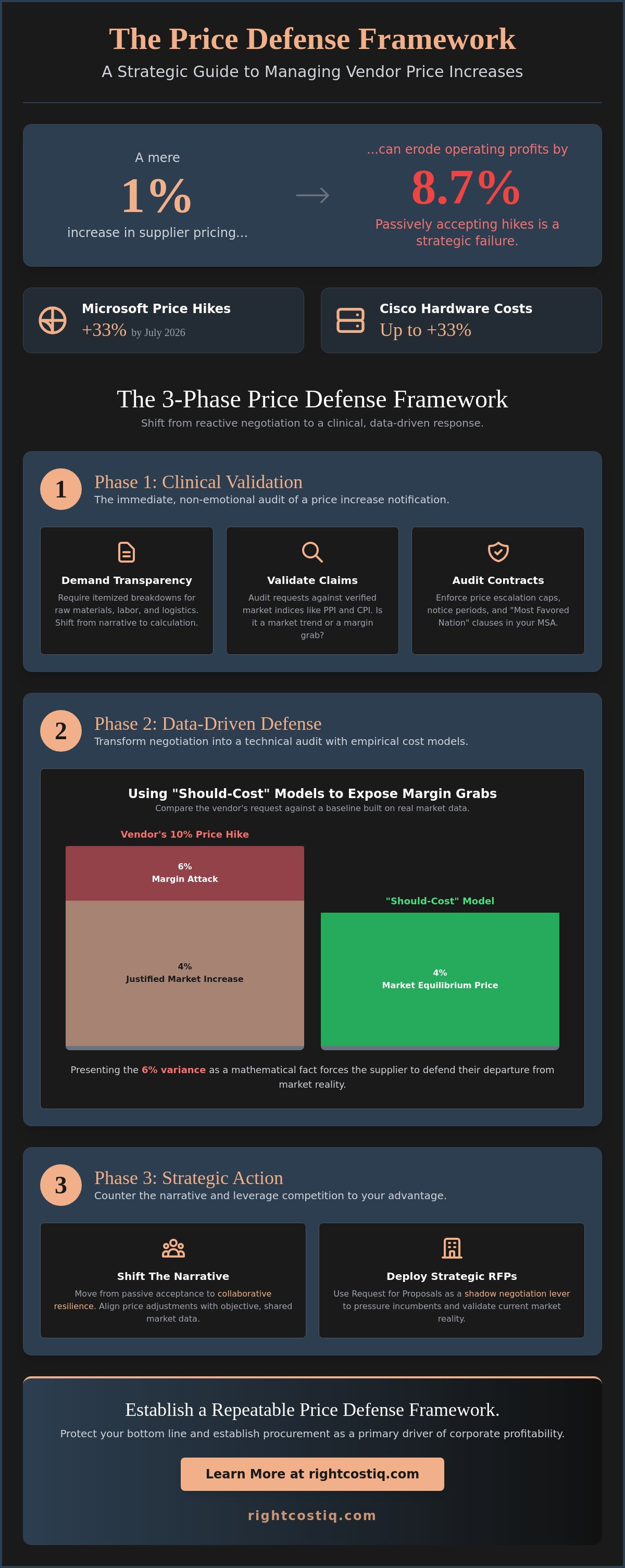
A 1% increase in supplier pricing can erode operating profits by as much as 8.7%. With Microsoft announcing 33% price hikes for July 2026 and vendors like Cisco increasing costs by up to 33% for hardware, procurement teams face a critical margin crisis. You've likely felt the pressure of inflationary mandates that lack market transparency. Many leaders fear that challenging these hikes will lead to supply chain disruption, yet passive acceptance is a strategic failure. Understanding exactly what to do when a vendor raises prices is the difference between operational stagnation and financial growth.
We'll move beyond reactive negotiation and implement a clinical procurement framework. You'll learn how to execute a data-driven response using professional benchmarking and price risk management architectures. This guide details how to leverage market price trending to validate costs and when to utilize RFP management to identify alternative sourcing options. By the end, you'll have a repeatable price defense framework that protects your bottom line and establishes your department as a primary driver of corporate profitability.
Key Takeaways
- Transition from reactive posture to clinical validation by demanding itemized cost breakdowns for raw materials, labor, and logistics.
- Discover exactly what to do when a vendor raises prices by utilizing "Should-Cost" models and category cost benchmarking to audit supplier requests.
- Deploy strategic RFP management as a shadow negotiation lever to validate current market reality and pressure incumbent vendors.
- Shift negotiation narratives from passive acceptance to collaborative resilience by aligning price adjustments with objective market data.
- Establish a repeatable price defense framework using market price trending and forecasting to mitigate future margin erosion.
Clinical Validation: The Immediate Response to Vendor Price Escalation
The "Clinical Validation" phase serves as the first line of defense against margin erosion. It is a non-emotional, data-centric audit designed to strip away the rhetorical layers of a price increase notification. When determining what to do when a vendor raises prices, you must treat the request as a hypothesis that requires empirical testing. This process mandates a comprehensive itemized justification of all cost drivers: raw materials, labor, energy, and logistics. By forcing this granular breakdown, you shift the conversation from general market sentiment to specific financial calculation.
Suppliers often deploy a "regrettable but necessary" narrative to soften the impact of escalation. Your objective is to identify logical fallacies within these claims. Categorize the increase immediately. Is this a legitimate market-wide trend supported by verified indices, or is it a supplier-specific margin grab disguised as inflationary pressure? Clinical validation ensures that any adjustment is rooted in objective reality rather than opportunistic pricing. It establishes a professional boundary where data, not relationships, dictates financial outcomes.
The Burden of Proof: Demanding Transparency
Professional procurement teams require vendors to provide specific indices supporting their claims, such as the Producer Price Index (PPI) or Consumer Price Index (CPI). Standardizing this data through a formal Price Increase Request Form eliminates the ambiguity of email-based notifications. This structured approach allows you to flag inconsistencies instantly. If a vendor claims logistics costs are rising while global energy indices are trending downward, the justification fails the validation test. Transparency isn't a courtesy; it's a prerequisite for continued partnership. You can further validate these claims by utilizing Should-Cost models to determine if the proposed hike aligns with actual manufacturing and delivery realities.
Contractual Compliance Audit
Before engaging in negotiation, execute a thorough review of existing Master Service Agreements (MSAs). Look for price escalation caps that limit annual increases to a specific percentage or link them to a trailing 12-month index. Notice period requirements are equally critical. If the vendor failed to provide the 60-day or 90-day lead time mandated by the contract, the increase is technically invalid for the current cycle. Enforcing "Most Favored Nation" (MFN) clauses ensures your pricing remains competitive relative to the vendor's other clients. This level of oversight is a core component of Strategic sourcing, as it protects long-term value and prevents arbitrary cost spikes. If the contract doesn't allow for an immediate hike, the clinical validation phase ends with a formal rejection based on non-compliance. This sets a firm precedent for future interactions and reinforces the requirement for data-driven justification when considering what to do when a vendor raises prices.
Leveraging Procurement Analytics and Cost Benchmarking for Price Defense
Effective price defense requires moving beyond the simple validation of indices to the construction of empirical cost models. When determining what to do when a vendor raises prices, procurement teams must leverage Procurement Category Cost Benchmarking to establish "Should-Cost" models. These models function as a clinical baseline, stripping away supplier margin and identifying the true economic cost of a good or service. By comparing the proposed increase against real-world market price trending data, you can quantify the exact variance between a vendor's request and the actual market equilibrium. This data-driven approach replaces a defensive posture with strategic authority. It effectively transforms the negotiation into a technical audit.
Quantifying the financial impact is the next critical step in your defense. You must identify "Spend Under Management" metrics to determine how the hike affects the total category budget. If a vendor requests a 10% increase, but market data suggests a 4% equilibrium, the 6% delta represents a direct attack on your operating margin. Presenting this variance as a mathematical fact rather than a negotiation preference changes the power dynamic. It forces the supplier to defend their departure from market reality. Implementing these tactics for responding to vendor price increases ensures that your organization doesn't absorb unnecessary inflationary pressure. Utilizing a benchmarking audit can reveal where these variances are most acute within your current supplier base.
The Power of Should-Cost Modeling
Break down the product or service into its constituent economic drivers: raw materials, direct labor, overhead, and logistics. Use third-party data to verify the "fair" price based on current market conditions. This model isn't a suggestion; it's a clinical baseline for the negotiation. It provides a transparent view of where the vendor's pricing deviates from the expected norm. By isolating each cost component, you can identify which specific driver is being leveraged to justify the increase. This precision prevents vendors from using broad economic trends to mask opportunistic margin expansion.
Identifying Category Savings Opportunities
Analyze if the price increase makes this specific category a candidate for tail spend optimization. High-frequency, low-value purchases often hide significant margin erosion. Use procurement analytics to identify hidden cost offsets or determine if volume consolidation can mitigate the unit price increase. Shifting volume to a more efficient supplier or restructuring the category can often neutralize the impact of a price hike entirely. Determining what to do when a vendor raises prices often involves looking beyond the immediate contract to broader category health and sourcing efficiency.
Strategic Negotiation Architectures: Countering the Narrative
Negotiation is not a social dialogue; it's a strategic architecture designed to protect organizational margins. Once clinical validation has identified a variance between a supplier's request and market equilibrium, you must deploy the "Market Reality" lever. This involves positioning the negotiation as a collaborative effort to maintain supply chain resilience rather than a zero-sum conflict. By presenting the delta between their proposal and actual market trends, you force the vendor to justify why their specific operation is less efficient than the industry standard. This shifts the burden of proof back to the supplier, effectively neutralizing the emotional weight of the "inflationary pressure" narrative.
When determining what to do when a vendor raises prices in a constrained market, you must evaluate the Bargaining Power of Suppliers. High supplier power often leads to the "Monopoly" objection, where vendors claim their unique position justifies arbitrary hikes. Counter this by identifying indirect substitutes or process innovations that reduce your dependency. Utilizing a Negotiation Coach framework allows procurement teams to simulate these high-stakes interactions, ensuring that every counter-offer is rooted in technical data rather than conversational intuition.
The Non-Monetary Trade-Off
If the unit price increase is partially validated by benchmarking, shift the focus to non-monetary levers that improve cash flow or reduce total cost of ownership. Offer longer contract terms or exclusivity in exchange for multi-year price stability. Alternatively, negotiate extended payment terms, moving from Net 30 to Net 90, to offset the immediate cost impact. Propose value-engineering initiatives where the vendor identifies process efficiencies that reduce the overall cost of the engagement. These trade-offs ensure that even if the nominal price rises, the net financial impact on the business is mitigated through operational optimization.
Assertive Communication Frameworks
Effective negotiation rejects the "Accept or Reject" binary in favor of a "Validate and Align" model. Use data visualizations to illustrate the gap between vendor requests and market reality. This visual evidence makes it difficult for account managers to rely on scripted talking points. Clearly communicate that while you value the partnership, you're prepared to initiate a formal re-sourcing process if the increase isn't aligned with market data. This isn't a threat; it's a professional statement of what to do when a vendor raises prices that exceed clinical benchmarks. Assertive communication ensures that the vendor understands your organization prioritizes financial growth and operational efficiency above all else.
Executing the Competitive RFP: Re-Sourcing as a Negotiation Lever
Executing a Strategic RFP transforms a supplier's price hike from a bilateral dispute into a market-wide competitive event. When determining what to do when a vendor raises prices, your most potent tool isn't a persuasive argument; it's the credible threat of re-sourcing. This process functions as a "Shadow Negotiation," forcing the incumbent to compete against the most efficient actors in the current market. By automating the sourcing process through professional management platforms, you reduce administrative friction while simultaneously increasing competitive tension. A well-structured RFP signals to the vendor that your organization prioritizes financial growth over historical convenience.
A clinical approach requires integrating vendor performance tracking data into the evaluation. You must determine if the incumbent has actually earned the right to a premium price through superior service levels and KPI adherence. If performance metrics show stagnation or decline, the price increase becomes even less defensible. Automating this analysis allows procurement leaders to move fast, shifting volume to high-performers before margin erosion becomes permanent. To see where your suppliers stand, you can audit your current vendor performance against clinical benchmarks.
The 5-Step Tactical RFP Execution
- Step 1: Define specific technical requirements and performance KPIs to ensure apples-to-apples comparisons.
- Step 2: Identify a diverse pool of qualified alternative suppliers through verified market intelligence.
- Step 3: Distribute the RFP using a professional management platform to maintain a clean audit trail.
- Step 4: Score responses using objective, data-driven criteria that prioritize total cost of ownership.
- Step 5: Use the best alternative offer as your BATNA (Best Alternative to a Negotiated Agreement) in final discussions with the incumbent.
Analyzing the Total Cost of Switching
Transitioning to a new supplier involves more than just a unit price comparison. You must calculate the total cost of switching, which includes implementation, staff training, and technical integration. Compare this "Switching Cost" against the projected annual impact of the vendor's price increase. If the hike costs your organization $200,000 annually but switching only costs $50,000 in one-time expenses, the decision is purely mathematical. Factoring in vendor risk and historical performance ensures the final selection aligns with long-term operational efficiency. Understanding these variables is critical when deciding what to do when a vendor raises prices without a valid market justification.
Implementing Long-Term Price Risk Management and Performance Tracking
The final stage of a clinical framework involves shifting from defensive firefighting to strategic anticipation. Deploying Market Price Trending and Forecasting allows procurement departments to neutralize escalations before they manifest as invoices. By implementing a dedicated Price Risk Management system, organizations mitigate financial volatility and secure predictable margins across multi-year cycles. This proactive posture represents the definitive answer for what to do when a vendor raises prices in an increasingly volatile economy. Continuous Vendor Performance Tracking ensures that suppliers consistently deliver value that justifies their current price points. It prevents the gradual margin erosion that occurs when service quality declines while costs remain static.
Strategic procurement requires moving beyond the validation phase into a state of permanent market awareness. Establishing a clinical, proactive posture means your department functions as a profit center rather than a cost center. You no longer wait for a notification to react. Instead, you use data to dictate the terms of the relationship before the vendor even considers an adjustment. This architectural shift ensures that price hikes are met with an immediate, data-backed counter-response that protects the bottom line.
Forecasting as a Negotiation Shield
Predictive analytics provide the visibility required to lock in pricing before market peaks occur. By monitoring global supply chain signals, such as raw material shortages or specific shipping lane congestion, procurement leaders can execute strategic purchases ahead of anticipated hikes. Building "Index-Linked" pricing models creates a dynamic contract environment where costs adjust both up and down based on verified market benchmarks. This structural transparency removes the incentive for vendors to inflate prices during temporary market surges. It provides a permanent, data-backed solution for what to do when a vendor raises prices without a structural economic basis.
The RightCostIQ Advantage: Precision Procurement
Strategic architects require a unified platform to manage complex sourcing variables with absolute precision. Integrating benchmarking, competitive RFPs, and risk management into a single clinical workflow eliminates the inefficiencies of siloed data and manual tracking. This holistic approach drives margin expansion through relentless, data-driven optimization of every spend category. By centralizing market intelligence and negotiation architectures, you ensure that every dollar spent is clinically validated against current market reality. Optimize your procurement outcomes with RightCostIQ today.
Securing Operational Efficiency Through Clinical Procurement
Securing margin expansion in a volatile economy requires a fundamental shift from defensive purchasing to strategic architecture. You've seen that clinical validation and "Should-Cost" modeling provide the empirical foundation needed to challenge inflationary narratives. By integrating procurement category cost benchmarking with advanced market price trending, you move beyond guesswork. You establish a high-stakes corporate standard for financial growth that prioritizes data over dialogue. This methodical approach ensures that every supplier request is audited against objective market equilibrium rather than subjective sentiment.
Knowing exactly what to do when a vendor raises prices ensures your organization maintains its competitive advantage while others absorb unnecessary costs. Utilizing professional RFP management assistance acts as a critical negotiation lever, forcing competitive tension and validating current pricing structures. This clinical framework transforms procurement from a reactive support function into a primary driver of operational efficiency and bottom-line resilience. You're now equipped to lead your department with technical authority and unwavering focus. Your strategic response is no longer a matter of opinion; it's a matter of data.
Execute your next negotiation with clinical precision; start with RightCostIQ.
Frequently Asked Questions
How do I tell a vendor I won’t pay a price increase?
State clearly that the request is rejected because it fails clinical validation. Provide objective data showing the hike exceeds market equilibrium or violates existing Master Service Agreement (MSA) caps. You don't need to be aggressive; you simply need to be data-driven. Inform the vendor that any adjustment requires a full itemized justification of raw materials, labor, and logistics before it's considered for your budget cycle.
What is a reasonable price increase from a supplier in 2026?
A reasonable increase typically aligns with the U.S. annual inflation rate, which was 3.8% for the 12 months ending April 2026. Forecasts for June 2026 suggest a 4.2% year-over-year increase. However, specific sectors like technology see much higher volatility. Microsoft's 33% hike on certain Office 365 tiers is a outlier that requires category-specific benchmarking rather than general CPI tracking to determine fairness.
Can a vendor raise prices during a contract?
Price adjustments during a contract term are only permissible if specific escalation clauses or index-linked triggers are present in the MSA. You must review your notice period requirements immediately. If a vendor fails to provide the contractually mandated 60-day or 90-day lead time, the increase is technically invalid. Always verify if "Most Favored Nation" clauses apply to ensure you aren't paying more than the vendor's other clients.
How do you negotiate a price increase with a monopoly supplier?
Negotiating with a monopoly requires shifting the focus to non-monetary levers and total cost of ownership. Offer longer contract terms or exclusivity in exchange for price stability. If the unit price is non-negotiable, push for extended payment terms, such as moving from Net 30 to Net 90, to offset the cash flow impact. Use should-cost models to show the vendor that their request exceeds manufacturing reality, regardless of their market position.
What data do I need to challenge a vendor price hike?
You need itemized cost breakdowns for labor, raw materials, and energy compared against PPI and CPI indices. This data is essential when determining what to do when a vendor raises prices that seem arbitrary. Accessing third-party category cost benchmarking allows you to establish a "Should-Cost" baseline. This empirical evidence forces the vendor to defend their departure from market reality rather than relying on general inflationary narratives.
Is an RFP necessary every time a vendor raises prices?
An RFP isn't mandatory for every increase, but it's a critical lever when clinical validation fails. If a vendor's request exceeds the 4.2% year-over-year CPI benchmark or category equilibrium, a Strategic RFP tests the market's true pricing. It creates competitive tension and provides you with a Best Alternative to a Negotiated Agreement (BATNA). This process ensures that you aren't overpaying for a service that has become commoditized.
How can procurement software help with vendor price increases?
Procurement software provides the technical infrastructure for market price trending and risk management. It automates the identification of what to do when a vendor raises prices by flagging variances in real-time. These platforms integrate should-cost modeling and RFP management into a single workflow, allowing for clinical precision during negotiations. Software eliminates manual data entry errors and provides the fast-paced analytics required to protect organizational margins during inflationary spikes.
What is the best way to track vendor performance after a price increase?
The most effective method is utilizing a Vendor Performance Tracking Service to monitor specific KPI adherence. If you've accepted a higher price point, the vendor must demonstrate a corresponding increase in service quality or operational efficiency. Establish a formal scorecard that tracks delivery timelines, quality metrics, and support responsiveness. This continuous oversight ensures that the premium you're paying translates into measurable value and long-term supply chain resilience.


