

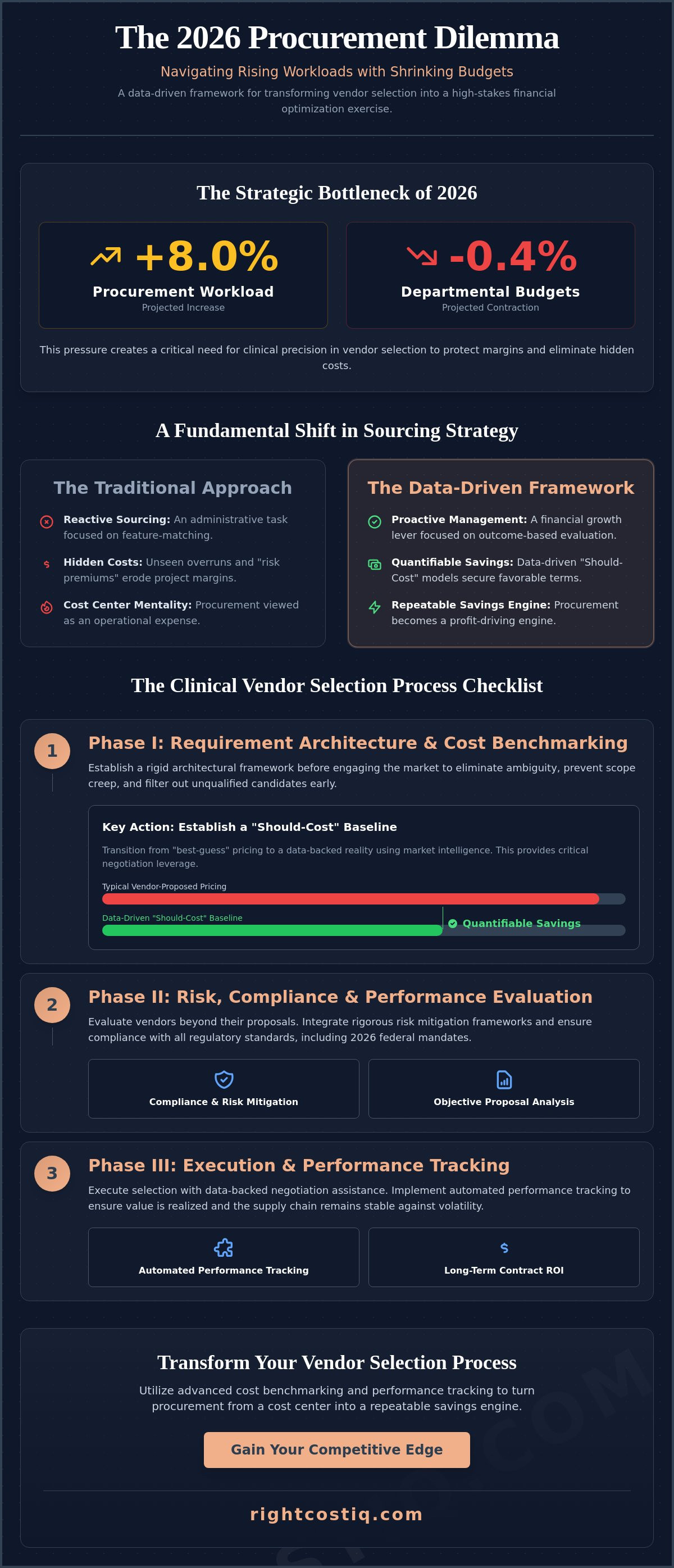
In 2026, procurement workloads are projected to increase by 8.0% while departmental budgets contract by 0.4%. This creates a strategic bottleneck where traditional sourcing methods fail to protect the bottom line. You already know that inefficient RFP cycles and hidden contract costs aren't just operational nuisances; they're direct threats to your margin. To navigate this contraction, your team requires a data-driven vendor selection process checklist that operates with clinical precision to eliminate waste and secure quantifiable savings.
This guide delivers a repeatable framework for executive decision-makers who prioritize cost benchmarking and rigorous risk mitigation. We'll show you how to utilize objective market intelligence to gain negotiation leverage and ensure compliance with the latest 2026 federal mandates, including the March 26 Executive Order. By the end of this article, you'll have the tools to transform vendor selection from a search for features into a high-stakes financial optimization exercise. We'll preview the specific metrics and automated performance tracking frameworks necessary to stabilize your supply chain against 2026 volatility.
Key Takeaways
- Reframe vendor selection as a clinical financial optimization tool to eliminate hidden contract overruns and protect project margins.
- Deploy a data-driven vendor selection process checklist to establish "Should-Cost" baselines and prevent expensive scope creep during the RFP cycle.
- Integrate rigorous risk mitigation and compliance frameworks to navigate the 2026 federal mandates and mitigate global supply chain volatility.
- Utilize advanced performance tracking and cost benchmarking to transform procurement from a cost center into a repeatable savings engine.
The Strategic Imperative of a Clinical Vendor Selection Process
Vendor selection isn't just an administrative task. In 2026, it's a primary lever for financial growth and risk containment. Suboptimal selection choices often lead to hidden cost overruns that erode project margins long after you sign the contract. By utilizing a rigorous vendor selection process checklist, procurement teams shift from reactive sourcing to proactive, data-driven category management. This clinical approach ensures every partnership is an intentional investment in supply chain resilience rather than a gamble on unverified capabilities. Precision in these initial stages determines the financial trajectory of the entire agreement, turning procurement into a profit-driving engine.
The economic consequences of poor vetting extend beyond the purchase price. Inefficient selection cycles lead to increased management overhead and friction during implementation. A structured supplier evaluation process provides the objective data you need to filter out low-performance candidates before they impact the bottom line. This level of precision is essential for maintaining EBITDA targets as procurement workloads increase by 8.0% while budgets contract by 0.4%. Leaders must treat every selection as a high-stakes financial transaction that requires absolute clarity and data-backed justification. Reactive sourcing is a luxury that modern enterprises can't afford.
The Financial Impact of Selection Precision
Selection rigor correlates directly with long-term contract ROI. When procurement teams fail to bench-mark costs, they inherit the vendor's inefficiencies. This lack of precision results in significant management overhead as teams struggle to correct service failures. Clinical execution at the selection stage prevents downstream costs. By prioritizing performance tracking and cost benchmarking, organizations secure favorable terms that optimize financial outcomes. This approach safeguards margins against inflationary pressures and market volatility.
Shifting to a Result-Oriented Sourcing Architecture
Modern sourcing requires a transition from feature-matching to outcome-based evaluation. Successful leaders align vendor capabilities with enterprise financial growth metrics. This architecture moves beyond the traditional RFP to a framework that prioritizes quantifiable results. Establishing a clinical framework for stakeholder alignment ensures cross-departmental requirements are integrated into the final decision without causing delays. This ensures the vendor selection process checklist acts as a strategic tool for maximizing value capture and operational efficiency across the entire supply chain.
Phase I: Requirement Architecture and Cost Benchmarking
Successful procurement begins with a rigid architectural framework. Before engaging the market, you must define the technical and financial boundaries of the engagement. This initial stage of the vendor selection process checklist requires more than a simple list of features. It demands a comprehensive requirement architecture that eliminates ambiguity and prevents downstream scope creep. By locking in non-negotiable compliance and security benchmarks early, you ensure that only high-quality candidates enter the evaluation funnel. This clinical approach filters out vendors who lack the infrastructure to meet 2026 regulatory standards before they consume valuable RFP cycles.
Requirement architecture acts as your primary defense against hidden contract costs. When expectations are fluid, vendors naturally build "risk premiums" into their pricing. A precise architecture forces transparency, requiring vendors to bid against a fixed, data-driven scope. This clarity allows for an objective comparison of proposals, ensuring that the final selection aligns with enterprise-level financial growth metrics rather than just departmental preferences. Proactive requirement setting is the foundation of a resilient supply chain.
Establishing the "Should-Cost" Baseline
You can't negotiate effectively without a baseline. Transitioning from "best-guess" pricing to data-backed reality requires advanced cost benchmarking and analytics. This process identifies price outliers in your historical spend data and establishes a "Should-Cost" model based on real-time market intelligence. When you understand the fair market value of a category, you gain the leverage to challenge inflated vendor-proposed pricing models. This transparency forces vendors to justify their margins against objective benchmarks rather than subjective value claims. If you're looking to optimize your current category spend, a free procurement diagnostic can identify immediate cost-saving opportunities.
Market Price Trending as a Selection Lever
Timing is a strategic asset. In 2026, market price trending acts as a critical selection lever that determines the long-term viability of a contract. By analyzing commodity and service price trends, procurement leaders can time RFP releases to coincide with market lows. Integrating price risk management into your initial sourcing strategy allows you to forecast future cost escalations. This foresight enables the construction of inflation-resistant contracts that protect your margins even as global market conditions fluctuate. If you aren't forecasting volatility, you're inheriting it from your vendors.
The Definitive Vendor Selection Process Checklist
Executing a high-stakes sourcing event requires more than a casual invitation to bid. It demands a structured sequence that transforms raw market data into a finalized contract. This vendor selection process checklist provides the operational roadmap for 2026, ensuring no stage of the evaluation is left to chance. By following these steps, procurement leaders eliminate the guesswork that often leads to budget overruns and implementation delays.
- Step 1: Stakeholder Alignment and Requirement Finalization. You can't source effectively if your internal teams aren't synchronized. Finalize technical specifications to ensure the RFP architecture is airtight and reflects the needs of every department involved.
- Step 2: Market Scanning and Initial Vendor Screening. Identify potential partners using the cost benchmarks established in Phase I. This initial screening filters for vendors whose financial models align with your established "Should-Cost" baselines.
- Step 3: RFP Issuance with Clinical Precision. This stage of the vendor selection process checklist requires the release of a document that leaves no room for vendor interpretation. Force bidders to provide granular pricing and performance commitments.
- Step 4: Comparative Analysis Using Weighted Scoring Models. Use the data from the RFP to rank responses objectively. This ensures that technical capabilities and commercial viability are evaluated independently to prevent bias.
- Step 5: Finalist Selection and Negotiation Coaching. Once the top contenders emerge, the focus shifts to value capture. Negotiation coaching helps your team identify and exploit specific leverage points uncovered during the benchmarking phase.
The RFP Execution Framework
Drafting an RFP that forces transparency is a technical skill. You must standardize response formats to allow for a direct, data-driven comparison across all bidders. This eliminates the marketing fluff that often obscures high-risk contract terms. For teams managing complex, multi-million dollar categories, utilizing professional RFP management services ensures that requirement detailing is clinically precise and legally robust. It's about creating a level playing field where value is quantifiable and performance is guaranteed.
Objective Evaluation and Scoring Models
Subjectivity is the enemy of procurement efficiency. You must develop weighted scorecards that prioritize bottom-line impact and risk mitigation over personal preferences. Separate technical capability from commercial viability to ensure a vendor's innovative features don't blind you to an unsustainable pricing structure. Cross-functional evaluation committees act as a final safeguard. They ensure the selection serves the entire enterprise's strategic goals; it's a necessary defense against departmental bias that can lead to suboptimal long-term partnerships.
Evaluating Beyond the Proposal: Risk, Compliance, and Performance
Proposal responses represent a vendor's ideal state, not their operational reality. A clinical selection strategy requires verifying these claims through historical data and rigorous performance benchmarks. This stage of the vendor selection process checklist moves from theoretical capability to proven reliability. You must integrate performance tracking into your scoring model to ensure the selected partner can meet required SLAs without increasing management overhead. Organizations that fail to operationalize performance metrics during selection often face higher management friction post-implementation. Precision here prevents operational decay.
Compliance is a non-negotiable pillar of 2026 procurement. The March 26, 2026 Executive Order on DEI in Federal Contracting introduced new clauses that prohibit certain activities in contracts over $15,000. Your evaluation framework must verify that potential vendors have already updated their internal policies to meet the July 24, 2026 implementation deadlines. Beyond regulatory adherence, you must evaluate data portability and exit barriers. High exit costs create vendor lock-in, which erodes your long-term negotiation leverage. A strategic architect ensures that every vendor relationship includes a clear, cost-controlled off-boarding path.
Operationalizing Performance Metrics
Defining KPIs and SLAs during the selection phase is essential for long-term value capture. Use vendor performance tracking to validate vendor claims against industry-standard benchmarks. This establishes a framework for continuous improvement that's legally binding and performance-linked. It's not enough to ask if a vendor can perform; you must verify their historical uptime and service quality through objective data. High-performing organizations use these metrics to rank finalists, ensuring that only those with a documented history of efficiency move forward.
Mitigating Financial and Operational Risk
Clinical risk mitigation requires deep-dive audits of a vendor's financial health and their sub-tier supplier network. You must assess geographic vulnerabilities to protect against global supply chain shocks. Building "right-to-audit" and "termination-for-convenience" clauses into your selection criteria provides the necessary safeguards for your bottom line. If a vendor's financial stability is questionable, the risk of service disruption far outweighs any potential cost savings. To identify hidden risks in your current vendor portfolio, schedule a complimentary procurement risk diagnostic today.
Executing the Selection: Negotiation Assistance and Implementation
Identifying the winning bidder is merely the midpoint of the procurement lifecycle. The transition from a preferred candidate to a functional partner requires a relentless focus on value capture and contract codification. This final stage of the vendor selection process checklist ensures that the theoretical savings identified during the benchmarking phase materialize as realized EBITDA growth. You must treat the period between selection and "Day 1" operations as a high-stakes transition that requires absolute tactical alignment between procurement, legal, and operational stakeholders. Precision during this handover prevents the value erosion that frequently occurs when RFP promises aren't strictly enforced.
A clinical transition plan acts as a safeguard for your bottom line. It bridges the gap between selection and implementation by defining clear milestones for vendor onboarding and data integration. Without this structure, organizations risk implementation delays that disrupt supply chain continuity and inflate management overhead. Success in 2026 demands that procurement leaders maintain a data-driven demeanor until the contract is fully operational and the first performance metrics are reported. Strategic architects don't just pick a vendor; they engineer a partnership that is financially optimized from the first day of service.
The Role of Professional Negotiation Assistance
Benchmarking data serves as your primary lever during final contract negotiations. Without objective "Should-Cost" baselines, vendors often attempt to claw back concessions during the final legal review. Leveraging expert negotiation coaching empowers your team to secure optimal commercial terms while ensuring all RFP performance commitments are codified into the final agreement. It's about transforming verbal promises into legally binding service level agreements that protect your margin. This level of negotiation rigor ensures that the vendor's pricing model remains transparent and inflation-resistant throughout the contract term.
Post-Selection Implementation and Analytics
Tracking the "Day 1" ROI of a new vendor relationship is essential for validating your sourcing strategy. You must integrate new vendor data into your broader procurement analytics ecosystem to maintain visibility into spend under management. Establishing a 90-day review cycle ensures implementation alignment and allows for rapid correction of any service failures. This methodical approach to post-selection monitoring turns procurement into a repeatable engine for financial growth. Continuous analytics provide the feedback loop necessary to refine your vendor selection process checklist for future sourcing events, ensuring long-term operational efficiency.
Engineering Long-Term Financial Growth Through Strategic Sourcing
Strategic procurement in 2026 requires a transition from subjective evaluation to clinical execution. By deploying a rigorous vendor selection process checklist, your organization secures the data-driven leverage necessary to navigate budget contractions and increasing workloads. This framework prioritizes requirement architecture and "Should-Cost" baselines to eliminate hidden contract costs before they erode your margins. It's not just about selecting a provider; it's about engineering a partnership that delivers quantifiable results through precise risk mitigation and performance tracking.
Maximizing value capture requires professional oversight and advanced market intelligence. You can secure a competitive advantage by utilizing clinically precise cost benchmarking and data-driven market price forecasting. Our expert negotiation coaching ensures that high-value contracts are codified for maximum financial impact. Optimize your sourcing with professional RFP Management and Negotiation Assistance to stabilize your supply chain and drive sustainable bottom-line growth. Your procurement function is ready to become a primary engine for enterprise-level success.
Frequently Asked Questions
What is the most critical step in the vendor selection process?
Establishing a rigorous requirement architecture is the most critical step. This phase defines the technical and financial boundaries of the engagement, preventing downstream scope creep. Without this foundational clarity, your vendor selection process checklist fails to filter out low-performance candidates effectively. Precision here ensures that the final partnership aligns with enterprise financial growth metrics rather than just departmental preferences.
How do you calculate the ROI of a new vendor selection?
ROI is calculated by measuring the delta between the "Should-Cost" baseline and the final negotiated contract value, adjusted for implementation costs and management overhead. You must account for quantifiable savings secured through better negotiation levers. Tracking these metrics from Day 1 allows for the validation of the sourcing strategy. High-performing teams use this data to prove procurement's contribution to the bottom line.
What are the most common pitfalls in enterprise vendor selection?
The primary pitfall is allowing subjective bias to influence the scoring of vendor proposals. Many organizations rely on vendor-provided marketing materials rather than objective performance tracking data. This leads to hidden contract costs and inefficient implementation cycles. Clinical execution requires a weighted scoring model that separates technical capability from commercial viability to ensure an assertive and objective decision-making process.
How does cost benchmarking improve the vendor selection process?
Cost benchmarking provides the objective market intelligence needed to challenge inflated vendor pricing models. By establishing a fair market value for a category, procurement leaders gain significant leverage during the final negotiation stages. This data-driven approach ensures that the vendor selection process checklist results in a contract that optimizes the bottom line rather than inheriting the vendor's internal inefficiencies.
What is the difference between an RFP, RFI, and RFQ in selection?
An RFI is used for market discovery to understand vendor capabilities. The RFP is a formal request for a strategic proposal that includes detailed requirements and pricing. An RFQ focuses strictly on the cost of specific goods or services. Strategic architects use the RFP to force transparency in vendor pricing structures while utilizing the RFI to narrow the field of potential candidates.
How can you prevent vendor lock-in during the selection phase?
Preventing lock-in requires codifying data portability and "termination-for-convenience" clauses during the initial selection phase. You must evaluate the cost of transition as a primary selection criterion. Establishing a clear off-boarding path ensures you maintain negotiation leverage for future renewals. Organizations that ignore exit barriers often face high switching costs that erode long-term financial growth and operational flexibility.
Why is stakeholder alignment often the bottleneck in vendor selection?
Bottlenecks occur when departments have conflicting priorities that aren't reconciled through a clinical evaluation framework. Stakeholder alignment requires a structured sequence where technical and financial requirements are finalized before market engagement. Without a cross-functional evaluation committee, subjective departmental preferences can delay the RFP cycle. Clinical precision in requirement detailing acts as the primary tool for synchronizing internal teams.
How often should vendor selection criteria be updated?
Criteria should be updated whenever market price trends or regulatory environments shift significantly. In volatile markets, an annual review is the minimum requirement to ensure your selection framework remains relevant. This allows your team to integrate new compliance standards and updated cost benchmarks into the sourcing architecture. Regular updates ensure your procurement function remains a sophisticated partner for high-level decision-makers.


