
A procurement savings report that lacks finance-validated methodology is merely a suggestion, not a strategic asset. While sourcing teams often celebrate negotiated discounts, the CFO typically views these figures with skepticism due to the persistent trust gap between contract signatures and realized P&L impact. Understanding how to present procurement savings to the CFO with clinical precision is the only way to bridge this divide. You've likely experienced the friction of presenting significant cost reductions only to have them discounted during the final budget reconciliation because the data lacked an auditable baseline.
This guide provides the strategic framework required to transform speculative estimates into finance-approved results. You'll learn to implement a standardized reporting methodology that eliminates savings leakage and aligns procurement activities directly with corporate financial growth metrics. We will detail the exact steps to move from raw data to validated P&L results, ensuring your department commands C-suite respect through rigorous cost benchmarking and performance tracking. This approach moves procurement beyond a back-office function and establishes it as a primary driver for financial optimization.
Key Takeaways
- Bridge the procurement-finance trust gap by securing upfront alignment on auditable baselines before negotiations begin.
- Master how to present procurement savings to the CFO by translating contract-level wins into validated P&L results.
- Construct a rigorous value hierarchy that prioritizes hard savings and strategic price risk management over simple cost avoidance.
- Architect your reports using declarative headlines that state financial outcomes immediately to ensure C-suite clarity and impact.
- Deploy clinical category benchmarking and vendor performance tracking to provide the evidence required for finance-level validation.
The Procurement-Finance Trust Gap: Why CFOs Discount Your Savings
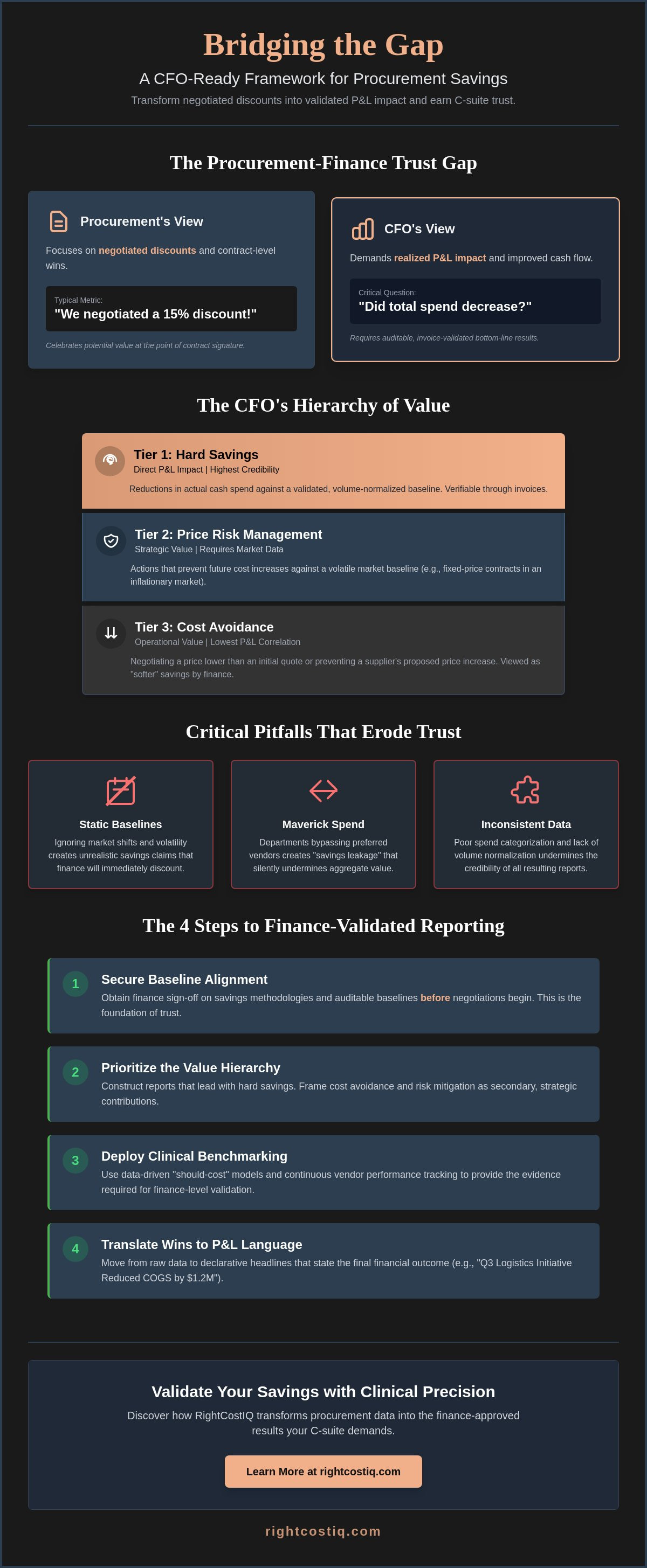
Mastering how to present procurement savings to the CFO requires acknowledging a fundamental truth: finance departments view negotiated discounts as theoretical projections until they manifest as P&L improvements. This disconnect creates a "trust gap" where procurement reports millions in value that never appears on the bottom line. CFO skepticism often stems from inconsistent volume normalization and disputed baselines. Without a clinical, audit-ready framework, procurement's strategic influence remains limited to administrative cost-cutting rather than financial growth leadership.
The friction originates during the initial stages of the procurement process when teams fail to align on auditable metrics. Finance leaders prioritize cash flow over cost avoidance. If your reporting doesn't account for market volatility or changes in operational volume, the CFO will likely discount your results. Bridging this gap requires a declarative reporting style that mirrors financial audits, focusing strictly on hard savings that survive rigorous scrutiny.
The Definition of Realized Savings in 2026
Realized savings represent the final, invoice-validated impact on the income statement. This differs sharply from forecasted figures or simple negotiated discounts. Clinical precision in this area demands that every dollar claimed is traceable from the initial bid to the final payment. Implementing a robust RFP management framework is essential for creating these auditable savings trails. It ensures that the competitive environment at the point of sourcing is documented, providing the "proof of work" required for C-suite validation. Industry professionals often observe significant "contract leakage" where negotiated rates aren't applied at the point of purchase, effectively erasing procurement value before it reaches the P&L.
Common Pitfalls in Procurement Reporting
Static baselines represent a primary failure point in modern reporting. Strategic leaders who understand how to present procurement savings to the CFO prioritize data integrity over optimistic projections, recognizing that a "fixed baseline" is a myth in volatile economies. Ignoring market shifts when reporting performance suggests a lack of financial sophistication. Additionally, maverick spend acts as a silent killer of procurement authority. When departments bypass preferred vendors, they create "savings leakage" that undermines aggregate calculations. Inconsistent data classification further erodes trust; if procurement cannot categorize spend with accuracy, the CFO will doubt the validity of the resulting savings claims. Effective presentation hinges on eliminating these technical discrepancies before they reach the executive suite.
Establishing Finance-Validated Baselines and Methodologies
The baseline represents the primary point of contention in any executive savings presentation. CFOs don't care about your "savings" if they don't believe your "starting point." Without an agreed-upon baseline, every reported dollar is subject to immediate discounting by the finance team. Strategic leaders who know how to present procurement savings to the CFO prioritize baseline validation over final negotiation totals. This clinical approach requires obtaining Finance sign-off on savings methodologies before a single RFP is issued. It's about aligning procurement and finance perspectives so that both departments speak the same language of P&L impact.
Technical accuracy depends on volume normalization. If you negotiated a 10% price reduction but production volume doubled, your total spend increased. Finance will see a budget overrun, not a procurement win. You must isolate price changes from volume fluctuations to ensure price-to-price comparisons remain valid. Utilizing sophisticated procurement analytics allows teams to establish "should-cost" models. These models act as a baseline anchor, providing a data-driven reality check against current market conditions rather than relying solely on historical spend that might already be inflated.
The Five Steps to Baseline Alignment
Establishing an unassailable baseline follows a methodical, five-step architecture. First, perform historical spend data extraction and cleansing to remove one-time anomalies or incorrect tax applications. Second, reach an explicit agreement on methodology: will you use "last price paid" or a "weighted average price" for the previous 12 months? Third, factor in external market indices to adjust for market-driven price changes. This ensures you aren't taking credit for falling commodity prices or being penalized for global inflation. Fourth, formalize the validation process with the Controller or FP&A lead. This signature transforms procurement data into finance-validated facts. Finally, document the finalized baseline within your tracking system to prevent retroactive disputes. For organizations seeking to identify these baseline gaps immediately, a diagnostic cost assessment can reveal hidden discrepancies in current reporting.
Technical Savings vs. Commercial Savings
CFOs categorize value into two distinct buckets: technical and commercial. Technical savings involve specification changes, demand management, and process optimization. These are structural wins. If you change a material specification to a lower-cost, high-performance alternative, the saving is permanent. Commercial savings focus on price negotiation, volume bundling, and term optimization. While valuable, these are often subject to market cycles. The CFO values technical savings higher because they're structural and less likely to "leak" back into the budget. When you understand how to present procurement savings to the CFO, you highlight these technical shifts as evidence of strategic business alignment rather than just aggressive bargaining.
Categorizing Value: Hard Savings, Cost Avoidance, and Risk Mitigation
To master how to present procurement savings to the CFO, you must deploy a value hierarchy that mirrors financial reporting standards. CFOs prioritize clarity. They require a clear distinction between realized cash flow and defensive cost management. By establishing a rigorous hierarchy that separates realized P&L impact from defensive cost avoidance, you eliminate the ambiguity that typically triggers executive skepticism. This categorization is not merely administrative; it is a clinical tool for margin expansion. Integrating these categories into a broader category management strategy allows procurement to transition from a transactional function to a driver of corporate financial stability.
Hard Savings: The P&L Impact
Hard savings represent the most critical metric for any finance leader. These are price-to-price reductions that result in immediate, direct cash flow improvement. For these savings to be valid, they must be traceable through to the departmental budget level. If a 5% reduction in unit cost doesn't result in a corresponding budget surplus or reinvestment opportunity, the CFO will view it as a phantom win. Capturing these results often requires addressing the fragmented spend found in non-core categories. Efficient tail spend management ensures that these small, high-volume transactions aggregate into significant hard savings that survive financial audits. Accuracy in this area builds the foundational trust required for more complex value discussions.
Cost Avoidance: Defending the Bottom Line
Cost avoidance is often dismissed by finance teams because it lacks a direct invoice-to-invoice comparison. However, in volatile markets, preventing a price increase is as vital as securing a discount. To make these claims credible, you must use external data to prove the value of your defensive actions. Utilizing market price trending allows you to demonstrate that while the market rose by 12%, your costs remained flat. Cost avoidance represents the delta between verified market inflation and the actual price paid. When presented against documented market indices, cost avoidance shifts from a vague procurement claim to a validated financial defense of the company's margins. This evidence-based approach is essential when learning how to present procurement savings to the CFO effectively.
Risk Mitigation and Strategic Value
Modern procurement acts as a strategic architect of financial resilience. Quantifying the value of supply chain resilience and vendor compliance moves the conversation beyond simple unit costs. Mitigating price volatility functions as a financial hedge for the organization, protecting the P&L from sudden market shocks. A clinical framework for risk management identifies the potential cost of supply failure and the financial benefit of a diversified vendor base. By positioning procurement as the entity that stabilizes future cash flows, you provide the CFO with a strategic value-add that exceeds traditional cost-cutting metrics. This level of sophistication ensures procurement's voice is heard during high-stakes financial planning sessions.
The CFO-Ready Reporting Architecture: From Data to Narrative
Transforming raw procurement data into a strategic narrative requires a structured reporting architecture that prioritizes financial impact over administrative activity. CFOs operate on tight schedules and demand immediate clarity. When determining how to present procurement savings to the CFO, you must lead with declarative headlines that state the financial outcome before detailing the tactical process. This approach ensures that the executive audience immediately understands the contribution to corporate profitability. A successful presentation doesn't just list activities; it builds a logical case for procurement's role in driving shareholder value.
The Executive Summary: The "Bottom Line" First
The executive summary must lead with the most vital metric: realized impact. State the total realized savings figure and translate it into metrics the C-suite tracks, such as Earnings Per Share (EPS) or EBITDA impact. High-level decision-makers prioritize margin expansion and strategic alignment. Your summary should provide a clear "bridge" that reconciles last year’s actual spend with this year’s performance, isolating procurement’s contribution from external variables. This financial reconciliation proves that savings aren't merely accounting artifacts but tangible increases in available capital that support the company's broader strategic goals.
Visualizing the Sourcing Pipeline
Data visualization must move beyond simple bar charts to explain the lifecycle of a saving. A waterfall chart is the most effective tool for this purpose. It should start with the initial negotiated savings, subtract "leakage" caused by non-compliance or implementation delays, and arrive at the final realized value. Highlighting the role of professional negotiation assistance demonstrates a commitment to closing the leakage gap through expert-led execution. By including market-adjusted performance metrics, you prove that procurement results are the product of strategic skill rather than favorable market fluctuations. This level of transparency builds the clinical authority required to survive rigorous C-suite scrutiny.
The most common objection from Finance is the claim that savings are simply the result of decreased volume. Your reporting architecture must anticipate this by including a volume normalization bridge. This identifies the portion of spend change driven by consumption versus the portion driven by price optimization. By proactively answering this question, you reinforce your position as a data-driven partner rather than a defensive cost center. Organizations looking to refine their financial storytelling can utilize a diagnostic reporting audit to ensure their data architecture meets the highest standards of financial accuracy and executive clarity.
Leveraging RightCostIQ for Clinical Savings Validation
Strategic procurement leadership requires more than spreadsheets; it demands a robust technical infrastructure that provides auditable outcomes. RightCostIQ functions as this foundation, transforming raw sourcing data into finance-validated results. When mastering how to present procurement savings to the CFO, the ability to provide "proof of work" is non-negotiable. By integrating RFP management and category benchmarking, teams create a transparent audit trail that satisfies even the most skeptical finance executive. This clinical approach ensures that procurement claims are backed by market-driven reality rather than internal projections.
Market price forecasting plays a pivotal role in justifying cost avoidance claims. Without a predictive view of market trends, defensive savings remain speculative. RightCostIQ provides the analytical depth required to prove that price stability in a rising market is a direct result of strategic intervention. Professional negotiation assistance acts as the critical bridge to ensure that "negotiated" savings actually become "realized" P&L impact. This transition from contract signature to invoice validation is where the trust gap is finally closed, establishing procurement as a primary driver of corporate financial health.
Benchmarking as a Verification Tool
Internal performance metrics often lack the context required for C-suite validation. RightCostIQ’s cost benchmarking provides the external verification necessary to prove that your results are competitive on a global scale. Market trending data acts as a preemptive strike against baseline disputes; it establishes a neutral starting point before you ever enter the boardroom. Leaders who understand how to present procurement savings to the CFO use these benchmarks to anchor their narrative in objective fact. You can explore RightCostIQ’s benchmarking capabilities to see how clinical data can eliminate reporting friction.
The ROI of Strategic RFP Management
Structured RFP cycles provide the definitive paper trail for every dollar claimed in a savings report. This documentation proves that competitive pressure, not just market luck, drove the financial outcome. Implementing automated RFP management increases process efficiency while ensuring that every vendor interaction is captured for future audits. This level of data integrity is what transforms procurement from a cost center into a strategic partner. To secure your department's influence and drive measurable margin expansion, you should optimize your procurement outcomes with RightCostIQ today.
Architecting the Future of Procurement Finance
Bridging the trust gap between procurement and the finance department requires a transition from speculative reporting to clinical, audit-ready validation. By implementing standardized baselines and a rigorous value hierarchy, you ensure that every dollar claimed is recognized as a tangible P&L improvement. Mastering how to present procurement savings to the CFO isn't just about data; it's about providing the strategic narrative that links sourcing activities to corporate EBITDA goals. You've now gained the framework necessary to move beyond administrative cost-cutting and into a role of high-level financial leadership.
Success in 2026 depends on leveraging technical infrastructure that offers clinical precision in cost benchmarking and finance-validated RFP management frameworks. Strategic market price forecasting and risk management are no longer optional; they're the evidence required to justify your department's strategic value. You're ready to command C-suite respect through data-driven transparency and operational efficiency. Master your next CFO presentation with RightCostIQ’s Negotiation Coach and begin your journey toward becoming a primary driver of financial growth. Your expertise is the engine that will power the organization's future resilience.
Frequently Asked Questions
What is the difference between hard savings and cost avoidance for a CFO?
Hard savings represent direct reductions in unit costs that yield tangible cash flow improvements and immediate budget surpluses. Cost avoidance involves preventing price increases in rising markets, acting as a defensive measure to maintain existing margins. CFOs prioritize hard savings because they manifest directly on the income statement, while cost avoidance requires external market data for validation.
How can I prove procurement savings are actually hitting the P&L?
Prove P&L impact by reconciling procurement data with actual invoice payments and departmental budget variances. Understanding how to present procurement savings to the CFO requires moving beyond contract signatures to track realized spend through the entire payment lifecycle. This clinical validation ensures that negotiated discounts aren't lost to maverick spend or implementation delays.
Why do CFOs often distrust procurement savings reports?
CFOs often distrust reports due to "savings leakage" and inconsistent baseline definitions. If a procurement team claims millions in value while total spend remains flat or increases, a trust gap emerges. These discrepancies often arise from failing to account for volume fluctuations or using unvalidated historical data that doesn't reflect current market conditions.
What is the best way to calculate a savings baseline in a volatile market?
Use a market-adjusted baseline that incorporates external price indices rather than a fixed historical cost. This approach ensures procurement isn't unfairly penalized for global inflation or credited for falling commodity prices. Clinical category benchmarking provides the objective data needed to anchor these calculations in market reality, ensuring the baseline survives financial audits.
How do I account for volume changes when reporting price savings?
Implement volume normalization to isolate price-driven savings from consumption-driven spend changes. By multiplying the new unit price by the historical volume, you create a technically accurate price-to-price comparison. This bridge allows you to explain exactly why total spend might have increased despite successful price negotiations, maintaining your credibility with the finance team.
What role does tail spend management play in CFO reporting?
Tail spend management captures fragmented savings across non-core categories that often escape high-level reporting. While individual transactions are small, their aggregate impact provides significant hard savings for the P&L. Managing this unclassified spend demonstrates a comprehensive approach to financial optimization and proves that no capital is being wasted through administrative oversight.
How often should procurement present savings reports to the C-suite?
Present high-level savings reports quarterly to align with corporate financial planning and earnings cycles. While performance tracking should occur monthly at the operational level, the CFO requires a strategic overview of realized impact every 90 days. This cadence ensures sourcing activities remain synchronized with the organization's broader EBITDA and margin expansion goals.
What are the most important KPIs for a procurement-CFO presentation?
Focus on realized P&L impact, contract compliance rates, and the ROI of sourcing activities. These KPIs move the conversation from administrative tasks to financial growth metrics. Highlighting how to present procurement savings to the CFO through these specific data points establishes your department as a sophisticated partner in corporate financial strategy and long-term value creation.


