

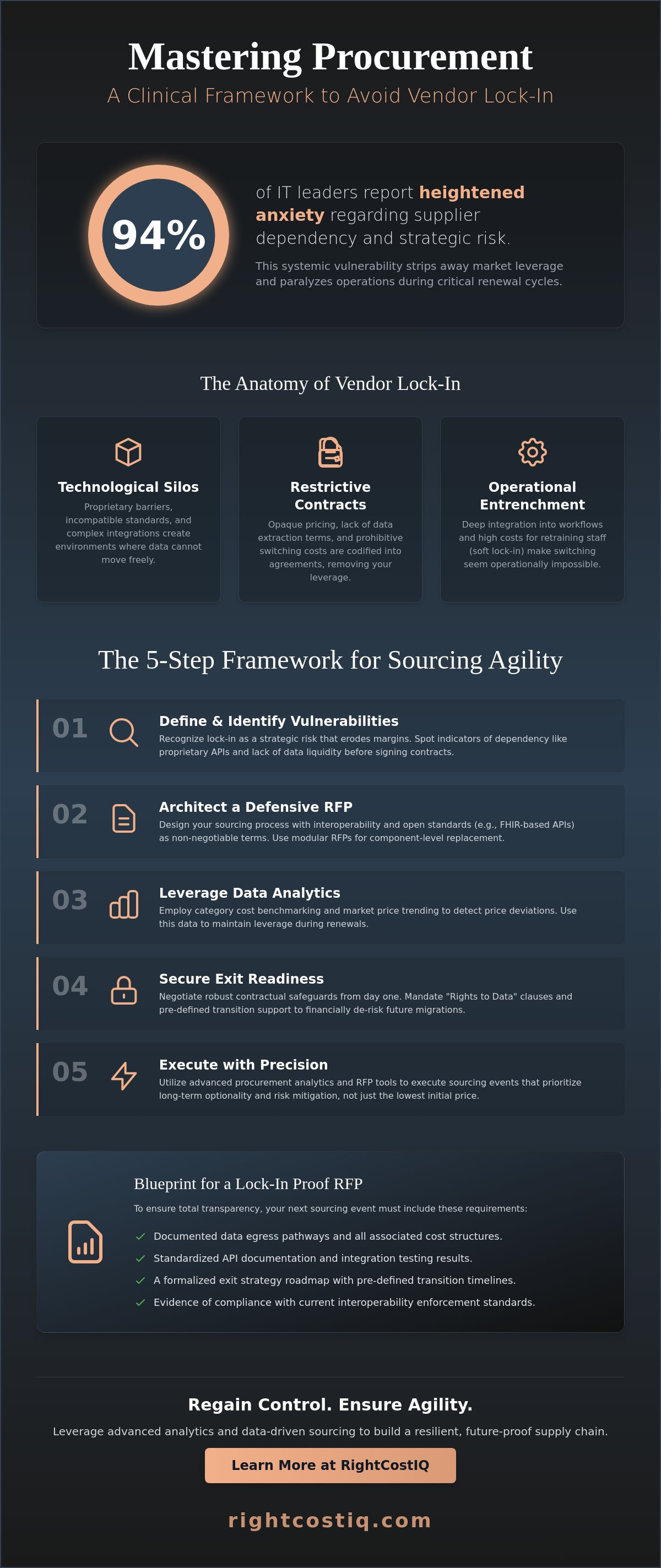
94% of IT leaders currently report heightened anxiety regarding supplier dependency, a sharp escalation in strategic risk according to February 2026 data. This systemic vulnerability often stems from a procurement architecture that fails to prioritize avoiding vendor lock-in strategies during the initial contract phase. You likely recognize the operational paralysis caused by opaque pricing structures and the prohibitive switching costs that strip away your market leverage during critical renewal cycles. Maintaining control over your infrastructure requires a shift from passive consumption to active, data driven sourcing.
This article provides the clinical procurement framework necessary for mastering these high stakes negotiations. You'll gain the specific technical integration standards required to maintain supplier optionality while mitigating financial risk. We'll analyze how to leverage the 21st Century Cures Act enforcement and standardized API protocols to ensure cost transparency and a de-risked supply chain.
Key Takeaways
- Define vendor lock-in as a strategic vulnerability that erodes margins and suppresses innovation. Learn to identify the indicators of commercial dependency before finalizing contracts.
- Architect your RFP process with interoperability and open standards as non-negotiable requirements to ensure long-term operational flexibility.
- Use category cost benchmarking and market price trending to detect price deviations. These tools are critical for avoiding vendor lock-in strategies and maintaining leverage during renewal cycles.
- Secure exit readiness through robust contractual safeguards, including "Rights to Data" and pre-defined transition support clauses that mitigate switching costs.
- Leverage advanced procurement analytics and RFP management to execute sourcing with a focus on long-term optionality and risk mitigation.
The Procurement Trap: Defining Vendor Lock-in for the C-Suite
Vendor lock-in represents a fundamental strategic vulnerability where switching costs, rather than value delivery, dictate procurement outcomes. This condition occurs when the financial, technical, or operational barriers to exiting a supplier relationship exceed the perceived benefits of a superior alternative. In the current fiscal environment, Defining Vendor Lock-in requires a focus on the three pillars of dependency: technological silos, restrictive contractual terms, and operational integration. 94% of IT leaders reported heightened anxiety regarding these dependencies in 2026. This data signals a market wide realization that passive sourcing leads to margin erosion, reduced innovation, and extreme price volatility.
The economic impact of lock-in is quantifiable and severe. When a vendor realizes a client's switching costs are prohibitive, they often implement aggressive price escalations that exceed market benchmarks. This creates a cycle of margin compression. Innovation also stagnates because the incumbent vendor loses the competitive pressure required to improve service quality. As of June 2026, the U.S. Department of Health and Human Services is actively enforcing information blocking provisions of the 21st Century Cures Act to combat these exact scenarios. Executing avoiding vendor lock-in strategies is no longer a choice; it's a requirement for enterprise survival.
The Anatomy of High Switching Costs
Integration complexity and data gravity serve as the primary friction points in high switching cost environments. Data gravity occurs when large datasets become so cumbersome that moving them to a competing platform is cost prohibitive. Organizations must differentiate between soft lock-in, which stems from user familiarity and convenience, and hard lock-in, which relies on proprietary barriers and incompatible standards. Transitioning between systems often requires significant capital for personnel retraining and workflow migration. Failing to quantify these hidden costs during the initial discovery phase leads to long term financial entrapment.
The Strategic Imperative for Commercial Agility
Maintaining vendor optionality links directly to enterprise resilience and margin expansion. Effective category management procurement treats lock-in prevention as a core driver for financial growth. Early warning signs of dependency include proprietary API requirements, lack of data liquidity, and refusal to provide cost free data extraction terms. By prioritizing avoiding vendor lock-in strategies, procurement leaders can ensure their supply chain remains responsive to market shifts. Commercial agility allows the organization to pivot quickly as new technologies, such as standardized FHIR-based APIs, become the industry standard for data exchange.
Architecting the RFP: Prevention Through Sourcing Design
Procurement leaders must treat the Request for Proposal (RFP) as the primary defensive mechanism against commercial entrapment. High level architecture determines long term financial outcomes. Establishing interoperability and open standards as non-negotiable requirements ensures technical liquidity from the start. This proactive approach to avoiding vendor lock-in strategies shifts leverage back to the buyer by mandating that vendors adhere to industry standard protocols, such as FHIR-based APIs or USCDI v3, rather than proprietary black boxes. Organizations that fail to codify these requirements during the sourcing phase often find themselves funding a vendor's R&D through non-competitive renewals.
Designing modular RFPs allows for component level vendor replacement. Instead of a monolithic contract, procurement teams should disaggregate services into functional modules. This structure enables the organization to swap underperforming components without dismantling the entire infrastructure. To ensure total transparency, include these mandatory submission requirements in your next sourcing event:
- Documented data egress pathways and associated cost structures.
- Standardized API documentation and integration testing results.
- Formalized exit strategy roadmaps with pre-defined transition timelines.
- Evidence of compliance with 2026 interoperability enforcement standards.
Standardizing the Evaluation Matrix
Scoring models must evolve to prioritize vendor flexibility and data portability. Traditional procurement often overweights initial discount depth, ignoring the downstream costs of dependency. Effective RFP Management must prioritize future exit feasibility over upfront price concessions. Technical bids should include comprehensive API transparency as a prerequisite for consideration. Research from The MITRE Corporation on mitigating vendor lock in acquisition suggests that competition models focusing on modularity and open interfaces provide the highest long term ROI. Weighting these factors at 20% or more of the final score ensures that strategic agility is built into the contract DNA.
The Role of Multi-Sourcing in Critical Categories
Multi sourcing strategies prevent single point of failure dependencies by allocating spend across primary and secondary vendors. This distribution maintains competitive tension and provides an immediate failover option. For critical infrastructure, implementing "Parallel Run" requirements allows for a seamless transition between providers. Utilizing professional RFP management services ensures objective distance and rigorous technical validation during the selection process. 89% of enterprises have already adopted multi cloud strategies in 2026 to achieve this exact level of resilience. For a deeper look at your current procurement posture, you can access our strategic analytics platform to identify hidden dependency risks.
Leveraging Analytics: Benchmarking to Prevent Price Creep
Data driven sourcing transforms procurement from a reactive administrative function into a strategic profit driver. Utilizing category cost benchmarking allows organizations to identify deviations from market price trends before they impact the bottom line. This analytical rigor is a cornerstone of avoiding vendor lock-in strategies, as it prevents suppliers from leveraging informational opacity to inflate margins. By integrating continuous market price trending, procurement teams neutralize vendor dictated pricing models and reclaim their position as market makers. This transition requires a move away from static, once every three year negotiations toward a model of constant market calibration.
Procurement analytics serve as the primary tool for deconstructing complex service offerings that vendors use to obscure true costs. When a supplier claims that inflation or "increased operational complexity" necessitates a 15% price hike, an organization armed with market intelligence can immediately validate or debunk that claim. 84% of organizations currently identify managing cloud spending as their top challenge, yet few utilize the granular benchmarking required to maintain leverage. Maintaining a de-risked supply chain depends on your ability to prove that a vendor's internal pricing is out of step with the broader competitive landscape.
Continuous Cost Benchmarking Protocols
Establishing baseline pricing through should-cost analysis provides the necessary transparency to evaluate vendor proposals against objective reality. This process involves decomposing complex services into their constituent cost drivers, such as compute power, storage, and labor. Procurement leaders must track vendor performance against industry specific cost indices to ensure the organization remains competitive throughout the contract lifecycle. Identifying "hidden" price escalators within service level agreements (SLAs) requires granular data analysis. Without this visibility, vendors can easily mask significant cost increases behind complex technical descriptors or bundled service offerings that lack itemized transparency.
Market Price Trending as a Negotiation Lever
Forecasting financial volatility is essential for securing price cap protections that protect the enterprise from sudden budget shocks. Market intelligence allows decision makers to challenge proprietary pricing justifications with undeniable external data. Market price trending provides the empirical evidence needed to counter vendor led price hikes by demonstrating exactly where internal cost increases diverge from broader industry movements. This level of insight is particularly critical in the 2026 cloud market, where on-demand pricing for standard 4 vCPU instances has remained relatively flat at $0.19 per hour across major providers. Implementing avoiding vendor lock-in strategies requires this constant calibration against market reality to ensure you never pay a premium for a vendor's perceived indispensability.
Contractual Safeguards: Negotiation Strategies for Exit Readiness
Negotiation isn't just about the entry price; it's about the exit price. Contractual safeguards turn avoiding vendor lock-in strategies into enforceable legal obligations. Organizations must draft "Rights to Data" clauses that ensure immediate, cost-free data extraction. This is vital because vendors often use data egress fees as a secondary lock-in mechanism. While the HHS is actively enforcing information blocking rules as of early 2026, your contract should provide more granular protection than federal minimums. Total data liquidity must be a contractual right, not a technical favor.
Escrow agreements for proprietary code or hardware designs provide a critical safety net. If a vendor goes insolvent or fails to meet performance benchmarks, you need the legal right to access the underlying technology to maintain operations. Termination-for-convenience clauses are also essential. These allow you to pivot to a competitor without proving "cause," which is often a high legal bar that vendors use to stall transitions. Combining these with Most Favored Nation (MFN) or capped escalation clauses ensures your pricing remains competitive even if you choose to stay with the incumbent. You can perform a procurement risk diagnostic to identify which of your current contracts lack these essential protections.
Defining the Exit Support Framework
Transition support shouldn't be an afterthought during the honeymoon phase of a new deal. Contracts must mandate vendor cooperation during the handover to a successor provider. Establishing pre-negotiated hourly rates for transition-related professional services prevents "exit tax" gouging when you decide to leave. You must specify the format and frequency of data exports within the SLA. This prevents the accumulation of technical debt and ensures your data remains in a portable, standardized format throughout the relationship. Without these specifics, vendors will use technical complexity as a weapon to delay your departure.
The Negotiation Coach: Precision Closing
Closing a complex deal requires identifying hidden lock-in triggers that standard legal reviews might miss. Utilizing a negotiation coach allows procurement teams to simulate exit scenarios during the contract drafting phase. This process uncovers subtle dependencies in support structures or third party integrations that could become friction points later. Securing audit rights for vendor performance ensures you can track compliance with these exit readiness terms in real time. If a vendor isn't meeting their interoperability obligations, you need a documented trail to trigger your termination rights and protect your margins.
RightCostIQ: Clinical Execution of Sourcing Agility
Execution of the clinical procurement framework requires a sophisticated technological foundation that prioritizes data liquidity and commercial optionality. RightCostIQ integrates advanced procurement analytics directly into your core sourcing infrastructure, providing the empirical baseline essential for avoiding vendor lock-in strategies. By automating the extraction of granular market intelligence, we dismantle the information asymmetry that vendors traditionally leverage to maintain artificial pricing power. This expert led approach ensures that your RFP management processes focus on long term risk mitigation and strategic flexibility rather than just short term cost avoidance. We provide the technical descriptors and cost analysis frameworks required to evaluate every bid through the lens of future exit feasibility.
Operational efficiency and margin expansion depend on rigorous vendor performance tracking and data driven oversight. Organizations that fail to monitor compliance often find themselves trapped in underperforming contracts that are technically and financially difficult to exit. RightCostIQ provides the technical validation required to ensure that every supplier meets their contractual interoperability obligations as defined in the initial RFP. This continuous oversight transforms procurement from a periodic negotiation into a perpetual state of market readiness, ensuring that your organization remains a market maker rather than a price taker. Our platform identifies deviations from market price trends in real time, allowing for immediate corrective action during the contract lifecycle.
Optimizing Spend Under Management
Consolidating tail spend allows organizations to increase total market leverage without increasing operational dependency on a single provider. We apply clinical precision to category strategy, ensuring that every dollar spent contributes to margin protection rather than vendor entrenchment. Monitoring supply chain compliance through automated performance tracking identifies early warning signs of service degradation or unauthorized price creep. This proactive management style ensures that your procurement architecture remains flexible and responsive to shifting enterprise needs, particularly as 2026 interoperability standards continue to evolve. By managing the entire spend profile, we eliminate the proprietary silos that often hide within fragmented procurement departments.
The RightCostIQ Advantage
RightCostIQ serves as the strategic architect for high stakes procurement, bridging the gap between traditional finance functions and cutting edge digital innovation. The synergy between our proprietary market price trending services and negotiation assistance provides a powerful toolset for dismantling proprietary barriers and technical debt. We don't just identify risks; we provide the specific technical and contractual frameworks required to eliminate them entirely. By aligning high level financial growth metrics with granular technical execution, we ensure that your organization remains agile in an increasingly complex and volatile supplier landscape. Our focus remains strictly on the bottom line, delivering the results and efficiency that modern C-suite leaders demand. Optimize your procurement outcomes with RightCostIQ and secure your long term commercial optionality.
Securing Long-Term Commercial Optionality
Strategic procurement demands a clinical transition from administrative order-taking to rigorous architectural design. You've seen how integrating interoperability standards and modular RFP structures creates a defensive perimeter against supplier dependency. Success requires neutralizing informational asymmetry through continuous cost benchmarking and codifying exit readiness within every service level agreement. Prioritizing avoiding vendor lock-in strategies ensures your enterprise maintains the commercial agility required to pivot as market dynamics shift. This isn't just about cost reduction. It's about reclaiming the structural leverage necessary for sustained margin expansion.
RightCostIQ provides the sophisticated tools required to execute this framework with total precision. We deliver proprietary cost benchmarking analytics, expert negotiation assistance, and comprehensive RFP management frameworks designed for high-stakes environments. Stop reacting to vendor-dictated terms and start architecting your own procurement outcomes. Execute a precision-led procurement strategy with RightCostIQ. You're now equipped to transform procurement into a primary driver of enterprise value.
Frequently Asked Questions
What is the most effective strategy for avoiding vendor lock-in?
The most effective strategy for avoiding vendor lock-in strategies involves establishing technical interoperability and data liquidity as non-negotiable requirements during the initial RFP phase. By mandating adherence to open standards and standardized APIs, organizations prevent proprietary silos from forming at the infrastructure level. This proactive architecture ensures that switching costs remain manageable throughout the contract lifecycle, allowing procurement leaders to maintain commercial optionality and leverage during future negotiation cycles.
How does multi-sourcing help in mitigating vendor dependency?
Multi-sourcing mitigates dependency by distributing critical workloads across primary and secondary providers to maintain a state of constant competitive tension. This strategy eliminates single-point-of-failure risks and provides an immediate failover option if a primary vendor fails to meet performance or pricing benchmarks. 89% of enterprises utilized multi-cloud strategies in 2026 to achieve this level of operational resilience, ensuring that no single ecosystem dictates their long-term financial outcomes.
What contractual clauses are essential for ensuring an easy exit?
Essential clauses for ensuring an easy exit include "Rights to Data" mandates, termination-for-convenience rights, and pre-defined transition support frameworks. These legal safeguards ensure that data extraction is cost-free and that the incumbent vendor must cooperate during the handover to a successor provider. Negotiating capped price escalations and audit rights further protects the enterprise from the "exit tax" often applied by vendors when they perceive a lack of alternatives.
Can open-source software completely eliminate vendor lock-in risks?
Open-source software reduces proprietary software dependencies but cannot completely eliminate vendor lock-in risks, as dependency often shifts to specialized service providers or proprietary distributions. While the underlying code is portable, the operational integration and support infrastructure can still create significant friction during a transition. True optionality requires combining open-source tools with rigorous contractual protections and standardized integration protocols to ensure total technical and commercial liquidity.
How often should a company perform a vendor lock-in risk assessment?
Organizations should perform a vendor lock-in risk assessment annually or whenever a major contract renewal or architectural shift occurs. This frequency ensures that procurement teams identify emerging technical dependencies or price deviations before they become prohibitive. Regular assessments allow for the recalibration of avoiding vendor lock-in strategies, ensuring that the current sourcing posture aligns with evolving market standards like USCDI v3 or FHIR-based API enforcement.
What role does procurement benchmarking play in renewal negotiations?
Procurement benchmarking neutralizes vendor-dictated information asymmetry by providing empirical evidence of current market price trends. During renewal negotiations, this data allows procurement leaders to challenge proprietary pricing justifications with objective cost indices. By proving that a vendor's internal rates diverge from broader industry benchmarks, organizations reclaim their position as market makers and secure the leverage required to demand capped escalations or improved service terms.
How do high switching costs impact long-term enterprise ROI?
High switching costs directly suppress long-term enterprise ROI by forcing organizations to accept non-competitive pricing and stagnant innovation. When the cost of migration exceeds the benefits of a superior alternative, the enterprise is effectively funding the vendor's profit margins through artificial entrapment. This financial friction prevents the reallocation of capital toward emerging technologies and operational improvements, resulting in a quantifiable reduction in overall competitive advantage and fiscal growth.
Is vendor lock-in ever a strategic advantage for a business?
Vendor lock-in is rarely a strategic advantage, though some organizations accept it temporarily in exchange for extreme integration depth or significant upfront price concessions. This trade-off is inherently risky, as the initial savings are often eclipsed by downstream price volatility and reduced innovation. A clinical procurement framework views any form of dependency as a strategic vulnerability that must be mitigated through rigorous architectural design and enforceable contractual safeguards.


