

The highest-scoring proposal isn’t automatically the best choice if evaluators apply criteria inconsistently. RFP evaluation criteria define how each response is judged against the buyer’s goals, while an RFP evaluation scorecard assigns weights and scores to those criteria; the weights should total 100%. Clear criteria matter, but the people scoring them matter just as much.
Cost, technical fit, implementation, security, and supplier experience can all shape a decision, but their importance depends on the procurement. This guide explains what to include in an RFP evaluation scorecard, how weighted scoring works, and how to assign criteria to evaluators with relevant expertise. You’ll also learn how to choose practical weights and build a scorecard that supports consistent, evidence-based decisions.
Key Takeaways
- Define criteria around the procurement’s objectives, then distinguish mandatory requirements from scored differences.
- Use a consistent scoring scale and documented rationale so evaluators can compare proposals on evidence, not impressions.
- Assign technical, financial, security, and operational criteria to evaluators with relevant expertise.
- Set category weights according to project priorities, and ensure the combined weights total 100%.
- Keep scoring records organized to support clear evaluation reports, vendor debriefs, and future procurement decisions.
1. What are RFP evaluation criteria?
RFP evaluation criteria are the defined standards for comparing vendor proposals against procurement goals. They translate priorities into assessable requirements, such as cost, delivery timelines, quality, relevant experience, and customer feedback. Each criterion should connect to a decision the evaluation team needs to make.
Group criteria so evaluators can distinguish what a solution must do from how it will be delivered and priced. Functional criteria cover required capabilities and outputs. Non-functional criteria assess qualities such as security, reliability, and usability. Pricing criteria capture proposed charges and total cost of ownership. For data security, ISO 27001 is an international standard for data security management, according to the International Organization for Standardization.
Make every criterion measurable. Replace “strong customer service” with specific evidence, such as a service-level commitment, escalation process, or customer reference describing comparable work. Replace “high quality” with acceptance requirements, documented testing, or relevant performance records. Each criterion should identify the evidence evaluators will review and what distinguishes an adequate response from a superior one.
Score price and total cost of ownership using the same cost components and time horizon for every vendor. Include relevant implementation, operating, maintenance, and transition costs, then set the cost weight according to its strategic importance. This prevents a low initial quote from obscuring significant costs elsewhere.
A playground equipment example shows how criteria and weights reflect the purchase. Pricing receives 30% of the evaluation, safety ratings 20%, and delivery and installation 20%. Warranty terms, vendor reputation, and equipment size each receive 10%. The example also considers safety standards, references, delivery, installation, and contract terms. These weights are illustrative; a buyer should align each share with its own requirements.
Structure the RFP so vendors respond directly to each criterion. Use matching labels for requirements, response fields, and evidence requests; this makes proposal review more traceable. For example, ask vendors to describe delivery milestones under the timeline criterion and provide a reference for comparable projects. A clear RFP management process can keep requirements and responses organized.
Eligibility and security criteria may also shape the evaluation. The 8(a) Business Development Program is a U.S. federal procurement program that can reserve contracts for eligible small businesses, according to the U.S. Small Business Administration. Define applicable eligibility requirements in the solicitation, then evaluate vendor responses against those stated criteria rather than informal preferences.
2. What is an RFP scoring matrix?
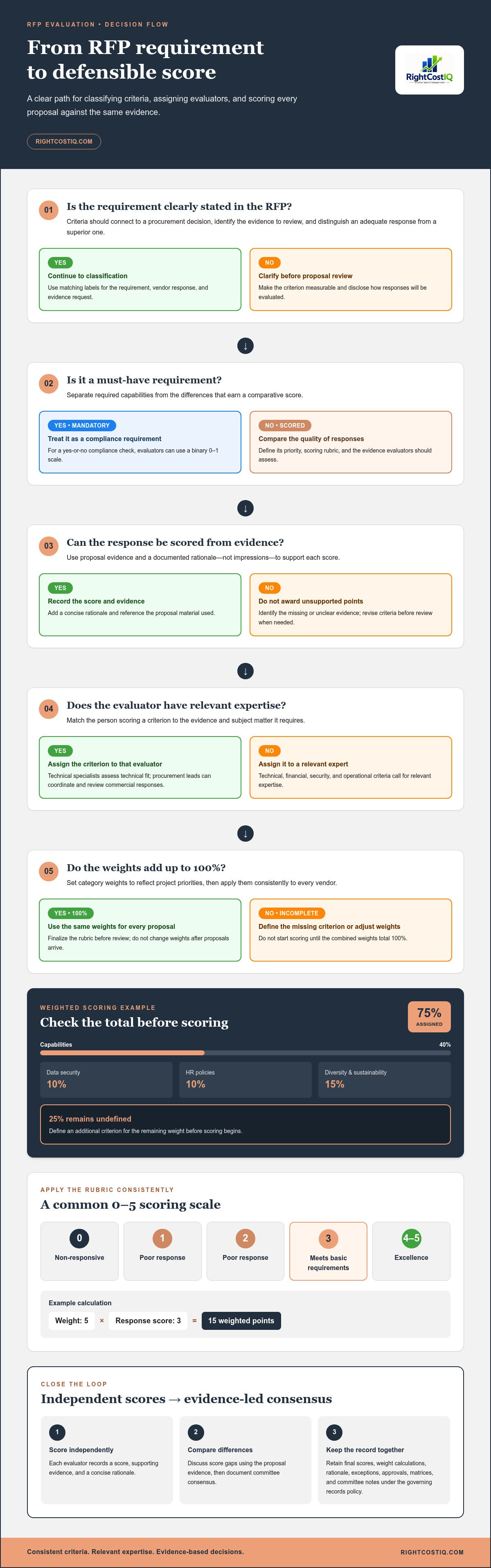
An RFP scoring matrix converts evaluation criteria into comparable scores for vendor proposals. It lists each requirement, its priority, the scoring rubric, evaluator notes, and weighted result. For example, multiply a requirement’s weight of five by a response score of three to produce 15 weighted points.
In the United States, procurement rules vary by government level and solicitation. Evaluators should follow applicable procurement policies and the evaluation method stated in the RFP. Consistent criteria support fair public procurement, and the matrix should document how each response meets the disclosed criteria.
Weighted scoring makes priorities visible. Assign weights that reflect the procurement’s objectives, then apply the same rubric to every vendor. In one example, capabilities receive 40%, data security 10%, HR policies 10%, and diversity and sustainability 15%. Those categories total 75%, so the remaining 25% needs an explicitly defined criterion before scoring.
Rubrics define what each score means, reducing subjective interpretation. A common scale runs from 0 to 5: zero means non-responsive, scores of one or two indicate a poor response, three meets basic requirements, and four or five signal excellence. For a yes-or-no compliance requirement, evaluators can use a binary 0-1 scale instead.
Have evaluators score independently before committee discussion. For each criterion, record the score, supporting proposal evidence, and a concise rationale. The committee can then compare differences, discuss the evidence, and document consensus scores. If one evaluator gives a technical response a three and another gives it a five, their notes should explain the difference.
A scoring report should record final scores, weight calculations, rationale, exceptions, and approvals. Keep vendor responses, completed matrices, committee notes, and the final decision together in the procurement file. Retention periods depend on organizational and procurement requirements, so follow the governing records policy rather than assuming a standard timeline.
Useful templates include a weighted spreadsheet with formulas, a compliance checklist, and a narrative rubric for technical responses. A template might pair each requirement with its weight, score, evidence reference, evaluator comment, and weighted total. The same documented criteria can guide a vendor debrief and help explain the decision consistently.
Common risks include changing weights after proposals arrive, applying different standards to vendors, and awarding points without evidence. Reduce these risks by finalizing the rubric before review and auditing outlier scores. After each procurement, compare evaluator comments and vendor questions, then revise unclear criteria before the next RFP.
3. Assigning evaluators with relevant technical expertise
Assign each criterion to evaluators who can assess its evidence. Procurement leads can coordinate the process and review commercial responses, while technical specialists assess system fit, integration, and operational requirements. For a software contract, a user representative might assess workflow fit and an IT specialist might examine architecture. Match evaluators to the decision, not simply to a department.
Before proposals arrive, create a criteria-to-expertise map. List each criterion, the knowledge needed to assess it, the primary evaluator, and any supporting reviewer. A security criterion may require an information security specialist, while implementation timing may call for a project delivery lead. Mapping responsibilities early exposes gaps and keeps technical judgments with relevant reviewers.
Use separate scoring rounds when proposals call for distinct expertise. Assign evaluators to criteria that match their knowledge: procurement can review commercial terms, technical staff can assess functional requirements, and security specialists can evaluate controls. Tie every reviewer’s assignment to the published scoring criteria to keep the evaluation focused on contract requirements.
Before scoring, calibrate the team with a sample response or fictional example. Ask evaluators to score the same evidence, then discuss the reasons for different assessments. If one reviewer considers a product demonstration proof of security while another requires documented controls, clarify the evidence standard. Calibration aligns the process without requiring identical opinions where professional judgment is appropriate.
Have evaluators score their assigned areas independently before group discussion. Each person should cite the proposal section or attachment supporting each score. During consensus review, focus on the evidence and rubric, not the vendor’s reputation or presentation style. Record unresolved differences and the agreed rationale; a clear decision trail helps the procurement team explain how the panel applied each criterion.
Manage conflicts and access consistently. Ask evaluators to disclose relationships or interests that could affect impartiality, and reassign affected criteria when needed. Give every reviewer the same proposal version, clarifications, and scoring instructions. In a software procurement, do not let a vendor demonstration replace written evidence unless the RFP specified demonstrations as an evaluation method.
Before final approval, review the panel’s coverage. Confirm that every criterion has an accountable evaluator, high-risk areas have supporting expertise, and each percentage-weighted category has a qualified reviewer. Procurement can then verify the scores, check that evidence is recorded, and refer technical questions to the appropriate specialist before the committee makes its final selection.
4. Common evaluation categories and weighting
Weights should reflect which outcomes matter most to the procurement, not a default template. Technical expertise, functional performance, security, implementation, and total cost are common categories. Procurement teams typically make criterion weights add up to 100, allowing them to calculate each category’s weighted contribution transparently. A structured approach makes the evaluation process easier to explain and compare.
Technical fit and functional requirements assess whether proposals can deliver the required outcomes. One example assigns 25% to technical expertise, while another assigns 50% to functional requirements. These are separate example models, not percentages to combine automatically. Choose the category structure that matches the purchase: a software acquisition may emphasize required capabilities, while a service contract may prioritize delivery approach and expertise.
Non-functional requirements measure how the solution performs beyond its core functions. One example assigns 20% to non-functional requirements. For modern SaaS evaluations, security and compliance often receive 20-30% of the score; security-questionnaire evaluations may allocate 60-70% to compliance and audit capabilities. These higher security weights fit decisions where control evidence is central, not every procurement.
Implementation risk deserves a defined place when transition timing affects operations. An example RFP assigns 40% to implementation timeline, showing how a buyer can elevate schedule performance when it drives the decision. Assess the vendor’s milestones, dependencies, staffing approach, and transition plan against the required delivery outcome. Score evidence consistently rather than rewarding confident language alone.
Pricing and total cost of ownership commonly account for 20-35% of a matrix’s total score. Compare proposals using the same cost categories and assumptions, including applicable implementation and operating components. A low initial price should not earn an automatic top score if the overall cost model omits required elements. Set the pricing rubric before evaluation, then document how each response supports its proposed value.
Set weights only after ranking procurement priorities. If technical capability is essential and price is secondary, give capability more influence while retaining a meaningful cost assessment. If price is the dominant constraint, increase its weight and define acceptable technical performance separately. The final percentages must total 100, and every category needs a clear reason tied to the intended result.
Before releasing the RFP, test the model with hypothetical proposals. Confirm that a strong result in a high-priority category affects the overall ranking as intended, and that accumulated points for minor preferences cannot outweigh critical requirements. This sensitivity review helps ensure the RFP evaluation scorecard is strategically aligned, transparent, and useful for selecting a suitable vendor.
5. How do you build an RFP evaluation scorecard step by step?
Define the decision. Start with the outcome the requesting team needs. For a software purchase, that could mean replacing a legacy system while meeting integration and security requirements. Translate each outcome into a requirement vendors can answer and evaluators can verify. This keeps the scorecard focused on business needs rather than preferences that do not affect contract success.
Separate gates from scored criteria. Mark essential requirements as pass/fail when a proposal must meet them to remain eligible. Score differentiators that distinguish qualified proposals, such as usability, implementation approach, or support model. For example, required data handling could be a gate, while the quality of a vendor’s documented security approach receives a comparative score.
Choose categories and assign weights. Group related requirements, then distribute weight according to their importance to the outcome. The category weights should add up to 100 so evaluators can calculate a weighted percentage. A system replacement might prioritize technical fit and implementation, while another procurement may give price and ongoing operating requirements greater influence.
Define the evidence and rubric. For every criterion, specify what proposal content counts as proof and what separates score levels. A delivery plan might be assessed through milestones, dependencies, and assigned responsibilities. Use a consistent scale, such as 0-5, and describe each level before proposals arrive. Evaluators then judge responses against the same standard instead of personal interpretations.
Assign reviewers and test the model. Match criteria to evaluator expertise, then confirm that each requirement has an accountable reviewer. Run sample responses through the formula to check that scores behave as intended. If a strong technical result should outweigh a minor preference, verify that the weights produce that outcome. Make sure every reviewer can follow the calculations and scoring instructions.
Publish the method in the RFP. Explain the evaluation categories, weights, pass/fail gates, and evidence vendors must provide. Use the same labels in the solicitation and scorecard so reviewers can find supporting material efficiently. For example, ask vendors to respond under the heading used for the implementation criterion and present milestones in a consistent format.
Control changes and retain the decision trail. Finalize criteria and weights before reviewing proposals. During evaluation, document scores, evidence references, and reasons for material changes or consensus decisions. After selection, review bidder questions and evaluator feedback to identify unclear wording or weak measures. Use those findings to improve the next scorecard while preserving a consistent procurement method.
RightCostIQ: Request For Proposal (RFP) Management and Negotiation Assistance
RightCostIQ provides Request For Proposal (RFP) Management and Negotiation Assistance for teams seeking structured support from solicitation through vendor negotiations. This support can help when evaluation criteria, proposal comparisons, or negotiation preparation call for focused procurement expertise. Procurement Category Cost benchmarking and Analytics adds market context to cost reviews, helping teams assess proposals against category pricing factors. Together, these capabilities connect evaluation findings with commercial decisions. If your team is refining an RFP process or preparing to negotiate, contact RightCostIQ to discuss your procurement needs or visit RightCostIQ.com.
Put the evaluation framework to work
A scorecard is more valuable when its results inform future procurement decisions. After an award, compare the selected vendor’s delivery with the commitments and priorities recorded during evaluation. That feedback can sharpen future criteria, improve cost analysis, and make supplier performance reviews more specific. An RFP evaluation scorecard is not just a selection tool; it can connect sourcing decisions with ongoing procurement outcomes.
RightCostIQ offers Request For Proposal (RFP) Management and Negotiation Assistance, Procurement Category Cost benchmarking and Analytics, and a Procurement and Vendor Performance Tracking Service. These services help teams carry evaluation insights into negotiations, market comparisons, and vendor performance monitoring.
To discuss how procurement support could fit your process, contact RightCostIQ to discuss your needs. A clear evaluation framework gives your team a stronger foundation for the next sourcing decision.
Frequently Asked Questions
What are RFP evaluation criteria?
RFP evaluation criteria are the factors used to judge whether a proposal meets the buyer’s needs. A facilities team, for example, could assess whether a maintenance plan covers required equipment, response procedures, and reporting. Criteria should connect to actual contract outcomes. If a factor cannot affect eligibility, performance, or value, it may not belong in the evaluation.
What is an RFP scoring matrix?
An RFP scoring matrix is the working tool evaluators use to apply the solicitation’s evaluation method to vendor submissions. It can include requirement references, assigned reviewers, evidence notes, individual scores, and calculation fields. For a training-services RFP, the matrix might connect each proposed course module to stated learning requirements, making gaps easier to identify during review.
What is the difference between Pass/Fail and Scored Criteria?
Pass/fail criteria determine whether a proposal meets a stated threshold; scored criteria compare the strength of eligible responses. For example, a required insurance document could be a pass/fail gate, while a vendor’s transition plan receives a comparative score. An RFP evaluation scorecard should distinguish these clearly so vendors understand which requirements determine eligibility and which contribute to comparative scoring.
How are RFPs evaluated?
Evaluate RFPs by reviewing submissions against the solicitation’s stated requirements and decision method. First identify incomplete or ineligible responses, then assess qualifying proposals and record supporting evidence. For a logistics contract, reviewers might compare route plans with required service locations, operating assumptions, and reporting needs. The procurement lead consolidates the findings to support a documented selection decision.
How do I optimize my responses for maximum score?
Map each response to the RFP’s exact requirement labels, then answer every prompt directly. State the claim first and support it with evidence, such as a relevant project reference, workflow description, or supporting document. If a question requests a transition plan, provide its sequence, responsibilities, and dependencies. Use an RFP evaluation scorecard as a planning reference to track coverage before submission.
How do teams that win more RFPs approach scoring differently?
Effective response teams use scoring criteria as a planning framework, not just a final checklist. They identify priority requirements early, assign response owners, and gather supporting evidence while drafting. For a software proposal, product specialists can substantiate capability claims while delivery leads document implementation assumptions. In the final review, check that every answer addresses the buyer’s stated need, not merely the vendor’s preferred message.
What does pass/fail mean in an RFP evaluation?
Pass/fail means a requirement is judged as met or unmet, rather than scored against the relative quality of responses. A procurement team could use this approach for a mandatory form or minimum technical condition stated in the RFP. The solicitation should explain the required evidence and the effect of an unmet condition, so vendors understand the threshold before preparing their submissions.
What is an RFP evaluation scorecard?
An RFP evaluation scorecard records how proposals perform against the evaluation method. It can connect each response to its requirement, reviewer, evidence, and assessment, creating a traceable record for the selection team. For instance, a scorecard for consulting proposals could keep methodology and staffing assessments distinct, helping reviewers compare like with like and explain how the evidence supports their assessments.


