

A low broker fee can obscure the renewal terms that have the greatest effect on your benefits program. An employee benefits RFP is a structured way to compare brokers’ services, costs, renewal support, and contract terms; employers are advised to launch one 4–6 months before renewal. The goal is to assess the full value of each proposal, not just its headline fee.
Choosing a broker affects more than procurement: it shapes how your organization evaluates the market, weighs renewal options, and supports employees through plan changes. A structured comparison makes those trade-offs visible and ties each proposal to your priorities. This guide covers when to run an employee benefits RFP, what to include, how to set selection criteria, and which cost, renewal, and contract details to examine. It also explains how to plan the timeline around renewal and open enrollment.
Key Takeaways
- Compare broker service models against your organization’s priorities, including renewal analysis, employee support, and ongoing performance tracking.
- Look beyond the quoted fee: assess how each proposal explains market options, renewal recommendations, and compensation.
- Review contract length, renewal provisions, termination rights, and transition responsibilities before selecting a broker.
- Set evaluation criteria and scoring before issuing the RFP so proposals can be compared consistently against your requirements.
- Build the RFP around a clear scope, useful response questions, and a timeline that accommodates evaluation and implementation.
1. When should you consider a new broker or providers?
An employee benefits RFP is a formal process for comparing brokers’ services, compensation, renewal approach, and proposed outcomes. It gives employers a consistent basis for assessing providers against defined needs, rather than relying on a sales presentation or fee alone. Consider issuing one when service or renewal results fall short, your organization changes significantly, or the last market review is overdue. A well-scoped RFP can also show whether a broker’s service model still fits your workforce.
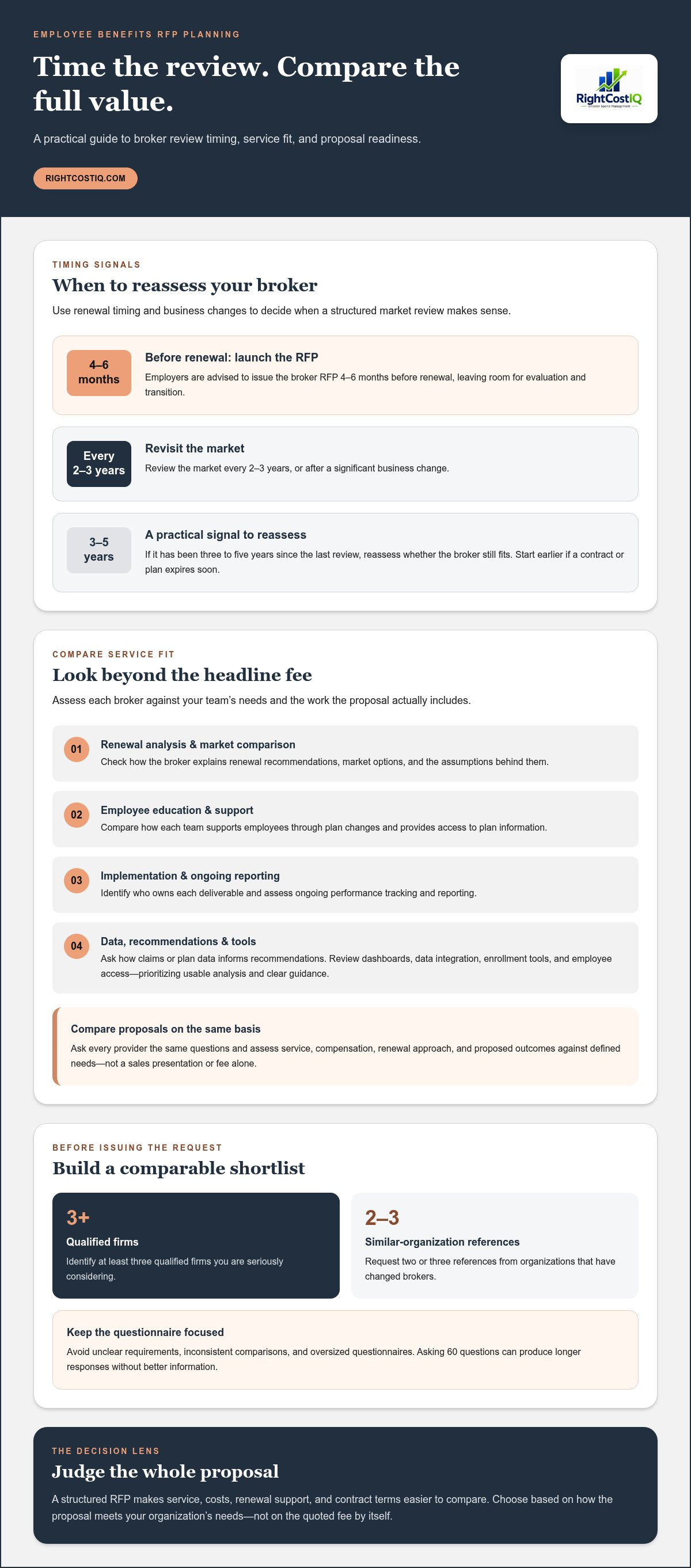
Timing matters. Employers are advised to issue a broker RFP 4–6 months before renewal and revisit the market every 2–3 years, or after a significant business change. If it has been three to five years since your last review, that’s a practical signal to reassess broker fit. Start earlier if your current contract or plan expires soon; the evaluation and transition need room to run. Use the employee benefits RFP schedule to set deadlines for data preparation, proposal review, and decision-making.
Assess each broker’s service model against your team’s needs. Compare renewal analysis, market comparisons, employee education, implementation support, and ongoing reporting. Ask how the team turns claims or plan data into recommendations, and identify who will own each deliverable. Evaluate technology by how well it supports those outcomes: review reporting dashboards, data integration, enrollment tools, and employee access to plan information. A polished platform matters less than usable analysis and clear guidance for employees.
What does it cost to run an employee benefits RFP? The cost depends on the scope, internal staff time, data preparation, and whether you use external RFP management. Define the workload early so you can plan resources and keep internal effort separate from broker compensation.
What information should employers provide to benefits brokers and vendors in an RFP? Include organizational priorities, plan and renewal details, workforce characteristics, service expectations, and the required proposal format. Set common questions and evaluation criteria so every provider responds to the same requirements.
What risks and common mistakes should employers avoid in an employee benefits RFP? Avoid unclear requirements, inconsistent comparisons, and oversized questionnaires; asking 60 questions can produce longer responses without better information. Keep the scope focused, disclose the evaluation method, and compare promised services with the outcomes your team needs.
Where can employers find employee benefits RFP templates and sample questions? The U.S. Environmental Protection Agency describes a useful template structure: project background, scope of work, proposal requirements, evaluation criteria, and information to provide respondents. Adapt those elements to benefits brokerage, then use a consistent RFP process framework to keep submissions comparable.
Before issuing the request, identify at least three qualified firms you are seriously considering. For confidence in the transition, request two or three references from similar organizations that have changed brokers. Assess each firm’s transition experience alongside its technology, analytics, and service commitments.
2. Benefits renewal and market analysis
A renewal review should test whether the current proposal fits your organization’s priorities, not just record the new premium. Compare the expiring plan with renewal options across coverage design, employee impact, service commitments, and cost drivers. Separate changes caused by plan design from changes in market pricing. This distinction helps leaders assess recommendations on their merits and understand the trade-offs.
Set a consistent basis for comparison before reviewing proposals. Request the same information from every broker, including assumptions, recommended plan changes, renewal rationale, and supporting analysis. If one proposal recommends a plan design change while another keeps the current design, ask both to explain the expected effect on costs and employees. This makes differences clear instead of treating each proposal as a standalone presentation.
Market analysis is useful when it connects pricing trends to decisions. Review the renewal in light of the current plan structure, utilization patterns, workforce needs, and timing of proposed changes. Market price trending and forecasting can help frame how market movement affects purchasing decisions. Use the analysis to distinguish a short-term shift from a longer-term cost risk, and tie recommendations to goals such as cost predictability, employee choice, or administrative simplicity.
- Separate: identify the cost effect of plan-design changes versus market movement.
- Compare: align assumptions and proposal details across brokers.
- Prioritize: rank recommendations against workforce needs and budget strategy.
Include retirement plans in the broader procurement review where relevant. Employers can rebid 401(k) service provider contracts to benchmark prices and services, then assess whether retirement plan fees are competitive. Keep this analysis distinct from health-plan renewal decisions, but use a consistent method: define scope, compare equivalent services, and document the basis for selection. This gives decision-makers a clearer view of total benefits purchasing.
The U.S. Environmental Protection Agency notes that cost and technical evaluations can be conducted sequentially. Apply that approach by assessing the service model and renewal analysis first, then reviewing cost proposals against the same scope. This helps prevent a low quoted cost from outweighing strategic fit before you understand what each offer includes.
Close the review with a decision record. Capture the selected option, key assumptions, rejected alternatives, and the reasons behind the recommendation. If analysis identifies a need for a more structured sourcing process, use a consistent RFP management approach to organize proposal comparisons and negotiation priorities.
Close the review by considering whether benefit priorities align with employee preferences. In a Glassdoor study cited on the page, 79 percent of employees preferred better or additional benefits to a pay increase. A 2018 America’s Health Insurance Plans survey found that 14 percent of employees considered mental health services a priority, while a 2021 Willis Towers Watson survey reported that 73 percent of respondents planned to increase mental wellbeing support. Use these findings to inform, not replace, the organization’s own assessment.
3. Contract terms and termination
A broker proposal becomes operational through its contract, so compare the service commitments with the answers in the proposal. Define the covered work, named deliverables, reporting cadence, renewal support, and responsibility for employee communications. If a proposal promises renewal analysis, for example, the contract should describe the analysis and when you will receive it. Clear scope makes performance measurable and reduces ambiguity during coverage transitions.
Separate the initial term from renewal options and the maximum contract term. Jacksonville University’s brokerage and consulting agreement sets an initial term of three years, with renewal options for up to three years, or portions thereof, and a maximum term of six years. The City of Brevard’s proposed contract allowed continuation for an additional two plan years under the same terms and conditions. These examples show why each option needs explicit dates and conditions.
Termination language matters just as much as duration. The City of Brevard anticipated a provision allowing services to end at any time on thirty (30) days' notice. In your review, identify who may terminate, how notice must be delivered, and what support continues during the transition. Specify access to plan records, outstanding reports, open renewal work, and handoff responsibilities. These details help protect continuity if the relationship ends near renewal.
What legal and compliance requirements apply to employee benefits RFPs in the United States? Federal law requires employee benefits brokers to disclose their compensation to employers. Jacksonville University’s RFP also required its contractor to comply with the Health Insurance Portability and Accountability Act of 1996, cited as 42 U.S.C. 1320d-8.
Make compliance responsibilities specific in the proposed contract. Jacksonville University required brokers to advise on ERISA-related filings, COBRA, HIPAA, Medicare, FMLA, and the ACA. Use that list as an example of RFP scope, then define which advice, filings, and reporting tasks the selected consultant owns. Specify how the broker will flag deadlines and direct questions to the organization’s responsible teams.
Use a contract review matrix to compare responses and catch gaps between the proposal and agreement. For each commitment, record the proposal answer, final contract wording, accountable party, and evidence of completion. Include compensation disclosure, service scope, renewal deliverables, data handling, transition assistance, and termination notice. If the final contract narrows a proposal promise, resolve the difference before award. This connects evaluation to enforceable expectations and keeps coverage work aligned with the selected service model.
4. Defining selection criteria and planning around renewal dates
Compare responses against criteria established before vendors receive the request. Lockton recommends setting the RFP scoring method before issuing it, so the evaluation process uses consistent measures. Score each broker in every category on a 1–5 scale, then document evidence supporting each score. This helps distinguish a persuasive presentation from a proposal that meets the organization’s requirements.
Weight criteria to reflect the relationship’s priorities. Jacksonville University assigns 20% of its technical evaluation to each of four areas: benefits management and compliance, plan sourcing and selection, enrollment and member services, and cost containment. Employers can adapt those categories, then define what a strong response must describe. For example, cost containment scoring can assess the analysis and recommendations offered, not just broad claims of savings.
Use relevant qualifications as pass-or-score criteria. The City of Brevard required at least 5 years of public-sector brokerage experience. It also required experience serving employers with self-insured plans and at least 75 employees. An organization with different plan structures or workforce needs should define corresponding experience requirements, then apply them uniformly across vendor responses.
Plan backward from the current plan or broker contract expiration. Organizations may need to begin an RFP a year or more in advance. Set time for drafting, questions, response review, finalist presentations, approval, contract completion, and onboarding. Employers should shortlist 2–3 finalists after scoring submissions. Ask finalists to describe a transition plan covering the first 30, 60, and 90 days, then align its milestones with renewal work.
Build renewal deliverables into the calendar. The City of Brevard required a written renewal report at least 90 days before renewal. Its health plan year runs from July 1 to June 30, with annual open enrollment scheduled no later than May 15 before the July 1 benefit renewal. These dates show why plan-year milestones, reporting deadlines, and employee enrollment windows belong in the same project schedule.
How should employers compare employee benefits RFP responses? Apply the same documented criteria and scoring scale to each proposal, then shortlist 2–3 finalists for deeper review. Compare evidence, service commitments, renewal deliverables, and transition plans against the organization’s priorities, rather than letting an attractive extra feature outweigh stated requirements.
Before award, reconcile the evaluation document with the final agreement. Record the selected vendor’s promised deliverables, accountable teams, review cadence, and escalation process. After selection, track performance against those commitments so the relationship remains measurable beyond renewal and onboarding.
5. What should an employee benefits RFP include?
A strong RFP gives every broker the same scope, context, response format, and evaluation rules. The U.S. Environmental Protection Agency describes a useful template structure: project background, scope of work, proposal requirements, evaluation criteria, and respondent information. Apply those components to your benefits program, then define the decisions the process must support. A clear structure makes responses comparable and the final selection easier to document.
Start with organizational context that helps respondents tailor their recommendations. Describe the workforce, current plan structure, renewal timing, service challenges, and priorities. Specify which information vendors should use and how they should handle it. If employee education is a priority, for example, ask for a proposed approach and the resources it requires, rather than a general claim of capability.
Make the scope specific enough to compare deliverables. Identify the requested work across renewal analysis, plan sourcing, enrollment support, employee communications, reporting, and ongoing service. Separate required services from optional recommendations. For each area, ask who will do the work, what outputs your organization will receive, and how the work will be measured. These questions connect a broker’s proposal to operational expectations.
- Renewal: request the analysis, assumptions, options, and decision timeline.
- Service: ask for roles, escalation paths, and reporting deliverables.
- Technology: describe required integrations, reporting access, and employee-facing tools.
- Compensation: require a clear disclosure of how the broker is compensated.
- Conflicts: ask how the broker prevents recommendations from being influenced by compensation.
U.S. federal law requires employee benefits brokers to disclose their compensation to employers. Jacksonville University also expected proposers to explain how they avoid conflicts of interest, including steering clients toward carriers or products with higher commissions. Ask directly about compensation and conflicts, and require clear explanations in each response. This makes financial incentives visible during evaluation.
Set response instructions before distribution. State the submission format, due date, contact process for questions, and required attachments. Include evaluation criteria and explain how the organization will compare technical responses and cost proposals. Keep questions focused: an RFP with 60 questions can generate longer answers without producing better information. Remove prompts that don’t support a decision or contract requirement.
Finally, require respondents to identify assumptions, exceptions, and transition dependencies. A proposal should describe what the broker will deliver, what the organization must provide, and how responsibilities transfer after selection. For structured support in building and negotiating a procurement request, request an RFP diagnostic.
RightCostIQ: Request For Proposal (RFP) Management and Negotiation Assistance
RightCostIQ supports organizations that need structured RFP management and negotiation assistance to turn evaluation criteria into a clear sourcing decision. Use this support when your team needs help organizing proposal comparisons, aligning requirements, or preparing negotiation priorities. Procurement category cost benchmarking and analytics can add market context to cost assessments, while vendor performance tracking can help monitor agreed commitments after selection.
A disciplined procurement process starts with defined requirements, comparable proposals, and documented decisions. RightCostIQ also provides price risk management and tracking, as well as market price trending and forecasting, for broader procurement analysis. These services support procurement decisions; they do not replace advice from a qualified benefits professional.
For support with your RFP process, contact RightCostIQ or visit rightcostiq.com.
Turn the decision into ongoing oversight
Treat the RFP as the start of a measurable procurement cycle, not a document that ends at contract award. An employee benefits RFP can establish how your team will track vendor performance, capture renewal insights, and use those findings in future sourcing decisions. This continuity keeps procurement decisions grounded in documented evidence.
RightCostIQ provides Request For Proposal (RFP) Management and Negotiation Assistance, Procurement Category Cost benchmarking and Analytics, and Procurement and Vendor Performance Tracking Service. These services can support proposal evaluation, cost comparisons, and performance tracking after an employee benefits RFP concludes.
If you’re preparing a sourcing process or refining how proposals are assessed, contact RightCostIQ to discuss your RFP. A clear next step can help turn your requirements into a more disciplined procurement process.
Frequently Asked Questions
What is an employee benefits broker RFP?
An employee benefits RFP formally invites brokers to explain how they would support an employer’s benefits program. It gives decision-makers a shared framework for reviewing proposals, including service approach, compensation disclosure, and transition responsibilities. For example, an employer could ask respondents how they would coordinate renewal analysis with internal finance and HR teams, then compare those answers with the organization’s needs.
What happens after the RFP?
Once proposals arrive, evaluators score them against the published criteria, clarify material differences, and identify finalists for discussion. The organization then selects a provider, completes the agreement, and organizes the transition. Assign internal owners for data access, employee communications, and pending decisions. Next, turn the selected proposal’s commitments into a tracking document so you can review delivery after the transition.
When should you consider a new broker or providers?
Consider a change when recurring service issues disrupt decisions, recommendations miss leadership’s priorities, or employees cannot get clear benefits guidance. Organizational changes can also shift the support you need. Record specific examples, such as repeated delays in answering renewal questions or reports that omit information needed for planning. Documented gaps help distinguish a correctable service issue from a broader mismatch.
How is a benefits RFP different from a renewal quote?
A renewal quote focuses on proposed plan pricing and terms for an upcoming period. An employee benefits RFP evaluates the broader broker relationship, including service responsibilities, analysis, employee support, and transition approach. This wider scope helps employers compare how providers will work, not just what they recommend for one renewal. It also creates a clearer basis for aligning expectations before selecting a provider.
Which criteria and scoring weights should the RFP use?
Choose criteria that reflect your priorities, such as renewal analysis, service delivery, employee education, reporting, and compensation transparency. Set minimum requirements for essential capabilities, then weight the remaining criteria by business importance. Ask evaluators to score independently and cite proposal evidence for each rating before discussing differences. For instance, distinguish a documented deliverable from a general claim of expertise.


