
A procurement process can meet its cost targets and still fail if suppliers are not treated fairly and consistently. The ethical considerations in procurement and negotiation include equal access to information, consistent bid criteria, conflict-of-interest controls, confidentiality, honest negotiation, and honoring commitments. These safeguards make ethical conduct part of the decision process, not an afterthought.
That standard applies throughout the procurement cycle. Supplier selection, contract terms, labor conditions, environmental impact, and day-to-day performance can all create ethical and operational risks. Clear policies support consistent decisions, while audits and training help teams put expectations into practice.
This article explains what ethical procurement means and why it matters, covering fairness, sustainability, human rights, bribery and corruption, and responsible negotiation. It also outlines how policies, supplier reviews, audits, and employee training can help organizations identify risks and strengthen accountability across their supply chains.
Key Takeaways
- Build supplier selection around documented requirements and consistent evaluation criteria to make decisions fair and defensible.
- Assess labor, environmental, and social risks across the supply chain, including subcontractors and sub-suppliers.
- Use clear negotiation records and contract performance measures to support honest agreements and accountable supplier relationships.
- Make an ethical procurement policy practical with management commitment, role-specific training, regular audits, and progress monitoring.
- Use RFP management, cost benchmarking, and vendor performance tracking to strengthen procurement decisions and oversight.
What is Ethical Procurement and Why is it Important?
Ethical procurement means acting fairly, lawfully, and responsibly throughout sourcing, supplier relationships, and the supply chain. To manage conflicts of interest, require decision-makers to disclose personal or financial interests, document each disclosure, and exclude conflicted individuals from affected decisions.
Supplier Due Diligence and Accountability
Supplier due diligence is a structured review of a supplier’s conduct, business activities, and supply-chain risks before and during a business relationship. It matters because ethical contract standards can fall short if buyers overlook subcontractors, workplace practices, or changes in performance. Map relevant suppliers and subcontractors, record identified risks, and assign clear responsibility for follow-up.
Training helps sourcing staff apply the same review standards and recognize conflicts of interest. Monitoring then compares supplier conduct with agreed expectations, while records show who assessed findings and approved corrective action. The U.S. federal minimum hourly wage is $7.25, according to the U.S. Department of Labor; wage checks should also consider applicable standards where supplier work occurs.
Ethical Sourcing Roadmaps and Criteria
An ethical sourcing roadmap connects business needs with supplier criteria, risk reviews, and ongoing oversight. It helps teams identify priority concerns before a sourcing decision locks in a supplier or commercial terms. Define the need objectively, then assess labor practices, environmental impact, legal compliance, and the supplier’s ability to meet documented requirements.
Cooperative purchasing can broaden supplier access by combining buyer demand, but shared sourcing still requires transparent criteria and accountable decisions. A roadmap should explain how participants assess bids, manage conflicts, and monitor supplier conduct. For example, buyers can set expectations for subcontractors in sourcing requirements and track performance against them after the award.
Fair Competition and Equal Supplier Treatment
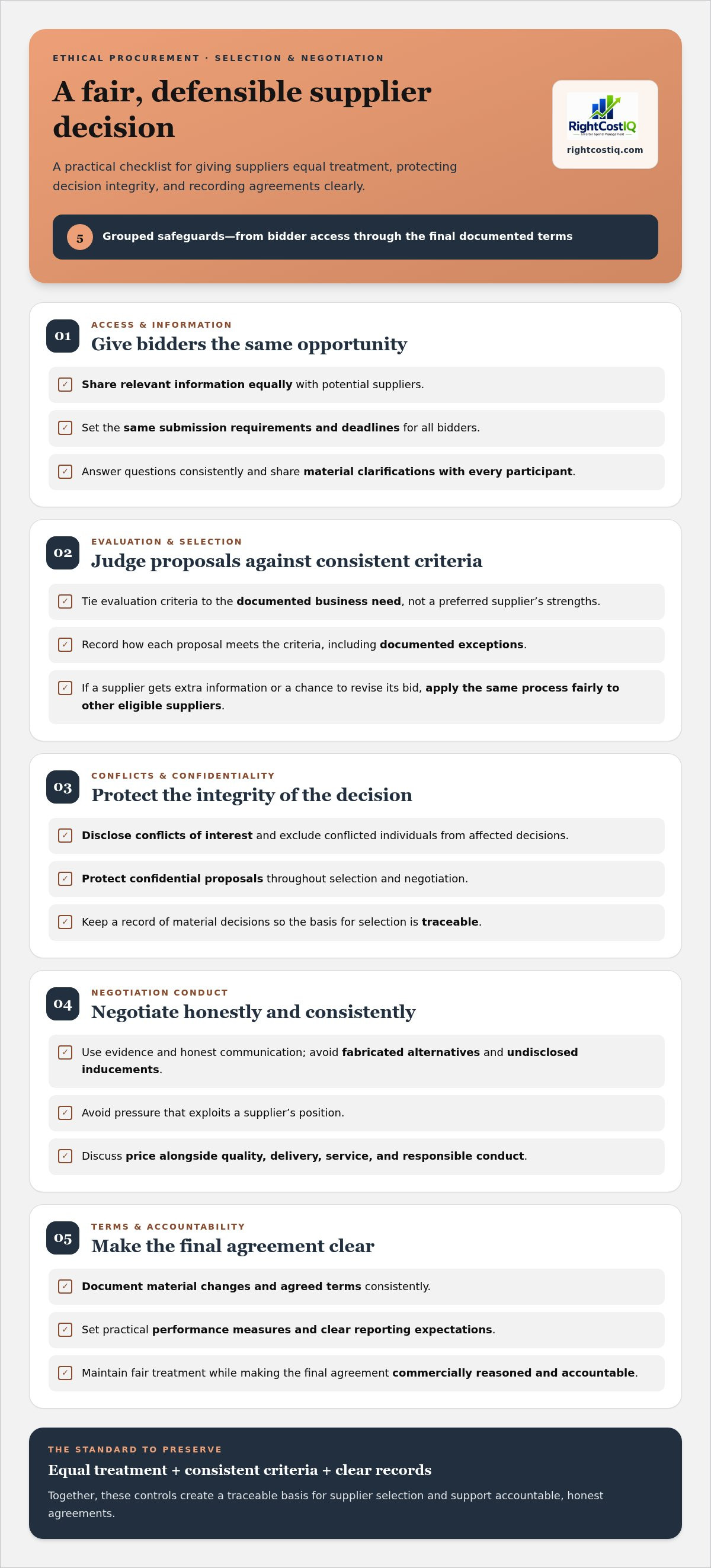
Fair competition gives potential suppliers equal access to relevant information and evaluates proposals against consistent criteria. Unequal treatment can distort competition and undermine confidence in the award decision. Set the same submission requirements and deadlines for all bidders, answer questions consistently, and share material clarifications with every participant.
Keep evaluation criteria tied to the business need, not a preferred supplier’s strengths. Record how each proposal meets the criteria, including any documented exceptions. If a supplier receives additional information or an opportunity to revise its bid, apply the same process fairly to other eligible suppliers. This creates a traceable basis for selection and reduces the risk of favoritism.
Ethical Selection and Negotiation
Ethical supplier selection and negotiation rely on evidence, honest communication, and safeguards against personal influence. Negotiation shapes both commercial outcomes and the standards suppliers must meet. Compare bids with published requirements, disclose conflicts, protect confidential proposals, and document material decisions and agreed terms.
During negotiations, avoid fabricated alternatives, undisclosed inducements, or pressure that exploits a supplier’s position. Discuss price alongside quality, delivery, service, and responsible conduct, then document changes consistently. Buyers can negotiate practical performance measures and clear reporting expectations while maintaining fair treatment. These controls help ensure the final agreement is commercially reasoned and accountable.
Ethical practices across the procurement cycle
In the United States, applicable rules depend on the transaction and organization. The Foreign Corrupt Practices Act (FCPA) makes it unlawful for a U.S. person or company to offer, pay, or promise anything of value to a foreign official to obtain or retain business. Negotiators should assess total value alongside labor, human rights, and environmental requirements, treating these standards as sourcing criteria rather than optional concessions.
Ethical practices should shape every stage of procurement, from defining a need through supplier management and contract closeout. At universities, Stanford focuses on energy-efficient, environmentally friendly technology, while Arizona State University incorporates life-cycle cost analysis into procurement decisions. These examples show how institutions can align purchasing choices with operational and sustainability objectives.
Labour and Environmental Standards
Labor and environmental standards set supplier requirements for workplace conduct and the impact of products, services, and production. They matter because a low bid can shift costs to unsafe work, excessive hours, pollution, or poor product lifecycle outcomes. Procurement teams can compare bids using documented criteria for labor conditions, safety practices, materials, energy use, and environmental impact.
Cost savings should come from better specifications, efficient logistics, and lifecycle value, not weaker protections. Buyers can assess whether proposed delivery schedules are realistic and whether suppliers can meet labor and environmental requirements. Evaluating these factors alongside price makes trade-offs explicit and supports defensible award decisions.
Unethical and Illegal Procurement Practices
Unethical procurement includes favoritism, undisclosed conflicts, bribery, coercion, and misuse of confidential bid information. These practices distort competition, damage reputations, and can create legal exposure. Illegal supply-chain practices can also involve goods produced through human rights abuses, child labor, counterfeiting, or environmental damage.
Controls should cover direct suppliers and subcontractors. Buyers can document decision rationales, retain sourcing records, and establish channels for reporting suspected misconduct. If a supplier’s conduct conflicts with contractual expectations, record the issue and assign responsibility for follow-up. Consistent handling helps prevent informal exceptions from eroding ethical standards.
Circular-economy practices extend ethical decision-making beyond purchase and delivery. Before selecting an option, procurement teams can assess product durability, repairability, reuse, recycling, and end-of-life handling. Lifecycle planning can reveal whether a lower initial price may lead to more waste or replacement demand later.
For example, a university purchasing technology can compare energy efficiency, expected useful life, and available reuse or recycling pathways. Specifications can favor materials and designs that support recovery rather than disposal. These criteria bring environmental impact into sourcing and give suppliers clear expectations for responsible product stewardship.
For universities and other organizations, the practical test is whether ethical commitments influence specifications, evaluation, contract terms, and supplier reviews. Procurement teams can connect each commitment to a decision point and retain evidence of how bids and supplier performance were assessed. That record links institutional priorities to day-to-day purchasing.
Fairness, transparency, sustainability, and social responsibility
Ethical procurement principles turn organizational commitments into consistent decisions, clear contracts, and accountable sourcing records. Buyers can apply them through evaluation criteria, negotiation records, supplier disclosures, and public reporting.
Fairness in Contract Negotiation
Fair contract negotiation gives each party a consistent process and considers relevant commercial and performance factors. It matters because balanced terms support reliable supplier relationships and reduce disputes over expectations. Buyers should document changes to scope, delivery, quality, and payment terms, then explain how each change affects the agreement.
For example, if a delivery schedule changes during negotiations, record the revised dates and the supplier’s responsibilities. Apply the same decision standards across comparable contracts, and do not use confidential bid details to pressure another supplier. A clear rationale lets reviewers trace how the final terms were reached.
Transparency and Confidentiality
Transparency means explaining procurement criteria and decisions, while confidentiality protects sensitive supplier information. Both matter: incomplete disclosure can undermine fair competition, but careless sharing can expose bid details or commercial data. Separate information intended for all bidders from confidential material, and control access to proposals during evaluation.
For each sourcing event, retain records of requirements, clarifications, evaluation results, approvals, and contract changes. Share material updates consistently with participating suppliers. In public institutions, documented decisions also help explain how purchasing choices serve institutional objectives and support public accountability.
Honesty in Negotiations
Honesty in negotiation means accurately presenting facts, authority, alternatives, and constraints. Fabricated claims can distort decisions and damage relationships after a contract is awarded. Negotiators should distinguish firm requirements from preferences, confirm assumptions, and summarize agreed points in writing before finalizing contracts.
If a buyer says a requirement is mandatory, the team should have a documented business reason. If a proposal changes, record the revised term and its impact rather than relying on memory. These practices create a useful audit trail and reduce later disagreements about commitments.
Sustainability and Social Responsibility
Sustainable and socially responsible procurement incorporates environmental and social criteria into supplier evaluation and contract management. It matters because purchasing decisions shape supply-chain practices beyond the immediate transaction. Buyers can assess energy use, material sourcing, worker conditions, and community impact alongside quality and operational fit.
The University of California System prioritizes environmentally friendly options and socially responsible sourcing. The University of British Columbia prioritizes suppliers that create employment opportunities for marginalized communities. These examples show how organizations can set measurable priorities, communicate them to suppliers, and review progress against stated commitments.
Public accountability depends on communicating both progress and challenges. Organizations can report the criteria used, explain how contracts support their priorities, and identify areas where supplier performance needs improvement. Consistent records link procurement practices to outcomes and help stakeholders distinguish documented commitments from unsupported claims.
Human rights, modern slavery, child labor, bribery, and corruption
Human rights and corruption risks can arise in supplier workplaces, through intermediaries and gifts, or during pricing discussions. Procurement professionals need controls for supplier conduct and for decisions that could compromise a buyer’s independent judgment.
Human Rights and Labour Abuses
Human rights and labor due diligence examines whether suppliers protect workers from forced labor, child labor, unsafe conditions, discrimination, and excessive hours. Risks can exist below a direct supplier, including among subcontractors. Map key supply-chain relationships, identify where work is performed, and include worker protections in supplier expectations.
Review evidence that employment is voluntary and workers can leave their jobs. Check whether employment terms explain wages and whether safety procedures are demonstrated in the workplace. Supplier reviews should also consider freedom of association and whether workers can raise concerns without retaliation.
When a concern arises, record the facts, identify responsible parties, and set corrective actions with follow-up. This gives procurement teams a basis for tracking supplier conduct instead of relying only on a code of conduct or signed statement.
Bribery and Gifts to Public Officials
Bribery involving public officials occurs when something of value is offered, promised, or provided to influence a business decision. Gifts or incentives tied to contract awards can undermine fair sourcing and create serious legal exposure. The Foreign Corrupt Practices Act (FCPA) makes it unlawful for a U.S. person or company to offer, pay, or promise anything of value to a foreign official to obtain or retain business.
Procurement professionals should record gifts, hospitality, and requests for special treatment, then follow the organization’s approval and reporting procedures. An offer made during an active supplier evaluation deserves particular scrutiny because it could affect, or appear to affect, impartial judgment.
Kickbacks and Price Fixing
A kickback is an illicit benefit exchanged for favorable procurement treatment; price fixing involves competitors coordinating prices instead of competing independently. Both matter because they distort contract decisions and undermine market confidence. In 2010, several airlines, including British Airways and Korean Air, were fined for conspiring to fix air cargo prices.
Keep supplier communications and pricing decisions documented, and escalate unusual payment requests or unexplained pricing coordination. Siemens paid over $1.6 billion in bribes in a global bribery case described as occurring in 2008. The example shows why controls must cover intermediaries and transactions across the supply chain.
Bribery and Illicit Incentives
Illicit incentives include payments, discounts, rewards, or other benefits offered in exchange for special consideration during supplier evaluation or negotiation. They shift decisions away from objective criteria and can conflict with personal or organizational interests.
Separate legitimate commercial terms from personal benefits, document concessions, and route unusual offers through formal review. Procurement teams should also provide a clear way to report suspected corruption. Prompt escalation preserves records and allows responsible leaders to assess concerns consistently.
Ethical procurement policies, audits, and training
Organizations put ethical standards into daily procurement practice through written policies, supplier audits, staff training, and clear reporting channels. To report and investigate a suspected violation, provide a confidential reporting route, preserve relevant records, assign an impartial investigator, document findings, and track corrective action to completion.
A written policy should define the conduct expected of employees, managers, suppliers, and subcontractors. It can cover conflicts of interest, gifts, confidentiality, fair competition, human rights, environmental expectations, and escalation procedures. Clear, concise rules help staff apply consistent standards throughout sourcing and contract management.
Senior management should endorse the policy and follow its requirements in their own decisions. For example, a policy can define how employees disclose supplier relationships and who reviews those disclosures. It can also set a specific gift-value limit, such as US$5, giving staff a concrete reference when deciding whether to accept or refuse a gift.
Review policies regularly and update them when organizational practices or legislative requirements change. The Chartered Institute of Procurement & Supply (CIPS) provides an ethical procurement framework and code of ethics for organizations to consult. Teams can use such frameworks to check whether their own rules address practical sourcing risks, rather than relying on broad commitments alone.
Supplier audits assess whether actual conduct matches the organization’s code and contract expectations. Internal teams or independent third parties can review records, supplier processes, and relevant work areas. A useful audit plan links each finding to evidence, an owner, a corrective action, and a follow-up review.
Risk-based monitoring directs audit effort toward suppliers and activities with greater exposure. Procurement teams can track findings, corrective-action completion, and recurring issues using defined indicators. Regular reviews help management identify patterns, such as repeated documentation gaps or unresolved labor concerns, and adjust oversight accordingly.
Training should prepare procurement personnel and managers to apply policy requirements in real sourcing decisions. Scenario-based sessions can cover gift offers, confidential bid information, conflicts, supplier complaints, and suspected misconduct. Managers can reinforce training by discussing documented examples and explaining how the organization handled them.
During an investigation, restrict access to relevant records, maintain a dated evidence log, and separate fact-finding from award decisions. Interview relevant personnel and document their accounts consistently. Then communicate findings through appropriate internal channels, apply corrective measures, and review whether policy or training changes can prevent recurrence.
Make policy implementation measurable by connecting staff training, supplier reviews, audit findings, and corrective actions. Assess procurement risks and performance to identify where stronger oversight can support consistent, accountable decisions.
RightCostIQ: Request For Proposal (RFP) Management and Negotiation Assistance
RightCostIQ supports procurement teams with structured RFP management and negotiation assistance. This service can help organize supplier proposals and commercial discussions as teams formalize sourcing requirements and compare bids. Procurement Category Cost benchmarking and Analytics adds market-price context to cost evaluations, while the Procurement and Vendor Performance Tracking Service supports ongoing supplier oversight.
These services suit organizations seeking stronger visibility into sourcing decisions, pricing, and vendor performance. They complement internal ethics policies and controls, but do not replace them. Contact RightCostIQ to discuss how its procurement support can fit your sourcing priorities.
Make Ethical Procurement Part of the Next Decision
The next sourcing event is an opportunity to turn ethical standards into measurable decision controls. Identify where supplier selection, negotiation, or performance oversight needs clearer criteria, then assign responsibility for reviewing evidence and addressing gaps. Consistent execution makes ethical considerations in procurement and negotiation part of operational governance, rather than a policy detached from commercial decisions.
RightCostIQ supports this work through Request For Proposal (RFP) Management and Negotiation Assistance, Procurement Category Cost benchmarking and Analytics, and a Procurement and Vendor Performance Tracking Service. These offerings help procurement teams structure sourcing activity, assess cost information, and monitor vendor performance within their broader processes.
Choose a practical starting point, such as an upcoming RFP or a supplier category with unclear performance measures. Discuss your procurement priorities with RightCostIQ and consider where focused support can strengthen your process. A clear next step can help your organization build more accountable sourcing decisions over time.
Frequently Asked Questions
Should You Lie In a Negotiation?
No. Negotiators should not fabricate facts, competing offers, authority, or commitments, because deception can distort decisions and undermine an agreement. Protect your position by stating genuine constraints selectively, asking clarifying questions, and distinguishing firm requirements from preferences. If a claim is misstated, correct the record promptly and document any resulting change. Accurate statements preserve credibility without requiring disclosure of every internal position or commercial priority.
What are the core ethical principles in procurement and negotiation?
The core principles are fairness, impartiality, accountability, honesty, confidentiality, and responsible supplier conduct. Ethical considerations in procurement and negotiation become practical when teams translate these principles into decision controls. For example, require conflict disclosures, limit proposal access to evaluation personnel, and record the rationale for award decisions. Include sustainability and worker protections in supplier expectations so ethical standards guide both sourcing decisions and ongoing contract oversight.
What rules apply to gifts, hospitality, and supplier incentives during negotiations?
Apply the organization’s written gift and hospitality policy, and follow applicable laws for the transaction and parties involved. Policies should clarify what requires disclosure, approval, or refusal, especially during an active evaluation or negotiation. Record the giver, recipient, purpose, and timing of an offer. The Foreign Corrupt Practices Act makes it unlawful for a U.S. person or company to offer, pay, or promise anything of value to a foreign official to obtain or retain business.
How can organizations prevent bribery, fraud, bid rigging, and collusion in procurement?
Use separated responsibilities, controlled bid access, documented approvals, and a reporting channel for suspected misconduct. For example, keep proposal evaluation separate from payment approval, and retain records of supplier communications and award decisions. Treat unusual pricing patterns or similar proposal errors as signals for further examination, not proof on their own. Assign an impartial investigator, document findings, and track corrective action so concerns are handled consistently and based on evidence.
What are best practices for fair and transparent supplier evaluation and selection?
Define the business need and evaluation criteria before reviewing proposals, then apply them consistently to each supplier. Give bidders the same material information and submission instructions, and document clarifications shared during the process. Use an evaluation record that connects each score to proposal evidence. If an exception is necessary, state its rationale and approval. This process helps reviewers understand why the selected supplier best met the requirements.
What ethical risks arise from confidential information and data handling in supplier negotiations?
Improper handling can expose a supplier’s pricing, technical approach, or commercial strategy to another bidder, distorting competition and damaging trust. Limit proposal access to personnel with a defined evaluation role, store files in controlled systems, and do not forward bid details through informal channels. Share only information authorized for release. Keep records of access, disclosures, and approved retention or disposal decisions to support accountability if questions arise.
What procurement ethics policies, training, and controls are most effective?
Effective programs combine clear written rules, management accountability, practical training, reporting channels, and supplier oversight. Train staff with realistic scenarios, such as a gift offered during an active RFP or a colleague’s undisclosed supplier relationship. Give employees clear escalation steps and protect review integrity by assigning impartial investigators. Track training completion, reported concerns, audit findings, and corrective actions so leaders can identify control gaps and strengthen procedures.


