

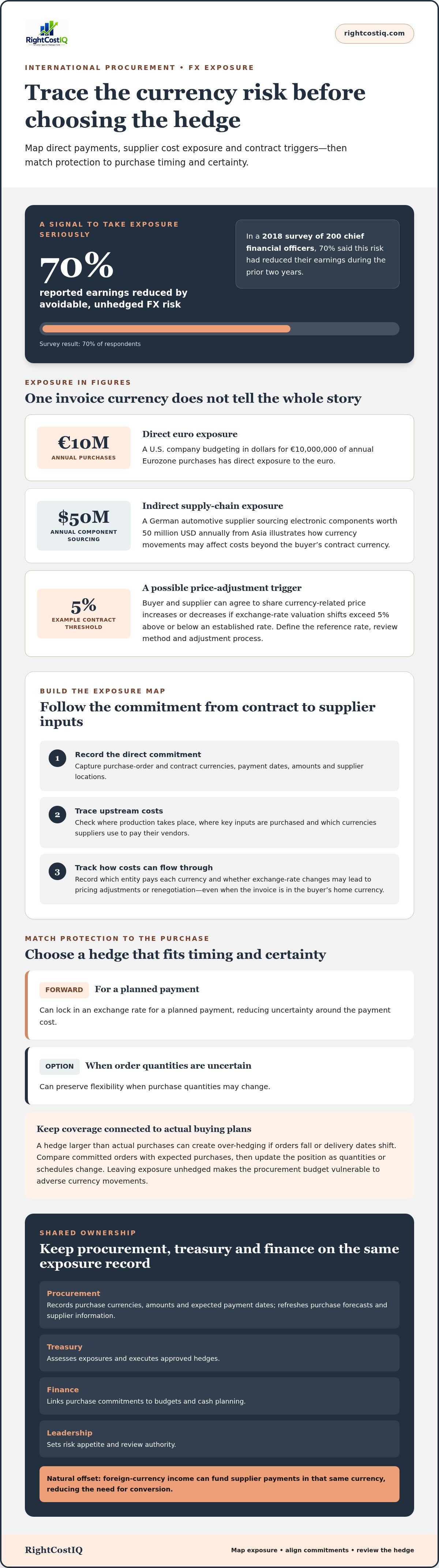
Currency risk arises where procurement commitments, payment currencies, and exchange-rate exposure meet. Mitigating currency risk in international procurement starts with identifying who bears the risk under each contract, then matching any hedge to the timing and certainty of the purchase. Forward contracts can lock in an exchange rate for a planned payment, while options can preserve flexibility when order quantities are uncertain.
Paying in your home currency does not necessarily eliminate currency risk. Contract terms can shift exchange-rate exposure between buyer and supplier, and a hedge can reduce uncertainty while limiting gains from favorable currency movements.
This article explains how to identify direct and indirect exposure, compare hedging approaches, and assess currency terms in supplier contracts. It also shows how procurement and finance can align decisions so currency risk is reflected in cost analysis, supplier negotiations, and purchasing plans.
Key Takeaways
- Align treasury, procurement, finance, and leadership on who owns currency exposure and how it will be monitored.
- Map direct and indirect foreign-exchange exposure across supplier contracts, payment currencies, and supply chains.
- Use contract terms and suitable hedging instruments to manage exchange-rate exposure while accounting for purchase timing and flexibility.
- Reduce exposure naturally by matching income and expenses in the same currency or aligning sourcing with sales markets.
- Separate transaction, economic, and translation risk to focus controls on the type of exposure affecting procurement decisions.
How do you manage currency risk in procurement?
Mitigating currency risk in international procurement starts with assigning clear ownership of exposures, documenting payment commitments, and aligning contract terms with financial controls. Treasury, procurement, finance, and leadership need a shared view of currency needs and supplier risks.
Cross-Functional FX Coordination
Cross-functional coordination assigns exposure tracking, supplier information, financial forecasts, and oversight to the teams responsible for each decision. It matters because procurement commitments can affect treasury’s hedge decisions and finance’s cash planning.
Procurement records purchase currencies, amounts, and expected payment dates; treasury assesses exposures and executes approved hedges. Finance links those commitments to budgets, while leadership sets risk appetite and review authority. In a 2018 survey of 200 chief financial officers, 70% said avoidable, unhedged foreign-exchange risk had reduced their earnings during the prior two years.
A shared exposure register helps teams compare purchase orders with invoices and forecasts. For example, procurement can flag a supplier payment due in euros so treasury can assess the currency need and finance can include it in cash planning.
Hedging Approaches and Trade-Offs
Financial hedging uses instruments such as forwards or options, while natural hedging aligns income and expenses in the same currency. The distinction matters because financial hedges can reduce uncertainty but may also limit gains when exchange rates move favorably.
Over-hedging can leave a company with a hedge larger than its actual purchases if orders fall or delivery dates change. Leaving exposure unhedged, by contrast, makes the procurement budget vulnerable to adverse currency movements. Compare committed orders with expected purchases before selecting coverage, then update the position when quantities or schedules shift.
Mitigating currency risk in international procurement also means considering natural offsets. A company receiving foreign-currency revenue can use those funds for supplier payments in the same currency, reducing the need for conversion. The right balance depends on forecast reliability, cash-flow capacity, and the organization’s risk appetite.
Corporate FX Hedging Rules
For U.S. companies, tax and accounting treatment depends on the hedge instrument, its purpose, and the underlying exposure. Requirements can differ by transaction and entity, so tax, accounting, and legal teams should assess a proposed hedge before execution.
Document the business exposure, hedge purpose, and transaction records, then align finance reporting with procurement commitments. This helps teams apply consistent internal controls and keep procurement hedges connected to the underlying purchases.
Supplier due diligence is another important control. Assess the financial stability of suppliers providing critical goods or services, and monitor changes that could affect delivery or liquidity. A supplier’s financial pressure can threaten continuity even when currency costs are hedged.
Mitigating currency risk in international procurement therefore requires regular updates to exposure records and supplier assessments. Periodic vendor questionnaires may miss sudden changes in supplier risk. Procurement can refresh purchase forecasts and supplier information together, giving treasury and finance a current basis for decisions.
Identifying direct and indirect foreign-exchange exposure in supply chains
Map each foreign-currency commitment from the purchase contract through supplier operations and upstream sourcing. This reveals where exchange-rate movements can change actual procurement costs, even when an invoice is denominated in U.S. dollars.
Mapping Supply Chain Currency Exposure
Exposure mapping records direct foreign-currency payments and indirect cost changes passed through suppliers. This matters because a domestic-currency invoice can still reflect a supplier’s foreign-exchange costs.
Start with purchase orders, contract currencies, payment dates, and supplier locations, then trace critical inputs upstream. For example, a U.S. company budgeting in dollars for €10,000,000 of annual Eurozone purchases has direct euro exposure. If a supplier buys key components in another currency, those costs can create indirect exposure through pricing adjustments or renegotiation.
Extend the map beyond first-tier vendors. A German automotive supplier sourcing electronic components worth 50 million USD annually from Asia illustrates how currency movements can affect a chain even when the buyer’s contract uses a different currency. Record which entity pays each currency and how cost changes flow through the agreement.
Supplier Operations and Currency Use
Review supplier operations and currency use to understand how foreign exchange affects a quoted price beyond the invoice currency. This helps buyers distinguish genuine currency exposure from a supplier’s general pricing decisions.
During commercial discussions, identify where production takes place, where inputs are purchased, and which currencies suppliers use to pay their own vendors. A Swiss supplier may invoice in Swiss francs while paying non-Swiss firms in their local currencies. Those upstream obligations can influence its pricing strategy. Understanding supplier operations gives procurement a clearer basis for assessing cost changes.
Buyers and suppliers can agree to share currency-related price increases or decreases if future exchange-rate valuation shifts exceed 5% above or below an established rate. Define the reference rate, review method, and adjustment process in the contract. A two-way mechanism makes the treatment of favorable and unfavorable movements explicit, rather than leaving the buyer to absorb every adjustment.
Supplier diversification can reduce dependence on one currency area, but compare landed cost, capability, and operational fit alongside exchange exposure. Where possible, maintain at least two potential suppliers for each material or product. A survey cited in the research found 80% of companies studied invested in supplier relationships and flexibility to reduce risk, supporting alternatives without treating sourcing changes as automatic.
Volume reallocation can preserve options when qualified suppliers operate in different currency areas. For example, a buyer could shift orders between approved sources as contract terms and currency costs change, while retaining the original supplier for critical volumes. Before shifting, account for switching costs, capacity, specifications, and delivery commitments. This keeps foreign-exchange decisions connected to supply continuity, not just the quoted rate.
Reviewing supplier contracts and negotiating protections
Choose a contract currency by weighing the buyer’s natural currency position, supplier costs, and which party can manage the resulting exposure. The contract should also define how exchange-rate movements affect prices, payment timing, and adjustment rights.
Currency Choice in Purchase Contracts
The chosen currency determines which party bears exchange-rate risk between pricing and payment. Ask suppliers to quote in both currencies, then compare the buyer’s total cost with any currency-risk premium included in the supplier’s quote.
Depending on the payment currency and contract terms, either the buyer or supplier may bear exchange-rate risk. Conversely, a U.S.-dollar price adjusted for exchange rates shifts the burden back to the buyer. Some Chinese suppliers have added currency-risk premiums of up to 3%, so compare dual-currency quotes against the contract’s adjustment terms.
Specify the reference exchange rate and review method in the contract. A clause may establish a movement range of up to plus or minus 5%, with a defined process for sharing increases or decreases outside that range. Also clarify how exceptional political or market events trigger a review, rather than leaving price changes open to interpretation.
Forward Contracts for Budget Certainty
A forward contract fixes an exchange rate for a specified future date and commits both parties to complete the exchange then. It can support budgeting when procurement amounts and payment dates are predictable, because the buyer can plan around a known conversion rate.
Forward delivery dates can range from 3 days to 1 year in the future, and forward contracts can hedge up to 95% of currency risk. The forward rate adjusts the current spot rate for the interest-rate differential between the currencies over the contract period. Forwards usually require no upfront payment, though providers may require margin or collateral.
Match the contract amount and value date to the purchase schedule. If a shipment or payment is delayed, some FX providers allow the forward’s value date to be adjusted. Confirm how delays and changes to the underlying purchase are treated before committing, since a hedge that outlasts or exceeds the procurement obligation can create a separate exposure.
Options and swaps suit different procurement profiles. A currency option gives the buyer the right, but not the obligation, to exchange a set amount at a predetermined rate on or before a specified date. It can suit uncertain quantities when preserving favorable rate movements matters. Currency swaps can help manage long-term currency exposures.
For recurring purchases, coordinate contract protections with finance and legal teams before renewal. Review the payment currency, adjustment triggers, rate source, and termination language together. RFP management and negotiation assistance can help structure these terms alongside supplier pricing, keeping currency protections aligned with the commercial agreement.
Natural hedging and currency matching
Natural hedging reduces foreign-exchange exposure by matching income and expenses in the same currency, sourcing locally in sales markets, or diversifying suppliers geographically. For example, a U.S. company with euro revenue can use those receipts to pay euro-denominated suppliers, reducing the amount it needs to convert.
Local Sourcing and Currency Diversification
Local sourcing and currency diversification align purchasing with the markets where a business earns revenue, helping reduce reliance on one currency. A company selling in Europe can assess euro-area suppliers alongside existing sources, comparing operational fit and total costs as well as currency exposure.
Supplier diversification can spread exposure across currency areas, but it does not remove all risk. Map supplier costs and payments by currency, then consider whether alternative sourcing can support business needs. Local sourcing may reduce currency conversion for particular purchases, while a broader supplier base can give procurement options when exchange rates shift.
Natural hedging also applies to foreign-currency receivables. A U.S. exporter expecting euros can match euro receipts against euro supplier payments or other euro expenses. Treasury can compare the timing and amounts of those cash flows, then hedge only the remaining net exposure with a financial instrument where appropriate.
That matching requires regular updates. If a European customer delays payment while a euro supplier invoice remains due, the timing mismatch can leave the buyer exposed. Track expected receipts and purchasing commitments by currency and payment date; revise the net position when contract timing, order volumes, or customer collections change.
Hedging Performance and Cost Metrics
Hedging performance metrics compare actual currency outcomes with budgets and the organization’s risk objectives. They matter because a hedge that reduces exchange-rate uncertainty may still create costs or fail to match changing procurement needs.
Track hedge coverage against forecast exposure, the effective exchange rate against the budget rate, and variance in cash outflows. Review transaction costs, spreads, collateral requirements, and the impact of timing differences. These measures show whether the hedge aligns with purchasing obligations, rather than judging success only by whether market rates later moved favorably.
Compare results across currencies and periods using consistent methods. For example, finance can examine whether euro hedges covered committed euro purchases and whether realized payments stayed close to budget assumptions. Separate gains or losses from hedge instruments from changes in supplier pricing, so favorable exchange-rate movements do not obscure procurement cost increases.
Use vendor performance tracking alongside currency measures to assess delivery, payment timing, and supplier changes that affect exposure. A supplier’s revised invoice schedule can alter the amount or timing of foreign-currency needs. Reviewing those changes with purchasing forecasts helps keep natural offsets and financial hedges aligned as commitments evolve.
Transaction, economic, and translation exchange-rate risks
Foreign-exchange risk in procurement is the possibility that exchange-rate movements change a purchase’s cost or a company’s financial position. Transaction, economic, and translation risks affect cash payments, long-term competitiveness, and financial reporting in different ways.
Identifying and Assessing FX Exposure
FX exposure assessment records foreign-currency positions and evaluates their likelihood and potential loss. It matters because procurement teams need to distinguish the risk of an upcoming payment from broader business or reporting effects.
Transaction risk arises when exchange rates change between contract conclusion and payment. Record each currency, amount, payment date, and budget rate, then update the assessment when purchase orders or supplier terms change. For example, a U.S. buyer owing euros faces a different cash cost if the euro strengthens before settlement.
Economic risk concerns long-term effects on competitiveness and market position. A stronger home currency may alter a supplier’s relative costs or the buyer’s sourcing economics over time. Translation risk occurs when foreign subsidiaries are consolidated into financial statements; it primarily affects reporting rather than cash flow. Separate these categories so a short-term payment hedge is not mistaken for a solution to long-term competitive exposure.
Currency Reviews and Exchange-Rate Bands
Formal currency reviews compare current exchange rates with agreed reference points and trigger defined decisions when movements cross a set band. This matters because buyers and suppliers can manage price adjustments through a documented process instead of reacting inconsistently to each fluctuation.
A contract may set a currency-movement range of up to plus or minus 5%. State the reference rate, review dates, and how price changes are calculated outside that band. If a supplier rejects an escape clause, formal reviews at preset times or after special events can keep pricing discussions structured.
For ongoing monitoring, track volatility indices, interest-rate differentials, and political-risk indices as early warning indicators. Currency alerts can flag exchange-rate movements against internal thresholds, but an alert should prompt an exposure review, not automatically change a purchase decision. Reassess affected contracts, payment timing, and supplier cost drivers before adjusting forecasts.
Currency ETFs can provide market exposure to a currency or currency basket, but they do not automatically match a procurement obligation’s amount, timing, or payment currency. Assess their tracking, liquidity, and holding period against the underlying exposure before treating them as part of a risk-management approach. For example, a supplier invoice due in euros calls for comparison with the company’s actual euro position, not simply a broad currency-market signal.
Maintain a current exposure register and review it alongside supplier performance and procurement forecasts. This connects exchange-rate alerts to real obligations, helping teams assess which changes affect budgets, contract terms, or sourcing decisions.
RightCostIQ: Request For Proposal (RFP) Management and Negotiation Assistance
RightCostIQ helps procurement teams connect currency exposure with supplier pricing, contract terms, and sourcing decisions through Request For Proposal (RFP) Management and Negotiation Assistance. Turn to this support when foreign-exchange changes complicate bid comparisons or supplier negotiations. Procurement Category Cost benchmarking and Analytics adds market context to supplier quotes, while Price Risk Management and Tracking Service helps monitor price exposure over time. Procurement and Vendor Performance Tracking Service supports visibility into supplier performance alongside cost changes.
These services help structure procurement information and negotiations; they do not replace treasury’s role in selecting or executing financial hedges. For clearer cost and supplier analysis, contact RightCostIQ to discuss your requirements.
Make currency discipline part of procurement strategy
Exchange-rate exposure should shape sourcing decisions before a purchase becomes a fixed commitment. Build that discipline into supplier selection, contract design, and procurement reviews so teams can respond to market changes without losing sight of commercial priorities. Mitigating currency risk in international procurement is an ongoing management practice, not a one-time hedge decision.
When supplier quotes are difficult to compare or currency shifts complicate negotiations, RightCostIQ can support the procurement work behind those decisions. Its Request For Proposal (RFP) Management and Negotiation Assistance helps structure sourcing discussions; Procurement Category Cost benchmarking and Analytics adds market cost context; and Procurement and Vendor Performance Tracking Service supports ongoing supplier oversight.
Explore a procurement diagnostic with RightCostIQ to identify where stronger cost and supplier analysis can support your next sourcing decision. A more deliberate approach can help your team move forward with clarity.
Frequently Asked Questions
How does exchange rate risk affect SMEs?
Exchange-rate risk can make an SME’s supplier bills and cash-flow forecasts less predictable, particularly when revenue arrives in one currency and payments are due in another. A weaker home currency can increase the local-currency amount needed to settle an unchanged invoice. For a smaller business with limited liquidity, that added funding need may compete with payroll, inventory, or other operating priorities.
What is the effect of the exchange rate on procurement?
An exchange-rate change can raise or lower the home-currency amount required to buy the same goods or services. It may also change a supplier’s input costs, quoted price, or willingness to hold a price through delivery. For example, if a buyer approves an order before a currency moves but pays later, the approved budget may no longer match the settlement amount.
What role does purchasing foreign currency in advance play in managing FX risks?
Purchasing foreign currency in advance can secure the funds needed for a known supplier payment and reduce uncertainty about the conversion rate. Unlike waiting to convert at payment, it commits cash before the invoice is due. Compare the payment schedule with expected foreign-currency needs, since buying early can leave funds idle or create a mismatch if the order changes.
How do exchange rate changes affect procurement costs and supplier pricing?
Exchange-rate movements can affect procurement costs through both the buyer’s conversion rate and the supplier’s cost base. A supplier may face changes in the price of imported materials, transport, or other foreign-currency inputs, then reflect those movements in a quote or later negotiation. When reviewing price revisions, separate currency-driven adjustments from changes in specifications, volume, or other commercial terms.
What currency hedging strategies can procurement teams use?
Procurement teams can combine financial hedges with operational measures. A forward can fit a committed payment with a known date; an option may suit uncertain purchasing quantities where flexibility matters. Currency matching can offset some payments with income in the same currency, while contract clauses can define how exchange movements affect supplier prices. The suitable mix depends on forecast reliability, payment timing, and risk appetite.
How do forward contracts, options, and currency swaps compare for managing FX risk?
A forward fixes an exchange rate for a future transaction and commits the parties to exchange on the agreed date. An option gives its buyer the right, but not the obligation, to exchange at a predetermined rate by a specified date. A currency swap can help manage longer-term currency exposure. Procurement teams can compare these instruments by exposure duration, cash-flow certainty, flexibility, and the commitment each creates.
How can buyers negotiate currency clauses and payment terms with international suppliers?
Buyers can negotiate currency clauses by defining the reference rate, its source, and the process for reviewing price changes. Payment terms should also match expected delivery, invoicing, and cash availability. For example, a contract can establish how parties discuss a material currency movement and whether an adjustment applies prospectively or to an existing order. Clear language reduces disputes over interpretation.
How can procurement teams forecast currency exposure and set hedge ratios?
Forecast exposure by consolidating purchase commitments, expected invoices, payment dates, and currencies, then distinguishing confirmed orders from estimates. Set hedge coverage against the portion of forecast demand supported by reliable commitments, and revisit it when order volumes or delivery dates shift. Scenario analysis can show how adverse and favorable exchange-rate movements affect the procurement budget, helping finance and procurement choose coverage consistent with risk appetite.


