

Vendor onboarding is a control process, not simply a handoff of paperwork. A vendor onboarding checklist for procurement brings supplier details, required documents, contract terms, payment setup, risk reviews, and performance expectations into one coordinated process. A designated owner guides each step so the supplier is approved, ready to begin work, and managed consistently.
It is easy to focus on collecting forms and overlook the decisions that protect the business: who verifies supplier information, which risks need review, who approves access, and how performance will be measured. A clear checklist gives procurement and internal teams shared responsibilities, defined approval points, and a record of due diligence.
This guide explains what to collect and verify, how to set contract and payment expectations, and how to assess financial, operational, and supply chain risks. It also shows how procurement, finance, legal, IT or security, and the business owner can coordinate onboarding before work begins and maintain oversight as the relationship develops.
Key Takeaways
- Build onboarding around supplier records, compliance evidence, system access, payment setup, and performance expectations, with a clear owner coordinating each step.
- Verify business identity, tax details, insurance, certifications, and banking information before activating a supplier.
- Match contract terms, invoice procedures, service measures, and confidentiality controls to the work the supplier will perform.
- Scale due diligence to the supplier’s financial, operational, and supply chain risk, then keep review responsibilities and records active after onboarding.
- Use procurement, finance, legal, IT or security, and business owners to make approvals explicit and prevent gaps between supplier selection and readiness to start.
What is a vendor onboarding checklist?
A vendor onboarding checklist coordinates supplier records, compliance reviews, approvals, system setup, and performance tracking. A standard process moves from screening and verification to agreed terms, setup, and assigned oversight.
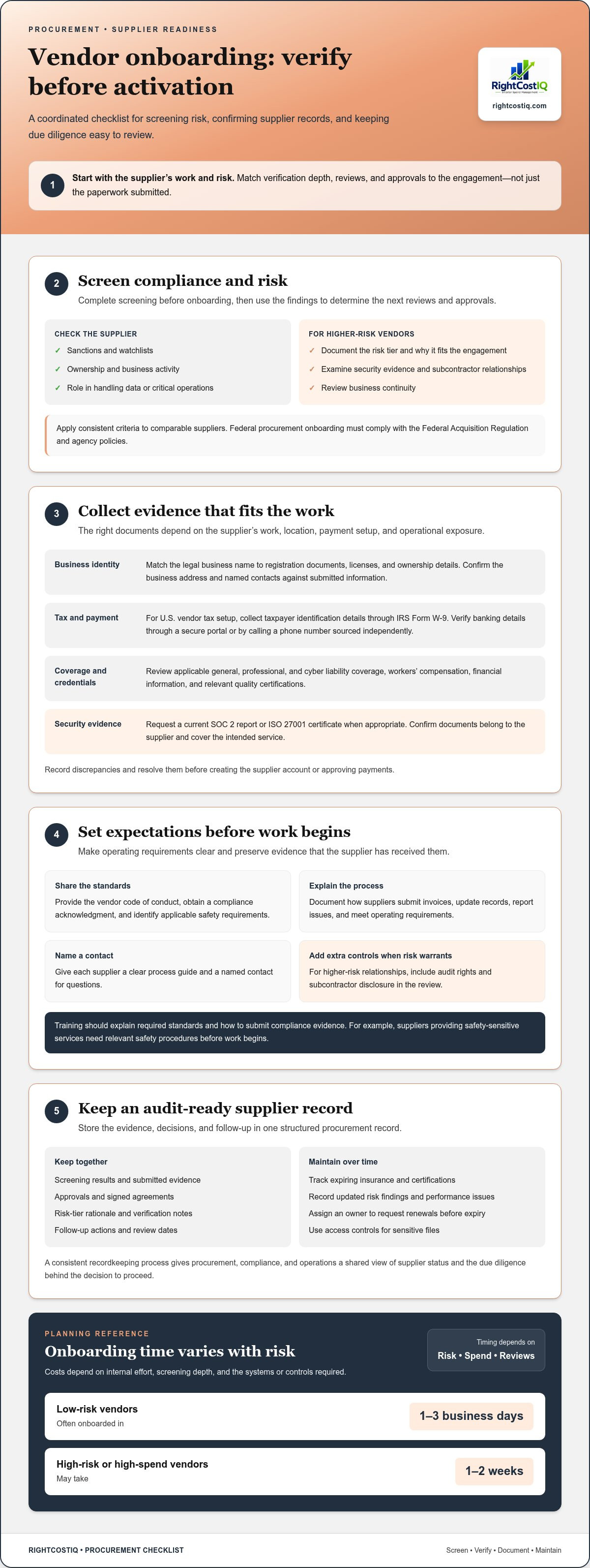
Low-risk vendors can often be onboarded in 1 to 3 business days; high-risk or high-spend vendors may take 1 to 2 weeks. Costs depend on internal effort, screening depth, and the systems or controls required.
-
Screen Compliance and Risk Before Onboarding
Screen each prospective supplier before onboarding, then match the checks to the engagement’s risk and value. Review sanctions and watchlists, ownership, business activity, and the supplier’s role in handling data or critical operations. For high-risk vendors, document the risk tier and examine security evidence, subcontractor relationships, and business continuity. According to the Federal Acquisition Regulatory Council, federal procurement onboarding must comply with the Federal Acquisition Regulation and agency policies.
Use screening results to determine which reviews and approvals come next. A supplier handling sensitive information needs closer scrutiny than one providing a limited, low-risk service. Apply consistent criteria to comparable suppliers and record why the level of due diligence suits the engagement.
-
Apply Compliance and Onboarding Practices
Collect evidence that matches the supplier’s work, location, and operational exposure. Records may include business licenses, insurance policies, financial information, and safety, diversity, or sustainability certifications. Review general, professional, and cyber liability coverage, workers’ compensation, and relevant quality certifications. For security review, request a current SOC 2 report or ISO 27001 certificate when appropriate.
Set clear ethics and compliance expectations before work begins. Obtain a compliance acknowledgment, share the vendor code of conduct, and identify applicable safety requirements. For higher-risk relationships, include audit rights and subcontractor disclosure in the review. Federal representations and certifications address compliance with federal laws, including those covering labor practices, environmental policies, and equal opportunity.
-
Maintain Records for Audit and Compliance
Store the completed checklist with vendor records and procurement documentation. Keep screening results, submitted evidence, approvals, signed agreements, and the rationale for the supplier’s risk tier together. A structured record helps teams respond to future audit questions and shows which due diligence steps informed the decision to proceed.
Assign an owner to maintain records throughout the relationship. Track review dates, expiring insurance or certifications, updated risk findings, and performance issues. Use a consistent recordkeeping process across departments, with access controls for sensitive files. Ongoing documentation gives procurement, compliance, and operations a shared view of supplier status.
Vendor documentation and verification
Collect supplier documents through a consistent intake process and verify each record before approval. The evidence needed depends on the supplier’s work, payment setup, and access to company systems.
-
Verify Vendor Identity and Business Details
Match the supplier’s legal business name to registration documents, licenses, and ownership details. Confirm the business address and named contacts against the information submitted. For U.S. vendor tax setup, collect taxpayer identification details through IRS Form W-9, according to the Internal Revenue Service. Record discrepancies and resolve them before creating the supplier account or approving payments.
-
Review and Verify Vendor Documents
Use a checklist to review tax forms, payment details, proof of insurance, relevant certifications, signed terms, and a designated contact. Confirm that each document belongs to the supplier and covers the intended service. Verify banking details through a secure portal or by calling a number sourced independently. This helps reduce payment errors and protects critical supplier records.
-
Document Processes and Train Suppliers
Document how suppliers submit invoices, update records, report issues, and meet operating requirements. Give each supplier clear process instructions and a named contact for questions. For example, a supplier providing safety-sensitive services needs relevant safety procedures before work begins. Training should explain the required standards and how to submit evidence of compliance.
- Set document owners and renewal triggers during intake. Track expiration dates for insurance policies, business licenses, and certifications. Assign an internal owner to request updated documents before they expire, then record the replacement and review date. Apply the same renewal process across suppliers, increasing review frequency when changes to services, ownership, or operating conditions could affect risk.
- Keep a complete document trail in the supplier’s procurement record. Include submitted versions, verification notes, approvals, and follow-up actions. If a document is incomplete, identify what is missing and assign someone to resolve it before activation. A consistent file structure helps procurement, finance, and compliance teams find evidence without searching email histories.
- Review the intake process as supplier requirements change. Use a self-service portal or standard form to collect information up front, route approvals, and flag missing documents. Explain how to submit information, including accepted file formats and secure entry of payment details. Clear instructions reduce avoidable back-and-forth and support accurate records throughout the relationship.
Contracts, payment terms, SLAs, and confidentiality
Finalize commercial terms before system activation. Align the contract, finance controls, service measures, and access permissions with the supplier’s work.
-
Agree on Contract and Service Terms
Define deliverables, pricing schedules, payment terms, and service-level agreements in the contract. Specify performance metrics, reporting expectations, volume discounts, and remedies for missed requirements where appropriate. Include purchase order terms, a master service agreement, and a non-disclosure agreement when they fit the engagement. Complete applicable data processing terms before activation when the supplier will access data.
Document invoice formatting, submission instructions, required evidence, approvers, and payment timelines. Finance needs these details to process invoices accurately. Confirm that agreed service measures can be tracked consistently, such as delivery timeliness or quality against documented specifications.
-
Review Applicable Contract Schedules
For a government purchase, check whether a GSA Schedule or an agency-specific contract applies. A GSA Schedule gives vendors access to a range of government buyers under pre-negotiated pricing and terms. Match the purchase to the applicable schedule and solicitation requirements, then document the contract vehicle and relevant pricing terms.
For agency-specific agreements, align the supplier’s scope, deliverables, and reporting with the applicable contract documents. Keep the selected terms together in the procurement record so the business owner and finance team work from the same approved scope.
-
Execute Contracts and Set Up Systems
Obtain required Legal, Finance, and IT Security reviews before execution. Confirm the final contract version, signatures, approval record, and effective operating instructions. Contract negotiation and system setup are estimated to take 1-3 days, depending on the work involved.
After execution, configure the procurement platform and payment workflow to reflect approved terms. Set purchase order requirements, invoice routing, approvers, and supplier access permissions. Do not activate system access before completing applicable data processing terms.
- Set finance approvals and spend controls before issuing purchase orders. Define who can approve commitments, who verifies invoices, and what evidence supports payment. A purchasing policy template assigns approval for spend under $1,000 to a department head; adapt approval routing to the organization’s own policy and delegation structure.
- Translate the contract into operational checkpoints. Assign an owner to monitor service levels, pricing changes, renewal dates, and unresolved issues. A custom scorecard can link agreed KPIs to review discussions, while clear escalation steps help teams address missed targets before they disrupt delivery.
- Confirm readiness with the supplier before work begins. Share purchase order procedures, delivery or service requirements, billing contacts, and confidentiality expectations. Ensure the supplier understands which systems they may use and which information they may handle. Keep the executed agreement and setup decisions together to support consistent administration.
Financial, operational, and supply chain risk assessment
Scale onboarding to the supplier’s importance, value, and exposure. Assess financial resilience, operational continuity, standards, and relationships across the supply chain.
-
Assess Financial and Supply Chain Risks
Evaluate the supplier’s financial stability, delivery capacity, and ability to sustain the required service. Compare available financial records with the engagement’s scale, and identify dependencies such as reliance on one facility or critical subcontractor. Map key supply chain relationships, including fourth parties handling data or essential operations. Record how disruption could affect continuity, cost, quality, and delivery, then assign an internal owner to track priority risks.
-
Manage Regulatory and Standards Risks
Identify the standards and oversight relevant to the supplier’s work, data, and industry. For example, SOC 2 and HIPAA are standards associated with vendor risk management, while higher-risk vendors may provide SOC 2 or ISO 27001 evidence for review. For AI-enabled vendors, consider whether regular audits against ISO 42001 support the organization’s alignment goals. Document applicable evidence, gaps, and review decisions.
Use the NIST Cybersecurity Supply Chain Risk Management program as a reference for ongoing supplier risk management. Organizations covered by the FTC Safeguards Rule should understand their service-provider oversight obligations. Match controls to the relationship instead of applying identical requirements to every supplier.
-
Screen Vendors by Risk Tier
Assign each supplier a risk tier based on spend, business criticality, data access, operational role, and replaceability. A supplier accessing sensitive information or supporting a core process warrants deeper review than one with limited access and a readily replaceable service. Record the tier and the factors behind it. This provides a consistent basis for screening and prevents disproportionate scrutiny of low-impact relationships.
For higher-risk vendors, examine security evidence, ownership, business continuity, and subcontractor practices. Include relevant operational and financial checks, then escalate unresolved concerns to the appropriate internal reviewers. Reassess the tier if the supplier’s scope, access, or business role changes.
-
Tailor Onboarding to Risk Tier
Translate each risk tier into specific onboarding controls and ongoing review requirements. A low-risk supplier may need basic business and payment records, agreed terms, and a named owner. A higher-risk relationship may require security questionnaires, data-processing terms, ownership checks, continuity information, access reviews, and executive or compliance approval.
Tie the control plan to the supplier’s work. For example, review a vendor’s security evidence if its access to company data expands. Schedule follow-up reviews, monitor changes in supply chain relationships, and document decisions in the vendor record. Procurement and operations can then focus resources on risks with the greatest potential impact.
Procurement and vendor management responsibilities
Clear ownership turns supplier selection into controlled execution. Assign a coordinator, define each department’s decisions, and document handoffs before work begins.
- Appoint one procurement or operations owner to guide the relationship from intake through launch. This person tracks open tasks, resolves handoff gaps, and keeps the supplier informed about decisions. For example, the owner can maintain a workflow showing document status, approval status, system access, payment setup, and the next action. The coordinator manages progress but does not replace Legal, Finance, IT, or business approvals.
- Assign decision rights to the departments responsible for each control. Procurement or vendor management coordinates the checklist and supplier communications. Finance validates payment setup and invoice routing; Legal reviews contract terms; IT or security evaluates data access; the business owner defines operational needs. Name an approver and a backup for each decision so unclear authority or absence does not stall the process.
- Separate vendor approval from onboarding readiness. Approval determines whether the organization should use the supplier; onboarding establishes whether the supplier can start safely, receive payment correctly, and meet operating expectations. Before launch, the owner should confirm that required approvals, records, system access, payment setup, and supplier contacts are in place. Keep work paused until critical dependencies have a named decision-maker and documented status.
- Use a shared portal or workflow to route tasks and make outstanding actions visible. Automation can assign approval tasks, request missing information, remind owners about expiring records, and trigger checklists based on risk tier. Keep human review for legal, compliance, security, and high-risk decisions. A system can route evidence, but designated reviewers must assess it and record their decisions.
- Set post-launch accountability before the supplier begins work. Identify who manages the account, troubleshoots service issues, reviews performance, and communicates changes. Agree on performance measures and review them quarterly; procurement and the business owner can examine delivery, quality, responsiveness, and unresolved actions together. Provide the supplier with a sample evaluation form when useful, then record follow-up owners and due actions.
- Review the workflow at least once a year and after material process changes. Compare approval delays, repeated information requests, and incomplete handoffs to identify friction. Update role assignments when departments, systems, or supplier responsibilities change. A consistent ownership model gives everyone a clear route for decisions, escalation, and operational support.
RightCostIQ: Request For Proposal (RFP) Management and Negotiation Assistance
RightCostIQ supports procurement teams seeking structured supplier selection, stronger commercial terms, and ongoing performance oversight. Its Request For Proposal (RFP) Management and Negotiation Assistance helps teams manage sourcing events and negotiations. Procurement Category Cost benchmarking and Analytics can inform cost comparisons, while the Procurement and Vendor Performance Tracking Service supports supplier monitoring after onboarding.
These services are relevant when a sourcing decision needs clearer market context, negotiations require disciplined preparation, or supplier performance needs structured tracking. Price Risk Management and Tracking Service and Market Price Trending and Forecasting Service can also support decisions when market movements affect procurement planning.
For support aligned to your procurement priorities, contact RightCostIQ.
Make Supplier Governance a Procurement Advantage
Use the next supplier decision to strengthen procurement’s contribution to the business. Treat a vendor onboarding checklist for procurement as a working governance tool, then use its records and ownership model to improve future sourcing decisions. The next step is to connect supplier selection with measurable commercial and operational outcomes.
RightCostIQ can support this work through Request For Proposal (RFP) Management and Negotiation Assistance, Procurement Category Cost benchmarking and Analytics, and its Procurement and Vendor Performance Tracking Service. These services help procurement teams structure sourcing, assess cost context, and maintain visibility into supplier performance.
If your organization is refining supplier governance or preparing a sourcing initiative, contact RightCostIQ to discuss your procurement priorities. A focused next step can help turn onboarding discipline into stronger, more consistent procurement decisions.
Frequently Asked Questions
What documents and information should a procurement vendor onboarding checklist include?
A vendor onboarding checklist for procurement should capture the information needed to identify, approve, pay, and manage each supplier. Include the legal entity name, registration details, tax form, ownership and contacts, payment instructions, insurance evidence, relevant certifications, contract records, and service scope. Add an internal owner, approval status, and document review dates. If a supplier has multiple business units, record which entity will provide the service and receive payment.
What due diligence checks should procurement perform before approving a vendor?
Before approval, assess whether the supplier is legitimate, suitable for the work, and appropriate to the engagement’s risks. Compare its business identity and ownership details, screen relevant sanctions or watchlists, and review financial and operational evidence. For a supplier handling sensitive data, assess security controls and subcontractor relationships. Record findings, unresolved issues, and the rationale for approval so reviewers can understand the decision later.
How do businesses verify a vendor’s tax information, W-9, EIN, and banking details?
Compare the supplier’s legal name and taxpayer identification details across its tax form, registration records, and vendor master file. U.S. vendor tax setup often includes collecting taxpayer identification details through IRS Form W-9, according to the Internal Revenue Service. Match the payment beneficiary to the approved legal entity. Collect banking details through a secure portal, or verify changes by calling a phone number obtained independently, not one supplied in the payment-change request.
What vendor insurance certificates and coverage limits should procurement require?
Set insurance requirements according to the supplier’s work, exposure, contract obligations, and potential impact on people, property, or operations. Review relevant general, professional, cyber liability, and workers’ compensation evidence where applicable. Confirm the named insured and policy dates, then record required coverage in the contract or onboarding record. No single limit suits every supplier; the appropriate threshold depends on the risks the engagement transfers or creates.
What cybersecurity and data privacy assessments are needed during vendor onboarding?
For a supplier that handles company data, assess its security evidence, data practices, and access needs before system activation. Review a current SOC 2 report or ISO 27001 certificate where appropriate, and map which supplier personnel need access to which data. Confirm data-processing terms, subcontractor handling, incident-response expectations, and access removal procedures. Apply two-factor authentication and least-privilege access, then schedule monitoring and a future review.
What legal, regulatory, sanctions, and compliance checks apply to new vendors in the United States?
Apply checks suited to the supplier’s work, location, and contracting context. Screen relevant vendors against sanctions and watchlists, and document the result. According to the Federal Acquisition Regulatory Council, federal procurement onboarding must comply with the Federal Acquisition Regulation and agency policies. Federal agencies check SAM.gov exclusion records for suspended, debarred, or otherwise excluded vendors. Review applicable contract representations and certifications for federal requirements.
How should procurement assess vendor financial stability, credit risk, and business continuity?
Assess financial resilience in light of the supplier’s expected role and the consequences of interruption. Review available financial records, payment or delivery concerns, and dependence on key facilities, customers, or subcontractors. Ask how the supplier would maintain service during disruption and identify practical alternatives if a critical input becomes unavailable. Document the evidence, risk judgment, and follow-up actions. Reassess if the supplier’s ownership, capacity, or operating model materially changes.
What approvals and vendor master data controls are needed to prevent fraud and duplicate records?
Separate approval roles for supplier selection, payment setup, and changes to vendor master data. Before creating an account, match new records against existing legal names, tax identifiers, addresses, and payment beneficiaries. Restrict edit access, log changes, and independently verify banking updates through a secure portal or a callback number sourced independently. Route exceptions to Finance or procurement for review, and retain the approval trail with the supplier record.


