

The smallest purchases can create the largest procurement blind spots. Tail spend typically represents around 20% of total spend while accounting for approximately 80% of procurement transactions. Effective tail spend management strategies bring these low-value, high-volume purchases into view so organizations can control costs without treating every purchase as a major sourcing event.
When spending is scattered across categories, suppliers, and buying channels, it is harder to spot patterns, apply purchasing policies, or identify opportunities to combine demand. This makes tail spend difficult to manage, even when individual transactions seem minor.
This article explains what tail spend includes, why it often escapes procurement oversight, and how spend analysis, supplier consolidation, and strategic sourcing can improve control. It also shows how procurement data and clear performance measures help teams focus on the opportunities that matter most.
Key Takeaways
- Define tail spend around your organization’s procurement context so teams can identify which purchases need targeted oversight.
- Clean and categorize purchasing data to reveal fragmented demand, spot-buying patterns, and supplier overlap.
- Use demand insights to consolidate suitable purchases and apply strategic sourcing where supplier competition can improve control.
- Combine clear buying processes, automation, and buyer guidance to reduce off-contract purchasing and administrative friction.
- Track performance with defined KPIs and regular reviews to see whether sourcing changes are improving spend control.
Supplier consolidation and strategic sourcing
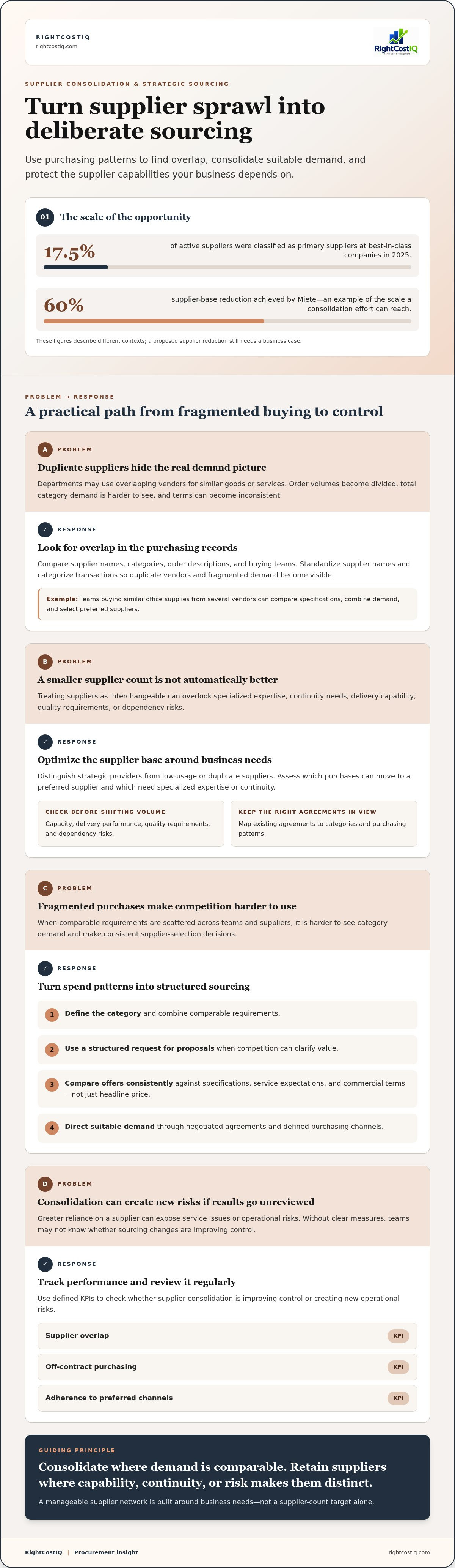
Supplier consolidation connects fragmented purchasing to deliberate sourcing decisions. Best-in-class companies had 17.5% of active suppliers classified as primary suppliers in 2025.
Consolidation for Greater Efficiency
Supplier consolidation directs suitable purchases to fewer suppliers instead of spreading demand across a fragmented base. Fewer supplier relationships can simplify ordering, invoice handling, and performance reviews. For example, teams buying similar office supplies from several vendors can compare specifications, combine demand, and select preferred suppliers. The goal is not simply to reduce the supplier count. It is to build a manageable network that meets business needs and cuts repetitive procurement work.
Supplier Sprawl and Duplication
Supplier sprawl occurs when departments use overlapping vendors for similar goods or services without coordinated sourcing. Duplicate suppliers can divide order volumes, obscure total category demand, and create inconsistent terms. Purchasing data helps identify those patterns: compare supplier names, categories, order descriptions, and buying teams to reveal overlap. Miete reduced its supplier base by 60%, illustrating the scale of change a consolidation effort can achieve. Each proposed reduction still needs a business case.
Supplier-Base Optimization
Supplier-base optimization aligns the number and mix of suppliers with demand, category needs, and operational requirements. Review purchasing records to distinguish strategic providers from low-usage or duplicate suppliers. Then assess which purchases can move to a preferred supplier and which require specialized expertise or continuity. This avoids treating every supplier as interchangeable. It also gives procurement a structured basis for directing recurring orders while retaining suppliers that meet distinct business requirements.
Risk and contract compliance should guide every consolidation decision. Before shifting volume, compare supplier capacity, delivery performance, quality requirements, and dependency risks. Map existing agreements to categories and purchasing patterns. A supplier with favorable pricing may still pose a risk if it cannot meet operational needs. Clear preferred-supplier guidance helps buyers use contracted channels, while performance tracking can surface service issues before broader consolidation increases reliance on one provider.
Strategic sourcing turns spend patterns into competitive purchasing decisions. Define the category, combine comparable requirements, and use a structured request for proposals when competition can clarify value. Compare offers against consistent specifications, service expectations, and commercial terms, not just headline price. Negotiated agreements can then direct suitable demand through defined channels. This connects purchasing analysis to supplier selection and gives teams a clearer basis for monitoring contract compliance.
A focused tail spend program can connect consolidation decisions with category priorities and supplier performance. Track changes through defined KPIs, such as supplier overlap, off-contract purchasing, and adherence to preferred channels. Review those measures at regular intervals to identify whether consolidated buying is improving control or creating new operational risks.
What Is Tail Spend Management?
Tail spend management brings low-value, high-volume purchases into a structured procurement process. It uses categorized spend data, analytics, and purchasing controls to identify where oversight can improve.
Spend Data Analysis and Categorization
Spend analysis organizes transaction records into consistent categories, suppliers, and buying channels. Clean the underlying data by standardizing fields and supplier names so duplicate vendors and fragmented demand become visible. Build the program by defining its scope, cleaning records, categorizing purchases, prioritizing opportunities, assigning owners, and setting review measures. These steps turn raw transactions into decisions procurement teams can act on.
Visibility and Analytics Opportunities
Spend visibility means having a usable view of purchasing across suppliers, categories, and teams. Analytics can reveal recurring spot buys, fragmented orders, and shifts in demand that are difficult to detect in separate invoices. Organizations using AI-powered procurement tools see a 24.4% increase in visibility into total spend. Pair transaction analysis with network performance metrics to distinguish sourcing opportunities from supplier service issues.
For example, repeated purchases of similar IT equipment across departments may point to an opportunity to standardize requirements. A category view can show whether orders are concentrated or scattered, while supplier performance data helps assess the effects of a change. Use these findings to prioritize categories based on observed patterns, rather than treating every low-value transaction as equally important.
Purchasing Tools for Tail Spend
Procurement cards can simplify low-value purchases, but limited transaction detail may make categorization and policy oversight harder. Catalogs show approved items and suppliers to support consistent buying, though gaps in product choice can push users outside the catalog. Guided buying directs employees to preferred channels and requirements, but works best when content is accurate and the process fits purchasing needs.
Automation can streamline purchase requisition approvals and invoice verification. Automate routine routing and validation, while sending exceptions, mismatches, or unusual purchases for human review. This reduces manual handoffs without removing oversight from transactions that require judgment.
Analytics is useful when teams connect purchasing records to decisions. Compare supplier names and category descriptions, group similar transactions, and flag repeated spot buys. Then determine which opportunities merit a sourcing action, a catalog update, or clearer buyer guidance. Reviewing one category closely can show where better data or controls would address the underlying pattern.
Program owners should establish category definitions, data-quality practices, and ownership before setting review measures. They can then track purchasing patterns and supplier performance over an appropriate review period. This structure helps teams assess whether a tool or process change addresses a specific source of unmanaged spend.
Tail spend definition and share of total spend
Tail spend is the portion of organizational purchasing made up of numerous lower-value transactions. Its precise boundary depends on the organization’s procurement context and category structure.
Defining Tail Spend
Tail spend generally refers to indirect purchases outside an organization’s closely managed strategic categories. It matters because small orders can involve many suppliers and appear across departments. Office supplies, marketing materials, and IT equipment are common examples. Define the scope using your purchasing patterns, category needs, and operational priorities, rather than applying a universal spending threshold.
Start by separating direct production inputs from indirect purchases, then examine how categories behave in your organization. An IT equipment purchase, for example, may be strategic for a technology business but routine for another organization. Record the categories, suppliers, and transaction types included in your definition. This gives procurement and finance teams a shared basis for reporting, comparison, and oversight.
Clear boundaries also prevent misleading comparisons. If one department includes recurring maintenance purchases while another excludes them, their tail-spend reports cover different groups of transactions. Document category rules and apply them consistently across purchasing records. Review the definition when needs or sourcing arrangements change so teams continue classifying comparable transactions together.
Characteristics and Share of Total Spend
Tail spend combines a modest share of overall spend with a large volume of transactions and suppliers. It typically represents around 20% of total spend, while purchases can involve up to 80 percent of an organization’s vendors. It also accounts for approximately 80% of procurement transactions. These measures describe different dimensions, so procurement should not treat them as interchangeable.
Transaction volume helps explain why tail spend can demand disproportionate administrative attention. Many small orders create separate approvals, supplier interactions, and invoices, even when each transaction has limited value. For example, repeated office supply orders across departments may generate many transactions while representing a much smaller share of total spending. Review transaction count alongside category value to understand workload and purchasing concentration.
Structured spend provides another useful point of comparison. Best-in-class companies had 55.3% of their spend on orders as structured spend in 2025. This measure describes the share of spend placed through structured orders, not the share classified as tail spend. Keeping those definitions separate helps teams interpret performance accurately and avoid drawing conclusions from unlike metrics.
To set a practical boundary, document the included categories, the transaction patterns used to identify them, and the review owner. Test the definition against examples such as office supplies, marketing materials, and IT equipment. A consistent scope gives reporting a stable foundation and clarifies which purchases the organization intends to manage as tail spend.
Challenges in managing tail spend
Tail spend is difficult to control because purchasing is distributed across categories, teams, suppliers, and processes. A routine office-maintenance order may follow a different approval path from a similar purchase elsewhere. These variations make it harder to apply policy, identify ownership, and compare transactions consistently.
Fragmented data creates a practical barrier. Supplier names, cost centers, descriptions, and invoice details may be recorded differently across systems. Procurement may then struggle to connect a purchase order to its invoice or identify repeated buying patterns. Start by mapping where purchasing records originate and which fields teams need for consistent reporting.
Limited buyer adoption can undermine formal purchasing channels. Employees may choose a familiar supplier or make a spot purchase when an approved route feels unclear or inconvenient. Onboarding and timely email reminders can explain available resources and purchasing processes. Without that guidance, procurement rules may exist on paper while routine orders continue outside them.
Manual approvals and invoice handling add friction to small purchases. Each low-value transaction can require review, matching, and follow-up, leaving procurement teams with less capacity for category analysis. A healthcare company reported that electronic invoice management can cut approval times by up to 50% for office-maintenance tail spend. The example shows how process design affects administrative workload.
Technology creates another challenge when procurement tools do not fit existing systems or buyer workflows. Poor integration can lead to duplicate entry, inconsistent records, or workarounds that weaken adoption. Automation can streamline requisition approvals and invoice verification, but teams still need clear exception handling. For example, routine invoices can follow a standard workflow while mismatches go to a reviewer.
Maverick spending is difficult to diagnose because each transaction may appear isolated. A logistics company may see maverick spending decrease by 20% after implementing automated procurement for tail spend categories. That outcome points to a key control issue: purchasing processes need to make compliant channels usable and visible, not merely define preferred suppliers.
Measurement can also fail when teams track activity without linking it to outcomes. A supplier-count reduction alone does not show whether costs, service, or contract compliance improved. Define KPIs for purchasing-channel use, invoice processing, and supplier performance, then review them at suitable intervals. Digital tail-spend tools can reduce annual expenditures by 5% to 10% on average, but consistent adoption and measurement determine whether teams can identify the impact.
What are the main strategies for reducing and controlling tail spend?
Effective control combines focused sourcing, practical buying channels, automation, and performance review. Tail-spend programs may generate P&L savings of 5% to 20% of total spend in scope, making clear priorities essential.
Start with categories where fragmented demand or inconsistent supplier offers create a sourcing opportunity. Compare equivalent requirements and commercial terms before selecting a purchasing route. A manufacturing firm achieved a 15% reduction in procurement costs by comparing supplier offers for MRO parts through a digital procurement platform. The lesson is practical: comparable specifications make supplier offers easier to evaluate and negotiate.
Use catalogs and guided purchasing to direct routine demand to suitable options. Keep catalog items aligned with employee needs, then explain how buyers should use the preferred route. Onboarding and timely email reminders can reinforce purchasing resources and processes. For example, employees ordering recurring office materials need clear category guidance, an accessible catalog, and a defined exception path.
Automation can reduce manual work in routine purchasing and invoice workflows. Configure systems to route requisitions for approval and verify invoice information, while sending mismatches for review. Procurement solutions should integrate with existing systems to support adoption without disrupting established buyer processes. Workflows that force duplicate data entry can encourage workarounds and weaken the controls they are meant to support.
Marketplace and consolidator solutions can provide another channel for suitable categories. More than 20% of B2B transactions are expected to be procured through marketplace and/or consolidator solutions. Assess whether those channels fit category requirements, supplier performance, and existing purchasing processes. They are not a universal replacement for sourcing; specialized specifications or service needs may require a different approach.
Set measurable targets before changing processes. Track indicators such as off-channel purchases, contract use, invoice exceptions, supplier performance, and category-level spend. Review results at defined intervals, then adjust controls when buyer behavior or service outcomes diverge from expectations. A lower supplier count alone cannot show whether the program improved purchasing discipline or operational performance.
Combine internal procurement knowledge with analytical capabilities where work requires deeper analysis or AI-driven spend management. Internal teams can define category requirements and operational constraints; analytical support can help identify patterns and prioritize sourcing opportunities. Tail spend management strategies work best when each action has an owner, a measurable objective, and a review point. Start with categories where purchasing evidence supports a clear intervention.
RightCostIQ: Request For Proposal (RFP) Management and Negotiation Assistance
RightCostIQ supports procurement teams seeking structured sourcing and stronger supplier negotiations. Its Request For Proposal (RFP) Management and Negotiation Assistance helps organize supplier responses and negotiation activity around defined purchasing requirements. Procurement Category Cost Benchmarking and Analytics helps teams compare category costs and assess sourcing opportunities. Procurement and Vendor Performance Tracking supports ongoing visibility into supplier results, while Price Risk Management and Tracking helps monitor price exposure.
Use these services when purchasing data points to a category that needs competitive sourcing, clearer cost benchmarks, or closer supplier performance oversight. They complement internal procurement decisions with focused analysis and execution support. To discuss your procurement priorities, contact RightCostIQ.
Turn Tail Spend Insights Into Procurement Action
The next step is to turn analysis into a decision the business can own. Select a category where purchasing records reveal a clear opportunity, assign an accountable owner, and agree on how progress will be assessed. This provides a practical starting point for applying tail spend management strategies without changing processes across every category at once.
As the work develops, use findings to guide sourcing priorities and strengthen procurement decisions. RightCostIQ can support organizations seeking structured expertise to move from spend insight to action. Start with a focused discussion about your procurement priorities and where analysis could help.
Discuss your tail spend priorities with RightCostIQ and take the next step toward more controlled purchasing.
Frequently Asked Questions
What is tail spend management and what categories does it cover?
Tail spend management brings low-value or unmanaged purchasing under clearer oversight. It commonly covers indirect categories such as office supplies, marketing materials, and IT equipment. The specific boundary depends on how an organization groups purchases and which categories it manages through strategic sourcing. For example, a business might include routine office equipment purchases while treating specialized technology procurement separately because it requires distinct supplier or technical criteria.
How much of total procurement spend and supplier count is typically tail spend?
Tail spend typically represents around 20% of total spend and can involve up to 80 percent of an organization’s vendors. It also accounts for approximately 80% of procurement transactions. These measures describe different things: spend share reflects value, vendor share reflects supplier breadth, and transaction share reflects purchasing volume. Treat them as general benchmarks, then define the relevant scope using your organization’s categories and purchasing patterns.
How can organizations identify and analyze tail spend using procurement data?
Organizations can identify tail spend by combining purchasing records across departments and examining supplier, category, transaction, and channel patterns. For example, compare supplier identifiers with invoice descriptions to spot cases where one vendor appears under different names. Segment transactions by category and buying team, then review repeat purchases and exceptions. This helps distinguish recurring demand from one-off needs and gives category owners a basis for prioritizing analysis.
How do procurement teams consolidate suppliers and increase contract compliance?
Procurement teams can consolidate suppliers by identifying vendors that serve overlapping needs, then assessing which purchases can move to preferred suppliers. Before shifting demand, compare supplier capabilities, service requirements, and operational dependencies. To improve contract compliance, make approved purchasing routes clear to employees and review transactions for off-contract activity. For example, category owners can examine recurring purchases that bypass agreements, identify process barriers, and adjust guidance or purchasing channels.
What KPIs measure tail spend management performance and savings?
Useful KPIs connect purchasing behavior to financial and operational outcomes. Track spend placed through contracts, off-contract transaction rates, supplier overlap, sourcing coverage, invoice exceptions, and supplier performance. Measure savings against a defined baseline and record whether changes affect service or purchasing conditions. For example, a category review can compare negotiated terms with actual orders to reveal whether savings are reaching transactions or exist only in the agreement.
What are common tail spend management risks, including maverick spend and supply disruption?
Maverick spend can weaken purchasing controls when employees buy outside approved channels, leaving spend fragmented and harder to monitor. Supplier consolidation can also increase dependency if too much demand shifts to one provider without considering capacity or continuity needs. Assess supplier performance and operational requirements before transferring purchases. Keep an exception route for specialized or time-sensitive needs, then monitor order patterns and service issues to detect disruption early.


