

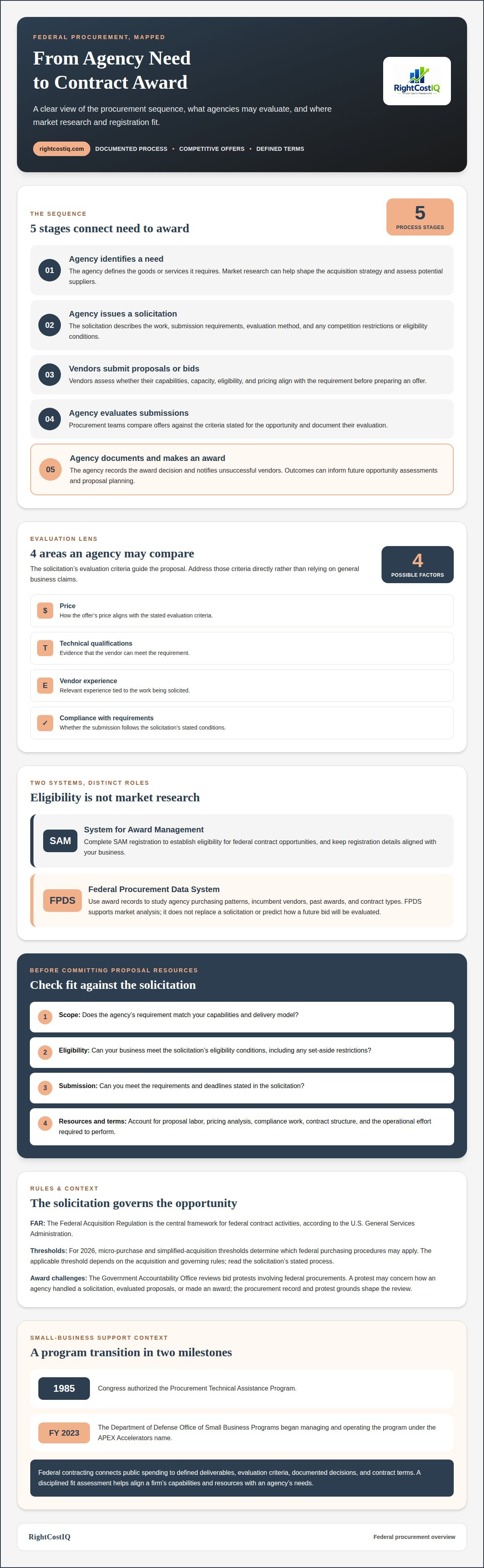
The procurement process for government contractors moves from an agency’s identified need to a solicitation, vendor proposals or bids, evaluation, and contract award. The Federal Acquisition Regulation (FAR), the central framework for federal contract activities according to the U.S. General Services Administration, governs that process. SAM registration is part of pursuing federal opportunities, while FPDS supports research into federal contract awards and the market.
Understanding the sequence is only part of the decision. Contract type also shapes pricing, cost responsibility, and how work is managed. A bid strategy that overlooks those terms may misjudge the opportunity.
This guide explains how government contracting works, where solicitations, SAM, and FPDS fit, and how fixed-price, cost-reimbursement, and time-and-materials contracts differ. It also explains how agencies evaluate offers and how contractors can decide whether an opportunity aligns with their capabilities and commercial priorities.
Key Takeaways
- Use FPDS award information and market research to assess federal demand, competition, and whether an opportunity fits your business.
- Understand the procurement sequence: agencies define a need, solicit offers, evaluate submissions, and document an award decision.
- Review each solicitation’s scope, submission requirements, evaluation criteria, and deadlines before preparing a bid or proposal.
- Complete SAM registration to establish eligibility for federal contract opportunities, and keep your registration details aligned with your business.
- Compare fixed-price, cost-reimbursement, and time-and-materials structures to understand how each affects pricing, cost responsibility, and contract management.
What is the Federal Procurement Data System (FPDS)?
The Federal Procurement Data System (FPDS) provides information about federal contract awards. Contractors can use its records to study agency purchasing patterns, incumbent vendors, and past awards. This evidence helps assess whether a market offers relevant opportunities before investing in a proposal. FPDS supports market analysis, but it does not replace a solicitation or predict how an agency will evaluate a future bid.
Federal procurement planning starts with an agency need. Market research helps define that need, assess potential suppliers, and shape an acquisition strategy. Contractors can use award records to identify agencies buying related services, review the types of contracts awarded, and compare past requirements with their capabilities. Repeated awards for a service may indicate demand, while a contract’s scope can show whether an agency’s needs match the contractor’s delivery model.
Federal procurement follows rules intended to support responsible public spending and fair competition. Titles 10 and 41 of the United States Code govern U.S. federal procurement. The Federal Acquisition Regulation (FAR) is the central framework for federal government contract activities, according to the U.S. General Services Administration. Agencies apply the relevant acquisition requirements when planning, soliciting, evaluating, and administering contracts.
Federal purchasing differs from state and local purchasing because each government operates under its own procurement rules and procedures. Businesses pursuing opportunities across jurisdictions need to account for each government’s solicitation process, eligibility requirements, and contract terms.
For 2026, micro-purchase and simplified-acquisition thresholds are acquisition limits that determine which federal purchasing procedures may apply. The applicable threshold depends on the acquisition and governing rules, so contractors should read the solicitation’s stated process rather than assume one procedure applies to every federal opportunity.
Contractors should also understand how award decisions can be challenged. The Government Accountability Office (GAO) reviews bid protests involving federal procurements. A protest may raise concerns about how an agency handled a solicitation, evaluated proposals, or made an award. The procurement record and the protest grounds shape the review. Because agencies document evaluations and award decisions, solicitation requirements and evaluation records are central to disputes.
There is no single fee for pursuing a government contract. Contractors should account for internal proposal labor, pricing analysis, compliance work, and the operational effort required to perform the contract. Costs depend on the opportunity’s scope, submission demands, and contract structure. FPDS market research can provide award context before proposal resources are committed.
What Is Government Contracting and How Does It Work?
Federal contracting turns agency requirements into purchases through documented procedures. An agency identifies a need, determines how to acquire the required goods or services, and invites competition where appropriate. Vendors then assess whether their capabilities, capacity, and pricing fit the requirement. The process connects public spending to defined deliverables, evaluation criteria, and contract terms.
For small businesses, a set-aside can determine who competes for an opportunity by limiting competition to businesses that meet the solicitation’s eligibility conditions. The solicitation is the controlling document: it describes the work, submission requirements, evaluation method, and any restrictions on competition. Before investing in a proposal, assess both eligibility and delivery capacity.
Federal agencies are required to support small-business participation in government contracting. This makes it worthwhile to study how an agency structures opportunities, but does not guarantee that a particular contract will be reserved. A firm may have relevant expertise and still need to meet the solicitation’s scope and eligibility rules. The practical question is whether the requirement fits the firm’s capabilities and whether it can meet every submission condition.
Contract evaluation connects an agency’s stated need to evidence from vendors. Procurement teams may compare price, technical qualifications, vendor experience, and compliance with requirements. A proposal should address the specific evaluation criteria rather than rely on general claims about the business. Agencies document evaluations and award decisions, then notify unsuccessful vendors. Those outcomes can inform future opportunity assessments and proposal planning.
Small-business support programs can help firms understand the federal marketplace and prepare to pursue opportunities. Congress authorized the Procurement Technical Assistance Program in 1985. In FY 2023, the Department of Defense Office of Small Business Programs began managing and operating the program under the APEX Accelerators name. The transition identifies the current program name and its federal management context.
APEX Accelerators are part of the support landscape for businesses considering government contracting. Entering the market involves more than finding a solicitation: firms must evaluate eligibility, interpret requirements, and align internal resources with the opportunity. A disciplined market-entry decision helps prevent a mismatch between a business’s capabilities and an agency’s needs.
Before pursuing a set-aside, focus on these decision points:
- Match the solicitation’s eligibility conditions to your business.
- Compare the required scope with your actual delivery capabilities.
- Map proposal evidence to each evaluation criterion.
- Use award outcomes and agency purchasing patterns to refine future bids.
This framework makes small-business participation a deliberate market strategy. The strongest opportunity is not simply one open to a small business. Its requirements, evaluation terms, and delivery demands should also align with the firm’s operating model.
Solicitations and contractor eligibility
A solicitation turns an agency’s identified need into a defined opportunity for vendors. Its terms help contractors decide whether to compete and how to prepare a responsive submission.
Solicitation Requirements
A federal solicitation describes the work, submission requirements, evaluation criteria, and deadline. After identifying a need, agencies may issue a request for proposals (RFP) or invitation for bids (IFB). These documents define the opportunity’s scope and how the agency will assess submissions. Review each requirement closely to identify the evidence needed, applicable terms, and potential gaps before committing proposal resources.
Agencies may announce opportunities through procurement websites, email distribution lists, or newspaper advertisements. The solicitation itself controls the bid: an announcement may flag an opportunity, but the full solicitation contains the details needed to prepare. Some notices use a request for qualifications (RFQ), as well as RFPs and invitations to bid. The document type signals what information the agency wants, so tailor the submission to its stated format.
Deadlines and submission instructions have practical consequences. A solicitation specifies when and how to submit, along with the evaluation criteria. Agencies may accept electronic bids; historically, many required paper bids in sealed envelopes. Follow the format and delivery instructions in the specific notice. A technically strong proposal can still fail if it omits a required form or uses the wrong submission channel.
Contractor Eligibility and Compliance
Contractor eligibility means meeting the conditions an agency states for competing on a particular opportunity. Compliance means following the solicitation’s submission terms and the ethical standards that govern federal bidding. Both affect whether an agency can consider a proposal. A firm’s general ability to perform does not replace stated eligibility conditions or required bid materials.
Start by comparing the solicitation’s scope and eligibility language with your business’s capabilities. If competition is reserved for a defined group, assess whether your firm meets that condition. Then map every submission requirement to evidence or documentation in your proposal. This review can uncover gaps before submission, such as an unanswered requirement or missing attachment.
The Procurement Integrity Act sets ethical standards for contractors and federal employees during bidding. Keep proposal preparation within those standards, and base communications and submission decisions on the solicitation’s stated process. A clear internal review can connect each requirement to its response:
- Confirm the opportunity’s scope and eligibility conditions.
- Match evaluation criteria to proposal evidence.
- Review required forms, format, and submission deadline.
- Keep bid conduct consistent with the Procurement Integrity Act.
After submission, agencies evaluate offers against documented criteria, which may include price, technical qualifications, experience, and compliance. A disciplined response clearly connects the agency’s requirements with the contractor’s supporting evidence.
System for Award Management (SAM) registration
System for Award Management (SAM) registration is part of establishing a business’s eligibility for federal contracting. Registration and opportunity research serve different purposes: SAM registration establishes eligibility, while solicitation documents explain how to compete for a specific award.
Individuals and organizations seeking eligibility for U.S. federal contract opportunities must register in SAM. Registration is a market-entry requirement, not a substitute for preparing a compliant bid or proposal. A registered business still needs to find relevant opportunities, assess each solicitation, and submit the requested materials by the deadline.
SAM also became the central opportunity destination after FedBizOpps transitioned. Federal procurement opportunities valued at $25,000 or more were listed on FedBizOpps, which later transitioned to SAM.gov. FedBizOpps officially transitioned to SAM.gov at the beginning of November 2019. This change placed opportunity discovery within the SAM environment, linking registration context with the search for federal solicitations.
Solicitation documents specify the response an agency expects. Government procurement documents include Invitations to Bid (ITB), Requests for Proposals (RFP), and Requests for Qualifications (RFQ). After identifying a need, an agency may publicly post an RFP or invitation for bids. The document type and its instructions determine what the contractor must submit. Respond to the actual request rather than relying on a generic package.
For an ITB or invitation for bids, follow the bid format requested by the agency. An RFP calls for a proposal addressing the stated requirements, while an RFQ requests qualifications information. For every format, read the scope, required submissions, evaluation criteria, and deadline together. This helps determine whether the opportunity fits the business and what evidence the response needs.
After submissions arrive, agency teams may compare price, technical qualifications, vendor experience, and compliance with stated requirements. They document evaluation decisions and notify participating vendors when they make an award. The outcome depends on the solicitation’s criteria and the submitted evidence, not SAM registration alone. This distinction clarifies where registration ends and proposal performance begins.
Winning the competition leads to a contract award, whose terms define the work and commercial arrangement. Federal procurement uses fixed-price, cost-reimbursement, and time-and-materials structures. Each handles payment and cost responsibility differently, so contractors should understand the proposed structure before committing resources or setting a bid price. The solicitation and resulting contract establish the applicable terms.
In practice, the sequence is clear: register in SAM, identify a suitable opportunity, respond in the required format, and review the award terms. An award marks the start of contract performance, not the end of procurement obligations. Contract management continues through delivery, performance tracking, and compliance with the agreement.
Fixed-price, cost-reimbursement, and time-and-materials contracts
Federal procurement uses fixed-price, cost-reimbursement, and time-and-materials contract structures, each with different pricing and cost responsibilities. For contractors, those differences affect bid assumptions, delivery planning, and exposure to changes. Contract type is a commercial decision, not just a label in the solicitation. Read the terms alongside the scope of work before pricing an offer.
Fixed-Price Contracts
A fixed-price contract sets a price for defined work. The contractor estimates the resources needed to deliver the scope and builds the proposed price around those assumptions. If labor, materials, or execution cost more than anticipated, the contractor’s margin may come under pressure. Careful scope analysis and cost estimates matter because the agreed price does not automatically rise when delivery costs do.
A well-defined deliverable, for example, makes it easier to estimate effort and identify cost drivers before bidding. If requirements leave important work unclear, understand how the contract handles changes. Compare the stated deliverables with internal cost assumptions. The key question is whether the price reflects the work as written, including dependencies and performance requirements.
Cost-Reimbursement Contracts
A cost-reimbursement contract bases payment on allowable costs under its terms, rather than one fixed price for all the work. The contractor must track costs and document them as the agreement requires. This structure can suit work that is difficult to estimate precisely in advance. It does not eliminate the need for cost discipline: clear records and active oversight remain essential.
Before bidding, identify which cost categories the contract addresses and how the agency will assess them. Forecast expected resource use, then consider how changes in scope could affect spending. A project with evolving technical requirements, for instance, may create uncertainty about the effort involved. The contract’s payment terms and cost controls determine how that uncertainty is managed.
Time-and-Materials Contracts
A time-and-materials contract links payment to labor time and materials under the agreement’s terms. Contractors need a clear understanding of the labor categories, expected effort, and material requirements. Actual work levels can affect total spending, making performance tracking important throughout delivery. The solicitation and contract define the billing basis, so align assumptions with those terms.
Compare the structures by asking what drives payment, who bears cost variation, and what records performance requires. A fixed-price model emphasizes scope and estimate accuracy. Cost-reimbursement puts greater weight on cost documentation. Time-and-materials makes labor and material tracking central. In every case, proposal assumptions should connect directly to the contract language.
Choose the structure that fits the work and your ability to manage its risks. Review scope clarity, cost predictability, change exposure, and tracking capacity before setting bid assumptions. To assess how pricing assumptions shape exposure, request a procurement diagnostic.
RightCostIQ: Request For Proposal (RFP) Management and Negotiation Assistance
RightCostIQ provides Request For Proposal (RFP) Management and Negotiation Assistance to help teams structure proposals and set negotiation priorities. Use this support when an opportunity calls for careful requirement analysis, coordinated responses, or a disciplined review of commercial terms.
Procurement Category Cost benchmarking and Analytics can provide market context for pricing decisions. Price Risk Management and Tracking Service and Market Price Trending and Forecasting Service support analysis of changing price conditions. After award, Procurement and Vendor Performance Tracking Service helps teams track vendor performance and operational outcomes.
These services support different stages: proposal preparation, pricing analysis, risk tracking, and post-award performance. The right focus depends on the procurement challenge and the decisions your team needs to make. Contact RightCostIQ to discuss the procurement support that fits your needs.
Turn procurement insight into a stronger bid strategy
Make opportunity decisions repeatable by setting a clear internal review point for every bid. Assess strategic fit, confirm delivery capacity, and test pricing assumptions against the work and contract terms. This discipline helps your team focus proposal effort on opportunities aligned with business priorities, rather than treating every solicitation as an automatic pursuit.
A practical review can also reveal where your process needs stronger cost visibility, proposal coordination, or performance tracking. Use those findings to improve how your team prepares for future opportunities. The procurement process for government contractors is more manageable when decisions connect market evidence with operational capability and commercial objectives.
RightCostIQ can help you evaluate procurement priorities and strengthen the analysis behind your next move. Request a procurement diagnostic to identify where focused support could improve your approach. Build a more deliberate pipeline, make each bid decision count, and move forward with a strategy grounded in clear business priorities.
Frequently Asked Questions
What is Government Procurement?
Government procurement is how public agencies acquire goods and services through structured purchasing procedures. For contractors, it creates a formal path from an agency requirement to a competed offer and possible award. A business providing a technical service, for example, can assess whether an agency’s need matches its expertise, delivery capacity, and commercial priorities before preparing a bid.
What are the steps in the U.S. federal government procurement process for contractors?
The procurement process for government contractors typically moves from agency planning and market research to a solicitation, contractor submissions, evaluation, award, and performance. Assess opportunity fit and eligibility, and determine whether your team can address the stated evaluation criteria. After an award, track deliverables against contract terms. This sequence helps teams identify the decisions and resources needed before committing to a bid.
What are federal government contract types, including fixed-price and cost-reimbursement?
Federal contracts include fixed-price, cost-reimbursement, and time-and-materials structures. A fixed price makes estimate accuracy and scope definition central to margin control. Cost-reimbursement requires disciplined cost documentation under the agreement. Time-and-materials makes labor and material tracking important during delivery. If you are forecasting uncertain effort, for example, compare payment terms with your ability to monitor costs and resource use.
How do contractors find and respond to federal contract opportunities on SAM.gov?
Contractors use SAM.gov to find federal opportunities and register in the System for Award Management to establish eligibility. Search for notices relevant to your capabilities, then review each solicitation’s scope, eligibility conditions, response format, evaluation criteria, and deadline. A matching notice is only a starting point. Build your submission around the specific instructions and requested evidence, and organize an internal review before submitting.
What are the rules for preparing and submitting a government contract bid or proposal?
A disciplined procurement process for government contractors begins with following the solicitation’s requirements for content, format, submission method, and deadline. Tie each response to a stated requirement, using evidence to support qualifications, experience, and pricing. If an evaluation criterion requests relevant experience, for example, explain how comparable work relates to the requested scope. Review the complete submission before delivery to catch omissions and inconsistent assumptions.
What are the FAR and agency-specific rules government contractors must follow?
The Federal Acquisition Regulation (FAR) is the central framework for federal contract activities, according to the U.S. General Services Administration. Contractors should review the solicitation and resulting contract for requirements that apply to the opportunity, including submission instructions and performance terms. Agency evaluation criteria shape the response, so use the notice and contract language to guide proposal preparation and contract administration.
What are common procurement risks, bid protests, and compliance penalties for government contractors?
Common risks include misreading requirements, submitting incomplete offers, underestimating delivery costs, and failing to track contract performance. A bid protest may challenge an agency’s procurement or award decision, and the Government Accountability Office reviews federal bid protests. The False Claims Act addresses fraud in government contract billing or performance. Accurate records, compliant submissions, and clear cost controls are core risk-management practices.


