

The quoted rate is only one part of freight spend. Negotiating freight and logistics contracts can reduce costs by grounding bids in a 12-month demand forecast, comparing rates with market benchmarks, and challenging minimum charges and accessorial rules. A strong contract also ties rate structures to actual shipping data and defines transparent fees, compliance monitoring, and incentives.
Freight costs involve more than the base rate. Fuel surcharges, delivery commitments, shipment profiles, and the terms behind each charge all matter. This guide explains how to prepare with freight data, evaluate carrier proposals, and review truckload, less-than-truckload, and small-parcel agreements. You’ll learn how to negotiate around your lanes and service requirements, spot contract terms that can erode savings, and set performance measures that keep costs and delivery expectations aligned.
Key Takeaways
- Build negotiations around a 12-month demand forecast, then refresh it monthly as shipping needs and market conditions shift.
- Establish a cost baseline that captures more than base rates, including accessorial charges and surcharge rules.
- Turn delivery promises into measurable service expectations, with clear reporting and incentives tied to performance.
- Compare provider options by lane and mode, and set a backup carrier priority in the routing guide.
- Review freight and small-parcel pricing terms closely, including the shipment characteristics that affect LTL class and billing.
How does carrier contract negotiation reduce shipping spend?
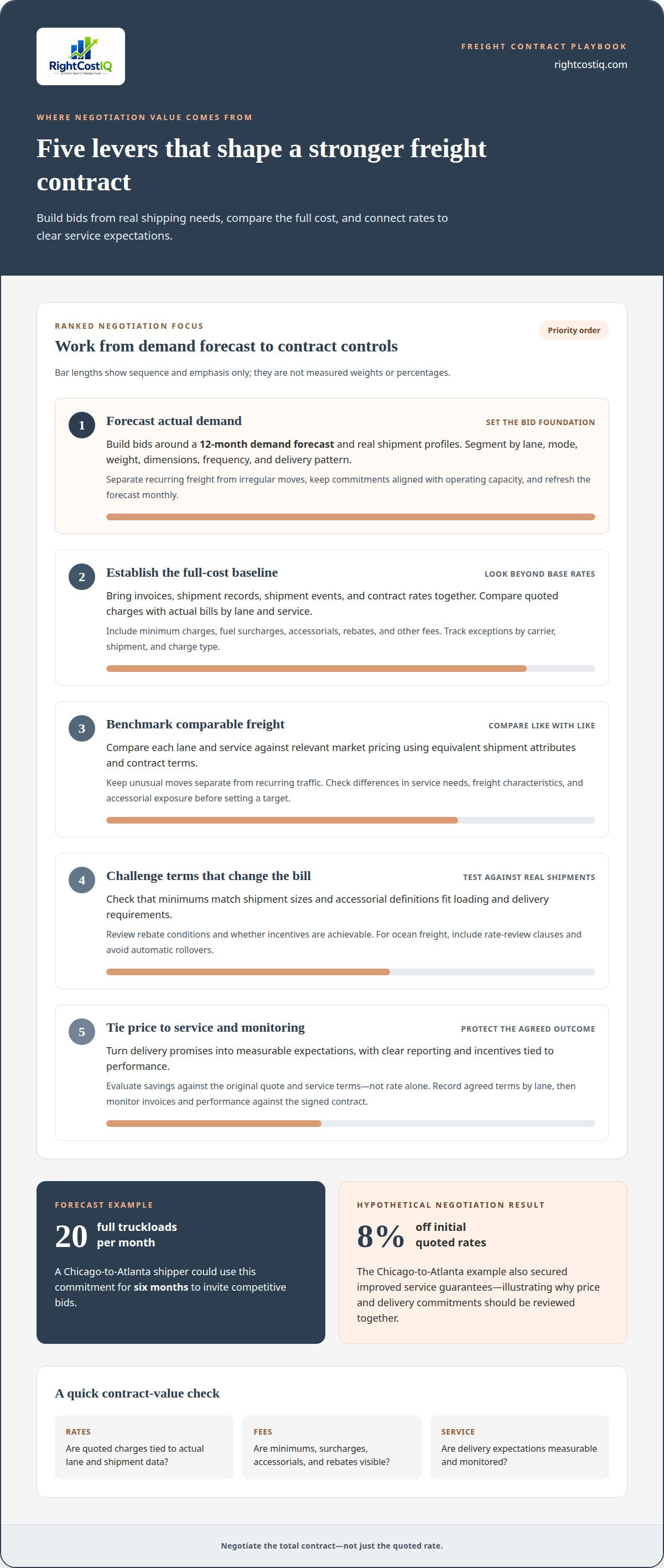
Start with a 12-month demand forecast, then build bids around actual shipment profiles. This gives carriers a clearer basis for pricing and helps shippers compare total contract costs.
Develop the profile from shipment records by lane, mode, weight, dimensions, frequency, and delivery pattern. Separate recurring freight from irregular moves so a carrier’s proposal reflects real demand rather than a blended average. Refresh the forecast every month to account for expected needs, market conditions, and potential disruptions. A Chicago-to-Atlanta shipper, for example, could use a commitment of twenty full truckloads per month for six months to invite competitive bids. Keep the commitment aligned with operational capacity; volume figures that don’t match actual shipping needs can distort the comparison.
Technology can turn raw records into negotiation evidence. Bring invoices, shipment events, and contract rates together, then compare quoted charges with actual bills by lane and service. Flag recurring minimum charges, accessorial rules, and rebate conditions for review. Track exceptions by carrier, shipment, and charge type so a rate reduction does not conceal offsetting costs elsewhere. The goal is a baseline that captures the full charge structure, not just the headline rate.
Compare contract terms with the shipping profile before making a counteroffer. Check whether minimums match shipment sizes, accessorial definitions fit loading and delivery requirements, and incentives reward volume or service outcomes the business can achieve. For ocean freight, include rate-review clauses and avoid automatic rollovers. The Program on Negotiation at Harvard Law School advises addressing the other party’s anchor before presenting a counteroffer. Support your position with lane-level data rather than reacting to an opening figure.
FOB Responsibilities and Cost Allocation
For ocean shipments under FOB terms, the buyer typically assumes ocean freight costs once the goods are loaded onto the vessel. Specify who selects the forwarder and manages container stuffing and documentation. FOB Origin places costs on the buyer after origin, while FOB Destination leaves the seller responsible farther along the delivery route. Separate product and freight costs in purchasing agreements to make logistics charges visible.
Needs-Based Negotiation Strategy
Set priorities before approaching carriers by reviewing forecasted lanes, service requirements, and shipment profiles. A shipper could exchange a credible volume commitment for competitive bids, then negotiate minimum charges, accessorial rules, and rebates against actual needs. Test each proposed saving against delivery requirements and total freight cost. Strong contracts connect rates to transparent fees, performance monitoring, and mutually beneficial incentives.
Evaluate savings against the original quote and service terms, not rate alone. In a hypothetical Chicago-to-Atlanta negotiation, a shipper saved 8% off initial quoted rates while securing improved service guarantees. That example shows why contract analysis should compare both price and delivery commitments. Record agreed terms in a lane-level comparison, then monitor invoices and performance against the signed contract.
Centralized freight data and cost baselines
Bring transportation records into one working dataset before comparing freight rates. Start with a consistent shipment identifier, then match each movement to its invoice, lane, service, and carrier. A shipment recorded as expedited in one system and standard in another, for example, can skew the comparison. Standardize service labels and units first. This gives procurement and operations a shared view of what each movement actually cost.
Build the dataset from source records, not summary totals alone. Combine invoices, shipment details, contract schedules, and accessorial line items. Keep the original invoice value beside any corrected or normalized value so reviewers can trace each change. Record the reason for an adjustment, such as a duplicate charge or misclassified service. A clear audit trail helps distinguish a genuine cost pattern from a data-entry issue.
Next, segment freight costs by the characteristics that influence carrier pricing. Compare like with like: the same lane, mode, service level, shipment profile, and billing basis. Keep unusual shipments separate from recurring traffic rather than letting a one-off move skew the baseline. For example, compare standard deliveries on a lane together, then review expedited shipments separately. This makes the baseline useful for negotiations, not merely descriptive.
Use the baseline to find where contract rates differ from actual spend. Review base transportation charges alongside accessorials, minimum charges, and rebates. A lower quoted rate may not reduce total spend if extra fees apply to the shipper’s regular shipment profile. Create a lane-level view of contracted terms, invoiced charges, and the reasons for variances. This gives negotiators specific issues to raise instead of relying on general claims that pricing seems high.
Benchmarking adds market context to internal records. Compare each lane and service with relevant market pricing, using equivalent shipment attributes and contract terms. Treat the result as a reference point, not a substitute for analyzing the shipper’s actual freight mix. Differences in delivery requirements, freight characteristics, or accessorial exposure can explain why a benchmark and carrier quote do not match. Identify those differences before setting a target rate.
Refresh the baseline as contract terms, shipment patterns, and carrier charges change. Procurement category cost benchmarking and analytics can help organize comparisons and surface cost drivers across categories. For a deeper category-level view, use procurement cost analysis to support rate discussions with a structured cost perspective.
Fuel surcharges and delivery guarantees
Negotiate freight rates by separating the base rate from fuel surcharges, accessorial charges, and incentives. Define each charge, its calculation method, and the shipment conditions that trigger it. Address minimum net charges, tariff schedules, service and deferred incentives, and carrier surcharges in the agreement.
Put the service-level agreement in writing and incorporate it into the main logistics agreement. It can set targets for picking and packing, delivery timescales, and order accuracy, with reporting requirements that allow both parties to assess performance. Specify how missed metrics affect service credits and whether exceeding thresholds may trigger bonuses or clawbacks.
For fuel surcharges, agree in writing on the benchmark, adjustment method, and review process. Define how rate increases are assessed and how contract renewals are handled. Ocean agreements should include rate-review clauses and avoid automatic rollovers.
Make surcharge terms auditable. The contract should explain which fuel measure drives adjustments, how the carrier applies it, and when the calculation takes effect. Specify whether changes apply to every lane or only to particular services. Clear calculations help transportation teams reconcile invoices with contract terms and distinguish valid adjustments from billing discrepancies.
Define accessorial rules just as precisely. List chargeable events, such as a delivery that requires an additional service, and state what documentation supports each charge. Set out how carriers submit accessorial claims and how shippers can dispute them. Clear rules reduce ambiguity and give both parties a consistent basis for reviewing exceptions.
Ocean freight pricing can combine base rates with bunker fuel adjustments, currency fluctuations, port congestion, and seasonal surcharges. Separate these components in the pricing schedule instead of accepting one blended figure. Identify which components can change, what evidence supports an adjustment, and how a change affects the quoted rate. This keeps cost drivers visible during review.
Define delivery guarantees in operational terms. State which delivery milestone is measured, what timestamp or record establishes performance, and how exceptions are reported. Align the metric with the shipment’s service requirement: a delivery commitment matters only if both parties can assess it consistently. Pair the target with reporting obligations and the agreed service-credit mechanism.
Build renewal discussions around actual shipment needs and documented performance. Carriers usually increase contract rates annually, and shippers may renegotiate when freight needs change. Compare requested increases with the agreement’s review terms, surcharge history, delivery results, and volume changes. Price risk management and tracking can help teams monitor market movement and prepare evidence for those discussions.
Provider market research and selection
Compare spot rates, contract rates, and broker proposals using the same lane, mode, shipment profile, and service level. Spot rates reflect a current move, while contract rates apply agreed terms to planned freight; brokers offer another route to carrier capacity. Evaluate the total charge and service fit, not just the quoted base rate.
Start market research with lane-level demand, then identify providers able to handle those movements. A freight routing guide should rank carriers by lane and mode based on rates, service levels, or both, and include a backup option. This makes provider selection repeatable instead of an improvised response to each shipment. It also gives the supply chain a clear process when its primary carrier cannot handle a move.
Benchmark your current rates against comparable market offers, keeping shipment characteristics and contract terms aligned. Most companies consider only 30% of the service-provider market when sourcing contracts, so widening the candidate pool can reveal alternatives. Don’t treat a broad quote as a valid benchmark unless it covers the same service, lane, and accessorial exposure. Use comparable bids to identify where a carrier’s proposal differs, then focus negotiation on those specific gaps.
Market conditions can shift the leverage available to shippers and carriers. The Cass Freight Index reported that shipments were down 4.1% year over year in June. ATRI described the capacity reduction as the largest since the freight recession began in 2022. Use these signals as context, then assess their relevance to your own lanes and modes. A national trend alone doesn’t establish the rate or capacity available for a specific shipment.
Fuel prices also affect proposals through surcharge mechanisms. Compare how each carrier calculates fuel adjustments, when changes take effect, and whether the contract separates surcharges from base rates. Review each calculation using the same shipment and service assumptions across bids. This helps distinguish a competitive base rate from a proposal that shifts costs into variable charges.
Consider the relationship as well as the price. A carrier with consistent performance on a critical lane may reduce operational disruption, while a new provider could create useful competitive leverage. Compare both against defined service requirements, reporting practices, and backup capacity. Some logistics providers offer carbon-offset packages or client scorecards, and some carriers offer preferential rates under green lanes or sustainability incentives. Include these options only when they support supply-chain priorities.
Use a structured negotiation process: shortlist providers by lane, compare equivalent bids, document rate and surcharge differences, then negotiate based on the findings. Market price trending and forecasting can help teams interpret changing conditions and prepare for sourcing decisions. Revisit the provider mix when shipment patterns or market signals change instead of relying indefinitely on an outdated comparison.
Freight and small-parcel contract analysis
For U.S. freight contracts, review governing-law, liability, claims, and dispute terms alongside the commercial schedule. The requirements to assess depend on the mode and transaction, so examine the agreement’s scope before applying any legal standard.
Connect every charge in the contract to the shipment details that trigger it. Freight agreements commonly specify distance traveled, cargo weight, density, freight class, and accessorial charges. Compare those terms with shipment records and invoice line items. If a charge depends on a delivery condition or handling requirement, confirm that the contract defines it clearly.
For U.S. less-than-truckload shipments, freight class can materially affect the quoted rate. The National Motor Freight Traffic Association groups cargo into 18 classes, ranging from Class 50 to Class 500, to standardize pricing. LTL rates can also reflect shipment density, handling complexity, and transit distance. During analysis, compare the class and shipment attributes used in the quote with the actual freight description and billing records.
Review small-parcel agreements separately, focusing on rate tables, shipment characteristics, and additional charges. Compare invoiced charges by service and package profile, then isolate recurring differences between the contract schedule and actual billing. Review how the agreement treats dimensional weight, handling, and service choices. A low base rate may not reduce shipping costs if the package mix regularly triggers other charges.
Assess the entire delivery cost, not only the line-haul or parcel label. The last mile can account for approximately 53% of a shipment’s total cost. Map the charges that accumulate from dispatch through final delivery, then identify which terms govern each segment. This makes it easier to see whether the contract’s pricing structure reflects the company’s actual distribution pattern.
Compare full truckload and LTL options using shipment size, capacity needs, and lane requirements. FTL contract rates can provide budget stability when LTL rates fluctuate daily. For LTL, test how class, density, handling, and distance affect the rate. Keep comparisons tied to the same shipment profile so a mode change is assessed on its full commercial terms.
Review operational and financial clauses together. Check rate schedules, accessorial definitions, invoicing requirements, performance measures, dispute procedures, liability allocation, and renewal provisions. Confirm that each term has a clear trigger, calculation basis, and responsible party. This makes invoice review more systematic and gives procurement a useful record for resolving billing differences.
Use the findings to build a concise exception file: contract clause, invoice example, shipment detail, and requested correction. A focused contract negotiation review can help turn those documented gaps into specific discussion points.
Applicable requirements depend on the mode and transaction, so review the agreement’s scope before applying a legal standard. Contract analysis should cover governing-law, liability, claims, and dispute terms.
RightCostIQ: Request For Proposal (RFP) Management and Negotiation Assistance
RightCostIQ provides Request For Proposal (RFP) Management and Negotiation Assistance for shippers preparing a carrier sourcing process or renegotiating freight terms. This support can help structure an RFP and negotiations around the shipment requirements, pricing components, and service measures identified in the analysis.
Procurement Category Cost benchmarking and Analytics can inform rate comparisons, while Price Risk Management and Tracking and Market Price Trending and Forecasting can support decisions as market conditions change. Once a contract is in place, Procurement and Vendor Performance Tracking can help monitor supplier performance against agreed expectations. These services can help internal teams connect freight data, market context, and contract decisions.
To discuss freight sourcing or negotiation support, contact RightCostIQ or visit rightcostiq.com.
Make the Next Contract Decision More Deliberate
A freight agreement should support the decisions your business will face next, not only the shipment profile it covers today. Assign an internal owner to connect commercial terms with planning, finance, and operations. That owner can bring emerging network changes into the next sourcing discussion before they become urgent exceptions.
Use each renewal or sourcing cycle to refine the decision criteria: which trade-offs matter most, which costs need tighter controls, and where service flexibility supports the business. This makes negotiating freight and logistics contracts a repeatable procurement discipline rather than a one-time rate exercise. The goal is a contract your teams can interpret consistently and use to make informed choices as requirements change.
When you’re ready to apply that discipline to an upcoming freight decision, contact RightCostIQ to discuss your contracts. A focused next step can help move your negotiation from analysis to action, with a clearer basis for the decisions ahead.
Frequently Asked Questions
What’s The Process For Negotiating Better Freight Terms?
A disciplined approach to negotiating freight and logistics contracts starts with defining the business decision and approval path. Set a target outcome, identify who can approve pricing and service exceptions, and prepare a bid comparison template before issuing an RFP. Score proposals against consistent commercial and operational criteria. Before signing, reconcile the selected offer with the final contract schedule so the terms negotiated appear in the documents teams will use.
Can I lower transportation costs without switching carriers?
Yes. A shipper can seek lower spend with its current carrier by reviewing lane allocation, shipment frequency, service choices, and recurring invoice exceptions. For example, separate urgent shipments from standard deliveries, then assess whether each service level matches the business need. Use documented patterns to discuss revised terms or a different service mix. Keeping the carrier relationship can preserve continuity while both parties address specific cost drivers.
How do companies improve service levels while cutting costs?
Service-level agreements align commitments with the outcomes customers need, rather than paying for faster or more specialized service on every shipment. Map delivery requirements by product or destination, then distinguish shipments that need strict timing from those with scheduling flexibility. Define how performance will be measured and reported. Review missed targets alongside cost changes so savings do not come from service reductions that cause downstream disruption.
What Is Negotiation In Logistics?
Logistics negotiation is the process of agreeing on the commercial and operating terms for moving, handling, and delivering goods. It can cover pricing, capacity commitments, service expectations, responsibility for charges, and how changes are managed. For example, a shipper and carrier may negotiate both a lane rate and the conditions that trigger extra fees. The goal is an agreement that supports operational requirements and makes obligations clear.
When Is Freight Negotiation Possible or Challenging?
Negotiation is possible when a shipper can present a clear business case, such as predictable lane demand, a changing shipment mix, or documented performance concerns. It becomes more challenging when requirements are volatile, service needs are highly specialized, or comparable pricing information is lacking. Prepare by distinguishing essential requirements from negotiable preferences. This clarity helps focus discussions on terms each side can evaluate and implement.
What are typical freight contract rates by mode and shipment type in the United States?
There is no single typical rate for U.S. freight contracts. Pricing depends on mode, lane, shipment size and characteristics, service level, capacity, and contract terms. LTL pricing can reflect freight class, density, handling complexity, and transit distance; truckload and parcel pricing use different shipment and service factors. Compare quotes only when the move characteristics and included charges align, then assess the full billed amount.
What liability, cargo insurance, and claims terms should a freight contract include?
Specify how the agreement allocates responsibility for loss or damage, what cargo insurance applies, and how a claim must be submitted and documented. Define the records required, who is responsible for each step, and how disputed claims are reviewed. Clarify how liability terms interact with the shipment’s declared characteristics and service arrangement. Review these clauses together rather than treating them as separate boilerplate sections.
What are common risks and hidden fees in freight contracts?
Common risks include unclear accessorial triggers, minimum charges, surcharge adjustments, automatic renewals, and invoice terms that do not match the negotiated schedule. A destination change during transit, for example, may require a reconsignment charge and a recalculated rate. Review sample invoices against the contract and identify which event supports each extra charge. Clear definitions and approval procedures help teams catch unexpected costs before they become recurring billing patterns.


