

A vendor’s quote is a starting point, not proof of fair value. Negotiating healthcare vendor contracts means using your organization’s requirements, market comparisons, and the supplier’s value to shape pricing and terms that support quality and reliable service. A strong negotiating position is built on evidence, not pressure alone.
Lower prices matter, but a rate cut is useful only if the agreement still meets operational needs. A focused negotiation weighs the offer as a whole, including service expectations, delivery, performance, and risks in the contract language. Prepare a data-backed proposal, compare market pricing, and use your organization’s purchasing needs to support your position. Address price adjustments, performance standards, renewal, and termination rights while protecting continuity and value.
Key Takeaways
- Define negotiation priorities around total value, including pricing, service expectations, and dispute-resolution terms.
- Use distinctive vendor capabilities and measurable outcomes to support a stronger proposal.
- Build rate requests with usage data, performance metrics, and relevant market comparisons.
- Review delivery, quality, warranties, indemnification, and exit terms alongside the price.
- Compare offers on a consistent basis and track market trends to identify where contract terms may be improved.
1. What is Vendor Negotiation?
Healthcare vendor negotiation is the process of agreeing with an external supplier on price, service, performance, and risk. Hospitals, clinics, and physician practices share that goal, but their priorities differ. A hospital may emphasize system-wide supply continuity, while a clinic may focus on a narrower service scope and predictable payment terms. Define requirements before discussing price.
HIPAA applies when a covered entity engages a vendor to provide a service that requires the use or disclosure of protected health information. In that case, the parties must enter into a Business Associate Agreement. Contract teams should also incorporate applicable state privacy requirements into terms covering data use, security, breach notification, and information handling.
For payer contracts, negotiate the fee schedule alongside operational provisions. Compare rates by service or code, then define how updates, claims issues, and payment disputes will be handled. Review the dispute-resolution language before signing, as many vendor contracts require alternative dispute resolution. Clarify the process, notice steps, and escalation path so the organization knows how to proceed if a disagreement arises.
Medical device negotiations should assess total contract value, not just the quoted unit price. A hospital buying equipment for several departments can request volume-based pricing, while a clinic may prioritize maintenance terms and continuity of service. Gather bids using the same specifications, quantities, and service requirements. This makes comparisons meaningful and helps distinguish a lower price from a stronger overall offer.
Payment terms also affect an agreement’s financial position. Discuss payment timing, invoicing requirements, and flexibility that fits the organization’s cash flow. For essential goods or services, healthcare providers may seek longer or more flexible payment terms and waivers of payment-default provisions, reducing the need to request extensions during a crisis. Support proposals with a clear business rationale, such as maintaining access to critical supplies when cash flow is constrained.
Review insurance contract terms beyond reimbursement rates. Consider medical policies, claim denials, down-coding, administrative burden, and renewal language. Set negotiation goals early and align the team on acceptable fee schedules, service terms, and dispute procedures. A practice may also use aged accounts receivable as a discussion point: providers can raise receivables more than 90 days old during payer contract negotiations. Document requested changes and compare the final language with the organization’s priorities before approval.
Preparation can include researching market prices and vendor offerings, setting objectives and priorities, leveraging volume purchasing, seeking multiple bids, negotiating payment terms, and exploring value-added services or incentives. For pharmaceutical purchases, bulk-purchase terms can help optimize inventory levels and reduce costs. The aim is favorable terms, quality products, cost-effective solutions, meeting regulatory requirements, and maintaining positive vendor relationships.
2. Using unique services and outcomes as negotiating strengths
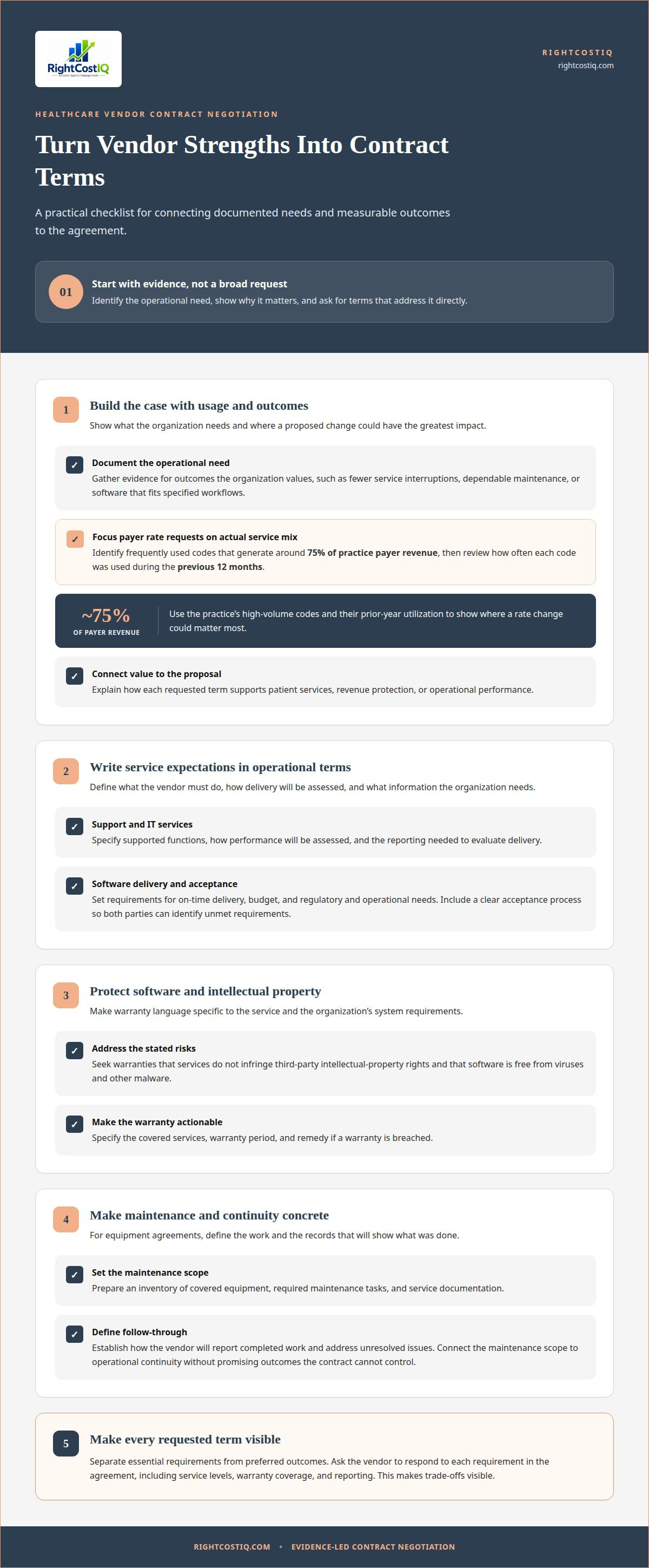
A vendor’s distinct capabilities can strengthen a negotiation when they address a documented operational need. Gather evidence of the outcome the organization values, such as fewer service interruptions, dependable maintenance, or software that meets specified workflow requirements. Connect that outcome to the proposed agreement. A hospital, for example, can explain how equipment availability affects department operations, while a clinic can identify the support needed to keep scheduling and billing workflows running.
For payer-related agreements, identify high-volume services and their revenue contribution before presenting a rate request. One preparation step is to identify frequently used codes that generate around 75% of a practice’s payer revenue, then review how often each code was used during the previous 12 months. This analysis shows where a rate change could matter most. It also helps focus discussions on actual service mix rather than a broad request detached from utilization.
Support and IT agreements should define service levels in operational terms. Specify the functions the vendor must support, how performance will be assessed, and what reporting the organization needs to evaluate delivery. For software services, negotiate requirements for on-time delivery, budget, and regulatory and operational needs. A clear acceptance process gives both parties a shared basis for identifying unmet requirements.
Software warranties can address intellectual-property and security concerns. Healthcare organizations can seek warranties that services do not infringe third-party intellectual-property rights and that software is free from viruses and other malware. Specify the covered services, warranty period, and remedy if a warranty is breached. Align these provisions with the organization’s system requirements so the language addresses the actual implementation.
Maintenance agreements can support timely equipment servicing and alignment with facility standards, helping reduce downtime and operational disruption. Prepare an inventory of covered equipment, required maintenance tasks, and service documentation. Then establish how the vendor will report completed work and address unresolved issues. For equipment used in patient care, connect the maintenance scope to operational continuity without promising outcomes the contract cannot control.
Finally, turn unique value into a structured proposal. Separate essential requirements from preferred outcomes, and explain how each requested term supports patient services, revenue protection, or operational performance. Ask the vendor to respond to each requirement in the agreement, including service levels, warranty coverage, and reporting. This makes trade-offs visible during negotiation and gives the organization a practical framework for assessing performance after signing.
3. Using data to support contract proposals and rate requests
A rate request is stronger when providers can show how proposed terms relate to actual service demand. Start with the practice’s needs, current vendor performance, preferred suppliers, and measurable priorities. For a payer proposal, examine reimbursement by service and compare current payment levels with market trends, industry standards, and performance metrics. This gives the provider a clear basis for explaining the request and its operational impact.
The key steps are to define objectives, set negotiation parameters, assemble the right expertise, and gather supporting data. Assign owners for financial analysis, clinical or operational requirements, and contract review. Before discussions begin, align the team on priority terms and acceptable trade-offs. Preparation keeps proposals consistent and supports productive vendor relationships as the parties work through differences.
For payer negotiations, use claims and billing information to show which services drive the request. Consulting firms may model reimbursement at the CPT-code level to benchmark rates. A provider might request an overall reimbursement rate of 200% of Medicare, or build a more granular proposal with 150% of Medicare on most codes and 250% for three high-volume codes. These examples illustrate how a rate position can distinguish broad goals from targeted requests.
Specialty providers can strengthen proposals by connecting rate requests to their service mix and performance evidence. Identify the procedures, patient populations, or operational outcomes that distinguish the practice, then document relevant utilization and reimbursement effects. For example, a specialty practice could show how a small set of frequently performed procedures shapes its financial position. Tie requested terms to actual activity rather than presenting an unsupported general increase.
Prepare a concise proposal that pairs each requested change with its rationale and evidence. A rate table can show current terms, requested terms, and the supporting benchmark for each service. Add utilization or performance data where it clarifies the request, and flag assumptions that affect the comparison. This format helps the vendor assess the proposal efficiently and gives the negotiation team a consistent reference for counteroffers.
Data helps the team assess trade-offs as well as opening positions. If a vendor challenges a benchmark, identify whether the disagreement concerns service scope, volume, or comparison method. Then revise the analysis or explain why the benchmark remains relevant. Specialty-provider support can help translate complex service and reimbursement data into a clear proposal, while operational leaders assess whether the proposed terms are workable.
4. Quality, delivery, warranties, indemnification, and termination
Price alone does not define a favorable agreement. Specify measurable quality standards, delivery schedules, service levels, and remedies for missed commitments. For example, a supply contract can set delivery windows and procedures for reporting shortages. An IT agreement can establish acceptance criteria tied to operational requirements. These terms give both parties a clear basis for assessing whether the vendor delivers as agreed.
Review warranties and indemnification separately. A warranty should state what the vendor promises, which services or goods it covers, and what happens after a breach. Indemnification provisions should address likely damages arising from the vendor’s acts or omissions. Examine any liability cap as well: some contracts limit total vendor liability to fees paid during the twelve-month period before the incident giving rise to the claim. Compare that limit with the risks transferred by the agreement.
For a vendor handling protected health information, negotiate the Business Associate Agreement alongside the main contract. It should allow termination if the vendor breaches it, require notice of possible security or privacy breaches, and require the return or destruction of healthcare information after the underlying contract ends. These provisions set out how to respond to contract failure and handle information at termination.
Address data security and cybersecurity exposure in the contract, not just in general assurances. Define breach-notification duties, information-handling expectations, and responsibility for damages tied to vendor acts or omissions. Review whether indemnification covers likely losses and whether a liability cap could restrict recovery. A cap based on fees paid before an incident may leave the organization carrying risks beyond the vendor’s contractual responsibility.
Term and exit rights determine how long the organization remains committed. Some vendor contracts span multiple years and allow termination only for vendor breach or before renewal. For non-essential agreements, healthcare providers may seek termination-for-convenience rights, although vendors may resist. Specify renewal dates, notice procedures, and decision deadlines. For multiyear agreements, negotiate fixed pricing and, where essential, quantity or service guarantees, with renewal at the provider’s option.
To manage renewals and price increases, define how prices can change and when the vendor must give notice. Consider annual escalators in multiyear agreements and specify the adjustment method. Before renewal, compare proposed changes with the budget and market conditions. Avoid open-ended adjustment clauses that leave timing or calculations unclear.
Hidden costs often sit outside the headline rate: restrictive renewal language, narrow service scopes, extra charges for delivery or support, and liability limits. Read every exhibit and incorporated schedule alongside the main agreement. A competitive offer is favorable only if its service obligations, price adjustments, exit rights, and risk allocation fit the organization’s operations.
5. Negotiation research and market-price comparisons
Market research gives buyers leverage only when it compares like with like. Before negotiating, define the item or service, required specifications, delivery conditions, service scope, and contract duration. Compare offers against those same criteria. A lower unit price may not provide the same value if it excludes maintenance, has different delivery terms, or covers a narrower service. This gives negotiating healthcare vendor contracts a factual basis instead of treating the first quote as the market rate.
Build a comparison set from current vendor proposals, market benchmarks, and the organization’s purchasing history. For each entry, record scope, quantity basis, pricing structure, and key service terms. Keep unlike offerings separate: equipment quoted without maintenance should not be compared directly with a bundled offer. This helps show whether a price difference reflects supplier pricing, a different specification, or a contract term that shifts cost or risk.
Market conditions can make historical prices unreliable. During the pandemic, some healthcare providers paid hundreds of times the normal price for personal protective equipment. This illustrates why a past invoice may not represent a current competitive rate during a supply disruption. Record when each quote or benchmark was collected, and distinguish temporary scarcity from sustained market movement before using it to support a proposal.
For payer agreements, compare reimbursement with Medicare and commercial benchmarks while accounting for covered services and the contract’s fee schedule. Standard insurance contract payment levels are tied to fee schedules that are three or more years old. Identify the schedule year and calculation method. Without those details, a comparison may make a proposed rate appear more or less competitive than it is.
Use the findings to develop a clear negotiation position. State which comparison supports the requested term, explain how the scope matches, and identify differences that affect interpretation. If bids vary, analyze service components and contract conditions before using the lowest quote as leverage. Payers and vendors may challenge a benchmark’s relevance; documented differences in scope and pricing help answer those challenges. This makes negotiating healthcare vendor contracts more disciplined and repeatable.
Market-price trending can help distinguish a short-term spike from sustained movement, while price-risk tracking can flag cost exposure. Apply these insights to renewal timing, price-adjustment language, and sourcing priorities. Keep the comparison and its assumptions with the proposal so the organization can use a consistent basis in future negotiations.
RightCostIQ: Request For Proposal (RFP) Management and Negotiation Assistance
RightCostIQ provides Request For Proposal (RFP) Management and Negotiation Assistance for organizations preparing supplier bids or negotiating contract terms. Its Procurement Category Cost benchmarking and Analytics can support market comparisons, while Price Risk Management and Tracking and Market Price Trending and Forecasting can help assess changing cost exposure. After an agreement is signed, Procurement and Vendor Performance Tracking can help monitor vendor performance against organizational expectations.
Turn to these services when internal teams need structured RFP support, clearer category cost benchmarks, or ongoing visibility into vendor performance and price trends. The right focus depends on the procurement challenge, whether evaluating bids, strengthening a negotiation position, or tracking costs after an award. Contact RightCostIQ to discuss your procurement needs.
Turn contract analysis into a stronger next move
The next negotiation can begin before a renewal notice arrives. Set a regular review point for vendor performance, pricing assumptions, and changing operational needs. This creates time to identify emerging risks, clarify priorities, and decide which contract changes matter most before discussions become time-sensitive.
Effective negotiation of healthcare vendor contracts is an ongoing capability, not a one-time price exercise. Build a repeatable process for recording decisions and tracking whether signed terms deliver the intended value. When internal teams need support turning market insight into a structured procurement strategy, RightCostIQ can help assess the next steps.
Contact RightCostIQ to discuss your vendor contracts and identify a practical path forward. A clear plan puts your organization in a stronger position for its next agreement.
Frequently Asked Questions
What is Vendor Negotiation?
Vendor negotiation is the process of shaping a supplier agreement around an organization’s requirements. It covers more than price: scope, delivery, service responsibilities, payment, risk allocation, and how changes are handled all affect the deal. For example, a clinic evaluating a software vendor can negotiate both the services included and the process for addressing unmet operational requirements. The objective is a workable agreement that balances cost, performance, and continuity.
Which contract terms should healthcare organizations prioritize when negotiating with vendors?
Prioritize terms that affect cost exposure, service continuity, information handling, and exit options. Match each term to a business risk: define what the vendor must deliver, how charges can change, who is responsible for a failure, and what happens when the agreement ends. For a vendor handling sensitive information, align the related agreement with the main contract. Review schedules and exhibits as well, since they may define scope or additional obligations.
How can healthcare providers benchmark vendor pricing and negotiate discounts?
Providers can benchmark prices by comparing equivalent scopes, specifications, and service conditions across vendor proposals and purchasing records. Normalize differences such as included support, delivery requirements, and contract duration before using one offer as a discount benchmark. Then use documented gaps to request a price adjustment, a different service bundle, or clearer cost protections. For payer rates, compare reimbursement with relevant Medicare and commercial benchmarks, taking covered services into account.
What are typical pricing models and contract lengths for healthcare vendors?
There is no single pricing model or contract term that fits every healthcare vendor agreement. Pricing may depend on a defined service scope, usage, or purchased quantities, so compare what triggers charges and how changes are calculated. Some agreements run for multiple years. Assess that commitment alongside renewal timing, price-adjustment language, and exit rights, since a lower starting rate may be less valuable if future increases or limited termination options constrain the organization.
What service-level agreements and performance metrics should healthcare vendor contracts include?
Service-level agreements should turn operational expectations into measurable obligations and a review process. Choose metrics that match the service: delivery timeliness for supplies, completion of scheduled equipment maintenance, or response and resolution tracking for IT support. Define how the vendor reports results, how exceptions are documented, and what corrective steps follow a missed requirement. A hospital can also align service reviews with department needs so performance tracking reflects the agreement’s actual scope.


