

A low quote creates value only when it meets the same requirements, delivery expectations, and terms as the other bids. RFQ management coordinates the process of defining requirements, requesting supplier quotations, and evaluating responses consistently. Managed RFQ services can organize these steps so procurement teams can compare prices and terms with a clearer understanding of what each bid includes.
Price matters, but it is not the only factor in a sound vendor decision. Differences in specifications, delivery schedules, payment conditions, and contract terms can make apparently similar bids difficult to compare and obscure an offer’s true value.
This article explains what RFQ management involves, how a structured process supports efficient procurement, and how to assess bids beyond their headline prices. It also covers when an RFQ is the right fit, what information to include, and how benchmarking and negotiation assistance can support vendor selection.
Key Takeaways
- RFQ management organizes supplier requests and responses so procurement teams can evaluate bids against consistent requirements.
- Clear specifications and structured response timelines help reduce administrative friction and make supplier expectations easier to understand.
- Compare total pricing alongside delivery, payment conditions, contract terms, and technical fit, not just the headline quote.
- Predefined evaluation criteria and a comparative matrix bring trade-offs into view and support a more transparent vendor decision.
- Cost benchmarking, negotiation assistance, and vendor performance tracking can strengthen sourcing decisions beyond the initial bid.
Procurement cycle time and administrative efficiency
RFQ management coordinates requirements, supplier invitations, questions, bid deadlines, and response evaluation within a procurement workflow. In logistics, it helps teams obtain comparable quotations for clearly defined services.
Procurement Questions and RFQ Management
RFQ management coordinates supplier requests, responses, clarifications, and evaluation. It matters because unanswered questions or inconsistent instructions can disrupt bidding and make offers harder to compare. An RFI serves an earlier purpose: procurement teams use it to gather information before formal procurement begins. Once requirements are clear, the RFQ requests quotations based on those requirements.
In logistics procurement, an RFQ typically states the service required, delivery schedule, quantities or operating needs, submission requirements, and payment terms. The process then moves through supplier invitations, a question period, quote submission, and evaluation. Closing supplier questions three to five days before the submission deadline gives procurement teams time to share clarifications consistently. A defined deadline keeps responses aligned for review.
RFQ timelines commonly span two to four weeks, depending on the requirements and supplier response window. Standard templates, structured approvals, and predefined criteria help reduce repetitive administration and support compliance. Automated tools can centralize invitations and track responses, while procurement staff remain responsible for requirements, clarifications, and award decisions.
Managed Services Compared with In-House Options
Managed RFQ services provide coordination support, while in-house teams retain direct ownership and sourcing software supplies digital workflow tools. The right model depends on internal capacity, process complexity, and the need for hands-on execution. Software can support templates, bulk invitations, notifications, and bid-status visibility. Managed support can complement these tools by coordinating tasks and keeping the process moving.
Manufacturing, distribution, construction, and professional services organizations often issue or receive more than 50 RFQs per month. Companies in these sectors may benefit when recurring volume or complex requirements stretch procurement capacity. Smaller teams can also use structured processes when a sourcing event involves multiple suppliers, detailed specifications, or strict deadlines.
Rules Affecting Managed RFQs
US rules affect an RFQ through the buyer’s procurement obligations and the requirements attached to the purchase. For government contracting, the Federal Acquisition Regulation governs the RFP/RFQ process described here. Industry requirements can also shape specifications, supplier qualifications, documentation, and approvals, so the solicitation needs to reflect the rules applicable to that procurement.
To control the cycle, define who answers supplier questions, how clarifications reach bidders, and which approvals must occur before award. Keeping RFQ materials, bids, evaluations, and contract records together supports an audit trail. This structure ties deadlines to accountable steps and makes compliance part of the workflow rather than a final review.
Comparative matrices and bid evaluation
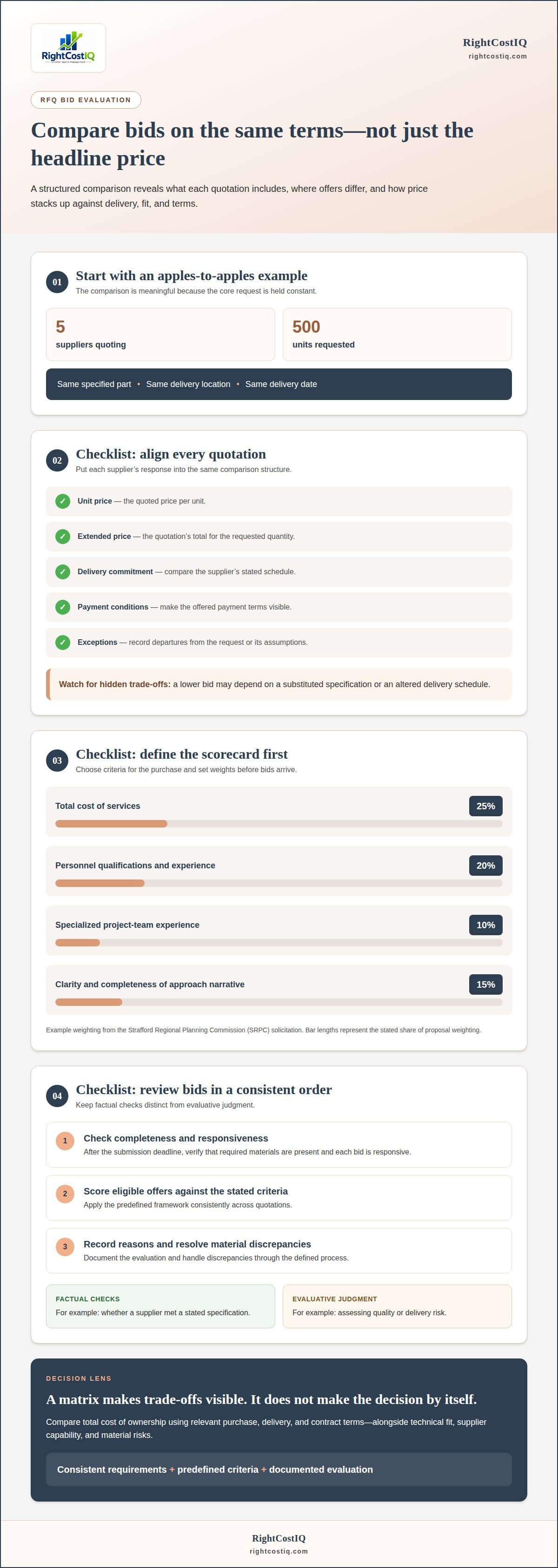
A comparative matrix puts supplier quotations into a consistent format, making differences in price, specifications, delivery, and terms easier to see. Procurement teams can assess each offer against the same criteria instead of relying on different proposal layouts or headline prices.
Consider a straightforward comparison: five suppliers quote for 500 units of the same specified part, delivered to the same location by the same date. A matrix can place each quotation’s unit price, extended price, delivery commitment, payment conditions, and exceptions in aligned columns. That format helps identify whether a lower bid depends on different assumptions, such as a substituted specification or altered delivery schedule.
Procurement teams evaluate suppliers and bids against predefined criteria, then compare total cost of ownership using relevant purchase, delivery, and contract terms. The matrix makes trade-offs visible, but it does not replace the judgment needed to assess technical fit, supplier capability, and material risks.
Criteria should reflect the purchase, not default to price alone. For a standardized item, procurement may prioritize specification conformity, quoted price, delivery commitment, and payment conditions. A service evaluation may also consider personnel qualifications, project-team experience, and the clarity of the supplier’s proposed approach. Setting weights before bids arrive helps evaluators apply the same framework to every quotation.
The Strafford Regional Planning Commission (SRPC) illustrates how a solicitation can make evaluation criteria explicit. It assigned 25% of proposal weighting to total cost of services, 20% to personnel qualifications and experience, 10% to specialized project-team experience, and 15% to the clarity and completeness of the approach narrative. These stated categories show how a buyer can assess cost alongside capability and response quality.
After the submission deadline, procurement first checks each bid for required materials and responsiveness. Evaluators then score eligible offers against the stated criteria, record their reasons, and resolve material discrepancies through the defined process. A systematic review separates factual checks, such as whether a supplier met a specification, from judgments about quality or delivery risk. Keeping both visible makes the comparison more useful to decision-makers.
Before award, the team can review the highest-ranked bids for exclusions, assumptions, and contract differences. An unusually low quotation may reflect a different scope, omitted requirement, or delivery condition, so the matrix should show the reason for any adjustment. Procurement then documents the evaluation and award rationale, preserving a clear record of how competition produced the selection. For proposal evaluations that need structured coordination and negotiation support, RFP management and negotiation assistance can support that work.
Competition, pricing, and contract terms
Competition creates useful pricing options only when suppliers quote against the same scope. A structured RFQ connects comparable bids with contract terms the buyer can assess and maintain.
Supplier Negotiation
Supplier negotiation clarifies or improves an offer before the buyer finalizes an award. Procurement can address price, payment conditions, delivery schedules, and contract language while preserving the requirements shared with bidders. If a supplier proposes a change, record its effect on scope and compare it with other offers on an equivalent basis.
Manual negotiations can lose context when emails, quote revisions, and internal approvals sit in separate files. A structured record links each supplier’s proposal to its clarifications and revised terms. This gives decision-makers a useful basis for selecting an offer and documenting why its terms fit.
Pricing and Competition
Competition gives buyers a basis for evaluating price and commercial terms across suppliers. An RFQ should communicate the required quantity, delivery schedule, and payment terms, so each quotation addresses a consistent request. For example, monthly deliveries over 12 months create a schedule bidders can price against directly.
Inviting only a selected group can limit competition, while opening participation can attract more bids and increase review demands. The buyer balances supplier reach with the capacity to evaluate submissions thoroughly. A low quote may also reflect a different scope or delivery assumption, so check its inclusions before treating it as the strongest offer.
Contract Terms and Finalization
Contract finalization turns the selected supplier’s accepted offer into documented obligations. The RFQ commonly identifies the required product or service, contract duration, delivery dates, and applicable terms. Procurement compares the proposed contract with the solicitation and bid, resolving discrepancies before completing the award.
For an IT service, a defined schedule can distinguish recurring support from one-time deliverables. The contract should align those commitments with agreed payment conditions and stated service requirements. Document any change to scope, timing, or terms clearly so the final agreement reflects the selected offer.
Document control supports a defensible process from invitation through award. Keep RFQ materials, supplier bids, evaluation records, and final contracts together as an audit trail. Set access permissions according to each participant’s role, and give vendors the permissions they need to use the RFQ application. Procurement can also track supplier questions and quote revisions, keeping the record connected to the relevant submission.
After evaluation, the buyer records the award decision and communicates the outcome to offerors. Before execution, reconcile the final contract with the chosen quotation, including price, delivery schedule, payment conditions, and any accepted exceptions. This final comparison helps maintain consistency between the competitive process and the obligations both parties will follow.
Gathering pricing and technical information
Accurate quotations depend on complete pricing inputs and technical requirements. Manual information gathering can consume 40-60% of response time before quote preparation. A structured submission process helps procurement collect comparable data, identify gaps, and streamline review without confusing price differences with specification differences.
Start by linking every price request to a defined item or service scope. Capture quantities, units of measure, required attributes, quality standards, compliance requirements, delivery conditions, and any applicable packaging or labeling requirements. For example, an equipment request that omits a quality standard can produce bids based on different specifications. Those responses may look comparable while representing different offers.
Pricing accuracy also depends on how suppliers present their calculations. Request unit prices, extended totals, delivery charges, payment conditions, and stated assumptions in consistent fields. During review, match each cost line to its specification and submission documents. If a response excludes a requested technical feature, record the exception separately instead of comparing it silently with a compliant offer.
Technical information adds context to a quote. Procurement can request product or project specifications, relevant certifications, delivery timelines, and evidence of past performance. Past performance helps assess whether a supplier has completed comparable work, but it should remain distinct from price. A low quotation and a strong delivery record answer different evaluation questions; neither replaces the other.
RFQ software pricing in India varies by solution type. The stated ranges distinguish basic tools from advanced logistics systems, not client service fees. Scope, software capabilities, and operational requirements determine the fit.
Before evaluating software, map the information flow from request creation to supplier response and quote review. A system that centralizes requirements, supplier submissions, and response status can reduce repeated data gathering. Automated workflows can also flag missing fields for follow-up. Automation cannot correct an ambiguous specification, however; procurement must clearly define the requested outcome before invitations go out.
Past performance information is most useful when it relates to the work under consideration. Procurement can compare a supplier’s relevant project history with required technical capabilities, delivery expectations, and quoted scope. Vendor performance tracking helps teams retain records of delivery and service outcomes for future sourcing decisions. This feedback loop gives later pricing reviews more context than a quotation alone.
Buyer RFQ specifications and vendor selection
An RFQ works best when organizations define the purchase before inviting suppliers to bid. Buyers typically issue it before choosing a vendor or creating a contract, using clear requirements to ensure each proposal addresses the same need.
Begin with a detailed description of the goods or services, then identify the attributes suppliers must meet. For a physical item, specify exact descriptions or part numbers, quantities, units of measure, size, quality, and required features. For a service, describe the scope, expected deliverables, and relevant project requirements. These details help vendors price equivalent work instead of interpreting an ambiguous request differently.
Include operational conditions that can change an offer. State the delivery location and required date, along with any packaging or labeling needs. Set the response deadline and explain submission requirements. If compliance standards or certifications apply, include them in the RFQ so vendors can address them in their proposals. Each field clarifies what a complete response needs to contain.
Selection criteria should relate directly to the purchase. Organizations can define how they will assess price, technical conformity, delivery capability, relevant experience, and compliance before reviewing bids. Apply the criteria consistently across vendors. This makes it easier to distinguish a response that meets every technical requirement from a lower-priced offer with a different specification or delivery schedule.
Competition depends partly on how the buyer invites suppliers. Considering three to five vendors per RFQ can balance competition with the effort needed to evaluate responses. Invited bidding limits participation to the selected group, while a broader process may attract more submissions and require additional review. The right invitation strategy depends on supplier availability and the complexity of evaluating each proposal.
Use a consistent RFQ template for recurring purchases. Standard fields for specifications, quantities, deadlines, required documents, and commercial terms make supplier responses easier to compare. They also reduce the risk that one vendor receives different instructions or overlooks a requirement. If a supplier asks a material question, share the clarification with all invited bidders so proposals are based on consistent information.
Vendor selection follows a defined sequence: assess submissions for completeness, compare responsive bids against the published criteria, document material differences, and record the award rationale. Review supplier risks alongside price and technical fit before creating the contract. A clear record links the chosen proposal to the stated requirements and gives stakeholders a transparent account of the decision.
For a sourcing event with complex specifications or negotiation needs, get support with RFP management and negotiation to structure requirements and evaluate vendor proposals.
RightCostIQ: Procurement and Vendor Performance Tracking Service
RightCostIQ helps procurement teams connect sourcing decisions with ongoing supplier oversight through its Procurement and Vendor Performance Tracking Service. Turn to this support when bid evaluation is complete and you need to track vendor performance against operational expectations, or when sourcing decisions need stronger cost context. Procurement Category Cost Benchmarking and Analytics can inform category-level pricing analysis, while Price Risk Management and Tracking helps monitor exposure to price changes. For sourcing events that require proposal coordination or negotiation, RightCostIQ also provides Request For Proposal (RFP) Management and Negotiation Assistance. These offerings support distinct stages of procurement, from assessing market costs to tracking supplier performance after selection. Contact RightCostIQ to discuss your procurement requirements.
Turn sourcing decisions into ongoing procurement discipline
The next opportunity is to connect each sourcing decision with the cost and supplier insights that inform future procurement. Managed RFQ services can support this continuity when teams need structured proposal coordination, informed negotiation, or clearer visibility into supplier performance.
RightCostIQ offers Request For Proposal (RFP) Management and Negotiation Assistance, Procurement Category Cost Benchmarking and Analytics, and Procurement and Vendor Performance Tracking Service. These capabilities support connected stages of procurement, from evaluating sourcing opportunities to monitoring supplier performance after selection. Choose support that aligns with your current priority, whether you need stronger negotiation preparation, category cost insight, or vendor performance tracking.
A focused conversation can clarify how these services relate to your procurement objectives and current sourcing needs. Contact RightCostIQ about your procurement needs and identify a practical next step for strengthening your sourcing process.
Frequently Asked Questions
What is RFQ management?
RFQ management coordinates a buyer’s quotation request, supplier communications, submissions, and evaluation. For example, a procurement team sourcing replacement components can use a controlled process to capture supplier questions, track revised quotes, and record its decision. This is useful when several departments contribute requirements: it keeps suppliers working from the same information and helps decision-makers trace how an award was reached.
How long should RFQ responses take?
Simple RFQ responses are generally expected within 24-72 hours, while complex RFQs may require 5-10 business days. These are supplier response expectations, not the full sourcing-cycle duration. A buyer’s deadline should reflect specification complexity, the documents suppliers must prepare, and the time needed to clarify questions. For a multi-stage evaluation, the procurement schedule also needs time after submissions close for review and award decisions.
What Is an RFQ?
An RFQ, or request for quotation, is a procurement request asking vendors to quote for a defined product or service. It commonly includes the required items, quantities, specifications, and related documents, along with commercial details such as payment conditions. A buyer might issue one for a specified component with a fixed quantity and delivery requirement. Suppliers respond with offers the buyer can assess against the stated need.
What is RFQ management in logistics and why is it important for Indian businesses?
In logistics, RFQ management coordinates requests for quotes from freight or logistics suppliers against defined service requirements. A business can describe the shipment or service, route, pickup and delivery needs, timing, and requested commercial terms, then organize supplier responses for evaluation. For Indian businesses, this structure helps procurement teams compare offers consistently across logistics requirements, rather than treating each quote as an isolated price.
What is RFQ?
RFQ means “request for quotation.” It is the buyer’s formal invitation for suppliers to submit pricing and related terms for a specified requirement. The buyer defines what is needed before vendors quote. For example, a request for a particular service can state its scope and timing, allowing suppliers to price against a shared description instead of proposing different interpretations.
What are managed RFQ services and how do they work?
Managed RFQ services provide external coordination for some or all of a buyer’s quotation process. The work can include organizing requirements, preparing supplier communications, monitoring submissions, coordinating clarifications, and supporting bid review. The buyer remains responsible for its business needs and final selection. RightCostIQ provides related Request For Proposal (RFP) Management and Negotiation Assistance to support procurement teams with proposal processes and negotiation.
What tasks do managed RFQ service providers handle?
Managed RFQ service providers can coordinate request documents, supplier invitations, incoming quotations, clarification records, and evaluation administration. For example, they may organize responses into a consistent review format and flag missing information for follow-up. The work depends on the sourcing engagement. Procurement teams retain decisions about requirements, evaluation priorities, supplier selection, and award, keeping commercial authority with the buying organization.
What information and documents are needed to start an RFQ?
To start an RFQ, procurement needs a clear scope, item or service specifications, quantities, units of measure, delivery requirements, submission deadline, and applicable commercial terms. Attach relevant drawings, technical specifications, or compliance requirements when applicable. For a service request, include expected deliverables and timing. A defined evaluation approach also helps suppliers understand how their offers will be assessed and what supporting information to submit.


