

The lowest bid can carry the greatest risk. A sound RIMS vendor selection weighs financial stability, service capability, compliance, and contract terms alongside price, so the choice supports immediate needs and long-term procurement goals.
Price alone cannot show whether a supplier will meet quality expectations, delivery timelines, or service commitments. The assessment also depends on what you are buying: direct and indirect procurement can involve different operational, financial, and continuity risks.
This guide explains how to structure an evaluation, assess vendor risk and capability, and define contract and payment terms before deciding. Learn how to use an RFP, compare proposals against clear criteria, and monitor performance after selection. A consistent process grounds supplier decisions in business needs, not the appeal of a single offer.
Key Takeaways
- Use weighted criteria to compare suppliers on total value, service fit, risk, and business alignment, not price alone.
- Define deliverables, timelines, service levels, performance measures, and payment terms clearly in the contract.
- Assess financial, operational, compliance, and security risks against the requirements that matter most to your organization.
- Adapt evaluation criteria to the distinct continuity and performance priorities of direct and indirect procurement.
- Use structured RFP support, cost benchmarking, and supplier performance tracking to strengthen decisions and ongoing oversight.
What Is Vendor Selection?
For RIMS vendor selection, assess how each supplier meets business requirements, operational needs, risk tolerances, and future plans. Key criteria include capability, service quality, financial stability, compliance, cost, and strategic fit.
Document the process and compare evidence consistently instead of relying on a polished sales presentation or the lowest bid.
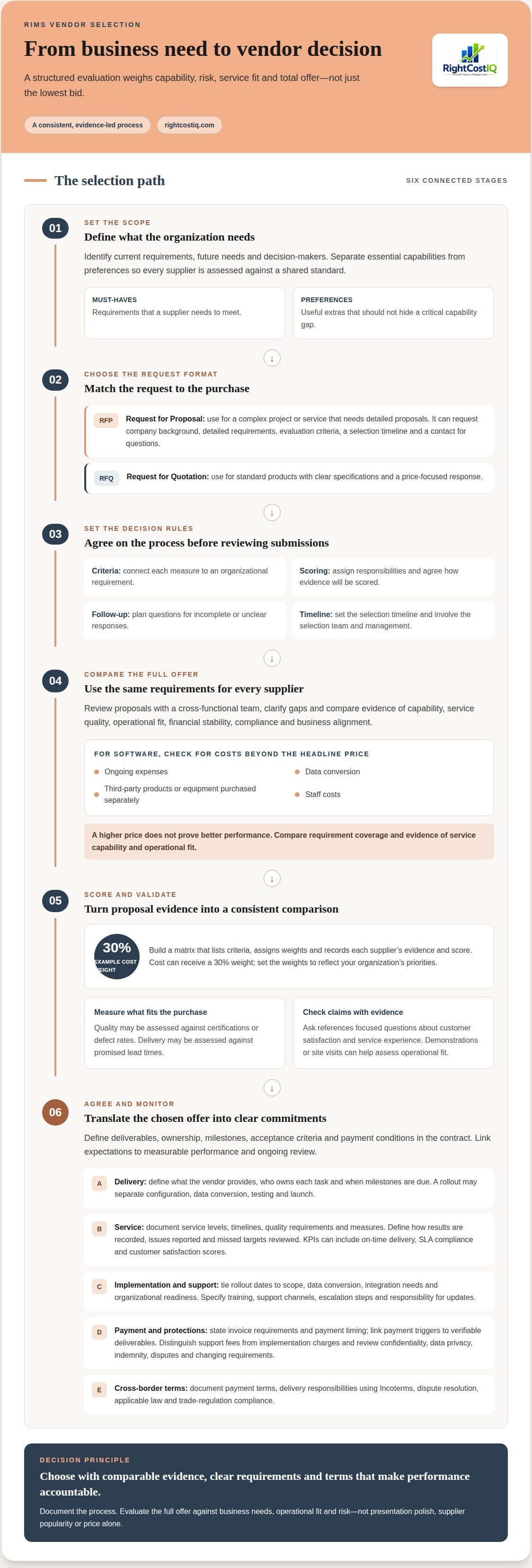
- Set the evaluation scope. Identify the organization’s current requirements, future needs, and decision-makers. Separate essential capabilities from preferences so suppliers are evaluated against a shared standard.
- Choose the request format. Use an RFP when the project or service is complex and needs detailed proposals. Use an RFQ for standard products with clear specifications and a price-focused response.
- Set a decision process. Define evaluation criteria, scoring responsibilities, follow-up questions, and the selection timeline before reviewing submissions. Include both the selection team and management in the decision.
Define Vendor Evaluation Criteria
Set criteria before inviting proposals and connect each one to an organizational requirement. Assess capability, service quality, operational fit, financial stability, compliance, and alignment with business goals. Separate must-haves from preferences; otherwise, a high score on optional features could obscure a critical capability gap.
Consider current and future needs in the same framework. For example, assess whether a supplier’s services support existing workflows and the organization’s strategic direction. Company size, popularity, and advertising are not proof of customer satisfaction or service quality.
Compare Suppliers and Proposals
Review proposals against the same requirements, using a cross-functional team to identify gaps and differences. An RFP can request company background, detailed requirements, evaluation criteria, a selection timeline, and a contact for questions. Clarify incomplete responses and compare the full offer, not just headline pricing.
Check what each quotation includes. For software, account for ongoing expenses, data conversion, separately purchased third-party products or equipment, and staff costs. A higher price does not prove better performance. Compare evidence of service capability, requirement coverage, and operational fit instead.
Build an Evaluation Matrix and Check References
Create a matrix that lists criteria, assigns weights, and records each supplier’s evidence and score. Cost can receive a 30% weight, but the organization should set weights to reflect its priorities. Score quality against certifications or defect rates, and delivery against promised lead times when those measures fit the purchase.
Use reference checks to assess customer satisfaction and service experience, not supplier popularity. Ask focused questions about the requirements under review, then compare feedback with proposal claims. Demonstrations or site visits can also help the team evaluate operational fit.
Contracts, service-level agreements, and payment terms
For a RIMS vendor, define service commitments, implementation milestones, training, support, and payment conditions in the contract. Set expectations before signing and connect them to measurable deliverables and performance measures.
- Translate requirements into contract deliverables. Specify what the vendor must provide, who owns each task, and when each milestone is due. For example, a rollout plan can identify configuration, data conversion, testing, and launch as distinct phases. Clear ownership and acceptance criteria streamline coordination and reduce disputes about completion.
- Set service-level expectations. Document the service levels, delivery timelines, quality requirements, and performance measures that matter to operations. Define how the parties will record results, report issues, and review missed targets. KPIs can include on-time delivery, service-level agreement compliance, and customer satisfaction scores.
- Make implementation and support specific. There is no single implementation timeline or training package that fits every RIMS purchase. Contract terms should tie rollout dates to scope, data conversion, integration needs, and organizational readiness. Define training audiences, delivery format, support channels, escalation steps, and responsibility for updates or future versions.
- Clarify payment terms. State payment timing, invoicing requirements, and any conditions linked to milestones or acceptance. Match payment triggers to verifiable deliverables, such as completed testing or an approved launch. For software, distinguish ongoing support fees from implementation charges, and specify whether updates or future versions carry additional charges.
- Address international supplier terms. For cross-border contracts, document payment terms, delivery responsibilities using Incoterms, dispute resolution, applicable law, and trade-regulation compliance. Assign responsibility for each delivery handoff so logistics expectations are clear. These provisions help the parties manage different operating environments without leaving critical responsibilities implicit.
- Plan negotiation priorities. Separate essential needs from preferred terms, then rank the issues for discussion. Set negotiation benchmarks, time constraints, acceptable alternatives, and a clear bottom line before entering talks. Consider the vendor’s perspective, but don’t trade away requirements that protect continuity, data, or service performance.
- Build protections into the agreement. Review confidentiality, data privacy, indemnity protections, dispute processes, and changes in requirements. Include warranty pass-through provisions where relevant, and identify who handles service failures or changing scope. These terms establish accountability and help preserve a productive vendor relationship after negotiation ends.
Organizations can evaluate vendors' ability to meet service-level agreements, delivery timelines, and quality requirements. Use that evaluation to ground discussions in the service expectations and measurable standards that matter to the organization. Contract negotiation planning should define time constraints and benchmarks. Software vendor contract negotiations should distinguish the organization’s needs from its wants. Organizations should rank their contract negotiation priorities and identify alternatives. This preparation helps teams keep essential protections in view while considering acceptable options during discussions, rather than making decisions without a clear basis for comparison.
Wheels' supplier standards include service-level agreements, warranty pass-through, indemnity protections, and data privacy guidelines. Wheels uses contractual protections and process oversight to support reliable supplier services. These examples show why it is important to consider both written safeguards and the oversight needed to support performance. When shaping terms, define service expectations, delivery, quality, and privacy requirements, and clarify priorities and alternatives before negotiation. This makes responsibilities and expectations more explicit for both parties.
Vendor compliance and risk assessment
Assess business fit, compliance exposure, and supplier risks before award. Common mistakes include choosing on price alone, overlooking delivery dependencies, and treating reputation as proof of operational control.
-
Assess Business and Vendor Requirements
Map business requirements to the vendor’s responsibilities and operational dependencies. Identify which functions rely on the RIMS vendor, what information it handles, and how a service interruption could affect the supply chain. These connections show which capabilities need closer scrutiny.
Define the requirements the vendor must meet. Consider data protection and privacy, environmental and sustainability expectations, labor and employment practices, and anti-corruption and ethical business standards. Tailor the assessment to the service and information involved. Avoid broad requirements that cannot be tied to a specific risk or evaluated consistently.
Record the evidence supporting each requirement. For example, distinguish a documented process from a general assurance in a sales presentation. Clear evidence makes supplier evaluations more consistent and helps identify gaps before they become contract issues.
-
Evaluate Compliance and Supplier Risks
Assess each supplier against applicable regulations and relevant industry standards. Focus on requirements that apply to your operations, the vendor’s service, and the data involved. A compliance statement alone may not show how controls work in practice, so examine the processes and supporting evidence.
Build a risk profile that covers financial instability, quality problems, delivery delays, compliance violations, and security breaches. Consider how each issue could affect business continuity, customer commitments, or access to essential services. A vendor management plan can record risk owners, performance expectations, compliance requirements, monitoring methods, and review points.
Treat reputation as one signal, not a substitute for assessment. Consider customer satisfaction alongside performance evidence and control processes. Schedule milestone check-ins and regular reviews after selection. Documented feedback can reveal emerging risks before a small issue disrupts supply chain operations.
-
Identify Liabilities and Selection Mistakes
Review potential liabilities before committing. Assess confidentiality, non-compete provisions, dispute resolution, and processes for changes in requirements. Identify responsibility if scope changes, information is mishandled, or service falls short. Align contract protections with the risks identified during the assessment.
Do not treat a low bid, strong reputation, or polished demonstration as proof that every critical requirement is met. Another common mistake is assigning responsibility for risks without defining how they will be monitored. Set clear owners, performance measures, and escalation paths for high-impact obligations.
Document why the selected vendor meets your requirements and how remaining risks will be managed. Ongoing supplier management should include performance reviews, feedback mechanisms, and milestone check-ins. This record supports consistent decisions and makes later changes easier to evaluate.
Vendor financial stability and service capabilities
Assess financial continuity, service delivery, geographic coverage, and technical fit before committing. Compare RIMS vendors’ integration compatibility, API requirements, and data migration approach against your existing systems and information needs.
-
Review Financial Stability
Assess whether the vendor can support your requirements throughout the expected relationship. Review available financial information, business continuity arrangements, and the vendor’s ability to maintain the services you depend on. A supplier supporting essential operations warrants closer scrutiny than one providing a replaceable, low-impact service.
Connect financial indicators to practical exposure. Consider what might happen if the vendor reduces support, changes its service model, or cannot maintain an important capability. A single financial snapshot is not a complete picture. Weigh it alongside service history, business priorities, and the vendor’s importance to your operations.
-
Assess Geographic Coverage and Service Capabilities
Map the vendor’s service coverage to the locations and teams that will use RIMS. Establish who provides implementation, training, ongoing support, and issue escalation across those locations. If your organization operates across regions, clarify service responsibilities and communication for each business unit.
Compare service capabilities with operational expectations. Review the proposed delivery model, service commitments, and ability to support required workflows. Identify gaps between the proposal and the support your teams need to implement and use the system effectively. Broad geographic reach does not guarantee consistent service at every location.
- Test integration fit. List the systems RIMS must exchange information with, then document the required data flows. Compare each vendor’s stated integrations with those systems and workflows. For API-based connections, define the information exchanged, its direction, and the business process it supports. Ask the evaluation team to record constraints, dependencies, and any manual work needed.
Test a realistic scenario, such as transferring a supplier record or updating an operational status. This can reveal differences that a feature list may hide. Establish who owns configuration and testing, and include those responsibilities in the implementation plan.
- Assess data migration and implementation readiness. Identify the source data, its condition, and the records needed for launch. Compare each vendor’s migration approach, including data mapping, validation, exception handling, and responsibility for resolving errors. A clear process explains how teams will reconcile migrated records with source information before relying on RIMS.
Connect migration work to training and support expectations. Determine which teams need to learn new workflows, what guidance they need, and how questions will be handled during rollout. This helps establish whether the vendor’s capabilities match your organization’s readiness and implementation requirements.
Vendor selection in direct and indirect procurement
Use a consistent vendor selection process, tailoring its criteria to the procurement category and business impact. Direct purchases can affect production or service delivery; indirect purchases support operations through areas such as software, facilities, or professional services.
- Classify the requirement. Identify whether the purchase supports production directly or enables broader operations. For a direct input, assess its effect on product quality, availability, and continuity. For an indirect service, assess user needs, process efficiency, and business support. This distinction determines which requirements carry the greatest weight.
- Scale the process to the decision. A simple vendor selection process typically takes 2-4 weeks. Enterprise software or strategic partnerships typically take 3-6 months. Use the longer planning horizon when stakeholders, system dependencies, or long-term operational effects require deeper evaluation. Set milestones for requirements, proposals, approval, negotiation, and onboarding.
- Choose the right market engagement. Use an RFI during early market research to gather general supplier information. Once requirements are clearer, use an RFP for complex projects or services requiring detailed proposals. For standard products with clear specifications, an RFQ focuses supplier responses on price. Match the request to the complexity of the purchase.
- Research and shortlist suppliers. Build a candidate pool using industry directories, referrals, trade shows, online searches, and business publications. Then shortlist suppliers against category-specific requirements. For direct procurement, test production fit and delivery capability. For indirect procurement, evaluate user adoption, integration needs, and service support. Record why each candidate advances.
- Coordinate evaluation across functions. Include procurement, operational teams, finance, and technical stakeholders where their input affects the decision. A direct material may require quality and production review; indirect software may require IT and end-user input. Evaluate proposals against shared criteria, then document trade-offs and approval rationale. This keeps category expertise connected to commercial decisions.
- Make onboarding part of selection. Plan vendor profiles, payment methods and terms, portal access, and order processes before award. Direct suppliers may need clear ordering formats and delivery coordination. Indirect providers may need defined access to relevant tools and user workflows. Treat onboarding readiness as a selection consideration, not an administrative task after contracting.
- Track category outcomes. Set performance expectations that match the purchase. Direct procurement may emphasize delivery and quality; indirect procurement may focus on service levels and user requirements. Review results against agreed KPIs and use category cost benchmarking to interpret pricing in context. Benchmark procurement category costs to support a more evidence-based comparison.
Organize the process around clear handoffs so category-specific requirements remain visible through award and onboarding. Structure supplier selection around needs identification, supplier research and shortlisting, proposal evaluation and selection, and negotiation and contracting. This carries the requirements set at the start through to the final agreement.
Generative AI in procurement can reduce the time needed to identify suitable suppliers by 90% or more. Automation can streamline RFP distribution and collaboration, helping teams coordinate requests and review proposals. These tools can support the workflow, while category-specific judgment and documented approval rationale guide the final choice. Keep the criteria consistent across evaluation so that trade-offs remain clear through negotiation and contracting.
RightCostIQ: Procurement and Vendor Performance Tracking Service
RightCostIQ supports procurement decisions with Request For Proposal (RFP) Management and Negotiation Assistance, cost benchmarking, and vendor performance tracking. Use these services when proposal comparisons need stronger cost context, negotiation priorities need structure, or supplier performance requires ongoing measurement.
For cost exposure, RightCostIQ’s Price Risk Management and Tracking and Market Price Trending and Forecasting services can inform procurement planning. Vendor performance tracking helps assess results against defined expectations after selection, connecting supplier oversight to operational goals.
Contact RightCostIQ to discuss your procurement and vendor evaluation needs.
Turn the Selection Decision Into Ongoing Value
Strong RIMS vendor selection does not end when an agreement is signed. Treat the decision as the foundation for ongoing procurement governance: keep ownership clear, connect supplier performance to business priorities, and revisit requirements when operations or sourcing conditions change. This discipline helps teams respond to emerging issues instead of letting the original evaluation become a static record.
RightCostIQ supports this work through Request For Proposal (RFP) Management and Negotiation Assistance, Procurement Category Cost benchmarking and Analytics, and Procurement and Vendor Performance Tracking Service. These offerings bring proposal evaluation, cost context, and supplier oversight into a more consistent procurement approach.
To discuss your vendor selection priorities and next steps, contact RightCostIQ about your procurement needs. A clear decision framework can give your team a stronger basis for action and continuous improvement.


