

An employee benefits RFP is a decision framework, not a price-only contest. The employee benefits RFP process typically includes one RFP from the employer to potential brokers, followed by a second set from the selected broker to potential providers. It defines the services required and helps compare proposals across administration, technology, analytics, costs, and ongoing support.
Cost matters, but a proposal also needs to show how its systems, reporting, and service model fit your organization’s needs. This guide explains what to include in the RFP, how to assess broker experience and provider responses, and how to set evaluation criteria before proposals arrive. It also covers cost control, technology integration, implementation, and the records that support a clear selection decision. The result is a structured way to compare options and connect benefits strategy with operational requirements.
Key Takeaways
- Build broker questions around your organization’s goals, then assess relevant experience, account-team responsibilities, and comparable client references.
- Set the RFP schedule around proposal review, selection, implementation, and renewal milestones so the transition has room for evaluation and testing.
- Keep a clear record of requirements, scoring, proposal decisions, and final agreements to support a consistent, traceable selection.
- Define administration scope in practical terms, including service responsibilities, compliance needs, technology integration, reporting, and ongoing support.
- Compare technology and cost-control proposals using measurable criteria, including analytics, user experience, and the value of each service component.
1. Questions about broker experience and account teams
What questions should employers ask benefits brokers and administrators in an RFP? Ask about relevant experience, assigned team members, service responsibilities, communication, technology, and performance measurement. Request specific examples that show how each vendor’s capabilities match your organization’s needs.
Tailor the questionnaire to your workforce, goals, and decision-making needs instead of sending a generic template. For example, if consistent employee education is a priority, ask how the broker supports communications during enrollment and throughout the plan year. If administration is the focus, ask how the administrator handles eligibility updates, reporting, and issue escalation.
Ask questions that reveal who will do the work, not just what the firm says it can do:
- Which account team members will lead strategy, routine communication, renewals, and escalations?
- What relevant experience does each proposed team member have with organizations of comparable size and complexity?
- How will the broker coordinate with benefits administrators, providers, and internal HR and procurement teams?
- What is the process for tracking open issues, assigning owners, and reporting resolution status?
- How does the administrator support employee education, enrollment communications, and routine service requests?
Ask each broker for two client references that reflect your organization’s size and complexity. Request examples of the work those teams performed, such as renewal planning, implementation coordination, or improved response workflows. Use the same prompts for every reference so the answers support a fair comparison.
Assess vendor capabilities with evidence-based questions. Instead of asking whether a broker offers strong analytics, request a sample report and ask how it supports a renewal or cost-control decision. For technology, ask how data moves between systems, what reports administrators can produce, and how users access support. Specific questions encourage comparable answers instead of broad claims.
Keep the RFP language direct. Define terms such as “account management,” identify the service period under review, and distinguish broker responsibilities from administrator responsibilities. A question about communication, for instance, should specify whether it concerns employer updates, employee education, or both. Link structured RFP requirements to the outcomes you plan to evaluate.
Set the review method before proposals arrive. HR should help define requirements and participate in scoring and broker selection, while procurement coordinates RFP development, vendor communication, and negotiation. This gives the employee benefits RFP process a consistent basis for comparing experience, service delivery, and team accountability.
2. When should you consider a new broker or providers?
Review an existing broker or provider when service performance, technology, costs, or business needs have changed. Employers often consider a market review after three to five years without one, and broker RFPs are also run every 2–3 years or after a significant business change. A renewal, acquisition, workforce shift, or persistent service issue can prompt an earlier assessment.
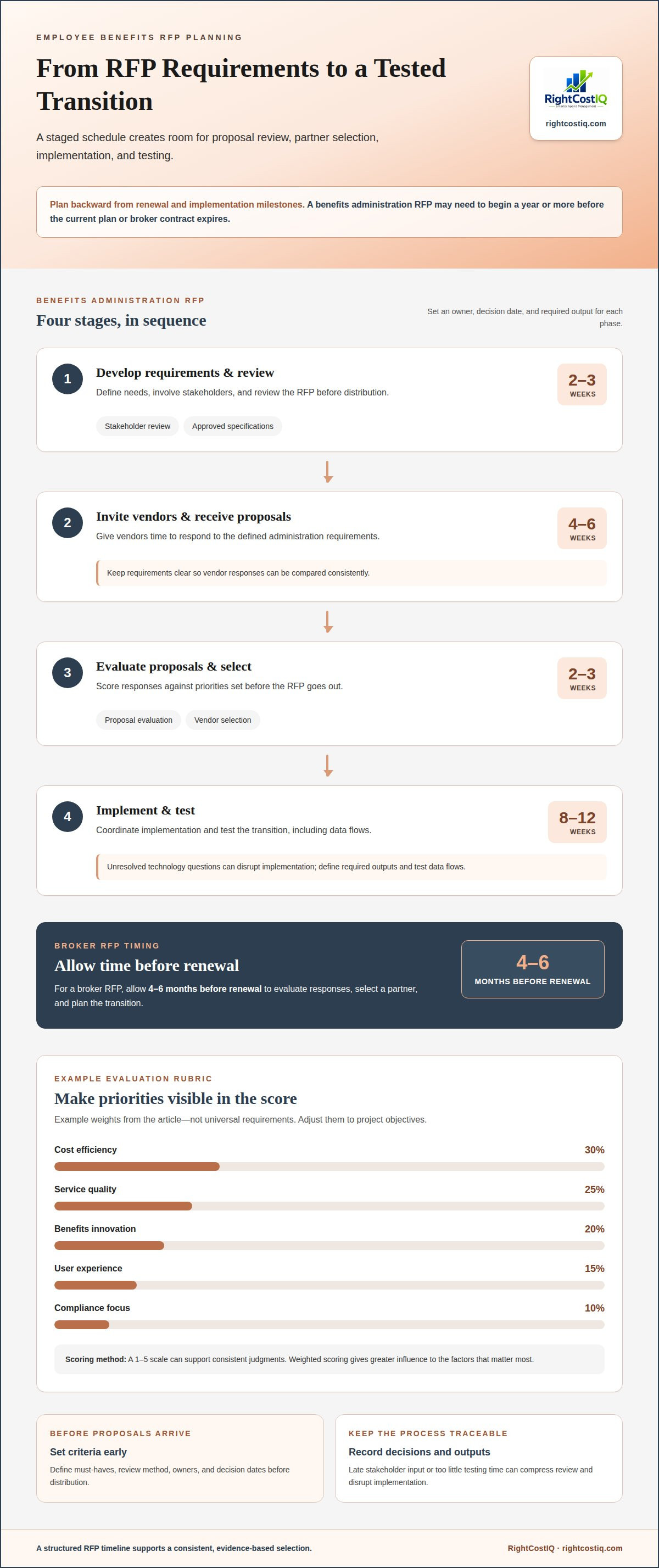
Build the schedule backward from renewal and implementation milestones. A benefits administration RFP may need a year or more before the current plan or broker contract expires. For a broker RFP, allow 4–6 months before renewal to evaluate responses, select a partner, and plan the transition.
- Allow 2-3 weeks for RFP development and stakeholder review.
- Give vendors 4-6 weeks to submit benefits administration proposals.
- Set aside 2-3 weeks for proposal evaluation and vendor selection.
- Plan 8-12 weeks for implementation and testing.
These phases require coordination. Delayed requirements can compress the review, while unresolved technology questions can disrupt implementation. Assign each phase an owner and decision date, and define its required output, such as approved specifications or tested data flows.
What federal and state laws affect employee benefits RFP requirements and vendor selection? In the United States, relevant federal frameworks can include the Affordable Care Act (ACA), HIPAA, ERISA, privacy rules, and COBRA. Identify which requirements apply to the plans and services in scope, and account for applicable state requirements where employees are covered.
Common risks include vague requirements, late stakeholder input, criteria created after proposals arrive, and timelines that leave too little time for testing. Reduce these risks by defining must-have criteria before distribution and involving HR, procurement, legal, information services, and finance early. Clear requirements make vendor responses easier to compare.
Score proposals against priorities established before the RFP goes out. A 1–5 scale for each category can help reviewers apply consistent judgments, while weighted scoring gives greater influence to the factors that matter most. One example rubric assigns cost efficiency 30%, service quality 25%, benefits innovation 20%, user experience 15%, and compliance focus 10%. These are example weights, not universal requirements; adjust them to the project’s objectives.
For broker evaluation, score relevant experience, account-team capability, communication, service model, and support for wellness or employee education. For providers, assess administration capacity, reporting, technology integration, security, and implementation approach. If employee experience is the leading objective, an example assigns 30% of the total score to user interface and decision-support features. Evaluate demonstrations against actual workflows, such as enrollment changes and report access, rather than presentation quality alone.
3. Archiving selection materials and broker agreements
A defensible selection record shows how the employer moved from requirements to a signed agreement. Create a controlled file for each benefits RFP, with a consistent naming convention, access permissions, and an index. For example, label the project by plan year and procurement category, such as “Health Insurance Renewal,” so HR and procurement can find the same decision record.
Archive the materials that shaped the outcome, not just the winning proposal. Keep the issued RFP, amendments, vendor questions and answers, submitted responses, evaluation criteria, completed scorecards, and approval records together. This document trail lets reviewers connect each requirement to a vendor response, score, and final selection rationale.
Organize the archive into practical folders or labeled sections:
- Requirements: Store the approved scope, service specifications, and stakeholder sign-off.
- Communications: Retain RFP distribution records, vendor questions, shared answers, and meeting notes.
- Proposals: Preserve each vendor’s submitted response and any formally requested clarification.
- Evaluation: File the scoring model, individual scorecards, consensus notes, and approval record.
- Contracting: Keep the executed broker agreement, schedules, amendments, and related service documents.
Use version control for every revised RFP or scorecard. A date and version label distinguish original requirements from later clarifications, while a change log records what changed and who approved it. Save any clarification sent to all vendors in the project record. This supports consistent evaluation and prevents outdated documents from influencing the decision.
Review the broker agreement against the selected proposal before signing. Match promised services to written responsibilities, including account-team roles, communication processes, reporting, renewal support, and issue escalation. If the proposal describes strategic planning but the agreement covers only routine servicing, resolve that scope difference in the contract documents. The agreement should identify expected deliverables and explain how changes will be documented.
Keep provider agreements separate from the broker contract. A health insurance carrier’s plan documents, administrative terms, and service commitments may have different owners and approval paths. Cross-reference related files by plan year and vendor name, but keep each executed agreement as its own authoritative record. This helps HR, finance, and procurement identify the responsible party without confusing broker duties with provider obligations.
Set access and retention controls with the appropriate records, legal, and information services teams. Limit sensitive employee or client information to authorized users, and use approved storage rather than personal inboxes or shared desktop folders. Define how records are transferred when staff change roles, and document the archive owner and review date. A complete selection file gives future teams a strategic baseline for renewal planning, service monitoring, and the next procurement cycle.
4. Benefits administration RFP purpose and scope
A benefits administration request for proposal is a formal document used to solicit service proposals from vendors. It translates an organization’s goals into requirements vendors can answer and evaluators can compare. For example, if reducing manual enrollment work is a priority, describe the relevant workflows and expected administrative support in the RFP.
Before drafting, define the project objectives and document them in a business requirements document. HR can outline employee and plan needs, while procurement captures sourcing requirements and decision criteria. Finance can identify reporting needs, and information services can describe integration considerations. These inputs help distinguish essential capabilities from optional recommendations.
State the scope precisely. A benefits administration RFP may cover:
- Service responsibilities: Define which tasks the vendor performs, such as enrollment administration, eligibility processing, or employee support.
- Technology integration: Identify systems and data exchanges that the solution must support, including payroll or HR platforms.
- Reporting: Describe the reports, data fields, delivery formats, and business decisions they need to support.
- Compliance and privacy: Specify applicable requirements and the security practices vendors must address in their responses.
- Ongoing support: Set out communication channels, escalation procedures, service expectations, and support for employees.
Separate administration requirements from broker responsibilities. For instance, a broker may advise on benefits strategy and renewals, while an administrator handles defined enrollment workflows. If both roles are part of one procurement, identify the accountable party for each requirement. This prevents proposals from seeming comparable when vendors have priced or interpreted different scopes.
Write requirements as observable outcomes rather than broad aspirations. Replace “provide excellent support” with a description of the support channels, request types, and reporting needed. Replace “integrate with existing systems” with the systems involved and expected data exchanges. Clear language reduces ambiguity and gives vendors a consistent basis for proposing their approach.
Use the RFP to test operational fit, not just feature availability. Ask vendors to explain how a new hire’s eligibility information moves from the HR system into benefits enrollment and how they handle exceptions. For reporting, request an example showing how administrators can review enrollment activity or service issues. These scenarios reveal whether a proposed partner’s processes fit actual organizational needs.
Close the scope by defining deliverables and boundaries. Identify implementation outputs, testing responsibilities, training materials, reporting handoffs, and ongoing service documentation. State what the selected vendor will own and what remains with HR, finance, or information services. A well-defined scope gives reviewers a shared baseline and a practical reference for contracting and later performance reviews.
5. Technology, analytics, and cost control
Evaluate technology as part of service delivery, not as a feature checklist. Trace a benefits transaction from employee selection through eligibility updates, payroll handoff, and reporting. Ask each provider to demonstrate the workflow using a representative scenario, such as an employee changing coverage after a qualifying life event. This shows how systems, data, and support processes connect in practice.
Assess the data behind each platform. Ask what reports decision-makers can access, how often information is refreshed, and whether HR can filter results by plan or employee group. A dashboard is useful only when its data supports a defined action. For example, enrollment trends can inform communications planning, while recurring service requests may reveal process friction affecting employee engagement.
During demonstrations, compare vendors against the same use cases:
- Show how an eligibility change moves between the HR platform and benefits administration system.
- Explain how users identify missing or inconsistent enrollment data.
- Demonstrate the reports available to HR, finance, and procurement.
- Describe employee access to plan information and decision-support tools.
- Outline how system changes, support requests, and reporting issues are tracked.
Cost control involves more than comparing headline fees. Request a consistent breakdown of included services, implementation work, technology components, ongoing support, and separately charged activities. Match each cost item to a defined deliverable. If one proposal bundles reporting and another lists it separately, normalize the comparison before scoring. This clarifies scope and reduces the risk of choosing a proposal that appears less expensive only because it excludes required work.
What are typical employee benefits broker and administration fees in the United States? Fees vary with the contracted scope, enrollment and service requirements, implementation responsibilities, technology needs, reporting, and support model. Request itemized proposals that separate broker compensation from administration charges, then compare equivalent deliverables and contract terms.
Ask shortlisted brokers for a sample renewal or cost-control strategy. Examine the assumptions, data inputs, recommendations, and follow-through measures. A useful analysis connects recommendations to the underlying plan or vendor data and explains how results will be tracked. Procurement category cost benchmarking and analytics can support this evaluation by providing a clearer basis for comparing cost components and market pricing.
Set performance measures before selection. For example, define which reports support renewal decisions, how service issues are categorized, and how vendor performance is reviewed. Use those measures to connect proposal claims with ongoing oversight. Assess benefit cost benchmarks to strengthen proposal comparisons and identify where further analysis can sharpen cost decisions.
RightCostIQ
RightCostIQ supports procurement teams seeking structured RFP execution, comparable cost insight, and clear vendor oversight. Its Request For Proposal (RFP) Management and Negotiation Assistance helps organize sourcing and negotiation activities, while Procurement Category Cost benchmarking and Analytics supports analysis of cost components. Procurement and Vendor Performance Tracking Service and Price Risk Management and Tracking Service can help with ongoing oversight after selection.
Consider this support when an upcoming benefits procurement needs a consistent evaluation framework, clearer cost comparisons, or stronger links between selection criteria and vendor performance. It can help procurement teams make decisions based on defined requirements, analysis, and documented performance measures.
Contact RightCostIQ to discuss your procurement objectives and RFP requirements.
Turn the RFP decision into a procurement advantage
Treat benefits sourcing as an ongoing decision discipline, not a document exercise that ends at award. A clear rationale for the selected partner gives leaders a reference point for future planning, while defined ownership keeps procurement, HR, and finance aligned as priorities change. This can make the next employee benefits RFP process more focused by carrying forward the decision logic, not just the final contract.
RightCostIQ can support teams preparing a benefits sourcing decision with structured procurement assistance. If you’re ready to define the next step for your RFP, discuss your procurement objectives with RightCostIQ. A focused conversation can help your team move forward with greater clarity and purpose.
Frequently Asked Questions
What is a benefits RFP?
A benefits RFP is a procurement tool for inviting proposals against a defined benefits need. It helps employers distinguish broker advice from administration services, which may involve separate vendors and contracts. For example, an employer can assess a broker’s renewal strategy separately from an administrator’s enrollment workflows. That distinction clarifies who owns each responsibility and helps decision-makers compare relevant capabilities rather than broad claims.
What happens after the RFP?
After selecting a preferred proposal, the employer resolves open commercial and service terms, then finalizes the agreement. The transition plan should identify who transfers required data, configures systems, tests workflows, and communicates changes to employees. For example, HR can track whether a sample eligibility change appears correctly in the administration system before launch. Once services begin, performance measures and issue records provide a basis for managing the relationship.
When should you consider a new broker or providers?
Consider a market review when service, technology, cost transparency, or organizational needs no longer align. Employers may review the market after three to five years without doing so, run broker RFPs every 2–3 years, or begin sooner after a significant business change. A merger, workforce shift, repeated service breakdown, or renewal proposal that misses current priorities can signal that existing arrangements need reassessment.
Who runs the process?
HR and procurement should jointly manage the process, with clearly assigned decision rights. HR defines workforce and plan needs and contributes to broker evaluation; procurement coordinates the sourcing process, vendor communication, and negotiation. Legal, finance, and information services can contribute focused reviews. For example, finance can assess reporting requirements while information services evaluates system dependencies. A named project lead then consolidates decisions and maintains the schedule.
What is an employee benefits RFP and when should employers use one?
An employee benefits RFP invites brokers or service providers to respond to documented organizational needs. Use one when an employer wants structured market input, is reconsidering its current arrangement, or needs proposals that address changed priorities. The employer issues an RFP to potential brokers; a broker may then solicit proposals from potential providers. That sequence separates broker selection from provider evaluation and clarifies each stage’s purpose.
What information should an employee benefits RFP include?
Include the services sought, current workflows, organizational objectives, system requirements, reporting needs, support expectations, and evaluation method. Clarify which responsibilities belong to a broker and which belong to an administrator. For example, specify whether a vendor must support enrollment communications, eligibility administration, or both. Describe the required proposal format and response deadline so vendors address the same scope and reviewers can assess equivalent information.
What are the steps and typical timeline for an employee benefits RFP process?
A typical employee benefits RFP process moves from requirements and stakeholder review to vendor proposals, evaluation, selection, implementation, and testing. A sample benefits administration schedule allocates 2-3 weeks to development and review, 4-6 weeks for vendor responses, 2-3 weeks for evaluation and selection, and 8-12 weeks for implementation and testing. Work backward from renewal so decisions and system preparation align.
How do employers define requirements and evaluate benefits vendors in an RFP?
Start by converting business objectives into specific service, technology, reporting, and support requirements. Separate must-haves from preferences, then establish scoring criteria before proposals arrive. Evaluate each response against the same use cases, such as how an enrollment change moves through connected systems or how a report supports a decision. Reviewers should record the evidence behind their scores rather than rely only on presentation quality or headline pricing.


