
A disciplined RFP process makes procurement decisions clearer and proposals easier to compare. This RFP consulting FAQ explains how consulting support can bring structure to requirements, team responsibilities, supplier research, proponent communications, and proposal evaluation.
An RFP should do more than collect proposals. When the scope is unclear or evaluation criteria are misaligned, responses can be hard to compare and decisions harder to justify. A structured process links the business need to the deliverables, assessment criteria, and final selection.
The steps ahead show how to define scope around outcomes, assemble the right internal team, and research the market. You’ll also learn how to communicate clearly with proponents and assess proposals for expertise, approach, delivery capability, and value, rather than relying on price alone.
Key Takeaways
- Define the business outcome, scope, and deliverables before inviting proposals so consultants can respond to a clear need.
- Bring procurement, project leaders, department heads, and executives into the process with clear decision-making roles.
- Use market research and consistent communication to shape the supplier field and support proponents through the process.
- Set evaluation criteria in advance, then compare proposals on expertise, approach, delivery capability, and overall value.
- Use RFP management and negotiation support when you need a structured process from requirements through proposal evaluation.
RFP research, proponent support, and proposal evaluation
Coordinate market research, proponent communication, and proposal review so every response addresses the same procurement need. This RFP consulting FAQ section covers practical controls that make the selection process easier to manage.
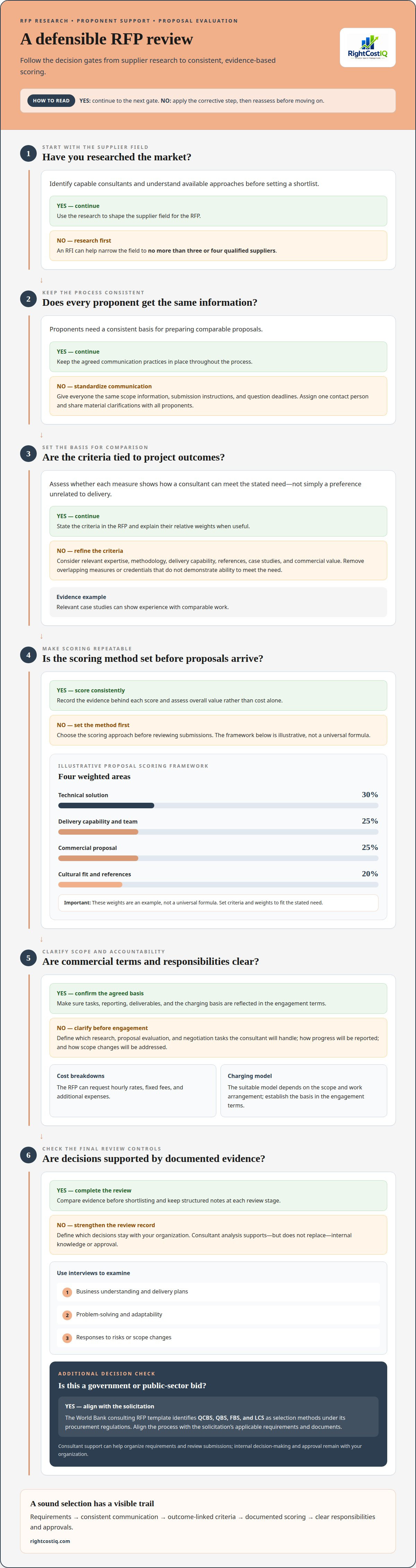
- Research the market and manage proponent communication. Identify capable consultants and understand available approaches before setting a shortlist. An RFI can help narrow the field for an RFP to no more than three or four qualified suppliers. Give every proponent the same scope information, submission instructions, and question deadlines. Assign one contact person and share material clarifications with all proponents. This reduces mismatched assumptions and gives suppliers a consistent basis for preparing proposals.
-
Choose Evaluation Criteria
Choose criteria that measure project outcomes, not preferences unrelated to delivery. Assess relevant expertise, methodology, delivery capability, references, case studies, and commercial value. State the criteria in the request for proposal, and explain their relative weights when useful. Avoid overlapping measures or credentials that don’t demonstrate how a consultant can meet the stated need. For instance, relevant case studies can show experience with comparable work.
-
Score Proposals
Set the scoring method before proposals arrive, then apply it consistently. One illustrative framework assigns 30% to the technical solution, 25% to delivery capability and team, 25% to the commercial proposal, and 20% to cultural fit and references. Treat these weights as an example, not a universal formula. Record the evidence behind each score, and assess value rather than cost alone. An RFP consulting FAQ can explain why documented rationale matters when scores differ.
- Clarify commercial terms and consultant fit. The RFP can request cost breakdowns, including hourly rates, fixed fees, and additional expenses. Before engaging a consultant, clarify which research, proposal evaluation, and negotiation tasks they will handle, how progress will be reported, and how scope changes will be addressed. These questions define responsibilities and deliverables. The suitable charging model depends on the scope and work arrangement, so establish the basis in the engagement terms.
-
Assess Risks and Bid Support
Define which decisions remain with your organization; consultant analysis does not replace internal knowledge or approval. RFP consultants can help organize requirements and review submissions for government and public-sector bids. The World Bank consulting RFP template identifies QCBS, QBS, FBS, and LCS as selection methods under its procurement regulations. Align your process with the solicitation’s applicable requirements and documents.
Capture structured notes at each review stage, then compare evidence before shortlisting. Interviews can assess business understanding, delivery plans, problem-solving, adaptability, and responses to risks or scope changes. For support managing this work, Request for Proposal management can help organize research, proponent communication, and evaluation.
How do I start the RFP consulting process with your team?
Start with the business decision, then build a documented selection process and timeline around it. Clear stages support transparency, realistic proposal preparation, and decisions connected to the project’s objectives.
- Define the project starting point. Bring the current scope, business objective, known constraints, and desired decision date to the kickoff. Identify the executive sponsor and the people who will approve the final selection. For example, if a CEO presentation is planned in eight weeks, work backward from that date through research, document approval, supplier responses, evaluation, and internal sign-off.
-
Set the Selection Process
Map each RFP process stage before drafting the request. Assign an owner for market research, document preparation, proponent questions, evaluation, and approval. Record how proposals will be received, who can access them, and how decisions will be documented. A clear process reduces inconsistent communication and gives stakeholders a shared view of responsibilities, decision points, and selection criteria.
-
Set the Timeline
Build the schedule backward from the required start date or executive decision. Include time for scope review, internal approvals, proposal preparation, questions, evaluation, interviews, and contracting. Give consultants a reasonable amount of time to prepare proposals. A complex RFP may require a timeline of four to six weeks, while a separate planning example describes a 12-week consulting project with a key CEO presentation scheduled in eight weeks. Treat these as planning examples, not fixed durations.
- Document governance and communication practices. Set a central contact for questions and define how answers will be shared with all proponents. Publish submission instructions, deadlines, required proposal sections, and the preferred format in the RFP document. For example, if stakeholders request a scope change after release, route it through an agreed approval process and issue the same update to every invited consultant. This supports transparency and keeps proposals comparable.
- Launch with decision controls in place. Confirm that the approved scope, timeline, communication plan, and evaluation method match before sending the request. Schedule review sessions around the proposal deadline, and reserve time for clarifications and stakeholder alignment. A structured RFP process helps the team trace each decision to documented requirements instead of informal preferences. A defined brief and decision path provide a practical foundation for RFP process management.
Definition and purpose of a consulting RFP
Use a consulting request for proposal to invite defined responses to a specific business need. The document helps procurement teams explain the work, compare approaches, and select a supplier against stated criteria.
- Define the decision the RFP must support. Start with the business problem, then explain why external consulting support is needed. For example, a company reviewing supplier performance could describe the decision it needs to make and the information it requires. This context helps consultants prepare relevant responses instead of guessing at the underlying objective. Tie the purpose to a business decision to keep drafting and evaluation focused.
- Describe the project and its boundaries. State the scope, objectives, requirements, and expected work directly. Identify the functions, processes, or locations involved when those details matter. Separate required outcomes from optional ideas, and distinguish included work from adjacent work. For example, a procurement analysis might seek category insights, while implementation remains outside the defined scope. Clear boundaries help make proposals comparable.
- Build the document around a complete response. Include an introduction and background, scope of work, project timeline, evaluation criteria, submission guidelines, budget considerations, and terms and conditions. Explain how proponents should organize their responses, including required sections, submission deadline, contact details, and preferred format. A consistent structure makes omissions easier to spot and allows evaluators to compare proposals against the same information, rather than interpreting different formats.
- Explain how procurement will assess submissions. Name the evaluation criteria before issuing the RFP, and connect each criterion to the project’s objectives. Criteria may cover relevant expertise, methodology, delivery capability, references, and commercial value. State relative weights when you want proponents to understand each criterion’s importance. Avoid criteria that do not affect project success. For example, a polished presentation should not outweigh a weak response to a core requirement.
- Use the RFP to structure a fair selection. Give every invited consultant the same project information, instructions, and opportunity to ask questions. Set a contact person and communicate material clarifications consistently. The RFP then serves as a shared reference during proposal review, interviews, and selection. It also records what the organization requested and how it reached its decision. This structure supports procurement transparency without prescribing a particular consulting methodology.
Specifying deliverables and requirements
Translate the organization’s business need into outputs consultants can understand, propose against, and deliver. A precise scope connects each requirement to an intended result.
- Describe the outcome before prescribing the work. State the business problem and what success should look like 12 months after the contract is awarded. For example, if the organization needs clearer supplier performance insight, name the decision that insight should support. Focus the RFP on what the organization needs, rather than prescribing the consultant’s methodology. This gives proponents room to propose an approach while keeping responses tied to the intended result.
- Turn the outcome into defined deliverables. For each output, identify its purpose, format, intended audience, and use. A procurement assessment might require an analysis, findings presentation, and prioritized recommendations. Explain what each item should help the organization decide or do. Avoid labels such as “report” without describing the expected content, since proponents may interpret that deliverable differently.
- Separate requirements from preferences. Mark essential capabilities or outputs and distinguish them from options that could add value. For example, an organization may need recommendations supported by supplier data, while leaving a particular analytical method open to the consultant’s proposal. This helps proponents identify mandatory needs and explain alternatives. It also gives evaluators a clearer basis for reviewing responses without treating every preference as a pass-or-fail condition.
- Make scope boundaries explicit. Identify relevant business units, processes, data inputs, and exclusions when they affect the work. If an engagement covers analysis but not implementation, state that directly. Describe dependencies the consultant should account for, such as access to internal stakeholders or existing procurement records. These details help proposals address the same operating context and reduce mismatched assumptions about responsibilities.
- Connect requirements to evidence and acceptance. For each deliverable, specify how the organization will determine whether it meets the agreed need. For example, a findings presentation could be required to address defined questions and support each recommendation with analysis. Align evaluation criteria with these outputs, and include relevant requirements in the RFP’s scope, timeline, and submission instructions. Specific requirements reduce ambiguity that can lead to vague proposals and misalignment.
Assembling the RFP project team
Assign ownership before drafting the RFP. A cross-functional team brings business requirements, procurement discipline, and delivery knowledge together.
- Name an executive sponsor. Select a senior leader who can confirm the project’s strategic purpose and resolve competing priorities. For example, a procurement initiative may affect finance, operations, and regional teams. The sponsor connects the RFP to organizational goals and supports timely decisions when stakeholders disagree. Define the sponsor’s approval role early so the team knows who can authorize scope changes or endorse the final recommendation.
- Assign a project manager. Give one person responsibility for coordinating the RFP schedule, meetings, inputs, and decision records. The project manager should track dependencies between drafting, internal review, supplier communication, evaluation, and approvals. For example, they can maintain a decision log listing the issue, owner, resolution, and impact on scope. This role helps prevent unresolved questions from surfacing only after proposals arrive.
- Include procurement and subject-matter leads. Procurement can manage the sourcing process, submission controls, and consistent communication. Department heads and technical specialists should define operational requirements and assess whether proposed approaches fit the work. If a project affects several business functions, invite a representative from each. Each representative should contribute within defined responsibilities, rather than introducing unrelated preferences during evaluation.
- Agree on decision rights and evaluation roles. Identify who provides evidence, who scores proposals, and who approves the selection. Match evaluators to the criteria they can assess: technical leads review methodology, procurement reviews commercial responses, and business owners assess delivery fit. Use the same criteria and scoring guidance across the team. Record individual assessments before group discussion so consensus reflects evidence, not the first opinion voiced.
- Set a working rhythm for the team. Schedule checkpoints around key project decisions, including scope approval, RFP release, evaluation, and final selection. Use each meeting to resolve a defined question, assign follow-up ownership, and update the decision record. For example, a scope review should confirm that requirements, deliverables, and evaluation criteria align. A clear process helps the team find gaps before they affect proposal review.
- Keep accountability visible through selection. Share a responsibility map that names each role and its decision boundary. If a department head supplies requirements but does not approve the award, make that distinction explicit. This avoids conflicting instructions to proponents and helps the project team maintain a traceable evaluation. To organize the workflow, use RFP project management resources as a practical next step.
RightCostIQ
RightCostIQ helps organizations structure RFP activity and strengthen procurement decisions with data and defined evaluation processes. Its Request For Proposal (RFP) Management and Negotiation Assistance supports planning, proposal review, and negotiation. Procurement Category Cost benchmarking and Analytics adds market context to sourcing decisions, while Procurement and Vendor Performance Tracking Service supports ongoing supplier oversight. Price Risk Management and Tracking Service helps organizations monitor price exposure as part of procurement planning.
Turn to RightCostIQ when your team needs support defining an RFP approach, evaluating proposals, or connecting sourcing decisions with cost and supplier performance insights. The scope should reflect your procurement challenge and the decisions your organization needs to make. Contact RightCostIQ to discuss your RFP and procurement priorities.
Make your next sourcing decision more deliberate
The next step is to make your RFP plan a decision system your team can use beyond one sourcing event. Connect defined requirements with the commercial evidence you gather and the supplier performance you need to manage. This alignment keeps procurement decisions anchored to business priorities instead of treating proposal selection as an isolated task.
This RFP consulting FAQ offers a starting point for deciding where structured support fits. RightCostIQ combines RFP management and negotiation assistance with procurement cost benchmarking, analytics, and vendor performance tracking. These services help teams connect proposal decisions with broader cost and supplier considerations.
Bring your current RFP challenge, goals, and key constraints into the next discussion. Contact RightCostIQ to discuss your RFP and identify a practical next step for your procurement process.
Frequently Asked Questions
Why should I consider RFP Consulting Services?
Consider RFP consulting when internal teams need procurement structure, market insight, or support evaluating proposals. For example, a sourcing team managing a complex category may need help aligning business requirements with supplier responses and commercial analysis. A consultant can organize the process and surface decision-relevant information. The right level of support depends on the work: a straightforward purchase with clear requirements may not need the same approach as a cross-functional sourcing initiative.
What is an RFI, and how does it differ from an RFP?
An RFI gathers information about potential solutions or supplier capabilities; an RFP asks proponents to submit proposals for a defined need. Use an RFI when the organization is still exploring the market or refining its options. Use an RFP when it can explain what it needs and wants comparable proposals. For example, an RFI can reveal service approaches before the organization prepares a detailed sourcing request.
Can you help with writing proposals in response to RFQs or RFPs?
RFP consulting generally supports the organization issuing and managing a request, rather than writing a supplier’s bid. If you’re responding to an RFQ or RFP, structure your proposal around the solicitation’s requested sections, requirements, and submission instructions. For example, map each requirement to a direct response and supporting evidence. RightCostIQ supports procurement-side RFP management and negotiation, helping organizations run their sourcing process.
How should you structure your RFP process?
Structure the process around decision gates: define the need, prepare and approve the solicitation, manage supplier questions, assess submissions, and document the selection. Assign an owner to each gate and keep decisions in a shared record. For example, log a requested scope change, its approver, and the communication sent to proponents. This creates traceability and helps the team see whether delays or decisions affect later evaluation activities.
What does an RFP for consulting look like?
A consulting RFP is a working document that tells firms what problem the organization wants addressed and what information to include in their proposals. It may include organizational context, project objectives, requested services, timing, selection approach, and response instructions. For example, a company seeking procurement analysis could explain its business question and ask firms to describe relevant experience and proposed outputs.
What are the key components of an RFP?
Core components commonly include background, project objectives, scope, deliverables, timeline, evaluation criteria, submission requirements, and contract terms. Add a designated contact for questions and explain how proponents should submit responses. For example, submission instructions can specify the required file format and proposal sections. Tailor each component to the purchase so suppliers have enough context without losing sight of the central need.
What is a Request for Proposal (RFP)?
A Request for Proposal is a formal document an organization uses to invite proposals from potential service providers or consultants. It explains the opportunity and asks respondents to present an approach for meeting stated requirements. For instance, a company seeking an operational review can use an RFP to invite proposed methods and deliverables, then assess responses using its stated selection approach.
What is an RFP, and why is it important for my organization?
An RFP is a procurement tool for inviting and assessing proposals, connecting a business need to a structured sourcing decision. It gives internal stakeholders a shared reference and helps suppliers understand what the organization seeks. For example, a finance and procurement team can use the same solicitation to coordinate expectations, compare responses, and document the rationale for selection.


