
Most procurement leaders treat supplier interactions as a series of soft-skill negotiations rather than a rigorous financial discipline. This strategic miscalculation leaves your organization vulnerable to unpredictable price fluctuations and the operational friction of inefficient RFP cycles. You've likely experienced the disadvantage of entering a high-stakes contract renewal without the objective data required to command the terms. Relying on legacy sourcing methods ensures that your vendor selection remains a reactive process rather than a proactive financial strategy.
Mastering modern vendor relationship management best practices requires a shift toward a clinical, data-driven architecture. This article provides the strategic framework necessary to transform vendor relationships into measurable financial growth engines. We'll analyze the integration of procurement category cost benchmarking, market price forecasting, and advanced negotiation strategies. You'll learn to replace subjective assessments with precise analytics that stabilize your margins and optimize your supply chain efficiency for 2026 and beyond.
Key Takeaways
- Transition from transactional procurement to a clinical architecture that treats vendor management as a primary driver of financial growth.
- Establish objective performance baselines using automated tracking to ensure total supply chain compliance and accountability.
- Neutralize market volatility by leveraging predictive price risk management and real-time market intelligence during contract negotiations.
- Eliminate selection bias and operational friction by standardizing your RFP lifecycle through automated management cycles.
- Implement vendor relationship management best practices by integrating professional cost benchmarking to protect organizational margins during critical renewal periods.
Redefining Vendor Relationship Management as a Financial Growth Driver
Traditional procurement models often fail because they prioritize social rapport over rigorous financial analysis. In the volatile fiscal environment of 2026, relying on legacy "handshake" agreements is a strategic liability. Leading organizations have transitioned to treating Vendor Relationship Management (VRM) as a clinical discipline designed to neutralize third-party financial and operational risks. This shift from transactional sourcing to strategic vendor architecting allows companies to transform their supply chains into measurable growth engines. By implementing vendor relationship management best practices, procurement departments move from being reactive cost centers to active contributors to corporate EBITDA.
Quantifying the ROI of a systemised vendor management policy is now a requirement for high-level decision-makers. A structured approach ensures that every contract renewal is anchored by objective benchmarking rather than anecdotal evidence. This methodology directly impacts margin expansion by identifying hidden cost drivers and neutralizing vendor-led price escalations before they compromise the balance sheet. Efficiency in this area isn't just about reducing spend; it's about the precision execution of capital allocation across the entire supplier ecosystem, much like how Computer Market Research uses SaaS solutions to automate and streamline channel management for global enterprises.
The Strategic Architect Persona in Procurement
The modern procurement leader must adopt the persona of a strategic architect. This role prioritizes objective value extraction over social cohesion. VRM is a technical framework for financial optimization that aligns external supplier performance with internal financial targets. It's a relentless focus on operational efficiency where every interaction is measured against its contribution to organizational stability. Organizations that utilize negotiation assistance based on hard data find they can command terms that were previously inaccessible through standard rapport-based sourcing.
Identifying Strategic vs. Tactical Vendors
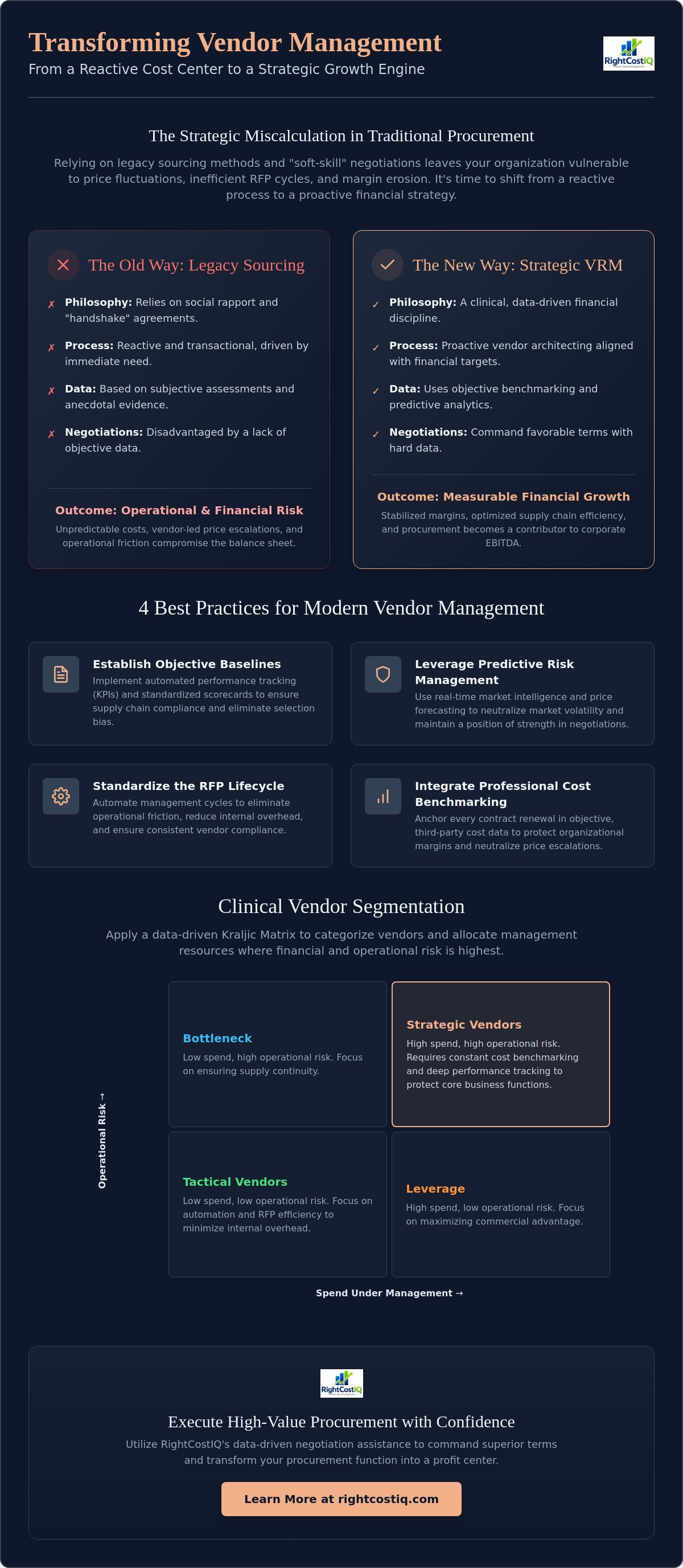
Effective resource allocation requires clinical segmentation. Not every supplier warrants the same management intensity. By applying a modern, data-heavy Kraljic Matrix, architects can categorize vendors based on spend under management and operational criticality. This ensures management resources are directed where financial volatility is highest.
- Strategic Vendors: These partners represent high spend and high operational risk. They require constant cost benchmarking and performance tracking to protect core business functions.
- Tactical Vendors: These involve low complexity and high market availability. Management focus here shifts toward automation and RFP efficiency to minimize internal overhead.
Applying vendor relationship management best practices means recognizing that tactical vendors don't require the same strategic depth as critical partners. Segmenting your portfolio allows your team to focus their analytical expertise on the 20% of vendors that typically drive 80% of the financial risk. This targeted approach stabilizes margins and ensures that procurement remains a lean, high-output function.
Implementing Clinical Segmentation and Performance Tracking Architectures
Trust is a byproduct of transparency, not a substitute for it. In high-stakes procurement, relying on subjective "good relations" is a failure of strategic leadership. You must establish a clinical baseline for vendor performance metrics (KPIs) that prioritizes financial alignment and operational resilience over conversational comfort. Standardizing the vendor scorecard allows for cross-category comparison, removing the selection bias inherent in siloed department reviews. When you integrate cost benchmarking with real-time performance analytics, you create a defensive shield against margin erosion. Implementing vendor relationship management best practices ensures that your organization maintains a position of strength during every market cycle.
A standardized clinical scorecard must move beyond surface-level assessments. It should focus on specific, measurable outputs that impact the bottom line. Consider these core components for your 2026 tracking architecture:
- Price Variance: Real-time tracking of invoice data against market benchmarks.
- Compliance Velocity: The speed and accuracy of regulatory and ESG documentation updates.
- Operational Reliability: Quantitative service level agreement (SLA) achievement rates.
- Risk Exposure: Financial stability ratings and price risk exposure within specific categories.
Data-Driven Performance Metrics for 2026
Modern performance tracking goes beyond simple delivery windows. It identifies "performance drift," which is the subtle, incremental decline in value or increase in price that often goes unnoticed until a contract renewal. Using Procurement Category Cost Benchmarking allows your team to validate vendor pricing against objective market data. This ensures that every dollar spent is justified by current market realities rather than legacy pricing structures. These vendor relationship management best practices transform your procurement office into a data-driven command center that proactively manages margin integrity.
The Architecture of Vendor Compliance
Manual audit trails are obsolete and prone to human error. 2026 procurement requires an automated architecture for regulatory and ESG compliance that operates independently of manual input. Linking performance data directly to contract renewal triggers ensures that non-compliant or underperforming vendors are flagged automatically. This systematic approach is especially critical when tail spend management is used to consolidate fragmented vendor bases. Consolidation without rigorous tracking leads to concentrated risk; automation mitigates this. You can begin identifying these hidden vulnerabilities within your own supply chain to ensure your strategic goals remain on track.
Leveraging Market Intelligence and Price Risk Management in Vendor Dialogues
Market volatility isn't an external variable to be managed; it's a core component of the procurement dialogue. Organizations that fail to integrate market intelligence into their vendor interactions remain perpetually reactive, vulnerable to supplier-led price escalations. Sophisticated vendor relationship management best practices require the use of market price trending as a neutral arbiter. This data-driven approach removes the emotional friction from negotiations, shifting the focus toward objective financial alignment. By utilizing predictive analytics, procurement architects can transform adversarial encounters into high-value strategic collaborations that protect organizational interests.
Unlike standard security-focused risk assessments that ignore fiscal health, this clinical framework prioritizes financial price risk as the primary destabilizer of vendor relationships. Data transparency builds a foundation of credibility that rapport alone can't sustain. When you present a vendor with objective market trending data, you aren't just asking for a lower price; you're demanding market parity based on verifiable intelligence. This shifts the power dynamic, ensuring that your procurement strategy is dictated by market reality rather than supplier margin targets.
The Clinical Execution of Price Risk Management
Forecasting future costs allows procurement teams to set realistic vendor expectations well before contract expiration. This proactive stance enables the implementation of index-based pricing models that reflect actual market conditions rather than arbitrary supplier increases. Price risk management serves as a technical buffer that stabilizes operational margins by neutralizing external market shocks through predictive data modeling. This methodical approach ensures your supply chain remains financially viable even during periods of extreme market turbulence. Vendors often respect data-heavy partners because clear forecasting reduces their own operational uncertainty, leading to more stable, long-term agreements.
Negotiation as a Continuous Process
The traditional "once-a-year" negotiation cycle is obsolete in the 2026 fiscal landscape. In a fast-paced economy, waiting twelve months to address pricing discrepancies leads to significant margin leakage. Continuous dialogue, fueled by real-time market data, is essential for maintaining cost parity. Professional Negotiation Assistance provides the benchmarking necessary to defend your organization’s bottom line during these ongoing interactions. For a deeper analysis of these technical frameworks, see our Negotiation Strategies for High-Value Procurement guide. This continuous engagement model ensures your vendor relationship management best practices are consistently applied, protecting your EBITDA from the erosion of unmanaged price volatility.
Optimizing the RFP Lifecycle to Standardize Vendor Compliance
Sourcing is the technical foundation of the entire vendor lifecycle. If the initial RFP is flawed, the subsequent management phase becomes an exercise in damage control rather than strategic optimization. Most organizations treat the Request for Proposal as a standalone event, yet it's the primary mechanism for establishing vendor relationship management best practices from the point of entry. By standardizing the RFP lifecycle, you eliminate the selection bias and subjective favoritism that often lead to suboptimal partnerships. Integrating cost benchmarking data into the initial sourcing request ensures that your baseline is anchored in market reality, effectively neutralizing vendor-led price inflation before it reaches the negotiation table.
Precision-engineered RFP documentation is a defensive tool for your organization's EBITDA. It forces transparency from the outset, requiring vendors to justify their pricing structures against objective market trending data. This alignment reduces price variance across your supplier base and ensures that your procurement strategy is driven by data rather than vendor-provided narratives. When you standardize compliance requirements within the RFP, you create a scalable framework that protects organizational interests regardless of the category or spend volume.
The RFP Management Framework
Defining technical requirements with clinical precision is the first step toward reducing long-term price variance. Vague specifications lead to inconsistent bids and hidden costs that emerge only after implementation. Using specialized RFP Management tools allows your team to streamline vendor responses and force direct, side-by-side comparisons across critical data points. You must shift your evaluation criteria from simple unit price to total cost of ownership (TCO). This comprehensive metric includes long-term maintenance, integration overhead, and price risk exposure. Precision-engineered documentation prevents vendors from masking operational inefficiencies, ensuring that your selection process remains a rigorous financial exercise.
Eliminating Sourcing Inefficiencies
Operational efficiency requires a departure from manual, fragmented workflows that delay strategic execution. Reducing the "time-to-contract" through automated workflows allows your organization to respond with agility to market shifts. A multi-vendor RFP strategy further enhances supply chain resilience by preventing over-reliance on a single source and maintaining competitive pressure. This approach aligns with broader Category Management in Procurement strategies, where each category is managed as a distinct financial portfolio. By standardizing these cycles, you ensure that every vendor enters the ecosystem under a rigorous compliance framework that supports vendor relationship management best practices across the enterprise.
You can run a free diagnostic on your current RFP process to identify hidden inefficiencies and stabilize your procurement margins.
Executing High-Value Procurement with RightCostIQ Negotiation Assistance
Strategic procurement reaches its highest level of efficiency when data-driven architectures move from the spreadsheet to the negotiation table. Integrating RightCostIQ's benchmarking analytics into your internal VRM policy ensures that every supplier interaction is anchored by financial reality rather than vendor-led narratives. Implementing vendor relationship management best practices requires more than just tracking; it demands the clinical application of market intelligence to protect organizational margins during critical renewal periods. Professional negotiation assistance serves as the final defensive layer, ensuring that the savings identified during the benchmarking phase are actually realized in the final contract.
Achieving total price transparency is impossible without sophisticated market trending and forecasting models. These technical tools allow procurement architects to predict price fluctuations and adjust their sourcing strategies before volatility impacts the balance sheet. By maintaining a continuous audit of vendor performance, organizations ensure operational compliance and eliminate the "performance drift" that erodes EBITDA over time. This methodical approach transforms procurement from a reactive function into a proactive financial growth engine.
The RightCostIQ Approach to Negotiation
Rapport-based negotiation is an obsolete strategy that exposes your organization to unnecessary financial risk. The RightCostIQ methodology uses clinical data to lead the vendor dialogue, forcing suppliers to align their pricing with objective category cost benchmarking. This expert-led approach identifies specific savings opportunities that are often hidden within complex service agreements or opaque pricing structures. By positioning RightCostIQ as your sophisticated partner for procurement optimization, you gain access to the technical frameworks required to command market parity and stabilize your long-term supply chain costs.
Next Steps: Auditing Your Current Vendor Base
Transitioning to a clinical VRM framework begins with a comprehensive audit of your existing supplier ecosystem. You must identify "at-risk" contracts where price risk exposure is highest and market alignment is lowest. Once these vulnerabilities are mapped, implement a pilot RFP cycle for your high-impact categories to establish a new, data-driven baseline for performance and cost. This systematic process ensures that your vendor relationship management best practices are scalable and consistently applied across the enterprise. You can optimize your procurement outcomes with RightCostIQ RFP Management to begin securing your margins for 2026.
Stabilizing Margins through Clinical Vendor Architecting
The shift from legacy, rapport-based sourcing to a clinical procurement architecture isn't just a trend; it's a strategic requirement for organizations targeting margin expansion in 2026. By implementing vendor relationship management best practices, you replace subjective vendor evaluations with a rigorous framework built on objective data and financial transparency. This transition requires the integration of precise performance tracking, automated RFP cycles, and predictive price risk management to ensure your supply chain remains a resilient engine for financial growth. It's about moving beyond simple cost-cutting to achieve long-term fiscal stability.
RightCostIQ provides the technical infrastructure necessary to execute this strategic evolution. Our platform delivers proprietary cost benchmarking and analytics, expert-led negotiation assistance, and comprehensive market price forecasting models designed to protect your organization's EBITDA. You can begin neutralizing market volatility and standardizing your procurement compliance with precision. It's time to transform your vendor ecosystem into a high-output financial asset.
Explore RightCostIQ's RFP Management and Negotiation Solutions to secure your strategic advantage and optimize your procurement outcomes.
Frequently Asked Questions
What is the difference between vendor management and vendor relationship management?
Vendor management is a transactional function focused on executing specific tasks and short-term contract fulfillment. Vendor relationship management (VRM) is a strategic discipline that utilizes data-driven architectures to align supplier performance with long-term corporate EBITDA. VRM incorporates advanced market intelligence and cost benchmarking to transform third-party entities into measurable financial growth engines for the organization.
How do I measure the ROI of a vendor relationship management program?
You measure ROI by quantifying margin expansion, cost avoidance, and operational efficiency gains across the supply chain. Track the delta between objective market benchmarks and your final negotiated contract rates to determine direct savings. Additionally, measure the reduction in price variance and the decrease in internal man-hours required for RFP cycles to calculate the program's total financial impact.
What are the most critical KPIs for tracking vendor performance in 2026?
The most critical KPIs include price risk exposure, compliance velocity, and total cost of ownership (TCO) alignment. These metrics move beyond simple delivery times to analyze the clinical financial health of the relationship. Implementing vendor relationship management best practices requires tracking how closely a vendor's pricing mirrors real-time market trending data to prevent subtle margin leakage over time.
Can automated RFP management improve vendor compliance?
Automated RFP management eliminates selection bias by ensuring every candidate meets standardized technical and regulatory requirements. It creates a systemized audit trail that forces transparency from the initial point of entry. This clinical approach ensures that only vendors capable of meeting strict ESG and operational standards enter your ecosystem, significantly reducing long-term compliance risks.
How does market price trending assist in contract negotiations?
Market price trending serves as a neutral, data-led arbiter that removes emotional friction from the negotiation process. It provides the objective benchmarking required to challenge supplier-led price escalations with verifiable facts. When you present real-time market data, you shift the dialogue from a request for discounts to a demand for market parity based on current fiscal realities.
Is vendor segmentation necessary for small-to-medium enterprises?
Segmentation is essential for any organization because it optimizes resource allocation and identifies where financial risk is concentrated. SMEs often operate with limited procurement bandwidth, so focusing analytical efforts on high-risk suppliers is a priority. Applying vendor relationship management best practices through segmentation allows you to apply clinical oversight where it generates the highest financial return for your business.
What are the risks of ignoring tail spend in vendor management?
Ignoring tail spend leads to unmanaged margin erosion and a fragmented vendor base that lacks strategic oversight. Small, frequent purchases across multiple unmanaged suppliers often aggregate into significant financial leakage that goes unnoticed by leadership. Consolidating this spend through automated tracking and benchmarking identifies hidden savings opportunities that contribute directly to organizational EBITDA expansion.
How can I reduce financial volatility with my primary suppliers?
You can reduce volatility by integrating predictive price risk management and index-based pricing models into your primary contracts. This proactive strategy utilizes market forecasting to set realistic expectations and neutralize external inflationary shocks. Professional negotiation assistance ensures these data-driven frameworks are correctly implemented during renewals to maintain long-term margin stability and protect your organization from unpredictable price fluctuations.


