
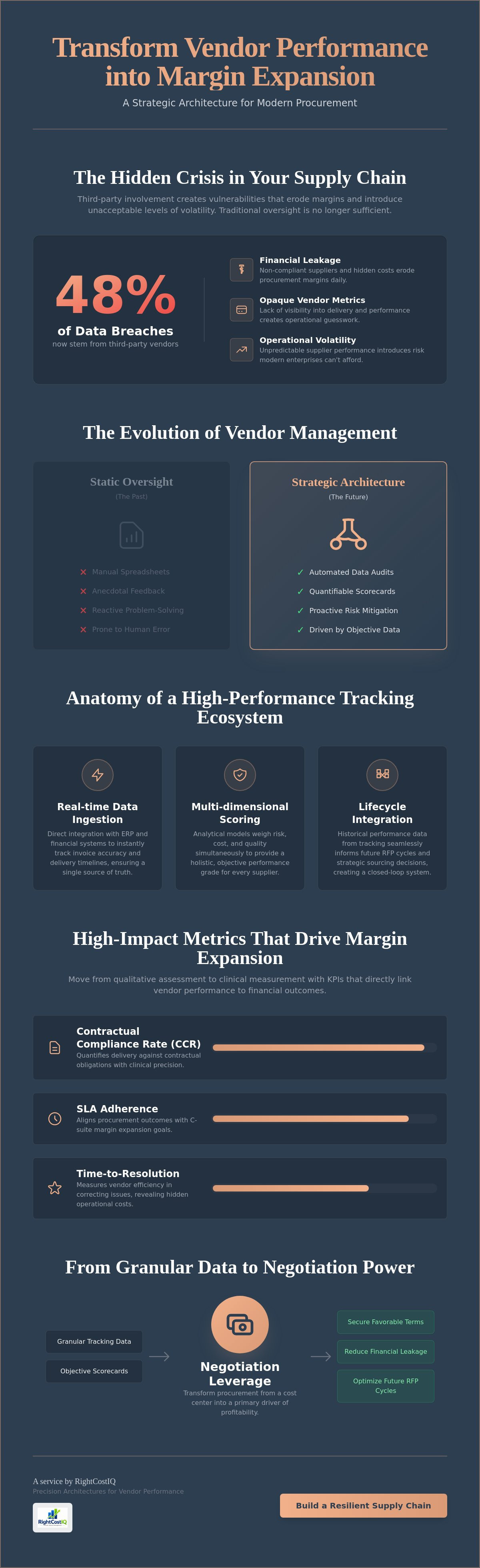
Third-party involvement now accounts for 48% of all data breaches, a sharp increase that signals a wider crisis in supply chain visibility. You're likely aware that opaque vendor delivery metrics and financial leakage from non-compliant suppliers are eroding your procurement margins daily. These operational gaps create a level of volatility that modern enterprises can't afford. Integrating a sophisticated vendor performance tracking service is the only way to replace these vulnerabilities with clinical precision and objective data.
This article provides the strategic frameworks and data-driven architectures required to transform vendor performance into a primary driver of margin expansion. You'll learn to develop quantifiable vendor scorecards that eliminate guesswork during RFP cycles and provide the negotiation leverage needed to secure favorable terms. We'll examine the technical methodologies for reducing operational volatility and ensuring that every supplier relationship contributes directly to your bottom line.
Key Takeaways
- Transition from tactical oversight to a strategic architecture that quantifies supplier delivery against contractual obligations with clinical precision.
- Adopt high-impact metrics such as Contractual Compliance Rate (CCR) and SLA Adherence to align procurement outcomes with C-suite margin expansion goals.
- Deploy a specialized vendor performance tracking service to automate risk mitigation and ensure rigorous compliance through real-time data audits.
- Follow a structured, two-phase implementation framework to integrate performance tracking architectures directly with existing enterprise ERP systems.
- Transform granular tracking data into objective negotiation leverage to optimize future RFP cycles and reduce financial leakage from non-compliant suppliers.
The Strategic Anatomy of a Vendor Performance Tracking Service
A vendor performance tracking service is a systematic architecture designed to quantify supplier delivery against rigorous contractual obligations. It's no longer enough to rely on anecdotal feedback or periodic manual reviews. Clinical precision is the new mandate for high-level decision-makers. This framework converts raw operational data into actionable financial intelligence, ensuring every vendor interaction contributes to margin expansion rather than acting as a drain on resources. Within the broader scope of supply chain management, performance tracking serves as the central nervous system, providing the visibility needed to eliminate financial leakage before it compounds.
By 2026, the shift from tactical monitoring to strategic performance orchestration is complete. Companies that fail to adopt these data-driven architectures face increased volatility and non-compliance risks. Tracking isn't an administrative burden; it's the foundation of a resilient procurement infrastructure. It allows leadership to identify underperforming assets and reallocate spend with surgical accuracy. This level of oversight is essential for maintaining a competitive edge in a market where margins are under constant pressure from global disruptions.
From Administrative Oversight to Financial Growth
Traditional spreadsheets fail to capture the nuances of modern vendor risk. They're static, prone to error, and lack the real-time connectivity required for agile procurement. Static tracking methods simply can't account for the fact that third-party involvement now accounts for 48% of all data breaches. Transitioning to automated signals allows for immediate intervention when a supplier deviates from agreed-upon standards. These triggers transform procurement from a reactive cost center into a proactive driver of enterprise-level financial stability. It's about reducing operational volatility through radical transparency.
Key Components of a Sophisticated Tracking Ecosystem
A sophisticated vendor performance tracking service requires seamless data ingestion from existing ERP and procurement platforms. This ensures a single source of truth for all supplier metrics, removing the subjectivity that often plagues vendor relationships. A robust ecosystem includes several critical architectural layers:
- Real-time Data Ingestion: Direct integration with financial systems to track invoice accuracy and delivery timelines instantly.
- Multi-dimensional Scoring: Analytical models that weigh risk, cost, and quality simultaneously to provide a holistic performance grade.
- Lifecycle Integration: The seamless transfer of RFP Management data into the performance lifecycle to ensure historical performance informs future sourcing decisions.
This architectural setup creates a closed-loop system where data doesn't just sit in a report but actively influences the next negotiation cycle. By integrating performance data with strategic sourcing, organizations gain the leverage needed to demand better terms and higher quality from their entire vendor base.
Quantifying Performance: Metrics for Procurement Margin Expansion
Margin expansion requires a shift from qualitative assessment to clinical measurement. A professional vendor performance tracking service provides the granular data necessary to align supplier output with C-suite financial objectives. Every metric must serve a strategic purpose. We focus on identifying financial leakage through variance analysis. This approach ensures that procurement isn't just a cost center but a primary driver of profitability. When you quantify performance with this level of rigor, you eliminate the subjectivity that often protects underperforming suppliers.
Hidden costs often hide within performance variances. If a vendor consistently delivers 48 hours late, the ripple effect through the supply chain creates a bottleneck that erodes margin. Measuring "Time-to-Resolution" for these bottlenecks provides a clear view of operational efficiency. It's not enough to know a problem occurred. You must know how quickly the vendor corrected it and what that delay cost the enterprise. This data provides the backbone for future negotiation leverage.
The Clinical Framework for Vendor KPIs
Distinguishing between reliability and quality is vital for high-stakes procurement. Reliability measures delivery speed and consistency. Quality measures output precision and adherence to technical specifications. Both are required for operational stability. Economic Value Add (EVA) calculates the true ROI of a vendor by factoring in the total cost of ownership against the value delivered. Contractual Compliance Rate functions as the primary metric for supply chain integrity by measuring the exact delta between promised deliverables and actual performance.
Service Level Agreement (SLA) Adherence acts as a secondary layer of defense. It tracks the granular details of the service delivery process. When these two metrics are combined, they create a multi-dimensional view of vendor health. This level of detail allows for a surgical approach to vendor management where underperformance is identified and addressed before it impacts the bottom line.
Advanced Benchmarking and Analytics Integration
Leveraging procurement analytics allows leadership to identify category-specific performance outliers that traditional reporting misses. Cost benchmarking then normalizes this data across diverse spending categories. It ensures you aren't overpaying for mediocrity. Market price trending data further refines these expectations during periods of high volatility, allowing for fair but firm performance adjustments. Organizations should perform a systematic diagnostic assessment to identify where their current tracking fails to meet these rigorous standards.
Mitigating Supply Chain Volatility through Automated Compliance
Supply chain volatility is an inherent risk, but non-compliance is an avoidable failure. Manual audits are insufficient for modern enterprise needs. You need a vendor performance tracking service that operates as an automated compliance engine. This architecture identifies early warning signals of supplier disruption or insolvency before they manifest as operational stoppages. By integrating these signals into your category management procurement strategy, you move from reactive damage control to proactive risk orchestration. It's about building a defensive perimeter around your margins.
Rigorous performance audits ensure that every supplier adheres to the specific safety, quality, and financial standards defined in the contract. This continuous oversight replaces the "trust but verify" model with a "verify then trust" data loop. When a vendor knows their performance is being monitored with clinical precision, their adherence to contractual terms naturally improves. This creates a culture of accountability that extends throughout your entire procurement ecosystem.
Automated Compliance and Risk Architectures
Implementing "Always-On" monitoring is the only way to replace the lag of periodic manual reviews. AI-led signals detect performance drift, which is the subtle decline in delivery precision or quality that often precedes a major breach. This system acts as a digital tripwire for your supply chain. Integrating Price Risk Management into this framework ensures that financial volatility doesn't compromise supplier compliance. It allows you to track whether a vendor's performance is suffering due to market-driven cost pressures or internal operational failures, giving you the clarity needed to make informed retention decisions.
Strategic Resilience and Supplier Diversity
Enterprise resilience relies on a diverse supplier base, but diversity without tracking increases complexity and risk. A professional vendor performance tracking service ensures that every vendor, regardless of size or category, meets the same high standards for reliability. This data also supports corporate social responsibility (CSR) goals by providing verifiable proof of ethical sourcing and labor practices. Tracking these metrics ensures that your diversity initiatives don't come at the cost of operational efficiency. Performance data provides the objective evidence required to validate the efficacy and operational stability of supplier diversity programs.
By centralizing this data, you gain a panoramic view of your risk landscape. You can see which categories are most vulnerable and which vendors are the most stable. This level of insight is critical for maintaining business continuity in an increasingly unpredictable global market. It transforms your supply chain from a potential liability into a resilient strategic asset.
Implementing a High-Performance Vendor Tracking Framework
Implementation requires a structured, multi-phase approach to ensure data integrity and strategic alignment. A professional vendor performance tracking service shouldn't be deployed as a standalone tool but as a core component of the enterprise financial architecture. This process moves beyond simple observation into active management and optimization. The goal is to create a closed-loop system where performance data informs every procurement decision.
- Phase 1: Defining the Strategic Objectives and Clinical Scope. Establish what success looks like for each category and align these goals with C-suite margin targets.
- Phase 2: Architectural Setup. Integrate the tracking service with existing ERP systems to ensure real-time data visibility and remove manual reporting lag.
- Phase 3: Establishing the Performance Review Cadence. Define the specific triggers for intervention and the methodology for corrective action plans.
- Phase 4: Leveraging Performance Data as a Negotiation Lever. Use historical scorecards to drive better terms and higher accountability during RFP cycles.
- Phase 5: Continuous Optimization. Refine performance expectations based on evolving market intelligence and forecasting data.
Architectural Setup and Data Integration
Objective performance scorecards require clean data ingestion from the outset. Without high-quality, normalized data, tracking becomes subjective and loses its strategic authority. Mapping specific performance metrics to tail spend categories ensures that even small-scale suppliers meet enterprise standards. This prevents the accumulation of minor inefficiencies that eventually erode margins. Cross-platform data synchronization is the technical prerequisite for achieving this level of granular visibility across the entire vendor base.
Executing the Performance Review Cadence
High-performance organizations move away from outdated annual reviews in favor of a quarterly Strategic Performance Alignment (SPA). This rhythm allows for rapid course correction and prevents performance drift from compounding into financial loss. When a vendor receives a "D" or "F" grade, the framework must trigger assertive corrective action plans immediately. If performance does not improve, leadership should utilize a Negotiation Coach to address chronic underperformance during contract renewals. This ensures that historical data directly informs future financial commitments and contract terms.
To evaluate the maturity of your current supplier oversight, perform a clinical diagnostic of your vendor performance tracking architecture to identify gaps in your compliance framework.
RightCostIQ: Precision Architectures for Vendor Performance Optimization
RightCostIQ delivers a professional vendor performance tracking service designed for clinical execution and total supply chain visibility. We don't view tracking as an administrative checkbox. It's a strategic asset. Our architecture integrates granular performance data directly with advanced RFP Management and negotiation assistance. This ensures that every historical delivery failure or success becomes a quantified lever during contract renewals. By turning opaque metrics into objective scorecards, we empower procurement leaders to demand accountability with surgical precision.
Quantifying the financial impact is the ultimate proof of an optimized tracking framework. Organizations utilizing our precision architectures consistently identify and reclaim financial leakage that previously went undetected. This isn't just about efficiency; it's about margin expansion. The integration of a sophisticated vendor performance tracking service is the ultimate driver of procurement efficiency. When data-driven tracking becomes the primary driver of operational stability, the relationship between the enterprise and its suppliers shifts from one of trust to one of verified performance.
The RightCostIQ Advantage: Beyond Traditional Tracking
Our proprietary methodology links real-time performance tracking to comprehensive price risk management. This provides a multi-dimensional view of vendor health that traditional tools lack. We don't analyze performance in a vacuum. Our market price trending services provide the necessary context to vendor data. For instance, if a supplier's quality dips during a period of extreme market volatility, our system identifies whether this is a systemic failure or a localized risk. You can access the full suite of RightCostIQ procurement tools to achieve total oversight across all spend categories.
Strategic Outcomes and Margin Expansion
RightCostIQ acts as a strategic architect for your procurement department. We move beyond software to provide high-level consulting and technical upskilling. Our frameworks help enterprises identify potential savings by exposing non-compliant supplier behaviors and optimizing category spend. We focus on results that impact the bottom line. The next step for any forward-thinking organization is to move away from legacy monitoring and initiate a clinical audit of their current vendor performance metrics. This audit serves as the baseline for transforming your procurement function into a high-performance engine of growth.
Mastering the Architecture of Supply Chain Profitability
A sophisticated vendor performance tracking service is the central nervous system of modern procurement. It replaces opaque delivery metrics with quantifiable scorecards that eliminate financial leakage. By shifting from reactive monitoring to proactive performance orchestration, enterprises transform supplier relationships into primary drivers of margin expansion. This data-driven approach provides the clinical precision required to mitigate volatility and ensure long-term operational stability.
RightCostIQ delivers this level of oversight through specialized healthcare financial analytics and RFP management with clinical execution. Our frameworks utilize advanced cost benchmarking and market intelligence to identify and reclaim lost profit. Transitioning to a high-performance tracking architecture is the final step in securing your competitive advantage. It's time to replace subjectivity with the relentless logic of data-backed negotiation leverage.
Optimize your supply chain with RightCostIQ’s precision tracking services. We look forward to architecting your procurement success.
Frequently Asked Questions
What is a vendor performance tracking service and why is it essential for 2026 procurement?
A vendor performance tracking service is a systematic architecture designed to quantify supplier delivery against contractual obligations with clinical precision. In 2026, this level of oversight is essential because third-party vulnerabilities now account for 48% of all data breaches. Organizations need real-time visibility to mitigate these risks and prevent financial leakage before it compromises the bottom line.
How does vendor performance tracking improve the RFP management process?
Tracking provides objective historical scorecards that replace anecdotal feedback during the RFP cycle. This data allows procurement teams to select suppliers based on verified reliability rather than marketing claims. It ensures that future contracts are built on a foundation of proven performance, providing the leverage needed to negotiate superior service terms.
What are the most critical KPIs for tracking healthcare vendor performance?
The most critical KPIs include the Contractual Compliance Rate (CCR) and SLA Adherence. These metrics measure the exact delta between promised deliverables and actual output precision. Tracking these ensures that suppliers meet rigorous safety and financial standards without creating operational bottlenecks that erode margins.
Can automated tracking services integrate with my existing ERP system?
Professional architectures are built to integrate directly with your existing ERP and procurement platforms. This setup enables automated data ingestion, creating a single source of truth for all supplier metrics. It removes the subjectivity and human error associated with manual spreadsheets, providing leadership with instantaneous performance signals.
How do I use vendor performance data as a lever in contract negotiations?
You use performance data as a negotiation lever by presenting quantified variances during contract renewals. When you show a vendor exact data on their delivery failures or quality drifts, they're forced to accept accountability. This transparency allows you to demand price adjustments or stricter penalty clauses based on their historical performance record.
What is the ROI of implementing a professional vendor performance tracking system?
ROI is achieved by identifying and reclaiming financial leakage caused by supplier non-compliance and operational delays. By reducing volatility and improving delivery precision, organizations experience direct margin expansion. The system pays for itself by uncovering hidden costs that traditional accounting methods often miss.
How does performance tracking help in managing tail spend and category risk?
Tracking applies enterprise-level standards to tail spend categories that are typically left unmonitored. This prevents small-scale inefficiencies from compounding into significant financial loss. It provides a holistic view of category risk, ensuring that every vendor relationship contributes to overall supply chain resilience.
What happens if a vendor consistently fails to meet performance benchmarks?
Consistent failure triggers an immediate corrective action plan or a strategic performance alignment review. The tracking data provides the objective evidence required to either fix the relationship or justify a transition to a more reliable partner. It ensures that underperformance is never tolerated as a standard operational cost.


