
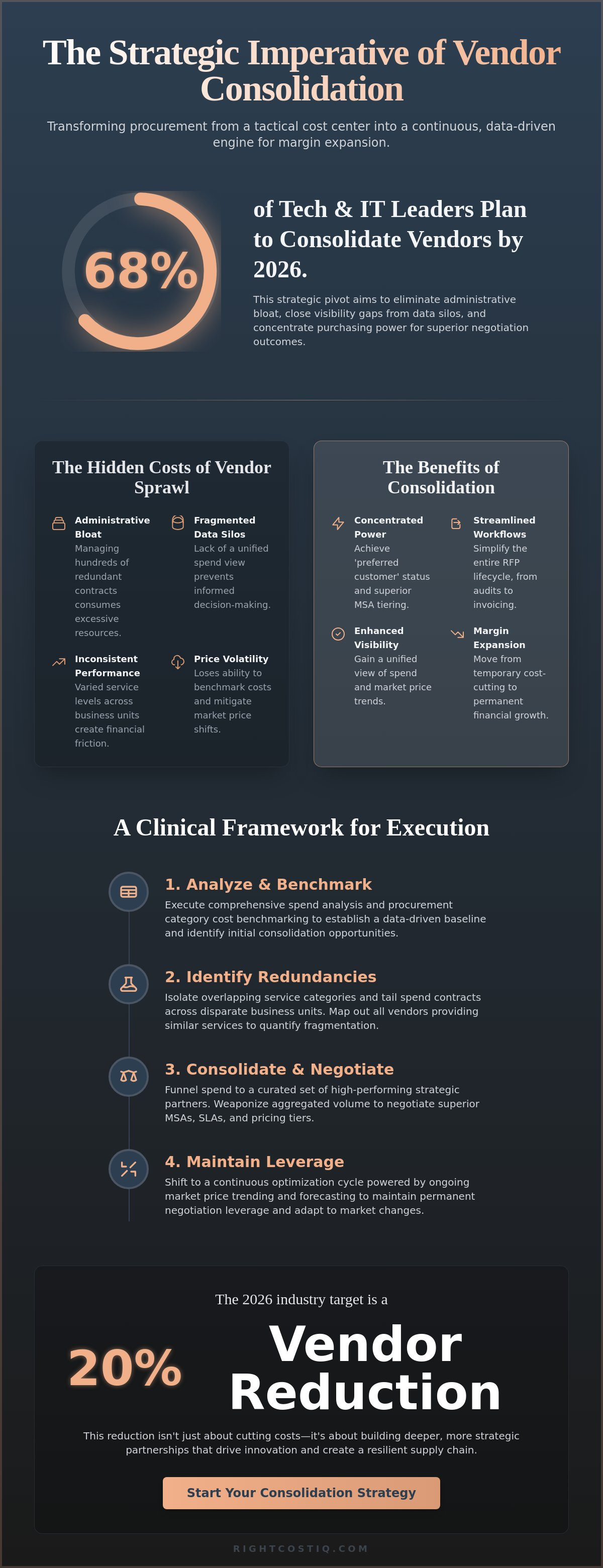
Sixty-eight percent of technology and IT leaders plan to consolidate their vendors in 2026, according to recent Gatekeeper data. This trend reflects a strategic pivot away from the administrative bloat of managing hundreds of redundant contracts and the visibility gaps caused by fragmented data silos. You understand that inconsistent vendor performance across business units creates unnecessary financial friction. Realizing the full scope of vendor consolidation strategy benefits requires a transition from cyclical cost-cutting to a continuous, data-driven capability that weaponizes market intelligence for superior negotiation outcomes.
This framework demonstrates how a rigorous consolidation strategy concentrates purchasing power to mitigate price volatility and drive measurable margin expansion. We analyze the specific mechanisms for streamlining operational workflows, reducing legal overhead, and enhancing visibility into market price trending. By applying procurement category cost benchmarking and advanced analytics, organizations can transform procurement from a reactive back-office function into a primary driver of financial growth. This article provides the clinical roadmap necessary to quantify ROI and justify transition costs to the C-suite through precise technical execution.
Key Takeaways
- Transition from tactical cost-cutting to systematic category optimization to transform vendor reduction into a long-term engine for margin expansion.
- Realize the full scope of vendor consolidation strategy benefits by concentrating spend to elevate your status as a preferred customer and secure superior tiering in Master Service Agreements.
- Streamline the RFP lifecycle and eliminate administrative bloat by implementing standardized contract frameworks across a narrowed, high-performing supplier base.
- Execute a clinical consolidation roadmap using comprehensive spend analysis and procurement category cost benchmarking to identify and eliminate category redundancies.
- Maintain permanent negotiation leverage by shifting to a continuous optimization cycle powered by ongoing market price trending and forecasting.
The Strategic Necessity of Vendor Consolidation in 2026
Vendor consolidation represents the systematic reduction of a supplier base to a curated set of high-performing strategic partners. This process is not a simple housekeeping exercise. It is a fundamental Consolidation (business) strategy designed to concentrate purchasing power and eliminate procurement friction. In 2026, the shift toward data-centric procurement architectures makes this transition mandatory for organizations seeking to maintain a competitive edge. Tactical cost-cutting offers temporary relief, while strategic category optimization delivers permanent margin expansion. One of the primary vendor consolidation strategy benefits is the elimination of invisible barriers to price transparency created by vendor sprawl.
Identifying the Indicators of Vendor Sprawl
Vendor sprawl often manifests as redundant service categories across disparate geographic business units. When multiple departments procure similar services from different vendors, the organization loses its ability to benchmark costs effectively. Managing overlapping tail spend contracts involves high administrative overhead that frequently exceeds the value of the items purchased. This fragmentation compromises the accuracy of C-suite financial reporting. Without a unified view of spend, leadership cannot make informed decisions regarding market price volatility or risk mitigation. Identifying these indicators is the first step toward reclaiming operational control.
The Shift from Tactical Sourcing to Strategic Partnerships
Modern procurement requires moving beyond transactional relationships toward integrated supply chain alliances. Consolidation enables deeper vendor performance tracking and ensures rigorous compliance with evolving 2026 regulations like the EU AI Act or CSDDD. Effective category management procurement serves as the diagnostic tool for identifying consolidation candidates. By centralizing spend with fewer partners, organizations gain the leverage needed to negotiate better volume discounts and service level agreements. This strategic alignment ensures that vendors are invested in the long-term success of the enterprise rather than just the next purchase order. Capturing the full range of vendor consolidation strategy benefits requires this shift from reactive sourcing to proactive partnership management.
The resulting concentration of spend doesn't just lower unit costs; it simplifies the entire procurement lifecycle. Reduced vendor counts lead to fewer invoices, streamlined audits, and a more robust understanding of supplier risk profiles. Organizations that successfully navigate this shift position themselves as sophisticated partners in an increasingly complex global market.
Concentrating Purchasing Power for Enhanced Negotiation Leverage
Concentrating enterprise spend transforms a fragmented procurement profile into a high-leverage asset. By funneling volume toward a limited set of strategic partners, organizations achieve "preferred customer" status. This status isn't just a label; it's a financial instrument that unlocks aggressive tiering within Master Service Agreements (MSAs). One of the primary vendor consolidation strategy benefits is the immediate reduction of price variance for identical SKUs across different business units. This concentration ensures that the pricing floor achieved by one department becomes the standard for the entire enterprise, eliminating the hidden tax of localized sourcing decisions. With the average target for vendor reduction sitting at 20% in 2026, the potential for volume aggregation is significant.
Weaponizing Volume in Contract Negotiations
Organizations must adopt calculated approaches to volume-based pricing structures and rebate programs to maximize the ROI of a narrowed supplier base. Concentrated spend profiles allow procurement leaders to demand preferential service level agreements (SLAs) that were previously unattainable with fragmented volume. This negotiation leverage ensures that the organization receives priority support, optimized lead times, and favorable liability terms. Utilizing professional negotiation assistance during the RFP stage ensures that these volume-based advantages are codified into the final contract language. Industry data from ASC Global indicates that a structured vendor consolidation strategy delivers a 3–7% reduction in the Cost of Goods Sold (COGS) while reducing purchase order touches by up to 40%. These metrics highlight the operational efficiency gains that accompany financial optimization.
Integrating Benchmarking into the Consolidation Process
Consolidation without data validation is a strategic risk. Integrating procurement category cost benchmarking into the selection process ensures that new consolidated agreements reflect true market value rather than just a marginal improvement over legacy costs. According to a guide on Vendor Consolidation: What It Is, Benefits & Strategy, a structured approach is essential for capturing long-term value. Validating vendor proposals against real-time market price trending data identifies best-in-class pricing targets through clinical cost analytics. Benchmarking functions as a financial safeguard by establishing a data-driven price ceiling that prevents overpaying during the vendor transition phase.
To ensure your new contracts align with current market realities, consider a pre-negotiation cost analysis to identify immediate savings opportunities and validate vendor claims before signing long-term agreements.
Mitigating Operational Complexity and Financial Volatility
Vendor consolidation strategy benefits extend far beyond immediate unit-price reductions. Managing a bloated supplier base introduces significant administrative friction that erodes corporate margins through hidden labor costs. By narrowing the field to strategic partners, organizations can streamline the entire RFP lifecycle and implement standardized contract frameworks. This reduction in complexity minimizes legal friction and ensures that compliance protocols are uniformly enforced across the enterprise. Industry experts recognize this shift as a strategic imperative for vendor consolidation in 2026, where operational agility is as critical as financial leverage.
Streamlining the RFP and Procurement Lifecycle
Managing fewer, higher-impact sourcing events transforms the procurement department from a clerical hub into a strategic engine. Administrative burdens such as vendor onboarding, performance reviews, and audit trails decrease significantly with a refined vendor pool. Professional RFP management becomes more efficient when data sets are concentrated rather than fragmented across hundreds of disparate entities. It's easier to maintain high standards when your team isn't drowning in redundant paperwork. Automating compliance tracking becomes a realistic objective within a consolidated ecosystem. This ensures that new 2026 regulatory requirements, such as the reporting obligations under the EU Cyber Resilience Act starting September 11, are managed with clinical precision across the entire supply chain.
Price Risk Management and Forecasting
Financial volatility is frequently the result of opaque pricing structures hidden within a fragmented vendor list. Concentrating spend with strategic partners allows procurement leaders to demand transparent cost-plus pricing models that reveal the underlying drivers of expense. This transparency is a prerequisite for effective price risk management. By utilizing market price trending and forecasting, organizations can secure long-term price stability even when global markets fluctuate. Precision forecasting allows for accurate budget projections, protecting the enterprise against unexpected global supply chain disruptions. This data-driven approach ensures that the consolidated base provides a resilient foundation for sustained margin expansion and captures the full range of vendor consolidation strategy benefits. It's about building a defensive architecture that weaponizes market intelligence to neutralize external price shocks before they impact the bottom line.
A Clinical Framework for Executing a Consolidation Strategy
Executing a successful consolidation requires a methodical transition from data collection to strategic negotiation. This process ensures that the organization doesn't just reduce its vendor count but actually optimizes its financial architecture. A structured five-step approach allows procurement leaders to capture the full spectrum of vendor consolidation strategy benefits while minimizing the risk of supply chain disruption. Organizations should prepare for a multi-year journey; most consolidation programs require 30 to 36 months to achieve an 18% reduction in vendors, with significant savings often realized in the third year.
- Step 1: Conduct a comprehensive spend analysis to identify category redundancies across all business units.
- Step 2: Utilize procurement category cost benchmarking to evaluate current vendor price performance against market standards.
- Step 3: Execute a professional RFP process to select strategic winning partners based on value rather than just unit price.
- Step 4: Implement rigorous vendor performance tracking to ensure ongoing ROI and contract compliance.
- Step 5: Continuously monitor market price trends to adjust the strategy dynamically as economic conditions shift.
Phase 1: Diagnostic Spend Analysis and Benchmarking
The diagnostic phase begins by categorizing spend into core and non-core categories. High-yield results often come from aggressive tail spend management, where hundreds of low-value transactions can be consolidated into a few strategic contracts. This phase also identifies "hidden gems", which are vendors with high performance ratings but low relative spend who may be candidates for expanded partnerships. By evaluating these metrics, procurement teams can visualize the potential for volume aggregation before engaging the market. It's about identifying where purchasing power is currently diluted and preparing to concentrate it for maximum leverage.
Phase 2: Strategic Selection and RFP Execution
Successful execution depends on developing objective scoring rubrics that prioritize long-term value, technical competence, and supply chain resilience over initial price tags. Managing complex negotiations ensures seamless service transitions and prevents integration costs from eroding expected savings. Gartner predicts that by 2027, 70% of organizations will consolidate their cloud-native application vendors to a maximum of three strategic providers. Achieving this level of focus requires the clinical execution of RFP management to maintain enterprise efficiency during the transition. Professional RFP management tools allow for the granular comparison of vendor capabilities against standardized benchmarking data.
To identify immediate opportunities for category optimization within your own supplier base, utilize our procurement health diagnostic to benchmark your current spend against best-in-class market rates.
Leveraging Advanced Analytics to Sustain Consolidated Value
Consolidation isn't a static corporate project; it's a dynamic optimization cycle that requires perpetual maintenance. To sustain vendor consolidation strategy benefits over the long term, procurement leaders must move beyond the initial RFP and implement advanced analytics that track real-time market shifts. Organizations that treat consolidation as a one-time event often see vendor sprawl return within eighteen months as localized departments bypass centralized controls. This phenomenon, often called vendor creep, occurs when non-approved suppliers slowly re-enter the ecosystem through localized spending. RightCostIQ provides the essential technical infrastructure for clinical procurement execution, ensuring that negotiated savings are captured and maintained through data-driven oversight. Ongoing market price trending acts as the primary tool for maintaining negotiation leverage during mid-contract reviews and renewals.
Preventing the Re-emergence of Vendor Sprawl
Maintaining a streamlined supplier base requires establishing strict, non-negotiable criteria for adding new vendors to the ecosystem. Every potential addition must undergo a clinical cost benchmarking analysis to ensure they don't undermine existing consolidated volume or introduce unnecessary risk. Quarterly business reviews (QBRs) should focus on hard performance metrics and compliance data rather than conversational updates, using data to hold strategic partners accountable. Automated performance tracking ensures contract compliance by identifying unauthorized price adjustments the moment they occur, allowing for immediate corrective action. This level of systemic control is what separates high-performing procurement teams from those simply reacting to market shifts. It ensures the integrity of the vendor ecosystem remains intact despite organizational growth.
The ROI of Professional Procurement Assistance
Quantifying the total cost of ownership (TCO) reductions achieved through consolidation requires a holistic view of the entire procurement lifecycle. These savings include unit-price compression, reduced purchase order touches, and a significant decrease in legal and compliance friction across all business units. Third-party negotiation expertise provides a critical competitive advantage during complex category shifts, offering the market intelligence needed to validate vendor claims and secure best-in-class pricing. By integrating market price trending and forecasting services, organizations gain the ability to predict budget requirements with precision and mitigate financial volatility. This strategic alignment ensures that vendor consolidation remains a primary driver of enterprise margin expansion and long-term financial health. It's time to move beyond tactical sourcing and embrace a clinical framework for procurement optimization.
Optimize your procurement strategy with RightCostIQ.
Securing Long-Term Procurement Agility through Clinical Execution
The transition from a fragmented supplier base to a concentrated strategic ecosystem represents a fundamental shift in corporate financial architecture. Organizations that successfully implement this framework weaponize market intelligence to eliminate administrative bloat and capture significant volume discounts. Realizing the full scope of vendor consolidation strategy benefits requires a commitment to continuous optimization and data-driven oversight. Tactical cost-cutting is temporary; strategic category management is permanent.
RightCostIQ provides the technical infrastructure to sustain these gains through proprietary cost benchmarking analytics and global market price trending data. Our expert negotiation assistance for MSAs ensures that your status as a preferred customer translates into aggressive contract tiering and ironclad compliance. By integrating advanced analytics into the RFP lifecycle, we help you maintain enterprise-wide price transparency regardless of market volatility.
Optimize your vendor landscape with RightCostIQ’s RFP Management.
Establishing a resilient, high-performing procurement engine is the primary driver for sustained margin expansion in 2026 and beyond.
Frequently Asked Questions
What is the primary benefit of a vendor consolidation strategy?
The primary benefit of a vendor consolidation strategy is the concentration of purchasing power to drive measurable margin expansion. By funneling enterprise-wide spend through a limited number of high-performing partners, organizations secure aggressive volume-based pricing and preferential service level agreements. This concentration eliminates the hidden tax of localized sourcing. It transforms procurement from a reactive back-office function into a high-leverage asset that mitigates price volatility across the entire supply chain ecosystem.
How does vendor consolidation reduce supply chain risk?
Vendor consolidation reduces supply chain risk by enabling deeper oversight and more rigorous supplier due diligence. Managing a smaller, strategic pool allows procurement teams to monitor compliance with 2026 regulations like the EU AI Act and CSDDD with clinical precision. Organizations gain greater visibility into tier-two and tier-three suppliers, which is essential for enterprise resilience. A narrowed focus ensures that strategic partners are more invested in the organization's long-term operational stability.
Can vendor consolidation lead to higher prices due to lack of competition?
Consolidation only leads to higher prices if the organization lacks the market intelligence to validate vendor proposals. Integrating procurement category cost benchmarking into the process prevents overpaying during the transition. While direct competition may decrease, the preferred customer status achieved through volume concentration often secures lower floor pricing than fragmented competitive bidding. Professional negotiation assistance ensures that vendors provide transparent cost-plus models that reflect true market value rather than arbitrary markups.
What is the difference between vendor reduction and vendor consolidation?
Vendor reduction is a tactical, count-focused exercise, while vendor consolidation is a strategic, value-focused framework. Reduction simply removes suppliers to lower administrative overhead, often without considering category performance. Consolidation systematically optimizes the supplier base to maximize vendor consolidation strategy benefits, such as enhanced negotiation leverage and streamlined operational workflows. It prioritizes long-term margin expansion over the immediate, surface-level goal of reducing the total number of active contracts.
How do I identify which vendors to keep during a consolidation project?
Identifying vendors to keep requires a clinical scoring rubric that evaluates technical competence, financial stability, and historical performance tracking data. Organizations should conduct a comprehensive spend analysis to identify suppliers who demonstrate high performance but currently receive low relative spend. These hidden gems are often the best candidates for expanded partnerships. The selection process must prioritize vendors who offer transparent pricing structures and demonstrate robust supply chain resilience against global disruptions.
How often should a company review its consolidated vendor list?
Organizations should implement a continuous optimization cycle with quarterly business reviews and annual strategic assessments. Quarterly reviews focus on data-driven performance metrics and contract compliance to prevent vendor creep. Annual assessments involve a deeper analysis of market price trending and emerging regulatory requirements to ensure the consolidated base remains competitive. This methodical rhythm ensures that the vendor ecosystem adapts to shifting economic realities without reverting to the inefficiencies of vendor sprawl.
What role does RFP management play in consolidating suppliers?
RFP management serves as the clinical mechanism for selecting high-performing strategic partners while weaponizing aggregated volume. It allows procurement leaders to compare vendor capabilities against standardized benchmarking data with granular precision. Effective RFP processes ensure that the transition to a consolidated model doesn't introduce hidden integration costs. By utilizing professional RFP management and negotiation assistance, organizations can codify volume-based advantages into the final Master Service Agreements to secure long-term price stability.


