
RFPs influence up to 40% of total corporate revenue, yet many procurement departments still treat them as administrative chores rather than strategic growth drivers. You likely recognize the frustration of managing opaque vendor pricing models and inconsistent supply chain compliance. These inefficiencies prevent you from quantifying procurement ROI to the C-suite; they turn vital sourcing decisions into guesswork. Understanding the benefits of a formal RFP process is the first step toward transforming your department into a center for financial growth. A disciplined approach replaces subjective selection with clinical precision.
This guide demonstrates how a formalized RFP framework serves as a clinical instrument for cost optimization, risk neutralization, and superior vendor performance. You'll learn to establish a data-driven framework for vendor selection that eliminates bias and ensures long-term partner alignment. We will also explore how to identify hidden cost savings through rigorous benchmarking and mitigate financial volatility within your supply chain. By integrating advanced analytics and market intelligence, you can turn procurement into a predictable, high-yield business function.
Key Takeaways
- Transform ad-hoc purchasing into a clinical procurement framework that ensures competitive price discovery and rigorous service validation.
- Leverage data-driven cost benchmarking to identify price variances across vendors and establish precise "should-cost" models.
- Realize the strategic benefits of a formal RFP process by utilizing market-indexed pricing to neutralize supply chain financial volatility.
- Institutionalize standardized RFP workflows to accelerate the sourcing lifecycle and reduce critical time-to-contract metrics.
- Secure superior vendor performance and optimized contract terms through professional negotiation assistance and procurement analytics.
The Strategic Architecture of a Formal RFP Process
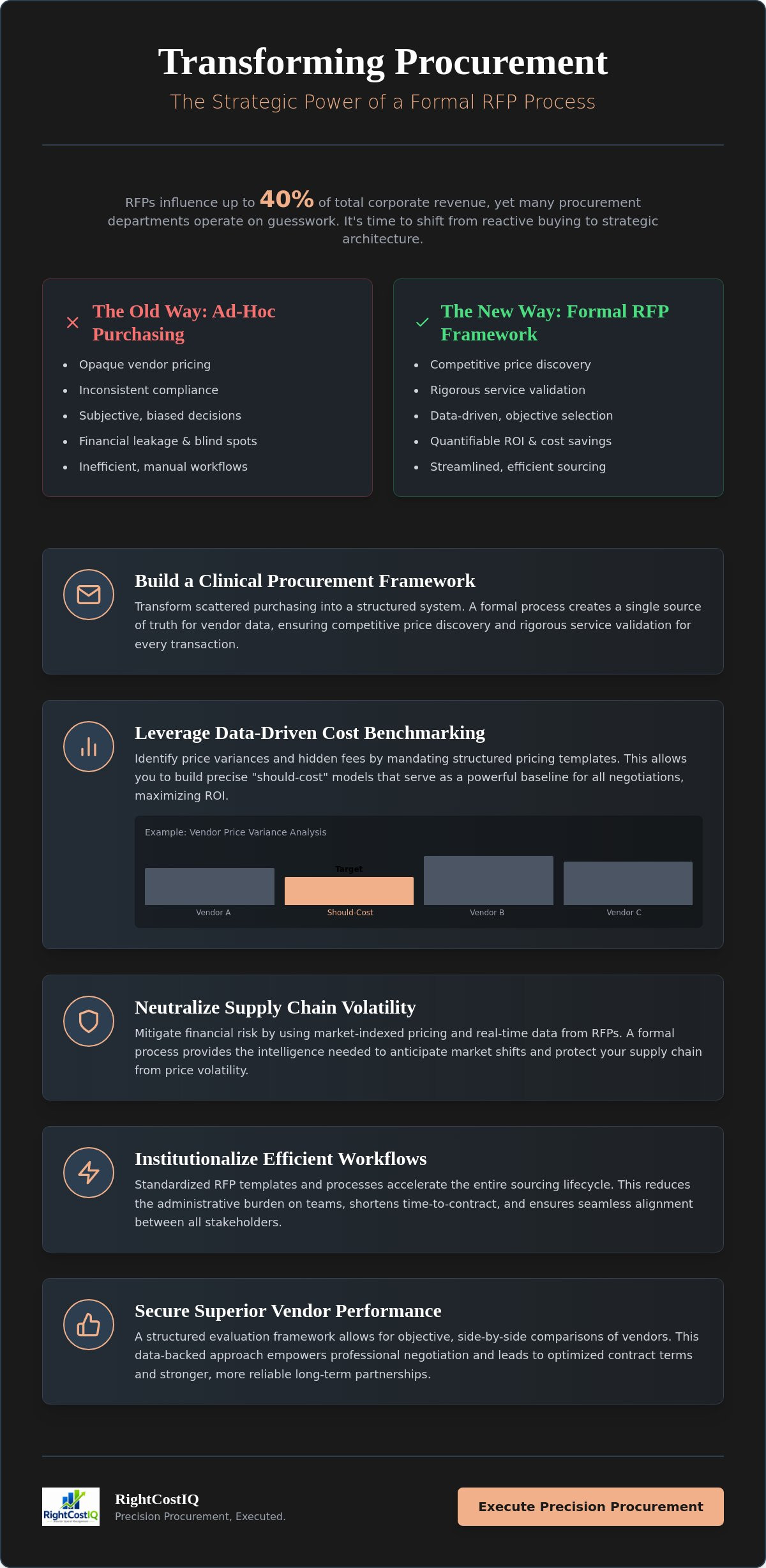
A structured procurement framework is the foundation of institutional fiscal health. In 2026, the transition from ad-hoc purchasing to clinical procurement frameworks is no longer optional for high-growth organizations. Ad-hoc sourcing relies on historical relationships and fragmented email chains; it lacks the rigor required for modern market volatility. This informal approach creates systemic financial leakage and operational blind spots that obscure the true cost of service delivery. By implementing a formal RFP process, your organization gains a clinical mechanism for competitive price discovery and service validation. This architecture ensures that every vendor interaction contributes to a single source of truth for vendor data.
The primary benefits of a formal RFP process stem from its ability to force transparency into opaque market sectors. When procurement teams operate without a formalized structure, they lose the ability to quantify vendor performance against enterprise benchmarks. Effective RFP Management centralizes these interactions, turning disparate bid responses into a structured database. This centralized intelligence allows decision-makers to identify outliers in pricing and service level agreements before contracts are signed. It's the difference between reactive buying and strategic architecting.
Beyond the Document: The RFP as a Data Engine
Formalizing the RFP process transforms qualitative vendor promises into quantitative data points. Instead of reviewing narrative proposals that vary in format, standardized evaluation criteria allow for side-by-side comparison. This objective framework eliminates subjective bias in sourcing, ensuring that selection is based on performance metrics rather than salesmanship. Integrating this data into the broader procurement technology infrastructure enables real-time analytics. Your RFP responses become the fuel for predictive modeling, allowing you to forecast future spend with surgical accuracy.
The Clinical Impact on Stakeholder Alignment
Internal friction often arises when departmental requirements conflict with enterprise-wide financial goals. A formalized process synchronizes these competing interests by establishing a clear roadmap for requisition and approval. Standardized documentation reduces the administrative burden on finance and legal teams, accelerating the review cycle without compromising compliance. When every stakeholder operates from the same playbook, the path from requisition to contract execution becomes seamless. A formal RFP is a strategic instrument for fiscal transparency that bridges the gap between operational needs and bottom-line objectives.
Maximizing ROI Through Data-Driven Cost Benchmarking
The realization of superior procurement ROI requires more than just receiving bids. It demands the conversion of vendor responses into granular cost intelligence. One of the primary benefits of a formal RFP process is the ability to fuel procurement category cost benchmarking with live market data. By mandating structured pricing templates, organizations can identify significant price variance across vendors. This analysis allows for the construction of a robust "should-cost" model, which serves as a clinical baseline for all future negotiations. When evaluating the benefits of a formal RFP process, the ability to institutionalize cost transparency stands as a primary advantage for financial decision-makers.
Structured data capture is the only way to uncover hidden fees and unbundled service costs that often inflate total cost of ownership (TCO). In high-volume procurement cycles, the economic impact of spend analytics is transformative. It allows for the identification of pricing anomalies that would otherwise be lost in narrative-heavy proposals. Precise data extraction ensures that "value-added" services are quantified and compared objectively. This level of scrutiny forces vendors to provide transparent pricing structures, effectively neutralizing the information asymmetry that usually favors the supplier.
Analytics-Led Price Discovery
Utilizing RFP data enables procurement architects to map market pricing trends in real-time. This dynamic approach allows for precise cost benchmarking against shifting industry standards. Transitioning from a "lowest bid" mentality to an "optimal value" strategy requires clinical analytics. This shift ensures that cost savings don't come at the expense of service quality or supply chain resilience. Organizations that prioritize data integrity can conduct a comprehensive diagnostic of their current spend to identify immediate margin expansion opportunities.
Quantifying Sourcing Success
KPIs for measuring financial efficiency must go beyond simple cost avoidance. A formalized sourcing event allows for the precise calculation of the delta between initial vendor quotes and final negotiated contracts. This metric provides a tangible ROI for the procurement function that can be presented directly to the C-suite. Integrating these outcomes into long-term category management strategies ensures that savings are captured and sustained over the entire contract lifecycle. This methodical approach turns procurement from a cost center into a primary driver of enterprise profitability.
Neutralizing Supply Chain Volatility and Price Risk
Supply chain volatility represents a systemic threat to corporate margin stability. While many organizations view procurement as a reactive function, a clinical RFP process serves as a primary tool for proactive price risk management. By integrating market price trending and forecasting into the sourcing phase, procurement architects can anticipate shifts in commodity or service costs. This forward-looking approach allows for the structuring of contracts with market-indexed pricing, which effectively mitigates financial volatility. Instead of accepting fixed prices that may become uncompetitive, organizations can link costs to objective market benchmarks to ensure long-term fiscal alignment.
One of the most significant benefits of a formal RFP process is its capacity to vet vendor financial stability and supply chain resilience before a contract is executed. An informal selection process often overlooks the underlying health of a supplier's balance sheet, creating exposure to downstream disruptions. A clinical framework mandates the disclosure of financial audits and disaster recovery protocols. This rigor ensures that your organization isn't exposed to the risk of supplier insolvency or operational collapse. Beyond immediate cost avoidance, the long-term benefits of a formal RFP process include the creation of a risk-neutral procurement environment that protects the bottom line.
Forecasting as a Negotiation Lever
Strategic procurement relies on the ability to leverage historical data to predict future price fluctuations. This intelligence transforms historical spend into a powerful negotiation lever. During the formal RFP process, establishing "most-favored-nation" clauses through clinical documentation ensures that your organization receives the most competitive rates available in the market. This structural safeguard is essential for mitigating the impact of inflation on long-term service agreements. It's about institutionalizing price protection within the contract architecture itself to prevent unmanaged cost creep.
Vendor Performance and Compliance Tracking
The RFP document serves as the clinical baseline for all future vendor performance tracking. Every promise made during the bidding phase must be converted into a measurable KPI. By using structured RFP response data, organizations can automate compliance monitoring and identify service failures in real-time. This ensures that the operational efficiency promised during the sales cycle is actually delivered. Rigorous vendor vetting and risk assessment during the RFP stage create a culture of accountability that persists throughout the entire contract lifecycle, driving superior performance and reliability.
Institutionalizing Operational Efficiency via Standardized RFP Workflows
Standardizing the sourcing lifecycle is the only way to achieve repeatable procurement success. Many organizations struggle with fragmented workflows that extend the "time-to-contract" metric and introduce unnecessary financial risk. One of the core benefits of a formal RFP process is the ability to institutionalize operational efficiency through standardized templates. This structure removes the ambiguity from vendor evaluation; it allows procurement teams to focus on strategic negotiation rather than administrative data entry. By implementing centralized RFP management platforms, your organization can scale its sourcing capabilities without a proportional increase in headcount.
Eliminating redundant manual tasks is critical for maintaining a lean procurement function. Traditional RFP cycles often involve hundreds of manual data points that must be verified across multiple spreadsheets. Realizing the full benefits of a formal RFP process requires the elimination of these manual redundancies through a clinical evaluation framework. This ensures that every sourcing event follows a rigorous, pre-defined path that minimizes the risk of human error. The resulting data integrity allows for faster decision-making and more accurate financial reporting to executive leadership.
The Workflow for Precision Execution
Execution excellence requires a methodical approach to every sourcing event. The following framework ensures that each RFP contributes to long-term enterprise value:
- Step 1: Clinical requirement gathering and stakeholder alignment to synchronize departmental needs with enterprise financial goals.
- Step 2: Leveraging cost benchmarking data to define a scope of work that accurately reflects current market price trending and forecasting.
- Step 3: Executing a multi-round RFP process to refine vendor shortlists through technical validation and competitive price discovery.
Automation and Technology Integration
Modern procurement demands the transformation of static documents into dynamic data sets for the C-suite. Automation reduces the administrative burden of high-volume RFPs by handling routine communications and data aggregation. This shift allows procurement professionals to operate as high-level consultants rather than clerical workers. Automated RFP management ensures that every interaction is captured within a clinical audit trail to maintain absolute compliance. Organizations looking to optimize their current workflows can conduct a comprehensive procurement diagnostic to identify specific bottlenecks in their sourcing lifecycle.
Executing Precision Procurement with RightCostIQ
RightCostIQ functions as the strategic architect for your RFP management, converting the theoretical benefits of a formal RFP process into tangible financial growth. While previous sections outlined the structural and analytical requirements of procurement, execution requires a specialized partner to navigate high-stakes vendor interactions. RightCostIQ integrates cost benchmarking and granular analytics into every sourcing event, ensuring no decision's made in a data vacuum. By utilizing advanced market trending models, the platform mitigates price risk before it impacts the balance sheet. This clinical approach ensures procurement isn't just an administrative process but a high-yield investment for the enterprise.
The value of professional negotiation assistance can't be overstated in high-stakes procurement. RightCostIQ provides the technical expertise required to challenge vendor pricing models that rely on information asymmetry. By establishing a single source of truth for market intelligence, the platform empowers procurement teams to demand transparency. This shift from reactive buying to strategic architecting is the defining characteristic of a modern procurement function. It ensures every contract's optimized for both immediate cost savings and long-term supply chain resilience.
Negotiation as a Clinical Discipline
Effective procurement requires moving beyond traditional "haggling" toward data-backed negotiation coach strategies. RightCostIQ provides the technical framework to leverage "should-cost" data during live vendor discussions, driving superior contract terms that reflect true market value. This discipline ensures negotiated savings are mathematically verifiable rather than anecdotal. When procurement architects use clinical data to anchor negotiations, the conversation shifts from price to value optimization. Beyond the initial contract, professional oversight maintains vendor performance standards, preventing the service degradation that often follows unmonitored agreements. It's about securing long-term partner alignment through clinical precision and unwavering accountability.
Next Steps for Strategic Optimization
Organizations must first audit their current RFP process for systemic financial leakage to begin the transition toward procurement excellence. This audit identifies where opaque pricing, unbundled fees, or manual inefficiencies drain corporate resources. Implementing a pilot RFP program for high-impact categories, such as tail spend, allows for a controlled demonstration of ROI before scaling enterprise-wide. These often-ignored categories frequently hide significant margin expansion opportunities that a formalized process can uncover. Engaging with RightCostIQ allows decision-makers to institutionalize these frameworks, turning procurement into a predictable driver of financial health. The path to clinical procurement starts with a commitment to data integrity, strategic rigor, and the adoption of advanced sourcing technologies.
Architecting a High-Yield Procurement Future
Transitioning from fragmented sourcing to a clinical procurement framework is a strategic imperative for margin expansion. You've seen how a structured approach transforms qualitative vendor bids into quantitative cost intelligence. By institutionalizing standardized workflows, organizations eliminate financial leakage and neutralize supply chain volatility through market-indexed pricing. The benefits of a formal RFP process extend beyond simple cost avoidance; they establish a foundation for long-term fiscal transparency and superior vendor performance. This evolution ensures that every sourcing event contributes directly to enterprise-wide financial growth.
RightCostIQ provides the specialized expertise necessary to execute these complex frameworks. As a partner specialized in healthcare financial analytics, we offer advanced "Should-Cost" modeling for high-value categories. Our global coverage ensures that complex supply chain negotiations are managed with surgical precision. It's time to replace administrative guesswork with data-driven architecting. Optimize your procurement outcomes with RightCostIQ’s RFP Management services and secure your organization's competitive advantage. Your path to clinical procurement excellence begins today.
Frequently Asked Questions
What is the primary difference between an informal bid and a formal RFP process?
The primary difference lies in the level of structural rigor and data integrity. Informal bids rely on fragmented communication and subjective criteria, which often leads to systemic financial leakage. A formal RFP process implements a clinical framework for competitive price discovery and service validation. This architecture ensures that every vendor response is evaluated against objective, standardized benchmarks rather than historical relationships or anecdotal evidence.
How does a formal RFP process improve vendor performance tracking?
A formal process converts vendor promises into measurable performance baselines during the sourcing phase. By capturing granular data, procurement architects establish the specific KPIs used for long-term vendor performance tracking. This ensures that the service levels promised during the bidding cycle are enforceable and auditable throughout the contract lifecycle. It transforms the RFP from a static document into a dynamic performance management tool.
Can a formalized RFP process actually save time in the long run?
Standardized RFP workflows significantly reduce the "time-to-contract" metric by eliminating redundant manual evaluations. While the initial setup requires precision, the use of automated templates and centralized management platforms accelerates the sourcing lifecycle. This efficiency allows procurement teams to scale their operations without increasing headcount. One of the core benefits of a formal RFP process is the institutionalization of repeatable, high-speed sourcing events.
What role does cost benchmarking play in the RFP lifecycle?
Cost benchmarking serves as the clinical baseline for every sourcing event. By analyzing RFP responses against market intelligence, organizations can establish a "should-cost" model that identifies price variances across vendors. This data-driven approach ensures that negotiations are anchored in market reality rather than vendor-provided quotes. It's an essential mechanism for maximizing ROI and identifying hidden fees within complex service categories.
How do formal RFPs mitigate price risk in volatile markets?
Formal RFPs mitigate price risk by incorporating market-indexed pricing structures into contract negotiations. This approach allows organizations to link costs to objective market benchmarks, protecting margins from sudden supply chain volatility. By utilizing market price trending and forecasting during the RFP phase, procurement architects can anticipate fluctuations and secure protective clauses. This proactive strategy replaces reactive buying with strategic risk neutralization and financial predictability.
Is a formal RFP process necessary for smaller procurement categories?
A formal process is essential for smaller categories like tail spend, where unmanaged leakage often occurs. Even low-value categories can represent significant cumulative savings when subjected to clinical procurement frameworks. Implementing a formalized structure ensures that bias is removed and competitive discovery is maintained across all spend tiers. It institutionalizes a culture of fiscal transparency that protects the organization's bottom line regardless of deal size.
What are the key KPIs for measuring RFP process effectiveness in 2026?
In 2026, the most critical KPIs focus on the clinical efficiency of the sourcing lifecycle. Key metrics include the "time-to-contract" duration, the delta between initial bids and final negotiated rates, and vendor compliance rates against RFP-established baselines. Organizations also track the percentage of spend managed through automated RFP workflows. These data points provide the C-suite with a quantifiable measure of procurement's impact on enterprise financial growth.
How does RightCostIQ assist in the negotiation phase of an RFP?
RightCostIQ acts as a strategic architect by providing professional negotiation assistance backed by granular analytics. The platform utilizes "should-cost" modeling and market intelligence to empower procurement teams during high-stakes vendor interactions. This clinical approach ensures that contract terms are optimized for both immediate cost savings and long-term resilience. It moves the negotiation phase beyond simple haggling toward a data-driven discipline focused on value optimization and margin expansion.


