
Nearly 50% of technology projects exceed their original budget and timeline when initial requirements lack clinical definition (DesignRush, October 2025). Most procurement leaders accept this cost opacity as an inevitable tax on innovation; yet, this systemic failure usually stems from a fragmented rfp process for software development. You've likely faced the frustration of comparing disparate vendor pricing models that feel like comparing apples to proprietary code, only to find yourself trapped in a vendor lock-in cycle due to poor initial contract structures.
RightCostIQ provides the strategic architecture to transform your sourcing from a guessing game into a data-driven RFQ sprint focused on margin expansion. By mastering this clinical framework, you'll eliminate scope creep, which 59% of MSPs cite as their primary project challenge, and secure transparent pricing through rigorous cost benchmarking. This article details a repeatable, AI-led methodology for vendor selection, ensuring your next development partner delivers high-performance results without the $2,000,000 enterprise price tag surprises.
Key Takeaways
- Transform procurement into a strategic value driver by utilizing the RFP as a clinical instrument for technical precision and margin expansion.
- Deploy an AI-led rfp process for software development to accelerate drafting cycles and ensure granular alignment between functional requirements and business outcomes.
- Identify pricing outliers through rigorous procurement category cost benchmarking and spend intelligence to secure transparent, market-aligned contracts.
- Execute high-stakes negotiations using market price forecasting and professional negotiation assistance to mitigate vendor lock-in and long-term price risk.
- Establish vendor performance tracking systems to maintain high-performance standards and ensure operational documentation remains current throughout the project lifecycle.
The Strategic Necessity of a Precision RFP Process for Software Development
The rfp process for software development serves as the architectural blueprint for technical alignment and fiscal accountability. It's a clinical instrument designed to dissect vendor capabilities and expose cost opacity before a single line of code is written. In an era where 59% of managed service providers identify scope creep as their primary project barrier (DesignRush, October 2025), precision in the sourcing phase is non-negotiable. Procurement is the new value driver. It transitions from a support function to a strategic architect of margin expansion. Informal sourcing methods, often characterized by "handshake agreements" or vague emails, inevitably lead to technical debt and systemic project failure. By integrating AI-led procurement optimization, organizations can compress vendor selection cycles while maintaining the data-driven rigor required for enterprise-grade software engineering.
The Economic Impact of Inefficient Software Sourcing
Vendor misalignment isn't merely an operational annoyance; it's a financial liability. Enterprise systems often range from $300,000 to over $2,000,000, and without rigorous spend intelligence, contract values frequently inflate by 25% or more. Nearly 50% of technology projects run late and over budget when requirements lack clear definition from the start. High-performance teams leverage should-cost modeling and procurement category cost benchmarking to eliminate these variances. There's a direct correlation between RFP precision and project success rates. A well-structured Request for Proposal (RFP) establishes a baseline for performance tracking and price risk management from day one. It prevents the $150,000 startup MVP from ballooning into a $300,000 legacy modernization nightmare through lack of oversight.
RFP vs. RFI vs. RFQ: Selecting the Right Procurement Instrument
Selecting the correct procurement instrument is the first step in strategic sourcing. An RFI (Request for Information) facilitates broad market discovery, identifying potential candidates within the tech stack landscape. Conversely, an RFQ (Request for Quotation) focuses strictly on price. This proves insufficient for custom development where hourly rates vary from $25 in offshore markets to $400 in US tech hubs like San Francisco. The rfp process for software development provides the necessary depth to evaluate both cost and technical execution simultaneously. It forces vendors to account for the 15% to 25% annual maintenance costs that many "simple" quotes ignore.
The Request for Proposal is the definitive clinical tool for complex software selection, requiring vendors to provide comprehensive solutions rather than just price points.
Architecting the Software RFP: Technical Specifications and Functional Requirements
High-performance procurement requires a clinical distinction between what a system does and how it survives. The rfp process for software development fails when technical specifications are treated as a wishlist rather than a rigorous performance contract. A precision-engineered RFP must include granular functional requirements alongside non-functional benchmarks such as latency, concurrent user capacity, and uptime. Integrating RFP Management: Strategic Frameworks into your drafting phase ensures every requirement correlates directly to a measurable business outcome.
As of February 2026, IT contracts involving software development in specific jurisdictions now require explicit provisions for data portability and transition support. This regulatory shift emphasizes the need for clear Service Level Agreements (SLAs) and technical debt management clauses. Without these, maintenance costs, which typically consume 15% to 25% of the original development budget annually, can spiral. Effective strategic sourcing for IT procurement mandates that vendors provide a breakdown of their tech stack to prevent expensive legacy dependencies. It's about securing long-term agility, not just a one-time delivery.
Defining the Technical Stack and Scalability Requirements
Specifying architecture preferences requires a delicate balance; you must define the environment without stifling the vendor's ability to innovate. Should-cost modeling acts as the primary tool here, allowing you to determine if a vendor's proposed timeline matches the complexity of the stack. For instance, US-based senior developers charging $150 to $400 per hour should demonstrate significantly higher velocity than offshore teams. Your RFP must also verify compatibility with existing enterprise procurement technology to ensure seamless operational integration.
Security, Compliance, and Data Governance Standards
Compliance isn't a post-launch checklist. It's a foundational requirement. Your RFP must mandate SOC2, GDPR, or CMMC 2.0 status, especially since the Department of Defense's implementation of CMMC 2.0 is now final. Defining data ownership and intellectual property rights from day one protects your firm from vendor lock-in. Establishing vendor performance tracking metrics during the RFP stage allows for objective security audits throughout the contract lifecycle. For organizations seeking to optimize these complex variables, professional RFP Management and Negotiation Assistance can secure the necessary contractual safeguards.
Proposal Evaluation and Benchmarking: Utilizing Spend Intelligence
Proposal evaluation is the pivot point where strategic intent meets financial reality. High-performing procurement teams don't just "read" bids; they deconstruct them using clinical spend intelligence to expose hidden variances. This level of analytical rigor is a core component of Category Management in Procurement, ensuring that every software sourcing event contributes directly to the organization's margin expansion. Without a standardized evaluation framework, the rfp process for software development descends into subjective decision-making, often favoring the most polished presentation over the most efficient technical solution.
Transparency in vendor labor rates and overhead is the baseline for clinical evaluation. As of May 2026, market data indicates US-based senior developers in hubs like NYC or San Francisco command $150 to $400 per hour, while offshore rates in India range from $45 to $75 for similar experience levels. Identifying outliers requires a deep understanding of these benchmarks. A vendor proposing senior-level architecture at junior-level rates is a red flag for future technical debt or bait-and-switch staffing tactics. Following established rules for an effective software development RFP ensures that vendors provide the granular data necessary for this level of scrutiny.
The Weighted Scoring Matrix: Beyond the Lowest Bid
A data-driven evaluation architecture eliminates subjective bias by designing a multi-variable scoring system. You should weight technical competency, financial stability, and cultural alignment according to the project's strategic value. For complex enterprise systems, technical innovation and long-term vendor stability might carry 60% of the weight, while the initial bid price carries only 40%. This prevents the "race to the bottom" where the lowest bidder wins but fails to deliver, a scenario that affects nearly 50% of technology projects when requirements aren't clearly defined from the start.
Market Price Trending and Should-Cost Analysis
Should-cost modeling for software engineering labor and infrastructure is the most effective defense against margin erosion. By using historical data and market price trending, you can forecast project costs with clinical precision. This analysis must account for the 15% to 25% annual maintenance costs that typically follow the original development phase. Identifying "hidden" costs such as API fees, licensing tiers, and cloud egress charges during the proposal stage prevents budget overruns. Clinical benchmarking prevents margin erosion during selection by ensuring vendor quotes align with verified market realities rather than arbitrary profit targets.
The RFP Sprint: A 5-Phase Execution Framework for Software Development
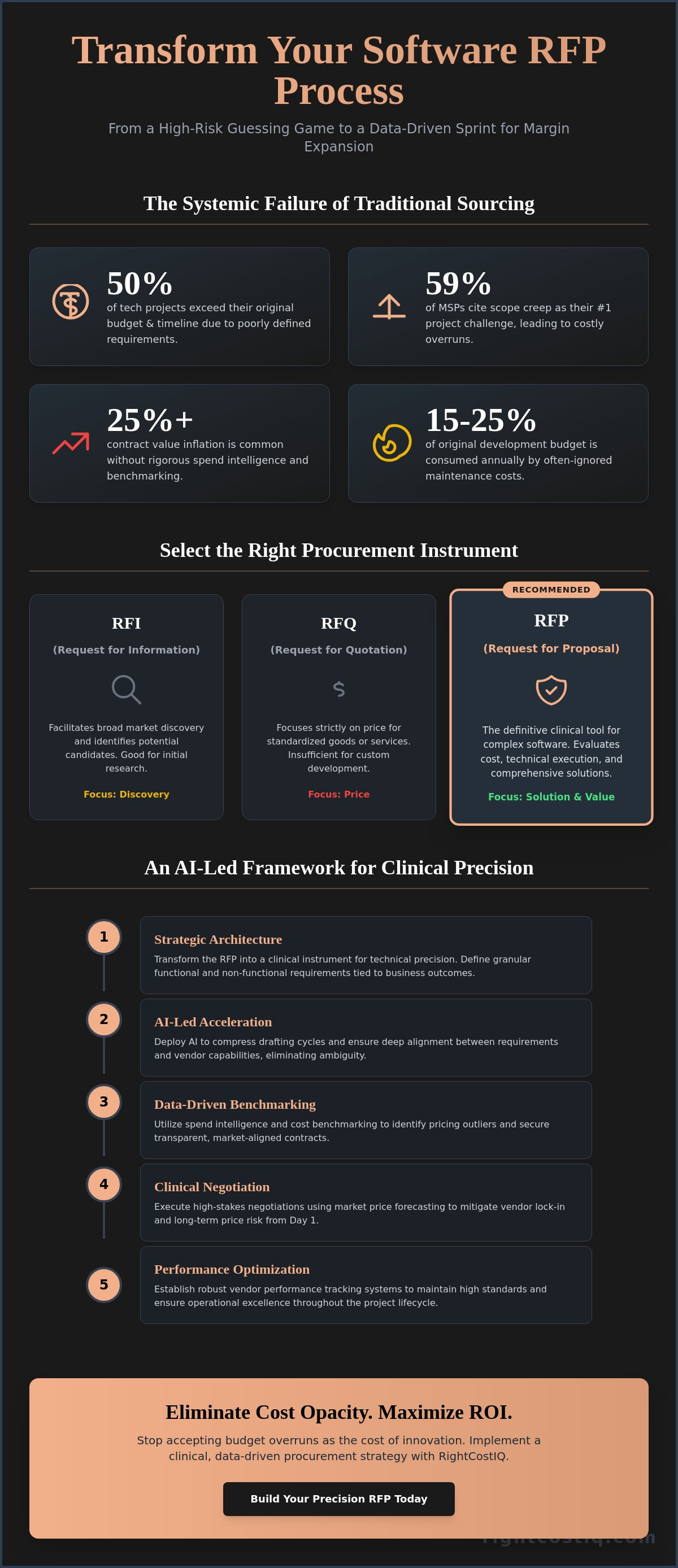
Modern procurement demands velocity. The traditional 120-day rfp process for software development is an operational bottleneck that stalls innovation. High-performing teams now compress these cycles into rapid execution sprints to capture market opportunities before they evaporate. This framework prioritizes clinical distance and data integrity across five distinct phases. Phase 1 focuses on internal alignment to define specific business outcomes. Phase 2 leverages AI-led procurement tools to generate technical requirements in hours. In Phase 3, you manage vendor engagement through a standardized Q&A process. Phase 4 involves executing comparative analytics to identify the optimal cost-performance ratio. Finally, Phase 5 moves into shortlisting and initial negotiation preparation.
Phase 1 & 2: Accelerating the Discovery and Drafting Cycles
Rapid requirement gathering requires a structured Go/No-Go framework to decide if a project warrants a full RFP. Stakeholder alignment must be clinical. You shouldn't waste time on features that don't drive margin expansion. Utilizing prompt engineering allows teams to generate complex technical sections of the RFP with surgical precision. While a typical timeline for proposal submission is 30 to 60 days, AI tools now decrease the average drafting time to approximately 25 hours. Setting rigid timelines prevents the procurement process from stalling and ensures the tech stack remains relevant by the time of selection.
Phase 3 & 4: Managing Vendor Interaction and Analytics
Maintaining clinical distance during vendor engagement is essential for objective evaluation. You should distribute the RFP to a sweet spot of three to five qualified vendors. Fewer than three reduces competitive tension. More than five creates an unmanageable evaluation load. Standardizing the Q&A process ensures every vendor receives identical information, protecting the integrity of the bid. This phase is about eliminating favoritism and focusing strictly on technical and financial merit.
Automating the comparison of vendor tech stacks and resource allocations allows for the execution of clean-sheet cost models. This level of spend intelligence exposes whether a vendor's pricing is grounded in reality or speculative profit. You'll identify if a nearshore team at $50 per hour offers better value than an offshore team at $25 per hour when velocity and quality are factored in. Organizations looking to compress these cycles can utilize RFQ Sprints to achieve rapid, data-driven vendor selection and secure high-performance partners without the usual administrative friction.
Beyond Selection: Clinical Negotiation and Vendor Performance Optimization
Selecting a vendor marks the conclusion of the evaluation phase, but the clinical execution of the rfp process for software development only yields results through aggressive negotiation and post-contract optimization. High-level decision-makers don't settle for the initial proposal. They utilize professional negotiation assistance to align vendor pricing with verified market benchmarks. Procurement is the new value driver; its efficacy is measured by the ability to convert spend intelligence into sustained margin expansion. Moving beyond a simple selection ensures that the technical precision established during the RFP phase isn't lost during contract finalization.
Market price trending and forecasting services serve as your primary negotiation levers. By referencing current data, such as the $50 to $100 per hour nearshore rates or the 15% to 25% standard for annual maintenance, you challenge vendor pricing assumptions with surgical precision. This ensures that contract values reflect real-world commodity indexing rather than arbitrary service markups. Using these data points during the rfp process for software development creates a position of strength, allowing you to secure high-performance partners at optimized price points.
Negotiation Strategies for Software Contracts
Effective negotiation requires more than just price reduction. It involves structuring performance-based incentives and penalty clauses that protect your technical roadmap. You should leverage should-cost modeling to identify where a vendor’s overhead is inflated. Price risk management allows you to mitigate future cost volatility, especially in long-term enterprise projects that range from $300,000 to over $2,000,000. These safeguards prevent the technical debt and budget overruns that often follow "handshake" agreements. Precision here ensures that the vendor remains accountable for the business outcomes defined in Phase 1.
Continuous Performance and Compliance Tracking
Optimization doesn't stop at the signature. Implementing automated systems for tracking software delivery milestones ensures that your project doesn't fall victim to the 59% of cases where scope creep stalls progress. You must maintain a current CMMC status or SOC2 compliance posture for the life of the contract, as mandated by the latest federal and industry regulations from May 2026. A dedicated vendor performance tracking service provides the visibility needed to ensure your partner remains a high-performing asset. It's about maintaining the clinical standards set during the sourcing event throughout the entire development lifecycle.
To secure these outcomes, optimize your software sourcing with RightCostIQ RFP Management and transform your procurement into a clinical engine for growth.
Scaling Technical Excellence through Procurement Precision
Scaling technical excellence requires a clinical shift from reactive sourcing to strategic architecture. You've seen how nearly 50% of technology projects fail due to poor initial definition (DesignRush, 2025). Mastering the rfp process for software development ensures your technical requirements align with fiscal reality from the start. By utilizing proprietary should-cost modeling and spend intelligence, you eliminate the cost opacity that leads to $2,000,000 budget overruns in complex enterprise systems. Success depends on maintaining clinical distance during vendor selection and leveraging data-driven negotiation levers to secure high-performance partners. Procurement is the new value driver, and its efficacy is measured by sustained margin expansion. It's time to transform your sourcing into a definitive engine for growth.
Master Your Software Sourcing with RightCostIQ RFP Management through AI-led procurement optimization and clinical negotiation assistance. Our framework provides the technical upskilling and competitive advantage needed to dominate your category. You don't have to navigate complex vendor landscapes alone. Start optimizing your technical spend today and secure the high-performing partnerships your organization deserves.
Frequently Asked Questions
How long does the RFP process for software development typically take?
A standard timeline for proposal submission and evaluation ranges from 30 to 60 days. For complex enterprise systems exceeding $2,000,000, the cycle can extend to 120 days to ensure technical due diligence. High-performing teams utilizing AI-led procurement tools now compress the drafting phase to approximately 25 hours, significantly accelerating the total rfp process for software development.
Is an RFP necessary for small software development projects?
Yes, any project exceeding a $20,000 investment requires a formal sourcing instrument to prevent budget overruns. In Florida, IT projects over the $195,000 threshold mandate competitive solicitations by law. Even for startup MVPs priced between $15,000 and $150,000, an RFP establishes the clinical requirements necessary to avoid the 50% failure rate common in undefined tech projects.
What are the most common mistakes in software RFPs?
The most frequent failure is the lack of granular technical specifications, which leads to the 59% scope creep rate reported by managed service providers. Many organizations also ignore the 15% to 25% annual maintenance costs that follow the initial development phase. Failing to mandate data portability and transition support as of February 2026 standards often results in expensive vendor lock-in risks.
How do you compare different pricing models like Fixed Price vs. Time and Materials?
Effective comparison requires should-cost modeling to benchmark vendor labor rates against market averages. Fixed price models provide cost certainty for well-defined legacy modernizations, while Time and Materials models require rigorous vendor performance tracking to manage costs for evolving enterprise systems. You must normalize these bids by evaluating the total cost of ownership over a three-year horizon.
Can AI tools be used to manage the RFP process effectively?
AI tools are now essential for automating first drafts, ensuring compliance with CMMC 2.0 standards, and managing the bid lifecycle. These technologies shift procurement from manual text generation to agentic workflow execution. By integrating AI-led spend intelligence, decision-makers can identify pricing outliers in minutes rather than weeks, optimizing the rfp process for software development for maximum efficiency.
What should be included in the vendor evaluation criteria for software development?
Evaluation criteria must utilize a weighted scoring matrix that prioritizes technical stack compatibility, security compliance, and financial stability. You should weight technical innovation at 60% for complex systems, ensuring the vendor can handle modern platform engineering requirements. Financial scoring must account for hourly rate variances, such as the $150 to $400 range for US-based senior developers.
How do you ensure vendor compliance during the RFP process?
Mandate that all participants maintain a "current" CMMC 2.0 status and provide documented SOC2 Type II reports. Your RFP must explicitly require adherence to the latest data portability regulations to ensure long-term operational documentation remains accessible. Clinical procurement requires verifying these credentials during the shortlisting phase to prevent selecting a partner that creates a security or regulatory liability.
What is the role of a procurement consultant in software sourcing?
A procurement consultant acts as a strategic architect, providing clinical negotiation assistance and category cost benchmarking to drive margin expansion. They utilize market price forecasting to challenge vendor assumptions and secure favorable contract terms. By applying spend intelligence and should-cost modeling, consultants transform software sourcing from an administrative task into a high-leverage financial optimization event.


