
A savings forecast alone won’t make the case. Building a business case for procurement technology means connecting the proposed investment to business priorities, total costs, measurable benefits, implementation risks, and the cost of doing nothing. Use evidence-backed, conservative estimates for the approval case, and separate likely benefits from less certain possibilities.
Procurement technology should demonstrate value beyond adoption. A credible case explains how the investment could improve savings, efficiency, supplier performance, contract compliance, or risk management, and how results will be measured after implementation. The assumptions behind each estimate matter as much as the projected return.
This article offers a practical checklist for linking procurement goals to business strategy, comparing options, quantifying financial and operational value, and defining risk metrics. It also explains how to establish a baseline and track results after implementation, so decision-makers can assess whether the technology delivers the outcomes projected in the case.
Key Takeaways
- Separate committed savings from probable gains and longer-term strategic benefits to make projected value easier to assess.
- Connect procurement technology goals to leadership priorities, then compare options against the same business outcomes.
- Set baseline measures for savings, supplier performance, contract compliance, efficiency, and risk so results can be tracked after implementation.
- Assess sourcing opportunities and supplier consolidation through category cost analysis, market pricing, and performance data.
- Build a decision-ready case that shows investment, expected returns, key assumptions, implementation risks, and the consequences of doing nothing.
1. Separating guaranteed, probable, and strategic benefits
Procurement technology can support sourcing savings, reduce manual processing, improve supplier visibility, and strengthen contract compliance. Building a business case for procurement technology starts with tying each benefit to a process change and measurable evidence. For example, a sourcing workflow may reduce administrative effort, while supplier data analysis can reveal cost differences or performance issues that manual reviews may miss.
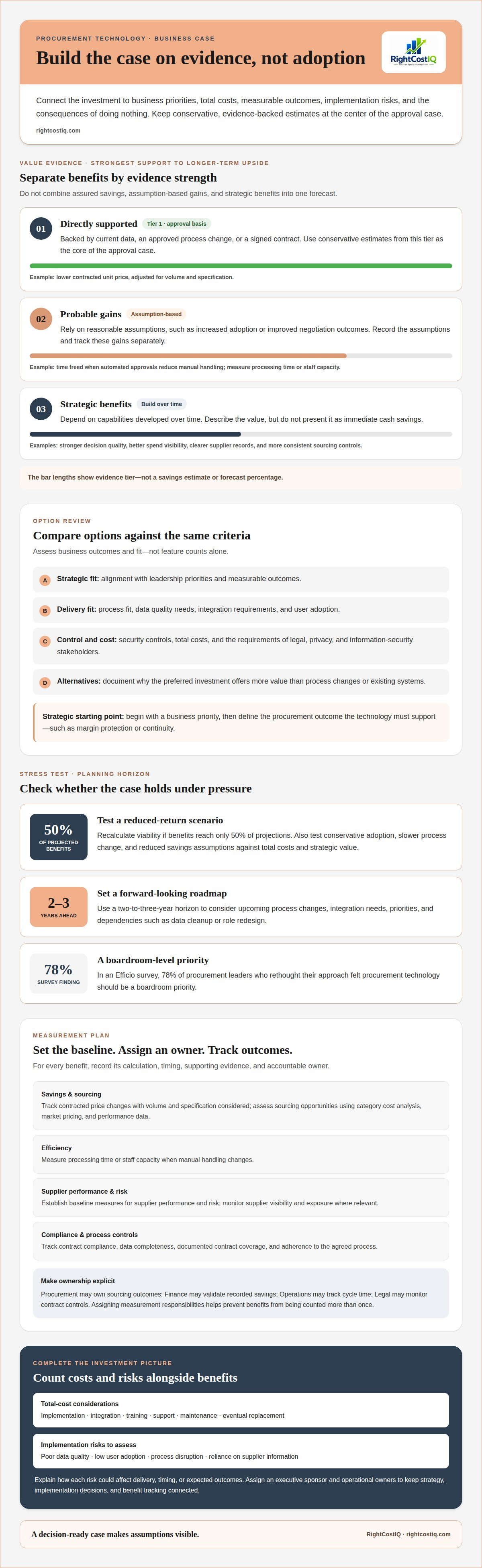
Separate benefits into three evidence tiers before presenting them to decision-makers. Tier 1 benefits are directly supported by current data, an approved process change, or a signed contract. Probable benefits rely on reasonable assumptions, such as increased adoption or improved negotiation outcomes. Strategic benefits, including stronger decision quality, depend on capabilities built over time and should not be presented as immediate savings.
For every benefit, record the calculation, owner, timing, and supporting evidence. A direct saving could be a lower contracted unit price than under the previous contract, adjusted for volume and specification. An indirect benefit could be staff time freed when automated approvals reduce manual handling. The first can appear in a cost forecast; the second needs an operational measure, such as processing time or staff capacity.
Include qualitative and operational outcomes, but do not present them as cash savings. Better spend visibility can help Finance identify budget variances; clearer supplier records can help Legal find contract gaps; standardized workflows can help Procurement apply sourcing controls consistently. These improvements support strategy, but need distinct measures, such as data completeness, documented contract coverage, or adherence to the agreed process.
Assess total costs alongside benefits and risks. Map implementation, integration, training, support, maintenance, and eventual replacement considerations across the technology’s expected use. Then assess risks such as poor data quality, low user adoption, process disruption, and reliance on supplier information. A viable case explains how each risk could affect delivery, timing, or expected outcomes.
Map each benefit to the stakeholder group that experiences it and the person accountable for measuring it. Procurement may own sourcing outcomes, Finance may validate recorded savings, Operations may track cycle time, and Legal may monitor contract controls. This prevents one benefit from being counted several times. A disciplined approach to building a business case for procurement technology presents conservative Tier 1 estimates as the approval basis, while tracking probable and strategic gains separately.
2. Aligning procurement investment with business strategy
Start with a business priority, then define the procurement outcome technology must support. If leadership is focused on margin protection, the case might prioritize spend visibility and sourcing decisions; if continuity is central, it might emphasize supplier performance and exposure monitoring. In an Efficio survey, 78% of procurement leaders who rethought their approach felt procurement technology should be a boardroom priority.
Compare solutions using consistent criteria, not feature counts alone. Assess alignment with strategic goals, process fit, data quality needs, integration requirements, user adoption, security controls, total costs, and measurable outcomes. A weighted evaluation can separate essential requirements from preferences, while a documented options analysis explains why the preferred investment offers more value than process changes or existing systems.
To validate the investment, test whether it remains viable if benefits reach only 50% of projections. Recalculate the case using conservative adoption, slower process change, and reduced savings assumptions. Then compare those results with the investment’s total costs and strategic value. A case that still supports a priority under reduced returns has stronger resilience than one dependent on an optimistic forecast.
Set the technology roadmap at least two to three years ahead. This horizon helps decision-makers assess whether an investment supports upcoming process changes, integration needs, and procurement priorities. It can also surface dependencies, such as data cleanup or role redesign, that may affect delivery. Assign an executive sponsor and operational owners to keep strategy, implementation decisions, and benefit tracking connected.
For organizations in the United States, procurement technology requirements depend on the data handled, contractual commitments, sector, and internal security policies. Map these conditions with legal, privacy, and information-security stakeholders, then document the controls and review responsibilities the solution must meet. Explain in the case how security requirements affect selection, implementation, and ongoing oversight.
Software implementation time depends on scope, integration complexity, data readiness, configuration, and the number of processes being changed. Resource planning should identify an executive sponsor, procurement process owners, IT and security specialists, data owners, and user representatives; each role supports decisions, testing, migration, or adoption. A technology roadmap should also consider lifespan: a 20-year investment may not generate the same return as it does during its first 10 years, so model value across its expected use rather than assuming returns remain constant.
Use a structured procurement investment fit review to connect strategic priorities with measurable outcomes and selection criteria.
3. Post-implementation measurement and reporting
Post-implementation measurement tests whether procurement technology delivers its approved outcomes. Set targets across a 12-month horizon and a 24-month horizon, separating early adoption signals from sustained financial or operational results. For example, log active user participation during rollout, then assess whether sourcing cycle times or contract compliance improve against the pre-implementation baseline.
Choose a defined KPI for each intended outcome. A savings target needs a calculation method, an agreed comparison period, and an owner who can reconcile results with Finance. Efficiency measures might include processing time or transaction rework; risk measures could track contract coverage or missed obligations. Avoid combining different outcomes into one score: a high adoption rate does not prove savings.
Establish the baseline before launch. If clean historical data is unavailable, use a 2-week baseline sprint to capture current procurement activity and data quality. Record the source, date range, definitions, and exclusions for each measure. For example, a cycle-time baseline should use the same start and end points as later reporting, or the comparison will not show whether implementation changed performance.
Translate operational records into visible risk measures. A team managing 800 obligations with a 15% baseline miss rate would have 120 missed obligations annually. After implementation, compare the same obligation population and definition, then report both the miss rate and count. Include severity or business impact where the records support it, so leaders can distinguish routine exceptions from exposure requiring action.
Consult stakeholders before finalizing success measures. Procurement can define sourcing and adoption indicators; Finance can approve savings rules; Operations can assess workflow effects; Legal and risk teams can identify relevant contract or control measures. Each group should confirm the measure, data source, reporting owner, and decision it informs. This keeps the dashboard focused on metrics stakeholders can use.
Use a recurring scorecard to compare baseline, target, actual performance, and variance. Briefly explain material changes, such as delayed integrations, incomplete supplier data, or low user adoption. Present financial and operational measures separately, and flag dependencies that affect interpretation. Recording metric definitions and owners lets executives compare reporting periods consistently.
Review results at planned checkpoints during implementation and after launch. Early reviews can identify adoption or data problems; later reviews assess whether target outcomes persist. If savings fall behind the approved trajectory, investigate usage, sourcing activity, or calculation assumptions before changing the target. Document corrective actions, accountable owners, and the next review date so measurement informs decisions rather than simply recording performance.
4. Cost savings from sourcing and supplier consolidation
Sourcing technology can reveal savings opportunities by bringing category spend, supplier terms, and purchasing activity into view. For example, a buyer can compare prices paid across business units for the same specification, then investigate differences before the next sourcing event. Account for volume, delivery terms, quality requirements, and contract conditions, not just unit price.
Build the savings case from a defined baseline. Group purchases by category, normalize differences in product or service specifications, and identify current contracted prices and actual purchasing patterns. Then estimate the effect of a specific action, such as renegotiating a contract or consolidating demand. Keep forecast savings separate from realized savings, which should reflect completed purchases under the new terms.
Supplier consolidation can strengthen negotiating leverage when demand is spread across vendors. It may also reduce duplicated onboarding, invoice handling, and contract administration. But using fewer suppliers can increase dependency or reduce supply flexibility. Before recommending consolidation, weigh the expected commercial and process benefits against continuity risks, supplier capacity, geographic coverage, and the impact of disruption.
Use category-level analysis to distinguish genuine savings from accounting shifts. Moving spend between suppliers does not necessarily reduce total business costs. Track changes against comparable specifications and demand, and include implementation expenses, transition work, and changes in service levels. A lower unit price, for example, may not deliver net value if expedited freight or quality issues increase.
Supplier performance data helps test whether a sourcing opportunity is sustainable. Compare delivery reliability, quality outcomes, responsiveness, and contract adherence alongside commercial terms. A supplier with a competitive quote may not offer the best total value if operational performance causes rework or delays. Use documented performance trends to inform bid requirements, evaluation criteria, negotiation priorities, and contract measures.
Present each opportunity with its category, baseline, proposed sourcing action, assumptions, and accountable owner. Separate hard savings from avoided costs and efficiency gains because they affect financial reporting differently. Renegotiated rates, for example, can be tracked against realized spend, while reduced administrative effort can be measured through process activity. Finance can then validate results using consistent definitions.
Technology can make spend patterns and supplier results easier to analyze across categories. The business case should identify which decisions will improve, what data supports them, and how savings will be captured after implementation. Prioritize opportunities with clear demand, comparable specifications, and actionable contract terms. Treat projected consolidation gains as estimates until purchasing behavior and supplier performance demonstrate the results.
5. Building a procurement business case checklist
A decision-ready case gives leaders a traceable path from business problem to approval and measurement. Use this checklist to make each claim testable, assign ownership, and surface assumptions before funding decisions. The project sponsor owns the business case, while Finance and operational stakeholders provide evidence and review key calculations.
- Define the problem. Describe the procurement issue and include a number in every problem statement. For example, identify the share of purchases processed outside the intended workflow or the volume of supplier records missing required information.
- Specify the proposed solution. Explain which process or capability will change, who will use it, and how it addresses the stated problem. Distinguish technology implementation from process redesign or training needed to deliver the outcome.
- Show the investment and return. Estimate total investment for each of the next five years. State the payback period in months and ROI as a percentage of the investment, with calculation methods and timing clearly identified.
- Quantify the value categories. Present hard savings, soft savings, risk avoidance, and revenue impact separately. Include financial and operational benefits such as efficiency gains, reduced exposure, supplier performance, and contract compliance.
- Document assumptions and evidence. Give Finance the assumptions and sources behind every estimate. Identify the baseline, data owner, calculation method, and conditions that could affect each projected benefit.
- Assess the risk of doing nothing. Describe the likely business consequence of maintaining the current process, using measurable evidence where available. Compare that exposure with implementation risks and the actions planned to manage them.
- Set approval and success criteria. Name the decision-makers, required approvals, accountable owners, and measures of success. Connect each measure to a reporting method and a post-implementation review.
Options analysis strengthens the recommendation. Compare the preferred solution with maintaining current processes and other feasible approaches, using consistent criteria for cost, capability, risk, and strategic fit. Explain why alternatives were rejected instead of presenting a preferred option without context. This gives leaders a clear rationale for approving the investment.
Keep the case distinct from the implementation plan. The case justifies the decision; the plan defines methodology, process, delivery responsibilities, and project management structure. After approval, carry the case’s targets into delivery documents so teams can track commitments against actual outcomes. Assess your procurement case and priorities to clarify the evidence behind the decision.
RightCostIQ
RightCostIQ helps connect procurement decisions with cost, supplier, and sourcing evidence. Its support can strengthen category analysis, provide clearer market context, and improve visibility into supplier performance and price risk. Procurement Category Cost benchmarking and Analytics can inform cost assumptions, while Procurement and Vendor Performance Tracking Service supports ongoing performance measurement. Request For Proposal (RFP) Management and Negotiation Assistance can align sourcing activity with the outcomes defined in the case.
These capabilities support evidence-led procurement decisions; they do not replace the organization’s responsibility for investment approval, implementation, or benefit tracking. Contact RightCostIQ to discuss the procurement priorities and analysis relevant to your business case.
Turn the business case into a decision
The next step is to turn the investment decision into action. Assign an accountable sponsor, connect approval conditions to implementation milestones, and keep the original case available as a reference. This creates a clear line from the investment rationale to delivery decisions, including adjustments when priorities or assumptions change.
Building a business case for procurement technology is most useful when it informs governance beyond approval. Use it to frame trade-offs, clarify which outcomes matter most, and establish how leaders will respond when actual performance differs from projections. This discipline keeps procurement technology tied to business decisions instead of treating implementation as the finish line.
RightCostIQ can support procurement analysis through its sourcing, cost benchmarking, and supplier performance offerings. If you’re ready to discuss how procurement priorities fit your case, contact RightCostIQ to discuss your needs. A clear next step can turn a sound investment rationale into focused action.
Frequently Asked Questions
What About Risk Mitigation Metrics?
Risk mitigation metrics show whether procurement controls reduce exposure or improve visibility. Track measures such as contract coverage, supplier concentration, unresolved price variances, and overdue supplier actions. Define each metric’s calculation and escalation threshold before implementation. For example, rising uncontracted spend can trigger a review of sourcing controls, while repeated supplier performance issues can prompt a corrective action plan with an assigned owner.
What is a business case for procurement technology?
A procurement technology business case is a decision document explaining why an organization should invest in a technology-enabled procurement change. It connects a defined business need to a proposed approach and outlines the evidence leaders need to authorize action. A useful case also states what approval enables, such as testing a workflow or integrating supplier data, and which conditions would justify changing course.
What business problems can procurement technology solve?
Procurement technology can address practical problems such as fragmented purchasing records, inconsistent sourcing processes, limited supplier performance visibility, and difficulty tracking price changes. For example, when teams store supplier data in different formats, analysis may miss overlapping purchases or emerging exposure. A technology-enabled process can organize information for review, but the business case should identify the specific decision or workflow the change is meant to improve.
How to calculate ROI and total cost of ownership for procurement software?
Calculate ROI by subtracting investment costs from measured benefits, dividing the result by the investment, and expressing it as a percentage. Define the measurement period and avoid counting a benefit twice. Total cost of ownership should include costs across the selected evaluation period, such as software, integration, implementation, training, support, and internal labor. Compare alternatives using the same cost categories and assumptions.
What are typical procurement software costs and pricing models?
Procurement software may use subscription, license, or usage-based pricing models, and the structure and scope affect total costs. For a specific engagement, pricing depends on the case and is provided after a quote request; relevant factors include required capabilities, user needs, integrations, and support scope. Compare costs across the same evaluation period, including implementation and ongoing operating costs rather than headline fees alone.
How to measure procurement technology benefits with KPIs?
Choose KPIs that match the intended process change, then define the data source, calculation, reporting owner, and review cadence. For example, a team seeking to improve sourcing participation can track the share of eligible events that follow the intended process. Pair that measure with results such as completed sourcing actions or documented supplier responses. Segment reporting by category or business unit to reveal differences in performance.
What steps are involved in building a procurement technology business case?
Start by defining the business problem and the decision required. Then compare viable approaches, identify the preferred solution, and document its investment, expected benefits, risks, and assumptions. Assign an accountable sponsor and agree on approval criteria. Translate the approved case into implementation milestones and reporting responsibilities. This sequence gives decision-makers a traceable rationale and helps delivery teams manage changes without losing sight of the original objective.
What data and stakeholder input are needed to justify procurement software?
Useful evidence can include purchasing records, supplier master data, contracts, invoice details, sourcing outcomes, and current process documentation. Procurement can explain workflow constraints; Finance can review calculation methods; IT can assess integration and security needs; business users can identify adoption barriers. Ask each group to clarify data definitions and ownership. For example, agree which purchases qualify before reporting savings from a new sourcing process.


