
AI procurement succeeds or fails before a contract is signed. Knowing how to procure AI technology means more than choosing a tool: it means matching a defined procurement need with reliable data, workable processes, and measurable business value. The technology is only one part of the decision.
AI can help procurement teams analyze information, automate routine work, and identify patterns, but its outputs still require governance and human oversight. This guide explains how to assess readiness, select initiatives with a clear business case, evaluate supplier fit, and plan implementation. It also covers how to connect expected benefits to practical measures, account for integration and ongoing operating needs, and keep people accountable for supplier decisions and contract approvals. The result is a structured approach to adoption, grounded in procurement priorities rather than technology for its own sake.
Key Takeaways
- Assess process pain points, data quality, system compatibility, and team capabilities before choosing an AI initiative.
- Prioritize use cases with measurable procurement outcomes, then build a business case that accounts for integration and ongoing costs.
- Use supplier evaluation criteria that cover technical fit, security, scalability, and performance, not just price.
- Roll out AI in phases, gather user feedback, and monitor results so implementation decisions stay grounded in operational evidence.
- Keep people accountable for supplier selection and contract approvals, using AI insights to support rather than replace judgment.
Human oversight in supplier selection and contract approvals
AI can screen supplier information, flag contract terms, and surface predictive risk signals. People must validate those outputs before decisions affect awards, obligations, or payment terms.
Expertise in Supplier Decisions
Human expertise means applying procurement judgment to AI outputs before selecting a supplier or approving contract terms. Models can organize evidence, but stakeholders remain responsible for weighing commercial fit, operational requirements, and exceptions. For example, a procurement specialist can challenge a ranking if a supplier’s delivery record or contract commitments conflict with the model’s recommendation.
Use AI to narrow the review, not to make an autonomous award. Procurement, legal, finance, and technical stakeholders can each assess risks within their remit. A risk flag, for instance, may prompt a closer review of a supplier’s performance history before an approval proceeds.
Vendor Security, Privacy, and Data Handling
Vendor security, privacy, and data-handling evaluation examines how a tool accesses, processes, stores, and deletes organizational information. To evaluate these areas, map the data shared with the tool and review the vendor’s controls, retention terms, access permissions, and use of submitted data. This matters because supplier records, contract terms, and payment information can have different levels of sensitivity.
Ask vendors to explain data flows, user access, retention, deletion, and whether customer data can be used to train generative AI models. Record each answer against procurement requirements, then involve security and privacy stakeholders in resolving gaps before approval.
Governance requires defined decision rights, review points, and escalation paths. Procurement AI can track contract terms and deadlines, then flag potential issues for staff. Keep human approval in the process for supplier awards, material contract changes, and exceptions, even when an AI workflow prepares the recommendation.
- Assign a named reviewer to validate supplier rankings and supporting evidence.
- Require staff approval before AI-generated contract changes enter a final agreement.
- Log overrides, reasons, and approvals so later reviews can trace decisions.
- Set an escalation route for missing evidence, conflicting outputs, or unusual terms.
Contract summaries need direct comparison with source documents. In one example, the actual contract specified net 45 payment terms, while a generative AI tool reported net 30. That mismatch shows why staff should verify critical fields against the signed text before approval. A structured RFP and negotiation process can also make supplier requirements and evaluation criteria explicit.
Governance is a material adoption risk: in a 2026 survey, 22 percent of procurement executives named lagging governance as the top unintended risk emerging from AI in procurement. Yet in a 2026 survey, 96 percent saw procurement’s future as a human-plus-machine model, and 62 percent expected a human-led model with AI support over the next three to five years. Keep that balance operational through documented reviews and ongoing supplier performance monitoring.
Procurement AI adoption and implementation stages
For U.S. public buyers, applicable procurement rules depend on jurisdiction; District agencies may use procurement methods under D.C. Official Code § 2 -354.01 and Title 27 of the DC Municipal Regulations. To pilot, deploy, and monitor an AI solution, start with a bounded workflow, gather user feedback, refine the tool, then scale and track performance, results, and ROI.
Procurement AI Adoption Stages
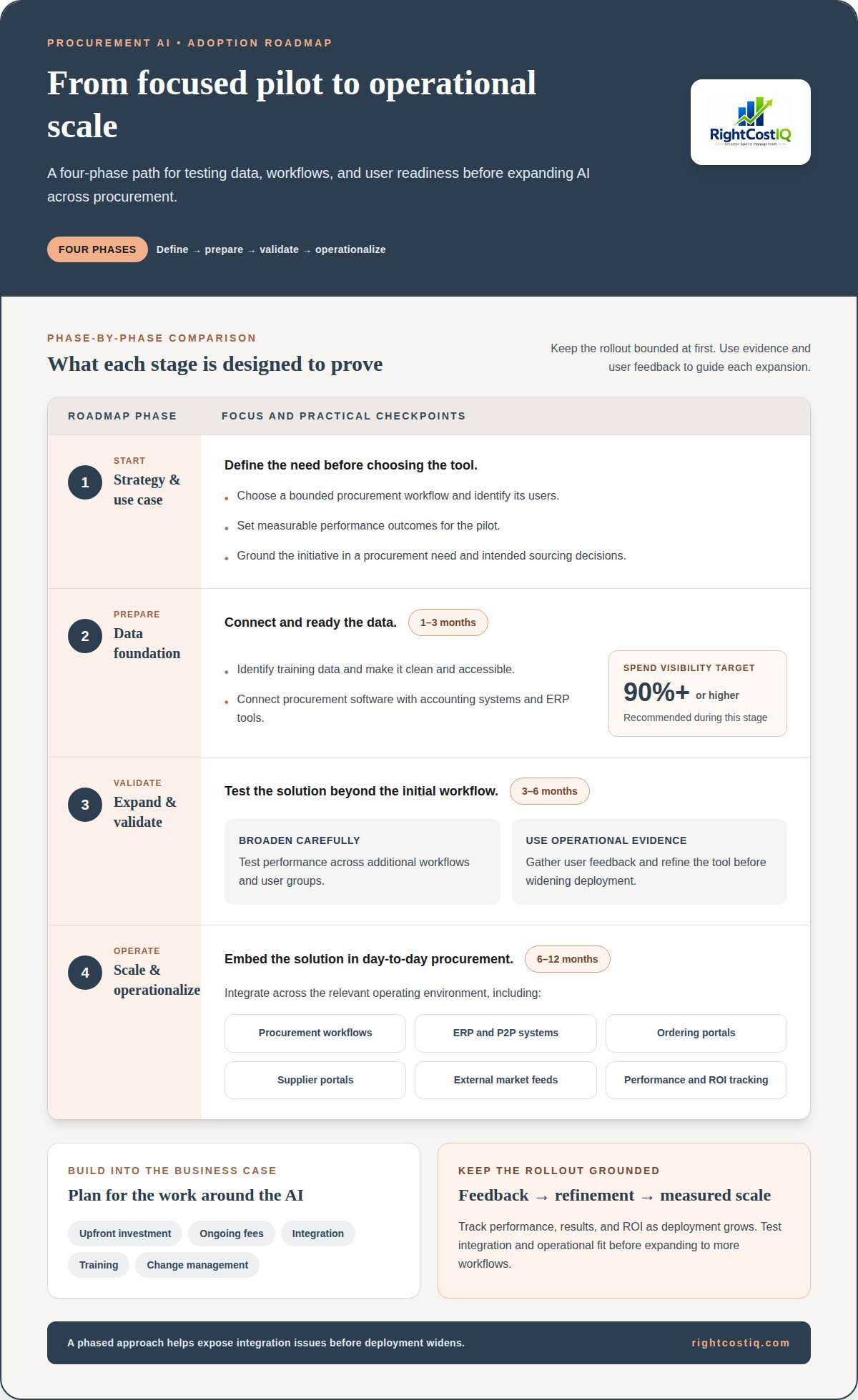
Procurement AI adoption can progress from a focused pilot to validated expansion and operational scale. Staging matters because each phase tests data, workflows, and user capabilities before wider deployment. A four-phase roadmap begins with strategy and use-case definition, establishes the data foundation, expands and validates the solution, and then scales it across operations.
The data foundation phase takes 1-3 months and centers on identifying training data and connecting procurement software with accounting systems and ERP tools. The roadmap recommends targeting 90% or higher spend visibility during this stage. Clean, accessible data helps teams assess whether AI outputs support the intended sourcing decisions.
Organizational Procurement Steps
Organizational procurement steps turn a defined need into a tested, integrated capability. They help teams align the solution with existing technology and daily workflows. For example, a pilot for invoice matching should connect with relevant purchasing and accounting processes before broader use.
During the expand-and-validate phase, which takes 3-6 months, organizations test performance across additional workflows and user groups. The scale-and-operationalize phase takes 6-12 months, embedding the solution into procurement workflows, ERP and P2P systems, ordering portals, supplier portals, and external market feeds. A phased approach helps expose integration issues before deployment widens.
The business case should include upfront investment and ongoing fees, as well as integration and training requirements. Change management also needs a defined plan: procurement staff must learn to interpret AI outputs, act on insights, engage strategically with suppliers, and manage workflow changes. For example, teams adopting AI-assisted sourcing need clear handoffs between automated analysis and buyer review.
Use a controlled rollout to test operational fit before scaling:
- Define the pilot: Select a bounded procurement process, its users, and measurable performance outcomes.
- Test integration: Confirm that the tool fits existing ERP and P2P systems and required data flows.
- Gather feedback: Ask internal users to evaluate the tool and identify workflow or output issues.
- Expand deliberately: Incorporate findings, train affected employees, and extend adoption to further workflows.
- Monitor continuously: Measure performance, results, and ROI, then adjust configuration and processes as needed.
This sequence connects procurement, technology, and workforce readiness. A pilot that produces useful predictions but lacks reliable data connections or trained users is not ready to scale. Phased validation helps organizations find those gaps before they affect broader operations.
Assessing procurement AI readiness
Assess accuracy, bias, explainability, and reliability by testing the tool against representative procurement cases and comparing its outputs with verified records. Review errors across supplier types, examine the factors behind recommendations, and repeat tests when inputs or workflows change.
Readiness starts with the procurement problem, not the technology. Map the current process, identify costly delays or control gaps, and define where automation could improve decisions. For example, a team considering AI for spend analysis should first establish which categories and records need better visibility.
Data quality determines whether artificial intelligence can produce useful procurement insights. Inventory relevant data sources, check consistency in supplier names and category codes, and identify missing fields. Suplari and Procurement Tactics report that 39% of procurement teams operate with fragmented data across spreadsheets and disconnected systems. Fragmentation can limit adoption until teams resolve access and integration needs.
Assess the supporting infrastructure and operating model alongside data. Deloitte reported that 43% of companies identified infrastructure as an AI-readiness gap, while 40% identified data management. Deloitte also reported that 20% identified talent readiness as a gap. These findings point to three practical review areas: systems, data ownership, and staff capability.
- Process fit: Document the existing workflow, pain points, decision owners, and points requiring human review.
- Data readiness: Check whether relevant records are accessible, consistently classified, and suitable for the intended use.
- Technology fit: Identify integration needs across procurement software, accounting systems, and ERP tools.
- Team capability: Establish who will interpret outputs, act on insights, and manage changes to procurement roles.
- Value measures: Define a baseline for cycle time, data quality, compliance, or savings before deployment.
Measure AI accuracy against the task, not a vendor’s general performance claim. For supplier recommendations, compare suggested matches with procurement specialists’ assessments and document false positives or missed candidates. For contract analysis, test extracted terms against source documents and record any discrepancies.
Bias and explainability need separate checks. Compare outcomes across supplier groups and categories to identify patterns that could disadvantage qualified suppliers. Ask how the system produces a recommendation, what data informed it, and which factors users can inspect. If staff cannot understand or challenge an output, it is difficult to govern reliably.
Finally, assess whether readiness supports the expected business case. Deloitte reported that 42% of companies considered their AI strategy highly prepared, a reminder to distinguish strategic intent from operational capability. Advance when the selected process, data, systems, and team can support a controlled evaluation. If a core input remains unreliable, address that constraint before relying on AI-generated savings estimates or recommendations.
Building the business case for procurement AI
Before buying AI, define the business requirement, target process, baseline, success measures, data needs, integration constraints, and accountable decision-makers. For example, an organization seeking faster invoice matching should specify the current workflow, required accounting connections, exception handling, and how it will measure accuracy and cycle time.
Connect each use case to a procurement outcome. AI can support supplier discovery and performance assessment, automate purchase order generation and invoice management, forecast demand, or identify supply-chain risks. Choose a problem with an observable operational baseline rather than justifying a tool through broad claims about innovation.
Translate the requirement into measurable objectives before evaluating vendors. A sourcing analytics initiative might track spend coverage, category insights, and the time analysts spend consolidating disconnected records. An invoice workflow might measure matching exceptions and manual review effort. Establish a baseline first, then define the desired outcome and review period.
Build a total-cost view that includes upfront investment, ongoing fees, integration work, data preparation, training, and internal support. Map each cost to the implementation scope. A tool requiring new connections to an ERP and accounting system, for instance, has different deployment needs from a capability embedded in an existing procurement platform.
Estimate benefits conservatively and separate hard savings from capacity gains. McKinsey reports that procurement teams using AI category agents are capturing efficiency improvements of 15 to 30 percent by automating non-value-added activities. Treat this as context, not a guaranteed result for an individual deployment. Base projections on the processes and workload the proposed initiative will actually affect.
Deloitte’s 2025 Global Chief Procurement Officer Survey reported that Digital Masters achieved an average 3.2x investment return on GenAI. Followers saw a projected slightly above 1.5x increase in ROI from GenAI. These reported outcomes show why capability and execution belong in the business case alongside technology selection. They are not a substitute for an organization-specific baseline.
- Operational value: Identify the task, affected stakeholders, and measurable performance indicator.
- Financial value: Distinguish cost reduction from released capacity and improved decision quality.
- Delivery requirements: Account for data access, integration, security review, training, and ongoing oversight.
- Governance: Name owners for results, approvals, exceptions, and performance monitoring.
Secure stakeholder alignment by presenting the use case, assumptions, cost of ownership, and review criteria together. Finance can challenge the savings model, IT can assess integration, and procurement users can validate workflow fit. The business case is ready for a decision when these groups agree on what success means and how to measure results after deployment.
What are the steps to procure AI technology for an organization?
Knowing how to procure AI technology starts with a defined need, then moves through supplier evaluation, contract approval, and controlled implementation. A disciplined process connects the selected tool to business requirements, existing systems, and measurable performance.
- Define the use case. Identify the procurement task, its current constraints, and the decision the AI tool should support. For example, specify whether the need is supplier discovery, contract analysis, invoice matching, or demand forecasting. Set measurable outcomes before reviewing products.
- Document requirements. Translate the use case into functional, technical, and operational criteria. Include expected data inputs, user roles, workflow integration, security needs, and human review points. A requirement for contract analysis, for instance, should identify which contract terms the tool must extract and how staff will validate them.
- Prepare the solicitation. Use an RFP to communicate requirements and request comparable supplier responses. Include evaluation criteria, implementation assumptions, support expectations, and evidence the supplier must provide. District agencies procuring AI tools must prepare a Scope of Work and an Independent Government Estimate.
- Evaluate supplier fit. Assess responses against the requirements, not just product demonstrations. Review security and data handling, compatibility with procurement software and ERP systems, scalability, and the supplier’s approach to performance monitoring. Record how each response meets or misses a stated criterion.
- Test the solution. Use product demos and trials to assess real tasks with internal users. A sourcing team could test whether the tool organizes supplier information in a useful format. Compare outputs with the underlying records, capture user feedback, and identify workflow or integration issues before selection.
- Negotiate and approve terms. Align the contract with the intended use, implementation responsibilities, data handling, performance expectations, and review process. Assign appropriate stakeholders to examine commercial and operational terms. Keep approval authority with people who can assess the consequences of contractual commitments.
- Pilot before broader rollout. Deploy the selected capability in a bounded workflow, gather feedback, and make adjustments. Confirm that it works with the existing technology stack and can scale with business and data needs. Monitor performance and ROI after deployment, then use results to guide expansion.
These steps create a decision trail from the initial requirement through supplier selection and ongoing oversight. For organizations considering how to procure AI technology, assess your procurement readiness to identify gaps that could affect evaluation or implementation.
RightCostIQ
RightCostIQ helps procurement teams strengthen commercial decisions around technology sourcing and supplier selection. Its RFP management and negotiation assistance supports structured evaluations, while category cost benchmarking and analytics help assess pricing and identify savings opportunities. Vendor performance tracking and price risk management can also inform supplier oversight after a contract is awarded.
Turn to these capabilities when your team needs clearer market context, comparable supplier proposals, or a disciplined way to track commercial performance. They complement AI procurement by supporting sourcing and supplier management decisions around the technology, rather than replacing internal technical, security, or legal review.
Contact RightCostIQ to discuss your procurement requirements.
Turn procurement priorities into your next decision
The next step is to turn interest in AI into a defined procurement decision: identify the business need, assign ownership, and establish how the organization will assess value over time. Knowing how to procure AI technology becomes more manageable when commercial evaluation and implementation planning are treated as connected decisions, not separate workstreams.
RightCostIQ supports related procurement decisions through Request For Proposal (RFP) Management and Negotiation Assistance, Procurement Category Cost benchmarking and Analytics, and Procurement and Vendor Performance Tracking Service. These capabilities help teams structure supplier evaluations, understand category costs, and monitor vendor performance as technology plans develop.
Use the next discussion to clarify the procurement challenge, the evidence needed for supplier selection, and the commercial outcomes that matter. Contact RightCostIQ to discuss procurement AI and identify a practical path forward for your organization.
Frequently Asked Questions
What is a procurement AI strategy?
A procurement AI strategy defines where artificial intelligence supports procurement goals, how the organization will govern it, and how results will be assessed. It connects use cases, data, systems, decision rights, and workforce needs. For example, a team might prioritize analyzing supplier proposals, then specify which decisions remain with buyers and how the outputs will fit existing sourcing workflows.
What is the typical cost of AI software, implementation, and ongoing support?
There is no single typical cost because pricing depends on the solution’s licensing model, usage, integrations, data preparation, and support requirements. Build a total-cost estimate that separates software charges from implementation, internal resources, training, maintenance, and ongoing support. For comparable proposals, ask suppliers to itemize each component and explain how charges change as users, data volumes, or functionality expand.
What should an AI procurement request for proposal include?
An AI procurement RFP should define the business use case, required capabilities, data inputs, system interfaces, security expectations, evaluation criteria, and implementation responsibilities. Include sample scenarios that reflect actual procurement work, such as categorizing a transaction or extracting a contract term. Ask suppliers to explain limitations, output validation, data handling, and how performance will be measured after deployment.
What are the risks of using third-party AI models and cloud services?
Third-party models and cloud services can create risks involving sensitive data exposure, unclear retention, service interruptions, model changes, and dependence on a supplier’s infrastructure. Map what information leaves internal systems and who can access it. Contract and technical reviews should address permitted data use, deletion, incident communication, continuity arrangements, and how the organization can retrieve its data if the relationship ends.
How do you negotiate AI procurement contracts, including data ownership and service levels?
Negotiate AI contracts by defining permitted data use, ownership of submitted information and generated outputs, retention and deletion terms, service levels, support responsibilities, and performance reporting. Clarify how changes to the model or service will be communicated and handled. For example, specify how the supplier reports an outage or material functionality change, and establish review steps for missed service commitments.
What U.S. laws and regulations apply when procuring AI technology?
Applicable rules depend on the jurisdiction. District agencies may use procurement methods under D.C. Official Code § 2-354.01 and Title 27 of the DC Municipal Regulations.


