
Supply chain regulatory compliance means meeting the laws and rules that apply across sourcing, production, transport, and sale. To understand how to ensure supply chain compliance, map suppliers and sub-tier sources, identify requirements in each relevant market, and use documented controls, audits, risk assessments, and ongoing monitoring to find and address gaps.
Requirements vary across countries and states, and limited visibility into supplier networks can make it harder to identify where risks and obligations lie. Compliance therefore depends on more than policies: businesses need accurate supplier information, clear accountability, and evidence that controls work in practice.
This article explains how compliance management systems, supplier audits, risk assessments, ESG performance, and end-to-end transparency fit together. These elements support traceability, help teams respond to changing requirements, and connect compliance oversight with supplier performance and operational resilience.
Key Takeaways
- Map applicable requirements across markets and supplier tiers to make accountability and compliance gaps easier to identify.
- Build a compliance system with clear policies, supplier records, governance, and processes for responding to issues.
- Use audits, certifications, and ongoing risk assessments to evaluate supplier controls and focus oversight where exposure is highest.
- Connect ESG performance and traceable supplier data to strengthen transparency and support more informed decisions.
- Track vendor performance and procurement costs to bring operational oversight and sourcing decisions into sharper focus.
What is Supply Chain Regulatory Compliance?
Supply chain regulatory compliance means meeting the laws and rules that apply to sourcing, production, transport, and sale. For U.S. imports, customs and forced-labor rules make product origin, production records, tariff classifications, and border documents central to shipment readiness.
Applicable Regulations and Legal Requirements
Applicable regulations are the requirements governing a supply chain’s products, suppliers, and transactions. They matter because a single shipment can involve obligations at multiple stages, from material sourcing to customs entry.
A practical framework for how to ensure supply chain compliance maps each product’s materials, manufacturing locations, transport routes, and destination markets. Import and export rules, tariff classifications, and border documents can all affect shipment readiness. For example, EU REACH governs chemical safety for products sold in Europe. The requirements depend on the product and the markets where it is made, moved, or sold.
Regulators and Industry Standards Organizations
Regulators enforce legal requirements, while standards organizations establish frameworks for consistent business practices. Knowing the difference matters because an industry standard does not replace a legal obligation.
U.S. Customs and Border Protection is an example of an agency enforcing supply-chain-related laws. The European Chemicals Agency is associated with product compliance requirements. ISO, the International Organization for Standardization, establishes frameworks for quality, safety, and traceability. Identify the regulator and relevant standard for each product and market, then assign internal owners to track requirements. This helps procurement and compliance teams coordinate controls and evidence.
Regulatory Applicability Across Geographies
Regulatory applicability changes with the countries and states connected to a supply chain. A product can face different requirements where it is produced, imported, transported, or sold.
The United States-Mexico-Canada Agreement addresses forced and child labor in imported goods, workplace sex-based discrimination, and protections for migrant workers. The California Transparency in Supply Chains Act requires large retailers and manufacturers doing business in California to disclose efforts to eliminate slavery and human trafficking from their supply chains. Map supplier locations, product routes, and customer destinations to determine which rules apply at each stage.
Environmental and Forced Labor Regulations
Environmental and forced-labor regulations govern sourcing, product movement, and sustainability reporting. For teams considering how to ensure supply chain compliance, this means connecting supplier data to the rules that affect market access.
The European Union Deforestation Regulation prohibits covered goods from entering or being exported from the EU market if they originated from land deforested or degraded after December 31, 2020, according to the European Union. The EU Corporate Sustainability Reporting Directive requires companies to publicly disclose environmental and social data across their value chains. Environmental compliance can include emissions reduction, waste management, and sustainability reporting.
Section 307 of the Tariff Act of 1930 prohibits importing goods made wholly or in part with forced labor in any foreign country, according to U.S. Congress. These requirements make supplier origin data, production records, and ethical sourcing controls important inputs to compliance decisions.
Compliance management systems, audits, and certifications
A compliance management system connects supplier requirements, internal controls, records, and review processes. Audits and certifications provide evidence that controls are established and operating.
Compliance Systems and Program Development
A compliance program defines responsibilities, supplier standards, control procedures, and responses to identified gaps. It matters because separate policies cannot provide consistent oversight across a supplier network.
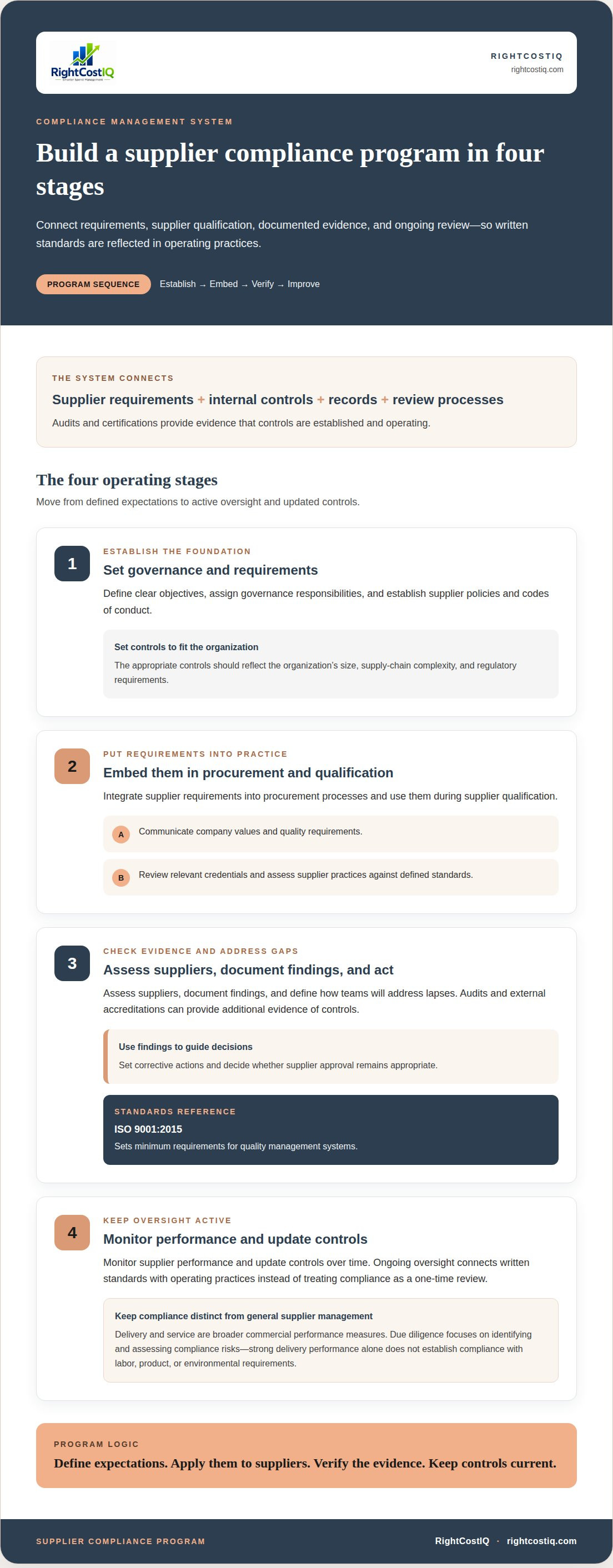
Build the program by setting clear objectives, assigning governance responsibilities, and establishing supplier policies and codes of conduct. Integrate those requirements into procurement processes, then define how teams will assess suppliers, document findings, and address lapses. ISO 9001:2015 sets minimum requirements for quality management systems. The appropriate controls should reflect the organization’s size, supply-chain complexity, and regulatory requirements.
To build the program, establish governance and requirements, apply them during supplier qualification, then monitor performance and update controls. This connects written standards with operating practices instead of treating compliance as a one-time review.
Supplier Compliance and Due Diligence
Supplier compliance management evaluates whether vendors meet specified legal, ethical, and operational requirements. General supplier management covers broader commercial performance, such as delivery and service, while due diligence focuses on identifying and assessing compliance risks.
Qualification can include communicating company values and quality requirements, reviewing relevant credentials, and assessing supplier practices against defined standards. Audits and external accreditations can provide additional evidence of controls. Use findings to set corrective actions and decide whether supplier approval remains appropriate. This distinction matters because strong delivery performance alone does not establish compliance with labor, product, or environmental requirements.
Traceability Technology and Automation
Traceability technology links supplier, product, and movement records so teams can locate information across the network. It matters when an audit, compliance issue, or recall requires evidence about a product’s origin or route.
A centralized compliance system can integrate supplier records, assessments, audit findings, and action plans. Automated notifications can flag expiring documents or compliance lapses, helping teams respond promptly. Compliance management software can also identify improvement areas and manage corrective action plans. The cost of software and audits depends on factors such as supplier-network complexity, system capabilities, and audit scope; pricing is determined by the case and provided after a quote request.
Automation supports oversight, but it depends on accurate, current inputs and clearly assigned owners. An outdated or incomplete digital record cannot establish supplier adherence. Configure systems around the organization’s actual controls, then use alerts and reports to route exceptions to responsible teams.
Compliance Records and Documentation
Compliance records document supplier status, assessment results, required controls, and follow-up actions. They matter because teams need consistent evidence for internal reviews, audits, and decisions about supplier accountability.
Maintain supplier licenses, certifications, insurance, and registration details, alongside relevant policies, codes of conduct, and audit records. Keep assessment results, test evidence, non-conformances, root-cause investigations, and corrective-action plans accessible to relevant departments. A centralized document management system can track required records and expiry dates. Clear ownership and organized retention practices help teams retrieve current evidence without relying on scattered files or individual inboxes.
Compliance standards, audits, and risk assessments
Standards define expected controls, while risk assessments show where supplier exposure needs attention. Together, they help organizations prioritize oversight and respond before a weakness disrupts operations.
Standards and Risk Assessments
Compliance standards provide criteria for evaluating supplier practices, while risk assessments identify where failures could affect legal duties, operations, or reputation. They matter because uniform checks can miss exposure concentrated in particular suppliers, jurisdictions, or materials.
Assess each supplier against applicable requirements and customer, investor, and partner expectations. Then rank risks by factors such as location, industry, and operating conditions. For example, a supplier operating in a high-risk environment may warrant deeper due diligence than one with established controls and accessible records. Record the rationale so internal teams can direct audits and resources consistently.
Use assessment findings to define mitigation actions, owners, and review triggers. Advanced analytics, scenarios, and simulations can help evaluate potential disruptions and their operational impact.
Ongoing Monitoring and Early Detection
Ongoing monitoring tracks supplier performance and compliance after qualification, helping teams identify changing conditions before they become larger issues. It matters because a one-time review cannot show whether controls remain effective as suppliers, operations, or risks change.
Set key performance indicators for qualified suppliers and review results against agreed requirements. Monitor audit findings, reported incidents, assessment responses, and unresolved corrective actions. Changes in a supplier’s performance or documentation can prompt a focused review, while recurring issues can trigger escalation and follow-up testing.
Keep data from surveys, assessments, audits, and tests accessible to relevant departments. This gives procurement, compliance, and operations teams a shared view of emerging exceptions and supports timely decisions instead of fragmented responses.
Visibility and Risk Mitigation
Supply chain visibility means having usable information about suppliers and the risks connected to their operations. It matters because limited sub-tier visibility can conceal exposure beyond direct vendors.
Only 12% of organizations have visibility into at least half of their Tier 2 suppliers, and only 1% have visibility into at least half of Tier 3 suppliers and beyond. Map supplier relationships beyond direct contracts, especially where sub-tier suppliers handle raw materials. Accurate, current data helps teams trace where a risk originates and which products or operations it may affect.
Use this view to prioritize controls, direct audits, and plan corrective action. A risk register linked to supplier records helps internal teams track exposure, accountable owners, and mitigation progress.
Risk Mitigation and Customer Trust
Risk mitigation reduces the likelihood or impact of supplier-related disruptions, while transparent reporting shows how an organization addresses identified issues. This matters because customers rely on clear evidence of responsible sourcing and dependable operations.
Connect supplier assessments to corrective actions, then document the issue, response, owner, and follow-up result. For example, a repeated quality finding should lead to root-cause investigation and preventive action, not just another audit entry. Ongoing monitoring can also support audit preparation and governance reporting.
Consistent evidence helps teams explain decisions to customers and business partners, protecting trust and reputation. A robust process makes exceptions visible, assigns responsibility, and tracks whether mitigation is working.
Environmental, social, and governance performance
Environmental, social, and governance performance translates supplier responsibility into operational measures. Strong oversight connects emissions, labor practices, safety, and accountability to sourcing and partner decisions.
Environmental performance includes emissions, waste management, and sustainability reporting across business operations. Scope 3 emissions extend attention beyond a company’s direct facilities to value-chain activities, including purchased goods and transportation. Build an emissions view using supplier and logistics data, then identify categories where more complete information would improve decisions. Track collection methods, reporting periods, and data ownership so teams can distinguish measured results from estimates. Consistent records also help governance teams explain how environmental performance is assessed.
Ethical sourcing connects environmental compliance with labor conditions and supplier conduct. Supplier codes of conduct can set expectations for worker safety, fair labor practices, and preventing forced or child labor. Procurement teams can integrate these requirements into supplier assessments and performance reviews, rather than treating them as separate policy statements. For example, a supplier scorecard can track audit findings, unresolved corrective actions, and environmental performance together. This view helps identify patterns and focus engagement where supplier practices need improvement.
Governance provides accountability for environmental and social commitments. Assign owners for supplier data, review processes, and corrective actions, then define how exceptions reach decision-makers. Reporting expectations can make environmental and social data quality across value chains important. Organizations can standardize supplier information requests and use automated workflows to route missing or inconsistent responses. Clear ownership supports consistent reporting across procurement, sustainability, and compliance operations.
Transportation operations also involve safety and environmental compliance considerations. Driver hours-of-service rules and hazardous materials handling are examples of transportation requirements that affect supply chains. The Federal Motor Carrier Safety Administration is an example of a government agency involved in enforcing supply-chain-related laws. Include transport partners in supplier oversight by tracking qualification information, relevant safety processes, and incident reporting. For hazardous materials, assess handling controls during transit to reduce the risk of spillage, leakage, or contamination.
Integrate these measures into ongoing vendor performance reviews. A defined scorecard can combine environmental data, labor and safety findings, documentation status, and corrective-action progress. Compare performance against internal requirements and partner expectations, then record decisions and follow-up ownership. Where data gaps limit assessment, identify the missing supplier inputs and prioritize collection based on risk. This creates a continuous governance process: measure performance, act on exceptions, and update sourcing decisions as evidence changes.
Supply chain compliance requirements and end-to-end transparency
Supply chain compliance spans product movement, supplier conduct, and the records supporting each decision. End-to-end transparency connects those requirements to evidence across supplier tiers and business processes.
Supply Chain Compliance Requirements
Supply chain compliance requirements are the legal and operational obligations that apply as goods move through sourcing, production, and trade. Identifying them matters because a product can trigger distinct requirements at different stages and borders.
Translate each applicable requirement into a control, responsible owner, and record. Import and export rules, tariff classifications, and border documentation all affect shipment processes. For conflict minerals, companies must conduct a Reasonable Country of Origin Inquiry, or RCOI, to investigate mineral origins. Maintain approved supplier lists where relevant, and connect each supplier to the materials and products it provides.
Requirements must reach beyond direct vendors. Map sub-tier suppliers handling raw materials before assembly, then document how each supplier relationship connects to product flows. EU operators must collect relevant data and supporting documentation from each supplier while examining and analyzing their business activities, according to EUR-Lex. This makes supplier data collection part of the compliance process, not an isolated reporting exercise.
Clear ownership matters. Businesses remain accountable for ensuring suppliers, carriers, and partners meet applicable requirements. Define who reviews records, who escalates missing information, and how exceptions affect sourcing or shipment decisions. These processes help streamline responses without losing the evidence behind them.
End-to-End Supply Chain Transparency
End-to-end transparency is the ability to trace relevant supplier, product, and movement information across the supply network. It matters because a direct supplier record alone may not reveal where materials originated or how goods moved.
Build traceability around linked records: supplier identity, source location, material or product, transaction, and transport stage. Keep information accurate and current, with clear data ownership and update processes. A connected view helps teams locate a product’s source and movement during a recall, investigate a compliance exception, or prepare an audit response.
Transparency also requires people across the network to understand their responsibilities. Communicate compliance requirements to suppliers, carriers, and internal teams, then establish processes for collecting and reviewing their information. For example, a shipment record should connect relevant origin information with supplier documentation and border paperwork. If a record is incomplete, route the exception to an owner and document its resolution.
Use visibility to direct attention, not simply to accumulate records. Map which data supports each requirement, identify gaps across supplier tiers, and prioritize follow-up based on product and market exposure. This structure can streamline internal reviews and make sourcing decisions more evidence-based. Assess procurement visibility gaps with a focused diagnostic.
RightCostIQ
RightCostIQ helps organizations strengthen procurement oversight through supplier performance tracking, cost analytics, and market intelligence. When compliance depends on consistent vendor performance and informed sourcing decisions, these capabilities can help teams monitor supplier outcomes and assess procurement risks alongside their compliance processes.
For sourcing events, Request For Proposal (RFP) Management and Negotiation Assistance supports structured supplier evaluation and negotiation. Procurement Category Cost benchmarking and Analytics can clarify market pricing, while Price Risk Management and Tracking and Market Price Trending and Forecasting support decisions amid changing market conditions. These services complement compliance programs; they do not replace legal advice, regulatory controls, or supplier audits.
If you’re aligning procurement decisions with supply chain oversight, contact RightCostIQ to discuss your organization’s needs.
Turn Compliance Priorities Into Procurement Action
A clear answer to how to ensure supply chain compliance starts with connecting oversight priorities to procurement decisions. Treat each unresolved supplier issue as an input to sourcing, negotiation, and performance management. Assign an owner, define the decision it affects, and set a review point so compliance information drives action rather than sitting in a report.
RightCostIQ supports procurement decisions through Request For Proposal (RFP) Management and Negotiation Assistance, Procurement Category Cost benchmarking and Analytics, and a Procurement and Vendor Performance Tracking Service. These capabilities can help teams bring supplier evaluation, cost insight, and performance oversight into their procurement approach.
Use the next review cycle to identify where procurement analysis can support your compliance priorities. Contact RightCostIQ to discuss your compliance priorities and explore a practical next step. A more deliberate procurement process can help your organization move forward with greater clarity.
Frequently Asked Questions
What Are Some Examples of Supply Chain Laws and Standards?
Examples include the U.S. Tariff Act of 1930, EU REACH, and ISO 9001:2015. Section 307 of the Tariff Act of 1930 prohibits importing goods made wholly or partly with forced labor in any foreign country, according to U.S. Congress. REACH governs chemical safety for products sold in Europe, while ISO 9001:2015 sets minimum requirements for quality management systems. These examples cover different obligations, so applicability depends on product and market.
What Is the Difference Between Supplier Management and Supplier Compliance?
Supplier management covers the broader commercial relationship, while supplier compliance tests whether a vendor meets applicable requirements and agreed controls. A supplier may deliver on schedule yet have unresolved documentation or labor-practice concerns. Keep commercial performance measures, such as delivery and service, distinct from compliance evidence, such as assessment results and corrective actions. Reviewing both together supports balanced decisions about supplier engagement, remediation, and continued sourcing.
Who ensures compliance, and what happens when it isn’t met?
Businesses should take responsibility for checking that suppliers, carriers, and partners meet applicable requirements. If a shipment fails a requirement, it may be held at customs, delayed at a border, or refused entry. Other consequences can include fines, legal damages, license suspension, or lost market access. The response depends on the applicable rule, the product, and the documented issue.
What does supply chain compliance include?
Supply chain compliance includes the controls and evidence used to meet applicable legal, product, labor, environmental, trade, and data-protection requirements. For example, a business may need to manage supplier conduct, product safety records, chemical declarations, import documentation, and transport controls. The relevant combination depends on what the organization buys, where goods are made, and which markets they enter. A compliance scope should connect each requirement to an owner and record.
Which U.S. laws and regulations apply to supply chain compliance?
Applicable U.S. requirements depend on the product, sourcing locations, and transaction. Examples include Section 307 of the Tariff Act of 1930, which prohibits imports made wholly or partly with forced labor in any foreign country, according to U.S. Congress, and the Uyghur Forced Labor Prevention law, which prohibits imports of goods made wholly or partly in China’s Xinjiang region. Product safety rules, customs requirements, and California disclosure obligations may also be relevant.
How do companies identify and assess supply chain compliance risks?
Companies identify risks by connecting supplier locations, products, materials, and operations to relevant requirements, then assessing the likelihood and impact of potential failures. For instance, a component sourced through several intermediaries may warrant closer origin review if its material raises traceability concerns. Consider supplier history, operating conditions, documentation quality, and business criticality. Record the assessment rationale and use it to prioritize reviews, audits, and corrective actions.
How should companies vet suppliers and conduct due diligence?
Vet suppliers by defining requirements before selection, collecting relevant company and product records, and assessing evidence against those requirements. For a manufacturer, this may include reviewing quality certifications, product declarations, and audit findings; for a carrier, qualification and safety records may be relevant. Incorporate expectations into supplier terms, document gaps, and assign follow-up actions. Reassess when a supplier, product, route, or applicable requirement changes.
How can companies monitor and audit supplier compliance?
Monitor supplier compliance through scheduled reviews of performance data, documents, incidents, and corrective actions, with audit depth guided by risk. An audit can examine records, controls, and operating practices against defined requirements; follow-up should establish whether findings were addressed. For example, repeated incomplete declarations may prompt targeted verification and a documented action plan. Keep results accessible to procurement, compliance, and operations teams, and escalate unresolved exceptions to accountable decision-makers.


