

A procurement request is easier to justify when you frame it around business value, not workload alone. If you’re working out how to convince your boss we need procurement help, build your case around current costs, measurable opportunities, and the consequences of leaving the problem unresolved.
It’s reasonable for management to question the budget, implementation effort, and likelihood of results. A credible proposal addresses those concerns with a clear baseline, transparent assumptions, and benefits linked to company priorities. Avoid promising unsupported savings. Instead, explain how you’ll measure outcomes and review progress.
This guide shows how to build a cost-benefit case, present it in a concise, decision-ready format, and respond to concerns about spending or disruption. You’ll learn to connect procurement needs to financial and operational goals, distinguish direct savings from broader value, and propose a practical next step. The aim is a focused discussion about whether procurement support can address a defined business need, not a request based only on how stretched your team feels.
Key Takeaways
- Build a cost-benefit case around expected value, implementation costs, and the opportunity cost of delaying action.
- Lead with the business problem, then use relevant evidence to support a practical recommendation.
- Connect the resource request to company priorities and prepare a clear response to budget objections.
- Separate measurable financial benefits from operational improvements, and define how results will be tracked.
- Address concerns about disruption by explaining the proposed approach, key dependencies, and how progress will be reviewed.
Preparing a cost-benefit analysis
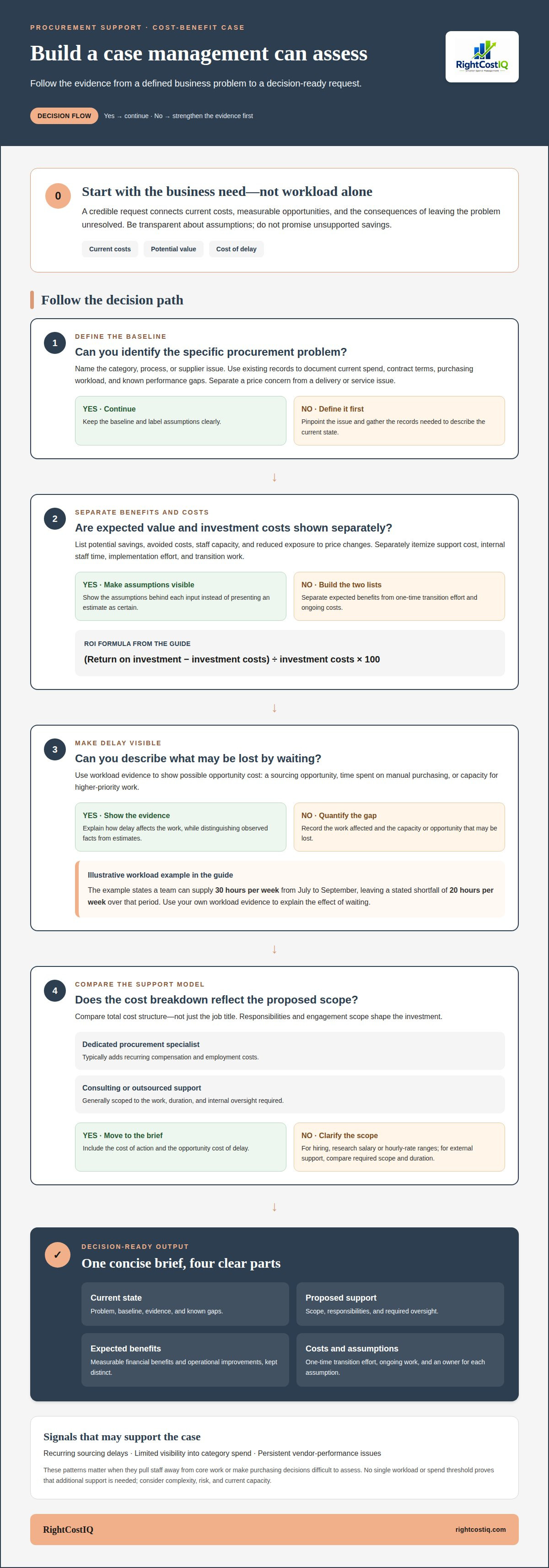
A procurement specialist typically adds recurring compensation and employment costs. Consulting or outsourced support is generally scoped to the work, duration, and internal oversight required. Compare the total cost structure, not just the job title: responsibilities and engagement scope shape the investment.
Signs you may need dedicated procurement support include recurring sourcing delays, limited visibility into category spend, and persistent vendor-performance issues. These patterns matter when they pull staff away from core work or make purchasing decisions difficult to assess.
- Define the business problem and baseline. Identify the category, process, or supplier issue behind your request. Record current spend, contract terms, purchasing workload, and known performance gaps. For example, distinguish a price concern from a delivery or service issue, since each calls for a different response. Use existing records to set a baseline, and label assumptions clearly.
- Estimate benefits and investment costs separately. List potential savings, avoided costs, staff capacity, and reduced exposure to price changes. Then itemize the support cost, internal staff time, implementation effort, and any transition work. Use the ROI formula: (return on investment minus investment costs) divided by investment costs, multiplied by 100. State the assumptions behind each input, rather than presenting an unsupported savings estimate as certain.
- Quantify the cost of waiting. Show what may be lost if the request is delayed: a sourcing opportunity, time spent on manual purchasing, or capacity for higher-priority work. Opportunity cost makes delay visible. A temporary-hire example illustrates the method: three ongoing projects each require business analysts for 10 hours a week from July to September. Combined need is 50 hours per week, while the team can supply 30 hours July to September, leaving a shortfall of 20 hours July to September. Use your own workload evidence to explain the effect of waiting.
- Build a decision-ready cost breakdown. Summarize the current state, proposed support, expected benefits, and costs in a compact table or one-page brief. Separate one-time transition effort from ongoing work, and name the owner of each assumption. For a hiring proposal, research salary or hourly-rate ranges; for external support, compare the scope and duration required. Show both the cost of action and the opportunity cost of delay.
Presenting the proposal using the SCORe storytelling model
Shape the proposal as a decision narrative: state the business problem, support it with evidence, and make a specific recommendation. Use the SCORe structure to keep the discussion focused on a decision rather than a general request.
-
Document Bottlenecks, Risks, and Missed Savings
Start with an example of where procurement work stalls. Record the request, approval, sourcing, or supplier step causing the delay, then describe its operational effect. For instance, show how repeated manual purchasing leaves less time for strategic sourcing. Distinguish documented issues from suspected risks, and attach evidence for each claim.
Describe missed savings as an opportunity to investigate, not guaranteed value. Note the category, supplier or contract involved, and the decision that could not be made. A clear sequence of events helps convince your boss that procurement pressure reflects a business constraint, not simply a busy team.
-
Present Quantitative Evidence and Benchmarks
Pair the bottleneck with measurable workload and spend indicators. Useful measures include transaction volume, sourcing activity, contract coverage, supplier count, and staff time spent on purchasing. No single workload or spend threshold proves that you need additional support. The case depends on complexity, risk, and whether current capacity can manage the work effectively.
Use a chart or concise table to compare the current state with the proposed outcome. Show the source, period, and calculation behind each figure, and distinguish observed data from estimates. For example, a company could show that task volume doubled over the preceding year while processes stayed unchanged, alongside its current procurement capacity. Don’t imply that volume alone proves a staffing need.
Connect each metric to an impact management recognizes, such as delayed sourcing decisions or limited supplier oversight. If the evidence shows a category-pricing gap, should-cost analysis can help frame the comparison.
-
Propose a Pilot or Phased Staffing Plan
Recommend a bounded first phase tied to a defined category, sourcing event, or supplier-performance issue. State the objective, responsibilities, decision owner, and measures for assessing whether the approach works. A pilot lets management evaluate the operating fit before considering broader staffing or procurement support.
Set a review point and identify what happens next under different outcomes. For example, propose continuing, adjusting, or stopping the work based on sourcing progress, workload relieved, and evidence gathered. Do not present the pilot as proof of savings before results exist. A procurement diagnostic can help structure the next discussion around the specific category and evidence.
Choose a presentation format that suits your boss’s communication preferences. Send a brief email for advance context, then use a conversation or presentation to explain the evidence and address objections. Make the request explicit: name the decision needed, the proposed first phase, and how you’ll review progress.
Building a confident case for resource requests
- Link the resource request to an objective in your organization’s strategic plan. Identify the goal, then explain how procurement capacity supports it through sourcing discipline, supplier oversight, or price-risk visibility. For example, if leadership prioritizes margin protection, describe how stronger negotiation preparation could support that goal without claiming unvalidated savings. Distinguish the resource from the outcome: staffing or external assistance is an input, while stronger decision coverage is an operational result. This helps management assess strategic relevance, not just urgency.
Make the connection explicit: name the business priority, the procurement activity it depends on, and the current constraint. If a strategic goal calls for more reliable supplier performance, explain how limited monitoring affects the team’s ability to spot issues and respond. To explain how to convince my boss we need procurement help, show the business goal, procurement activity, and constraint in one clear line of reasoning.
- Prepare a practical response to budget concerns before presenting your request. Identify a possible funding option or offset elsewhere. For example, propose reprioritizing lower-value work or reallocating existing capacity, then explain the trade-off. Don’t present a potential offset as confirmed savings. Name the decision-maker who would approve the change and the work that might be deferred.
Separate essential scope from optional work. If management can’t support the full request, identify a narrower starting point that still addresses the primary procurement constraint. Explain what the smaller scope would cover, what it would leave unresolved, and what evidence could inform a later decision. A transparent trade-off gives your boss options without disguising the resource requirement.
- Set aside enough time to review the proposal with your boss and prepare for likely objections. Send a concise pre-read that states the decision needed, business rationale, and requested resource. Use the meeting to clarify assumptions and discuss consequences, rather than reading every line aloud. If your boss questions the timing, explain which sourcing activity or supplier decision depends on added support.
Match the format to your boss’s communication preferences. Email may suit a manager who wants time to assess details; a presentation may help when several stakeholders need to discuss trade-offs. Keep the recommendation consistent either way. Bring supporting calculations and operational examples so you can answer questions without changing the core case. This makes how to convince my boss we need procurement help a focused management discussion, not a broad appeal for extra capacity.
- If your boss rejects the request, ask what drove the decision. Clarify whether the concern is cost, timing, scope, or confidence in the expected outcome. Then ask whether a revised solution addressing that concern would be considered. This turns rejection into specific direction instead of prompting an immediate repeat of the original request.
Revise only the parts affected by the feedback. If budget is the barrier, present a credible funding adjustment; if timing is the issue, propose a different sequence. If management questions the value, strengthen the connection between procurement work and organizational priorities. Summarize what changed and what decision is needed, then agree on a suitable time to revisit the proposal.
Estimating tangible and intangible benefits
Procurement support does not produce a universal amount of time or money saved. Estimate value based on the categories in scope, current purchasing workload, supplier terms, and measurable changes after support begins.
- Separate cash benefits from capacity benefits. Cash benefits include lower purchase prices, improved contract terms, or avoided costs tied to specific transactions. Capacity benefits involve staff time redirected from manual purchasing to analysis, sourcing, or supplier oversight. Keep these categories separate so management doesn’t mistake released hours for direct budget savings.
For example, if procurement assistance reduces time spent coordinating a sourcing event, report the hours released and the work completed with that capacity. Don’t convert those hours into financial savings unless your organization has a defensible method for valuing them.
- Set a baseline for each measurable outcome. Choose the category, supplier, or process the proposed support would affect. Record existing prices, contract terms, sourcing cycle time, staff workload, and relevant vendor-performance measures. Use records that match the scope, and keep the measurement period consistent when comparing results.
A category-cost baseline can help distinguish a price change from a shift in product specifications or purchasing volume. Similarly, comparing supplier performance against agreed service measures can reveal operational changes without presenting them as cash savings.
- Estimate financial value conservatively. For each sourcing opportunity, identify the current commercial position, the expected change, and the assumptions behind the estimate. Separate negotiated price improvements from cost avoidance, such as preventing unfavorable changes to terms. Don’t count the same benefit under multiple labels.
Use a range of plausible outcomes only when the underlying assumptions support it. Explain what could affect the result, including demand changes, specification differences, supplier response, and implementation timing. A transparent estimate is more useful than a precise-looking figure without a traceable basis.
- Translate operational benefits into observable measures. Track indicators such as time required to complete sourcing work, contract visibility, supplier issue resolution, and staff capacity assigned to strategic tasks. Give each measure an owner and a clear connection to the procurement support being evaluated.
For example, improved vendor tracking may reveal recurring delivery or service issues earlier. Report the trend and the resulting management action. Treat risk reduction as an operational benefit, not as guaranteed avoided spending.
- Present benefits with evidence and limitations. Pair each benefit with its baseline, measurement method, and evidence source. Separate realized results from projections, and explain which factors procurement support can influence. This lets management assess financial return alongside execution quality and resilience.
Close with a review plan that compares actual outcomes with the original assumptions. If category pricing changes but workload remains high, show both results. A balanced scorecard makes the resource decision accountable to more than a single savings figure.
The value varies with the work covered, purchasing workload, supplier terms, and results achieved. Calculate it against a consistent baseline rather than assuming it in advance. Report direct financial gains separately from staff hours freed up, and link each estimate to observable outcomes and defensible assumptions.
Understanding management concerns about budget, disruption, and results
- Address budget as a choice between defined options. Explain the requested investment, the work it covers, and the consequence of declining it. For example, compare focused support for a priority sourcing event with continuing the current process. Don’t present projected savings as approved funding. Show the assumptions behind the business case and how management could adjust the scope if the full request isn’t viable.
If leadership asks how to fund the request, identify a potential offset or lower-priority activity for review. State the trade-off clearly: reducing one activity may free capacity but delay its outcome. A specific funding path gives your boss a decision to assess instead of an unsupported request to “find budget.”
- Reduce disruption by defining the operating boundaries. Describe which procurement activities would change, who owns approvals, and how current purchasing would continue during the transition. For example, a sourcing project can define responsibilities for the requesting team, finance, and supplier communications. Identify dependencies such as access to contract records or timely stakeholder decisions.
Separate transition tasks from ongoing work. Explain how existing processes connect with the proposed support, and identify which approvals would remain unchanged. A clear handoff plan helps management assess operational impact without assuming every team must adopt a new workflow at once.
- Make results measurable before work begins. Choose indicators that match the request, such as sourcing progress, supplier performance, or exposure to changing market prices. Record the baseline, data owner, review method, and decision point. For example, a price-risk initiative should track the relevant category and the decisions informed by monitoring.
Distinguish activity from outcomes. Completing a sourcing event is an activity; a documented change in commercial terms is an outcome. Define how results will be reported and which assumptions management should revisit. This prevents a busy project from being mistaken for business value.
- Prepare for objections with direct evidence and choices. Ask which concern is decisive: budget, disruption, timing, or confidence in results. Respond with relevant evidence, not a longer version of the entire proposal. If your boss questions the scope, present a narrower option and explain what it covers and excludes.
For unresolved procurement costs or price exposure, request a procurement diagnostic to clarify the issue and support a focused management discussion. Close by confirming the decision, owner, and next review point. A clear record keeps follow-up tied to the concern management actually raised.
RightCostIQ
RightCostIQ helps turn a procurement support case into practical sourcing and supplier decisions. When the evidence points to category cost uncertainty, vendor-performance issues, price exposure, or a sourcing event requiring structured negotiation, its services can support the analysis and execution behind your proposal.
Use the business case you’ve developed to clarify the challenge, expected outcomes, and management’s main concerns. RightCostIQ provides RFP management and negotiation assistance, category cost benchmarking and analytics, procurement and vendor-performance tracking, and price-risk management and tracking. These services fit when your organization needs focused procurement expertise, rather than relying on general workload pressure alone.
Contact RightCostIQ to discuss the procurement challenge and the support that fits it.
Make the Next Procurement Decision Actionable
Turn management’s discussion into a decision with an owner, defined scope, and review point. Keep the proposal moving by recording what leadership needs to decide, what evidence could change its view, and when the issue should return to the agenda. This creates a practical path forward, even if the first response is to refine the request rather than approve it.
If you’re still considering how to convince my boss we need procurement help, focus the conversation on the business decision your case supports. A specific procurement challenge gives management something concrete to evaluate and helps you identify the right next action. Keep assumptions visible and update the case as new information becomes available.
Discuss your procurement support needs and take the next step with a clearer view of the challenge. A well-defined request can move the conversation from general concern to informed action.
Frequently Asked Questions
How do I calculate the ROI of hiring procurement staff or outsourcing procurement?
Compare the verified financial benefit attributable to procurement work with the full cost of the resource over the same period. For a hiring decision, include compensation and internal expenses tied to the role; for outsourced work, use the agreed scope and engagement costs. For example, assess one completed sourcing initiative, separating realized price reductions from avoided increases. Exclude benefits that can’t be linked to the work or are counted elsewhere.
What data should I include in a business case for procurement support?
Include transaction and contract records that let a decision-maker trace the issue to its source. A useful evidence pack may pair purchase orders with supplier, category, contract, and requesting-department details. Add examples of delayed approvals, urgent purchases, or supplier issues, with dates and business impacts. Identify the system or record behind each item, and distinguish measured facts from estimates so management can assess the case’s reliability.
What are the risks of operating without procurement expertise?
Without sufficient procurement expertise, teams may have less visibility into supplier terms, purchasing patterns, and exposure to changing market prices. For example, separate departments might buy similar items under different terms while no one tracks the contract conditions. Supplier performance concerns may also go unnoticed until they affect an internal team. These are risks to investigate, not automatic outcomes; their relevance depends on purchasing complexity, supplier reliance, and existing controls.
How can I address common objections to adding procurement staff?
Address each objection with a targeted option rather than defending every part of the request at once. For a budget concern, distinguish essential scope from optional work; for disruption, map responsibilities and approval points. If management doubts the need, identify a specific procurement decision that currently lacks analysis. Ask what condition would change the decision, document it, and use it to shape a revised proposal.


