

A budget gap is a decision point, not an automatic reason to cancel an RFP. An RFP should state an estimated budget range, and evaluation should weigh price against scope fit, proposal requirements, and potential return. If you’re deciding what to do when RFP responses are all over budget, first separate the price gap from the opportunity’s strategic value.
It’s reasonable to ask whether bids above budget could still deliver enough value to justify seeking additional funding or adjusting the scope. Start by understanding what each proposal includes, which costs drive the total, and whether changes would preserve the project’s core outcomes.
This guide explains how to assess pricing and opportunity ROI, consider options for budget approval, and request follow-up information that makes vendor responses easier to compare. You’ll have a clearer basis for deciding whether to revise scope, pursue approval, continue discussions, or pause the opportunity.
Key Takeaways
- Set evaluation criteria before reviewing bids, then apply the stated price weighting consistently alongside scope fit and technical value.
- Assess each proposal’s cost against the opportunity’s potential return, strategic fit, and the resources required to deliver it.
- If bids exceed available funding, examine whether scope changes or an approval request could preserve the project’s essential outcomes.
- Use focused vendor follow-up questions to clarify pricing assumptions, compare responses, and surface practical options.
- Compare total cost of ownership, not just the initial bid, to understand the broader financial implications of each proposal.
How evaluation criteria and price weighting affect proposal strategy
When every proposal exceeds budget, the scoring model helps distinguish a pricing gap from a poor fit. Compare bids against the criteria published in the RFP, including scope compliance, technical approach, experience, and cost. Apply the same standards to every vendor. Changing priorities after seeing prices can undermine a fair, defensible decision.
Set criteria and weights before reviewing proposals. For example, a model might assign 40% to technical approach, 30% to cost, and 30% to company experience. This is one possible weighting, not a universal formula. Choose weights that reflect the project’s mission: a complex implementation may prioritize technical capability, while a standardized purchase may give price greater weight.
Read the RFP’s evaluation section to determine how price affects the award decision. If price carries less weight, an over-budget proposal may still score well on essential capabilities. If price is the highest-weighted factor, the same gap may materially weaken its position. Don’t treat a high technical score as permission to ignore the stated budget or evaluation method.
Budget transparency shapes the proposals vendors submit. An estimated range gives respondents a reference for aligning solutions and pricing with the organization’s expected investment. If part of the scope is uncertain, invite vendors to itemize costs by project element and explain their assumptions. This can reveal whether the gap comes from a required deliverable, an optional feature, or a different interpretation of scope.
To compare proposals consistently, create a scorecard from the published criteria and record evidence for each rating. Check whether each response meets mandatory requirements, addresses the requested scope, and supports its claims with relevant experience. A proposal that omits a required element shouldn’t gain an advantage through an unrelated strength. Use the same scoring definitions across reviewers to reduce subjective differences.
Rules for negotiation or changes after submission depend on the solicitation terms and the purchasing organization’s governing rules. Preserve the published criteria, document decisions, and avoid giving one vendor an advantage through a material change that others cannot address equally.
If the budget changes, communicate the revised constraint and its effect on scope to all affected vendors through the process’s designated channel. If cancellation is necessary, send a clear notice explaining the decision and next steps. A Southeastern state with 20,000 assets canceled an FMIS RFP after bids exceeded its budget, illustrating that cancellation can be an outcome when funding and proposals do not align.
A structured RFP process makes evaluation criteria, budget expectations, and vendor responses easier to align before selection. When deciding what to do when RFP responses are all over budget, use the scorecard and documented assumptions to determine whether the opportunity still fits the organization’s priorities.
Assessing pricing strategy and opportunity ROI
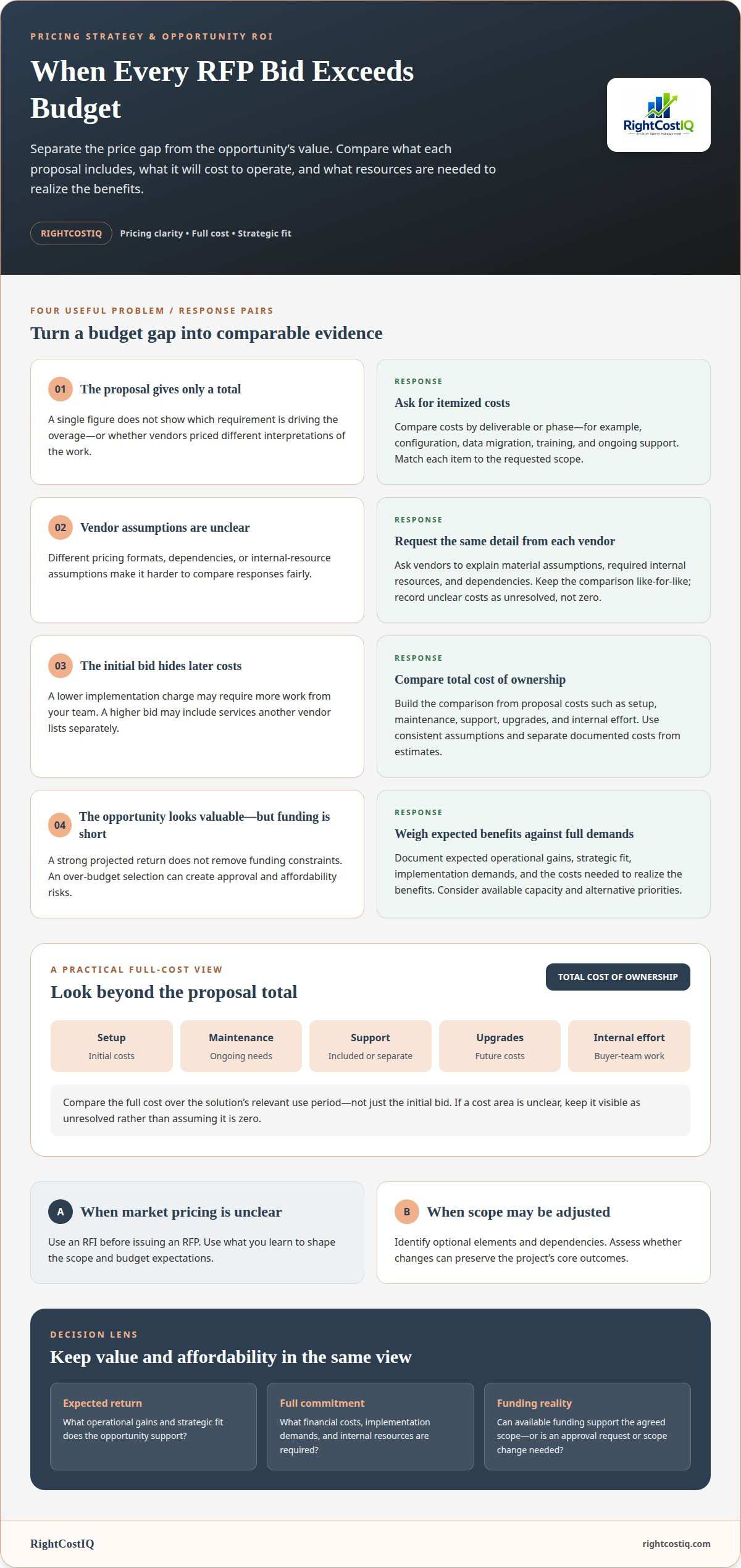
Price analysis should connect vendor assumptions with the opportunity’s expected operational and financial value. When market pricing is unclear, use an RFI before issuing an RFP, then use its findings to shape scope and budget expectations.
Reviewing Itemized Vendor Pricing
Itemized pricing breaks a proposal into costs for distinct deliverables, resources, or project phases. A total alone can’t show which requirement is driving the overage.
For example, an implementation proposal might separate configuration, data migration, training, and ongoing support. Compare each item with the corresponding scope requirement, then identify optional elements, assumptions, and dependencies. This can reveal whether proposals differ because vendors interpreted the work differently or priced different solutions.
Ask vendors to explain material assumptions behind each line, such as required internal resources or dependencies. Request the same level of detail from each vendor so procurement can compare like with like, rather than relying on different pricing formats.
Comparing Total Cost of Ownership
Total cost of ownership compares the full cost of operating a solution over its relevant use period, rather than focusing only on the initial proposal total. This matters because implementation and recurring needs can change the value of an apparently lower-priced bid.
Build a comparison from the costs identified in each proposal, such as setup, maintenance, support, upgrades, and internal effort. For example, a lower implementation charge may require more work from the buyer’s team. A higher bid may include services another vendor lists separately.
Use the same assumptions for each vendor and distinguish documented costs from estimates. If a proposal leaves a cost area unclear, record it as unresolved rather than treating it as zero. This creates a more useful comparison for approval discussions.
Assessing Opportunity ROI and Selection Risks
Opportunity ROI weighs a project’s expected benefits against its full resource demands and financial commitment. An over-budget proposal may still support a valuable opportunity, but a strong projected return doesn’t eliminate funding constraints.
Document expected operational gains, strategic fit, implementation demands, and the costs required to realize the benefits. If the opportunity competes with other work, compare its potential return with the procurement team’s available capacity and alternative priorities.
Selecting an over-budget vendor can create approval and affordability risks if funding doesn’t cover the agreed scope. Negotiating with only one bidder can also limit price comparisons and visibility into alternative approaches. Before moving forward, assess both risks against the organization’s procurement process and documented business case.
When market inputs or vendor assumptions need structured analysis, a procurement pricing assessment can help clarify the decision.
What if I don’t have an approved budget and I need options for approval?
Without an approved budget, treat vendor pricing as input for a funding decision, not as spending authority. Align the requested solution, available funding, and approval case before moving toward a signed contract.
Aligning Scope, Solutions, and Funding
Scope alignment means matching required deliverables to a solution the organization can fund. Vendors may price different interpretations of the same project outline. Separate essential outcomes from optional features, then assess whether a smaller or phased solution would still meet the business need.
For example, an organization could prioritize core functionality now and defer secondary requirements. Document which sections change, how each change affects the intended outcome, and what funding approval would be needed. Keep the business case tied to measurable operational needs, not just a lower proposal total.
Stating Budget and Project Constraints
A useful RFP budget statement gives vendors an estimated range and explains the constraints shaping the work. Include scope boundaries, timing priorities, and whether the organization welcomes alternative solutions. Clear constraints help vendors propose comparable options and make pricing easier to evaluate.
Revising Scope or Requesting a Best and Final Offer
Revising scope changes the requested work. A best and final offer request asks vendors to submit their strongest final terms under defined conditions. Either approach may help resolve a budget gap, but the solicitation’s terms and applicable procurement rules govern what can change after proposals arrive.
Before revising requirements, assess whether all participating vendors can receive the same information and a fair opportunity to respond. Explain the revised scope or request consistently, and document the evaluation approach. Don’t change evaluation criteria simply to favor a proposal that already scored well.
Canceling and Reissuing an Over-Budget RFP
Cancel and reissue when the proposals show that the current scope, budget, or solicitation assumptions can’t support a defensible award. Reissuing can make sense if funding, requirements, or market understanding has materially changed. First, document the reason for cancellation and communicate the decision to participating vendors.
Before signing a contract above approved funding, prepare an approval record. Document the selected proposal, budget variance, business rationale, funding source, scope implications, and required approvals. If approval is denied, revise the scope or pause the award. Vendor selection alone doesn’t authorize spending.
Requesting follow-up information from vendors
Follow-up questions turn unclear proposal details into useful evaluation evidence. If multiple vendors meet the evaluation criteria, request clarifications, references, or a walkthrough of a prior project before making a selection.
Tie each request to a decision gap in the response. For example, if a software proposal exceeds budget, ask the vendor to explain its assumptions, identify optional components, and show how each component supports the stated requirements. This helps distinguish a scope interpretation issue from a pricing or solution difference.
Use a question log to connect every request to the relevant section of the RFP. A consistent format might record the proposal reference, question, response, evaluator, and effect on scoring. This keeps answers traceable and helps reviewers apply the same criteria across comparable proposals.
- Ask which deliverables or assumptions drive the proposed total.
- Request a breakdown of required and optional capabilities.
- Clarify what changes if the organization removes or defers an element.
- Ask how the proposed solution addresses the project’s stated outcomes.
- Request references or a walkthrough relevant to the proposed work.
Set boundaries before sending questions. Keep clarifications focused on understanding submitted proposals, and follow the solicitation’s process for communicating with vendors. If an answer could affect multiple bidders’ understanding, share the same information through the established channel rather than privately updating one response.
References can help test claims that proposal writing alone can’t establish. Ask for examples of comparable projects, the vendor’s role, and how the prior work relates to current requirements. A walkthrough can show how a proposed software workflow operates, while a reference can provide context about implementation and ongoing performance.
Use follow-up answers to assess the published strategy, not quietly replace it. If a vendor proposes a different approach, record how it addresses the original requirements and whether the RFP permits that alternative. Don’t introduce new evaluation criteria during clarification. Otherwise, reviewers may compare one vendor against standards others never received.
Agencies and other organizations can use vendor responses to identify gaps in the RFP itself. If several vendors misunderstand the same requirement, document the pattern and consider whether the scope language needs revision. Any material change should follow the procurement process and give affected vendors an equal opportunity to respond.
Close the loop by recording each answer, its source, and its effect on evaluation. This supports a defensible comparison and gives decision-makers a clear basis for the next step: continue evaluation, seek approval, revise the solicitation, or stop the process.
When figuring out what to do when RFP responses are all over budget, organizations like RightCostIQ emphasize that preparation is key. Before reviewing responses, establish evaluation criteria and align them with the project’s scope and budget. An RFP can help an organization compare vendors for a complex project that requires specific skills, using predetermined criteria. Those criteria should assess whether each bid fits the scope and budget. The RFP should identify specific project elements and expected vendor deliverables.
A successful RFP can also help compare vendors on experience, pricing, and turnaround times. For a fleet software RFP, allow vendors at least 30 days to respond. Keeping these expectations explicit gives reviewers a consistent basis for assessing follow-up answers against the original requirements.
How to compare over-budget RFP responses on total cost of ownership
A proposal total shows only part of the financial commitment. Compare every response using the same ownership assumptions, scope, and operating context to identify why bids exceed budget and what drives long-term value.
Start by creating a common cost model for every vendor. Map each proposal to the same categories, such as implementation, recurring fees, maintenance, support, training, upgrades, and internal resources. Include only categories relevant to the solution being evaluated. This prevents different proposal formats from obscuring meaningful differences.
Next, separate quoted amounts from assumptions and exclusions. One vendor may include data migration while another treats it as a separate task. One may price administrator training, while another assumes the buyer will train users internally. Record these distinctions beside each line item so the comparison reflects equivalent deliverables, not headline totals.
Consider when costs arise, not just their category. A large implementation charge may occur early, while recurring support or maintenance continues during operation. Map those commitments across the period relevant to the decision, using a consistent timeframe for every response. This makes timing differences visible without treating future costs as interchangeable with upfront spending.
Account for internal effort when proposals assign work to the organization. For example, a software implementation that depends on internal data preparation may require staff capacity beyond the vendor’s quoted scope. Identify the work, responsible team, and dependency. If proposals assume different levels of buyer participation, request clarification before comparing totals.
Then assess what’s driving the budget gap. If all bids exceed the approved amount, compare shared cost categories and common assumptions. A recurring expense across proposals may point to a scope or budget-planning issue. A cost appearing in only one response may reflect a vendor-specific approach or a different interpretation of requirements. Treat each pattern as a question to investigate, not an automatic reason to select or reject a bid.
Use sensitivity analysis to test how changed assumptions affect the decision. Compare the proposed solution with a clearly defined reduced scope, deferred feature, or alternative delivery approach. Keep the original evaluation basis visible, and document how each revised scenario changes both cost and expected outcomes. This helps decision-makers see whether a lower commitment preserves the project’s essential purpose.
Finally, summarize each vendor’s total ownership picture, exclusions, assumptions, and unresolved inputs in one comparison. A defensible recommendation should explain the cost difference and its operational implications, not simply rank totals. To structure this assessment, request a procurement cost diagnostic.
Industry research cited in the guide says RFP responses can account for 33% of a company's total income, underscoring the stakes of consistent comparison.
RightCostIQ
RightCostIQ helps procurement teams evaluate over-budget RFP responses through RFP workflow, negotiation coaching, and cost analytics. Turn to its support when vendor pricing, scope assumptions, and projected value need a structured review before an award decision.
Its procurement category cost benchmarking and analytics can help clarify how proposed costs compare within a category. RFP management and negotiation assistance can support follow-up analysis and informed vendor discussions. Price risk management and vendor performance tracking can also connect sourcing decisions with ongoing procurement outcomes.
When multiple responses exceed budget, the next step is a decision grounded in comparable costs, business priorities, and a documented path to approval. Contact RightCostIQ to discuss your procurement challenge.
Turn the Budget Gap Into a Clear Decision
Use this decision to strengthen the next procurement cycle. Before launching another request, define how funding limits, scope flexibility, and approval authority will shape the process. This alignment gives stakeholders a shared basis for action before vendor proposals arrive.
If you’re deciding what to do when RFP responses are all over budget, focus on your organization’s next decision: adjust the opportunity, pursue funding, or pause. Record the rationale and accountable decision-makers so the outcome can guide future sourcing rather than remain an isolated exception.
RightCostIQ can support procurement teams with RFP management and negotiation assistance, cost benchmarking and analytics, and vendor performance tracking. Contact RightCostIQ to discuss your options and identify a practical next step for your procurement priorities.
A disciplined decision today can make the next sourcing opportunity more aligned, informed, and actionable.
Frequently Asked Questions
Should an RFP Include a Budget?
Yes. An RFP should provide an estimated budget range when the organization can define one. This helps vendors shape proposals around the available investment instead of guessing at affordability. If funding isn’t approved or part of the scope remains uncertain, describe the constraints and invite vendors to estimate costs against the requirements. A range is more useful when paired with scope details, priorities, and flexibility around timing or deliverables.
What should you do when every RFP proposal exceeds the budget?
First, identify whether the overage reflects shared project requirements or differences in vendor assumptions. Review what each proposal includes, then ask for clarifications about the largest cost drivers. If the essential scope remains valuable, assess whether funding approval or a revised delivery plan is viable. If the project can’t be funded or resized without losing its purpose, document the decision and consider pausing or canceling the process.
How to negotiate price with vendors after receiving RFP bids
Ask vendors to explain itemized costs, assumptions, and options for adjusting scope, using the same questions for each vendor. Follow the solicitation’s rules for negotiations and ensure material changes are communicated fairly to affected vendors.


