

A tariff increase can affect a supplier’s costs, but it does not automatically give either party the right to change an active contract. How to renegotiate an existing vendor contract starts with the agreement itself: a price-adjustment clause may set out a process, while changes outside its terms generally require both parties’ agreement.
That distinction matters when a supplier requests higher pricing. The right response depends on the contract language, the evidence behind the cost change, the supplier relationship and your alternatives. A price discussion alone doesn’t create a lasting change to the deal.
This article explains how professional support can assess contract terms and pricing impact, structure a negotiation around both parties’ interests, and document agreed changes in writing. It also covers how stronger contract review and vendor accountability can help protect your position before renewal.
Key Takeaways
- Set negotiation limits around business priorities, supplier realities, and the value of preserving continuity before discussions begin.
- Build a proposal around measurable benefits for both parties, then document agreed changes in a signed amendment.
- Review renewal dates, notice windows, termination terms, and price-adjustment provisions early enough to preserve negotiating options.
- Assess contract terms alongside supplier performance and internal user needs to determine whether renegotiation remains the right path.
- Strengthen accountability with clear performance measures, escalation routes, and regular contract reviews.
Can I Renegotiate My Vendor Contracts Because of Tariffs?
Tariffs can prompt a vendor discussion, but they do not automatically change an active U.S. contract. The contract terms and both parties’ agreement determine whether pricing or other terms can change.
Negotiation Limits and Influencing Factors
Before a vendor meeting, a professional sets negotiation limits by defining acceptable terms, priorities and alternatives. This helps prevent tariff pressure from pushing the business into a worse deal than having no agreement.
The analysis considers the contract’s pricing clause, evidence of cost changes, supplier leverage, service performance and the importance of continuity. A professional also agrees on limits with the internal contract signer and identifies concessions the business could offer. Essential or time-sensitive goods, limited alternatives and the need to preserve the relationship can all shape the strategy.
Negotiating Without a Contractual Right
Without a contractual right to adjust prices, renegotiation depends on the vendor agreeing to amend the contract. Under the U.S. contract-law description in this article, tariffs generally are not treated as force majeure events. A cost increase therefore does not automatically excuse performance or authorize a new price.
A professional brings relevant corporate staff and an executive champion into the negotiation, rather than relying only on account, service and governance personnel. If the vendor refuses to renegotiate, the team can present documented cost evidence, explore mutual concessions and maintain a measured tone to limit escalation. For goods essential to operations, continuity may matter more than a hardline demand.
Pricing Benchmarks and Competing Offers
A professional benchmarks the proposed price change against category market data and the contract’s current scope, volume and service levels. Competing offers provide useful leverage only when their terms and delivery requirements are comparable.
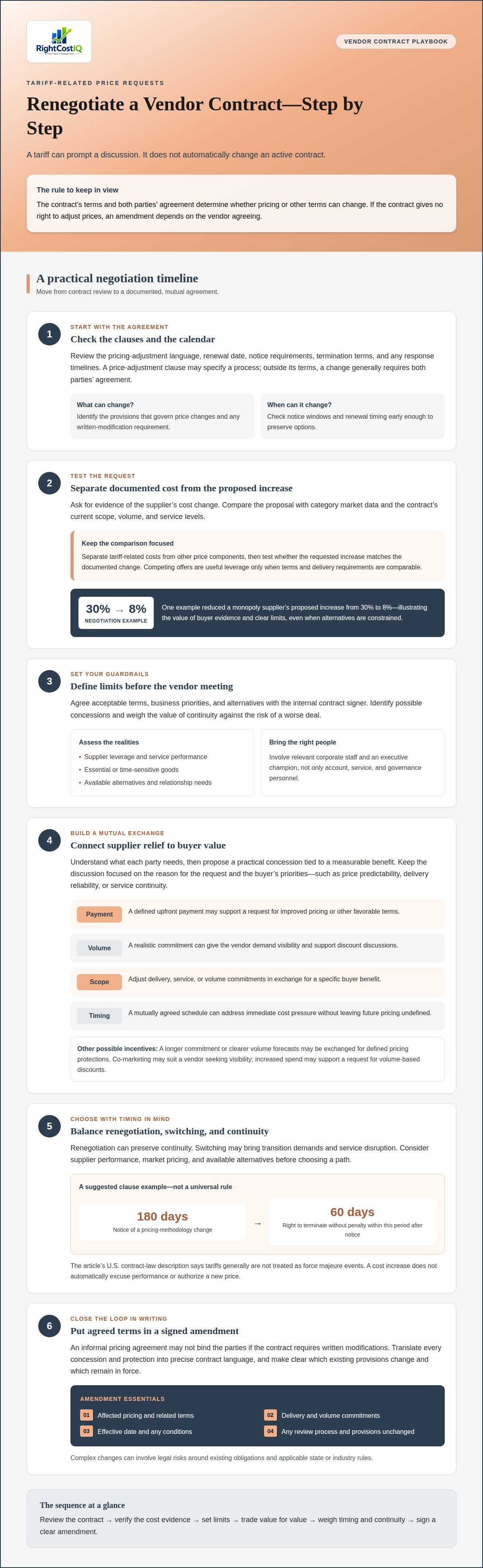
The comparison should separate tariff-related costs from other price components and test whether the requested increase matches the documented change. A negotiation example reduced a monopoly supplier’s proposed increase from 30% to 8%, showing why a buyer’s evidence and limits matter even when alternatives are constrained.
Renegotiation, Switching, and Timing Risks
Renegotiation can preserve continuity, while switching may bring transition demands and service disruption. The right balance depends on supplier performance, market pricing and available alternatives. Before choosing a path, a professional checks renewal dates and contract notice requirements.
Parties can discuss changes by mutual agreement, but the contract may set notice and response timelines. One suggested clause gives 180 days’ notice of a pricing-methodology change and a right to terminate without penalty within 60 days of that notice; it isn't a universal rule. In the United States, an informal pricing agreement may not bind the parties if the contract requires written modifications. A signed amendment should state the agreed pricing and related terms; complex changes can involve legal risks around existing obligations and applicable state or industry rules.
Mutual written contract modifications
A tariff-related price request can lead to a negotiated exchange, not just a choice between accepting or rejecting an increase. For teams seeking guidance on how to renegotiate an existing vendor contract, a professional identifies what each party needs from the revised arrangement and develops terms that connect supplier relief with measurable value for the buyer. For example, a supplier seeking pricing flexibility might consider a longer commitment or clearer volume forecasts in exchange for defined pricing protections.
Keep the discussion focused on the circumstances behind the request. A professional separates the supplier’s cost explanation from the buyer’s priorities, such as price predictability, delivery reliability or service continuity. When advising on how to renegotiate an existing vendor contract, the professional can assess the supplier’s needs and match them with a practical buyer concession. If the supplier needs revenue certainty, a defined purchasing commitment may be more useful than an open-ended promise. If the buyer needs protection from further cost shifts, a documented adjustment method can set boundaries for future changes.
Mutual incentives work best when they address a genuine commercial objective. A buyer with a capital-intensive business might offer upfront payment in exchange for more favorable vendor terms. A supplier focused on quarterly sales quotas may value a commitment that supports its targets. Co-marketing may appeal to a vendor seeking visibility with future customers or investors, while increased spend can support a request for volume-based discounts.
- Payment: A defined upfront payment may support a request for improved pricing or other favorable terms.
- Volume: A realistic volume commitment can give the vendor demand visibility and support discount discussions.
- Scope: Adjusted delivery, service, or volume commitments can connect a supplier’s requested change to a specific buyer benefit.
- Timing: A mutually agreed schedule can help address immediate cost pressure without leaving future pricing undefined.
Before finalizing an exchange, a professional translates each concession into precise contract language. The amendment should identify affected pricing, delivery terms, volume commitments, the effective date, and any conditions or review process. Both parties should understand which existing provisions change and which remain in force. If the contract requires written modifications, an informal pricing discussion may not be enough. Document material changes and have both parties sign.
Clear drafting also reduces later disputes about what the parties agreed to discuss or deliver. A professional can distinguish a temporary adjustment from a continuing price change and document any limits on its application. For complex terms or potential gray areas, legal counsel can help review the proposed language. A focused contract negotiation diagnostic can help identify which commercial terms need structured review before the parties sign.
Reasons vendor contracts renew without review
Annual renewals can pass with little scrutiny when routine approvals replace the work involved in negotiating an initial agreement. Automatic renewal dates, competing priorities and incomplete contract records can leave a supplier’s price increase unchallenged. A professional maps renewal deadlines and lock-in windows across the contract portfolio, then prioritizes agreements where price, performance or scope has shifted.
Review should start well before the renewal window. Organizations are advised to begin 12-24 months before renewal deadlines, giving teams time to assess market pricing, performance, and alternatives. An independent contract visibility review can organize terms and obligations, rate benchmarks, vendor performance indicators, and renewal leverage points. That view helps show whether the supplier’s proposed change reflects a cost shift or an opportunity to revisit broader commercial terms.
Tariff exposure can also make market context important. The United States-Mexico-Canada Agreement’s mandatory six-year review was scheduled for July 2026. Changes to USMCA rules of origin could affect tariff treatment for vendors in North American supply chains. A professional assesses whether the supplier’s affected goods rely on those supply chains, then considers how any tariff treatment change relates to the contract’s pricing mechanism. The review date alone doesn’t establish a price change.
Read price-change clauses closely: they may define both the triggers and limits for an adjustment. A professional identifies whether regulatory changes, commodity-cost thresholds or tariff imposition permit a request. The review also checks notice requirements, response timelines, supporting cost evidence and any cap on each adjustment. For example, a clause that limits each increase calls for a different negotiation position from one that sets a process without a stated cap.
Termination terms matter just as much. Before negotiations begin, a professional identifies automatic renewal language, notice requirements, termination-for-convenience rights and any lock-in period. These provisions shape leverage: missing a notice window may reduce the buyer’s practical options, while a usable exit right can support a credible alternative. The review also clarifies what happens to outstanding orders or services if termination takes effect.
Renewal decisions should connect contract terms with actual supplier performance. A professional compares service indicators and internal user feedback with the current scope, then identifies gaps that call for corrective terms or a broader sourcing decision. If pricing aligns with market benchmarks and service remains strong, targeted renewal changes may preserve value. If scope has drifted or performance has declined, early review gives the business more time to assess alternatives before its leverage narrows.
Assessing the current contract and relationship
A contract review should connect written obligations with the supplier’s actual performance. A professional examines scope, pricing, delivery, service levels, breach provisions and termination rights, then compares them with internal users’ experience. This avoids a common mistake: negotiating a tariff-related price change while overlooking recurring service failures or unused products. The review also tests the vendor’s operational importance and whether the relationship can support a sustainable agreement.
To prepare for renegotiation, a professional compares supplier performance indicators with the contract’s service commitments and current category pricing benchmarks. Internal user feedback adds context, such as recurring delays, unstable APIs, rate limits or slow responses that may not appear in formal reports.
The assessment brings operational evidence into the negotiating position. A professional separates documented issues from general dissatisfaction, then identifies which points affect cost, continuity or contract value. For example, repeated delivery delays can be assessed against agreed delivery terms, while a price proposal can be compared with market benchmarks for a similar scope. This gives both sides specific issues to discuss instead of relying on broad claims.
- Use and scope: Confirm whether internal teams still use the supplier’s product and whether actual use matches contracted volume.
- Performance: Compare delivery, service response, and other recorded indicators with the contract’s commitments.
- Commercial terms: Review price, adjustment mechanisms, scope changes, and any obligations attached to payment.
- Risk and exit: Identify breach consequences, termination rights, notice requirements, and any vendor right to hold goods until payment.
Relationship history also informs the approach. A vendor that consistently meets or exceeds service expectations may be a candidate for targeted renegotiation, particularly when pricing broadly aligns with benchmarks and continuity matters. If service quality has declined, scope has drifted or pricing sits materially above market, a competitive re-tender may be more appropriate. A professional weighs these factors together rather than treating a tariff request as the only decision.
Contract language deserves close attention before any change is proposed. The review identifies what happens if either party breaches, whether termination for convenience is available, and what notice applies. It also checks liability terms: a sample clause limits vendor liability to fees paid during the preceding 12 months. That example is not a universal standard; its relevance depends on the agreement and the risks being negotiated.
Finally, a professional brings contract records, performance evidence, market comparisons and user input together in a decision brief. The brief clarifies which terms need discussion, which operational issues need resolution and what outcomes support the business. A pre-negotiation meeting can then address what has and has not worked under the current agreement, protecting the relationship while keeping proposed changes tied to evidence.
Contract governance and vendor accountability
Contract governance turns negotiated terms into operating controls after the amendment is signed. A named contract owner can track supplier obligations, record performance evidence and coordinate decisions across procurement, finance and internal users. Without clear ownership, a price change may appear on invoices while delivery commitments or service conditions receive less attention.
Effective accountability connects each agreement to observable requirements. A professional translates provisions into measures the business can monitor, such as delivery completion, response times, service quality or agreed pricing rules. The contract owner records exceptions against the relevant obligation instead of treating every issue as a general relationship concern. This makes later discussions evidence-based and helps distinguish isolated incidents from recurring performance gaps.
- Assign responsibility: Identify who tracks each commercial and operational commitment, and who approves a response to nonperformance.
- Record evidence: Keep invoices, delivery records, service reports, and written notices with the corresponding contract terms.
- Review exceptions: Compare reported results with agreed measures, then document the cause and corrective action.
- Escalate consistently: Use the agreement’s dispute process and retain a record of each decision.
Vendor incidents can cause operational harm beyond the invoice amount. When seeking a service-related discount, buyers should account for the disruption and inconvenience caused. For example, a missed delivery that delays internal work may warrant a different commercial discussion from a minor reporting error. A professional links the requested remedy to documented impacts and relevant contract provisions, avoiding unsupported deductions or informal promises.
Price governance remains important after tariff-related changes. If an amendment uses a pricing formula or adjustment trigger, the contract owner can retain the supporting cost basis and compare later invoices with the agreed method. Any variance can then be raised with specific reference to the amendment, rather than becoming a dispute over what the parties discussed. Regular performance reviews also help identify whether a price change coincides with shifts in delivery, scope or service quality.
Treat dispute pathways as governance controls, not threats. Some agreements allow price disputes to be escalated to arbitration or mediation. A professional checks the relevant contract language, identifies the internal decision-maker and prepares the supporting record before escalation. When prior discussions have become tense, a structured process can keep the disagreement focused on terms and evidence.
A practical governance model therefore links each amendment to an owner, measurable obligations, records, and a defined escalation route. Use a vendor governance diagnostic to identify gaps between negotiated terms and performance oversight.
RightCostIQ: Procurement and Vendor Performance Tracking Service
RightCostIQ’s Procurement and Vendor Performance Tracking Service helps businesses monitor supplier performance against contract expectations. It is relevant when tariff-driven changes make cost control, delivery consistency and vendor accountability harder to assess together.
For a renegotiation, performance tracking can inform discussions about service levels and operational impact. Procurement Category Cost benchmarking and Analytics can add market pricing context, while Price Risk Management and Tracking Service can help teams understand changing cost exposure. When the agreement calls for a broader sourcing process, Request For Proposal (RFP) Management and Negotiation Assistance can support negotiation planning.
These services connect contract terms with cost and supplier performance, helping teams prepare an informed review before renewal. Contact RightCostIQ to discuss your vendor contract renegotiation needs.
Make the Next Contract Decision More Deliberate
A negotiation can inform future sourcing decisions as well as its immediate terms. For teams deciding how to renegotiate an existing vendor contract, the next step is to connect changed assumptions with upcoming purchasing decisions. Record what prompted the request, which terms addressed it and what performance evidence should shape the next review.
This creates an institutional record instead of leaving commercial context in email threads or individual memory. When another cost shift arises, decision-makers can distinguish a temporary adjustment from a broader change in supplier economics. Procurement, finance and operational owners can then work from the same rationale and keep priorities aligned.
The goal isn’t to reopen every agreement whenever market conditions move. It’s to make each decision more deliberate, with clear ownership of assumptions and consequences. Discuss your vendor contract priorities with RightCostIQ. A disciplined next step can help your team move forward with greater clarity.
Frequently Asked Questions
What should a professional review in your existing vendor contract before renegotiating?
A professional reviews the executed agreement alongside later amendments, purchase orders and invoices to identify differences between written terms and actual transactions. For example, an invoice may show a price or quantity that does not match the contract schedule. The review also considers current usage, open orders, delivery commitments and unresolved performance issues. Together, these records create a practical picture of the obligations and commercial history that should inform negotiations.
What contract terms can a professional negotiate, such as pricing, service levels, and payment terms?
A professional can negotiate pricing, adjustment methods, delivery schedules, service levels, payment timing and volume commitments. The relevant terms depend on what has changed and what each party can exchange. For example, a buyer seeking more predictable pricing might discuss a defined adjustment process alongside forecast volumes. A service-level change can address a recurring operational issue, such as slow response times, by clarifying expected performance and how exceptions will be handled.
What negotiation tactics help a professional preserve a good vendor relationship?
A professional keeps discussions focused on business evidence and shared objectives rather than blame. For example, they can separate a supplier’s cost request from a documented delivery concern, then discuss each issue using the relevant data. Agreeing on an agenda and rules of engagement helps keep the conversation productive. The negotiator can acknowledge the supplier’s constraints while explaining what the buyer needs to continue the relationship.
How can a professional document contract changes and ensure amendments are enforceable?
A professional prepares a written amendment that identifies the agreement, the changed provisions and the revised terms, then follows the agreement’s modification process. The document should clearly state how pricing, service levels or payment terms change and when those changes take effect. Both parties should sign through authorized representatives. For complex language or potential ambiguities, legal counsel can review the amendment before execution and help align it with the existing agreement.


