

The contract that seems easiest to budget can create the greatest exposure when project scope changes. A fixed-price agreement sets a price for defined work, leaving the contractor responsible for extra costs if the work was underpriced. A cost-plus agreement reimburses project costs and adds a fee, so the buyer bears more risk if expenses rise.
Both structures can work, but neither removes the need to negotiate scope, allowable costs, fees, and change-order procedures. Strong cost-plus vs fixed-price contract negotiation aligns these terms with project uncertainty and each party’s tolerance for financial risk.
This comparison explains how each contract handles costs, scope, and changes, then outlines the trade-offs that guide the choice. You’ll see when predictable deliverables support fixed pricing, when uncertain scope may favor cost-plus, and which negotiation criteria affect budget control and flexibility.
Key Takeaways
- Distinguish fixed-fee profit from percentage-based profit, and consider how each arrangement affects cost incentives.
- Match the contract structure to scope certainty, budget exposure, and the flexibility the project requires.
- Define reimbursable costs, fee terms, and cost controls clearly to make cost-plus reimbursement easier to manage.
- Set scope boundaries and change-order approval processes early to reduce disputes when requirements shift.
- Use procurement benchmarking and negotiation support to assess pricing, allocate risk, and strengthen contract terms.
What Is a Fixed-Price Contract?
A fixed-price contract pays the contractor an agreed amount for a defined job. The price generally stays the same even if actual costs differ from the estimate. This shifts much of the cost-overrun risk to the contractor while giving the buyer greater budget certainty when the scope is clear.
For U.S. federal contracts, the solicitation and contract clauses establish the applicable contract type and terms. The U.S. Government Publishing Office describes a statutory limit for cost-plus-fixed-fee contracts under 41 U.S.C. § 3905, but that provision does not set one universal profit percentage for every contract.
Fixed-price arrangements can still structure profit in different ways. With a fixed fee, the contractor’s profit is an agreed dollar amount, separate from reimbursable costs when the agreement provides for reimbursement. Under a cost-plus fixed-percentage arrangement, profit is calculated as a set percentage of total project costs. The percentage-based fee can rise as costs increase, while a fixed fee stays stable unless the work changes.
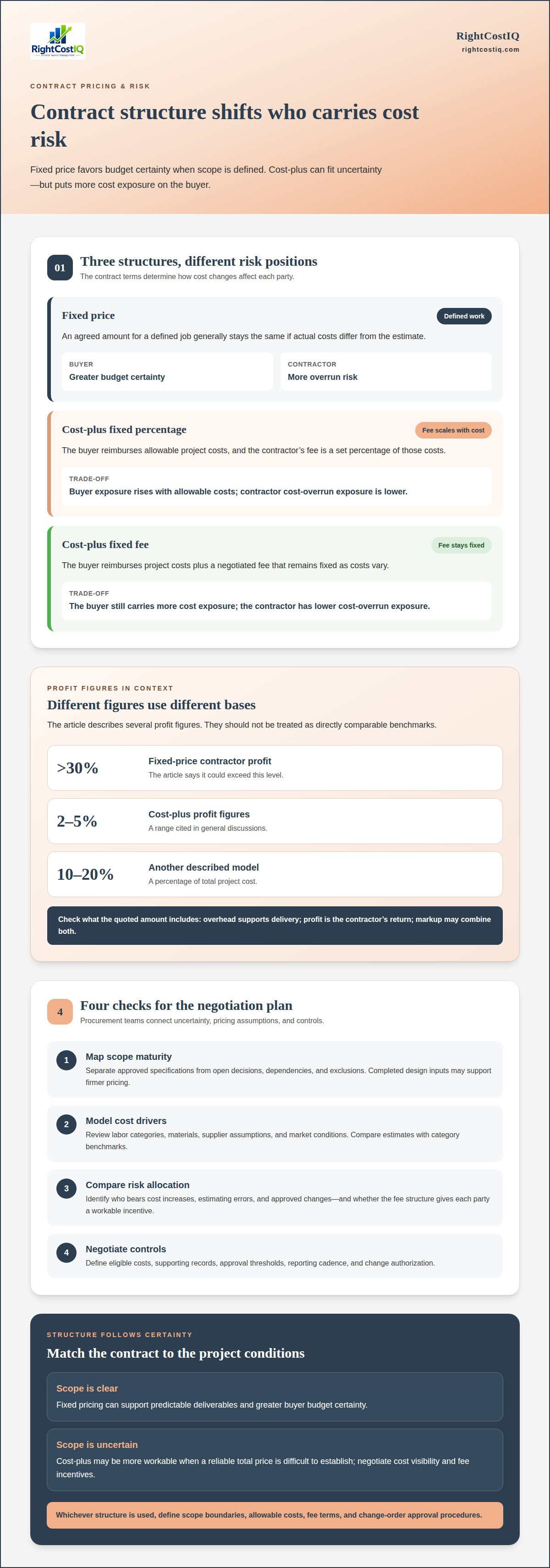
Overhead covers business expenses that support delivery, while profit is the contractor’s return. Markup may combine overhead and profit, so procurement teams should establish which components a quoted amount includes. Fixed-price contractor profit could exceed 30%, while reported cost-plus profit figures range from 2% to 5% in general discussions and 10% to 20% of total project cost in another described model. These figures use different bases and should not be treated as directly comparable benchmarks.
| Arrangement | Buyer budget exposure | Contractor cost risk | Profit basis |
|---|---|---|---|
| Fixed price | More predictable for defined scope | Higher if costs exceed estimate | Agreed total price or fixed fee |
| Cost-plus fixed percentage | Rises with allowable project costs | Lower cost-overrun exposure | Set percentage of project costs |
| Cost-plus fixed fee | Reimbursement plus negotiated fee | Lower cost-overrun exposure | Fee remains fixed as costs vary |
Procurement professionals estimate a fixed-price offer by defining deliverables, modeling labor and material requirements, and testing assumptions against market benchmarks. Should-cost analysis can help assess whether cost drivers support the proposed price. Negotiation then clarifies exclusions, risk allowances, and the process for pricing approved scope changes.
Cost-plus can suit buyers when scope is uncertain because work can proceed while costs are reimbursed. Contractors gain protection from unpredictable expenses, but buyers face greater cost exposure and need visibility into charges. Fixed price shifts much of that allocation in reverse: buyers gain price certainty, while contractors carry more estimating risk.
Choose fixed pricing when you can specify deliverables and assumptions with confidence. Consider cost-plus when uncertainty makes a reliable total price difficult to establish, and negotiate cost visibility and fee incentives to manage the buyer’s exposure.
How procurement professionals help clients choose between fixed-price and cost-plus contracts
Procurement professionals translate project uncertainty into a contract structure and negotiation plan. They start by separating defined deliverables from unresolved requirements. For example, a specification may set equipment quantities while leaving installation conditions open. That distinction shows which work can be priced firmly and where cost exposure needs tighter controls.
Next, they assess the quality of the cost baseline. A fixed-price proposal depends on clear assumptions about labor, materials, schedule, and exclusions. A cost-plus proposal needs defined reimbursable cost categories, reporting expectations, and fee mechanics. Professionals compare supplier estimates with category benchmarks and market conditions, then identify assumptions that could distort the total commitment.
They also assess how uncertainty affects the buyer’s priorities. A stable scope and a strong need for price predictability can support fixed pricing. Unresolved design choices or changing requirements may make cost reimbursement more workable, provided cost visibility and approval controls are clear. The assessment focuses on project exposure, not on which contract label sounds more favorable.
- Map scope maturity. Procurement teams separate approved specifications from open decisions, dependencies, and exclusions. A project with completed design inputs may support firmer pricing; unresolved requirements need an explicit treatment in the commercial terms.
- Model cost drivers. Teams examine labor categories, material requirements, supplier assumptions, and market movement. Category benchmarking helps distinguish a pricing variance from a change in scope or an outdated input.
- Compare risk allocation. The team identifies who bears cost increases, estimation errors, and approved changes. It then evaluates whether the proposed fee structure gives each party a workable incentive.
- Negotiate controls. Terms can define eligible costs, supporting records, approval thresholds, reporting cadence, and change authorization. These controls make cost-plus commitments easier to monitor and fixed-price changes easier to assess.
Finally, procurement professionals document the rationale for the chosen structure. A decision record can connect scope maturity, price assumptions, risk allocation, and governance requirements. This provides a consistent basis for stakeholder approval and later supplier performance reviews. If market volatility matters, price-risk analysis can identify which inputs need active monitoring during delivery.
For a project with mixed levels of certainty, professionals can also assess whether distinct work packages need different commercial treatment. A defined deliverable may be priced separately from exploratory work, if the agreement allows that structure. The analysis should preserve clear boundaries, cost reporting, and responsibility for each package.
A structured procurement diagnostic can help organize cost drivers and contract risks before negotiations advance. Review procurement cost drivers to frame the assessment around scope, pricing assumptions, and risk allocation.
Cost-plus contract structure and reimbursement
Cost-plus terms define reimbursable costs, fee calculations, and change approvals. Procurement professionals negotiate controls, caps, incentives, and change procedures together, linking cost reviews to project decisions.
How procurement professionals negotiate cost controls and caps in a cost-plus contract
Procurement professionals first define allowable cost categories, such as labor, materials, and subcontracted work. The agreement can require itemized records that connect charges to approved project activities. This gives reviewers a consistent basis for assessing invoices instead of treating every expense as automatically reimbursable.
A cap can limit the buyer’s exposure, but its terms must be precise. The parties define whether it applies to total project cost, a work package, or a specific cost category. They also set out what happens as spending approaches the limit, including notice, review, and approval steps. A cap limits exposure; documentation supports scrutiny below that ceiling.
How procurement professionals negotiate incentives and change orders in a cost-plus contract
Incentives link part of the contractor’s fee to agreed performance or cost targets. A U.S. cost-plus-incentive-fee structure starts with a negotiated fee, then adjusts it through a formula tied to allowable costs and target costs. Procurement professionals define the targets, measurement method, and adjustment rules before work begins.
Change-order terms address changes to authorized work, not routine cost reporting. Procurement professionals define who can approve a change, what supporting estimate is required, and how the change affects scope, schedule, and cost limits. For example, a new deliverable can require documented approval before related costs enter the project forecast.
Fee design also affects incentives. Under a cost-plus-fixed-fee arrangement, the contractor receives a negotiated fee that generally does not vary with final project cost. A cost-plus fixed-percentage arrangement calculates profit as a share of project costs, so the fee can rise as costs increase. Cost-plus-no-fee terms reimburse allowable incurred costs without paying a fee.
For U.S. contracts, the statutory fee limit is distinct from negotiated controls. Under 41 U.S.C. § 3905, the U.S. Government Publishing Office states that a cost-plus-fixed-fee contract’s fee generally cannot exceed 10% of estimated cost, excluding the fee. Procurement professionals should distinguish this rule from caps on reimbursable project costs.
Strong contract administration continues after signature. Procurement teams can align invoice reviews with cost categories, track approved changes against forecasts, and compare actual performance with agreed targets. These controls help identify variances early and preserve a clear record of decisions. A well-defined cost-plus structure combines reimbursement rules, fee mechanics, and approval procedures in one operating framework.
Fixed-price contract scope and change orders
In a fixed-price agreement, the scope defines the work covered by the agreed price. Procurement professionals connect deliverables, assumptions, exclusions, and change procedures so both parties can evaluate later requests consistently.
Fixed-Price Contract Scope
A defined scope specifies what the contractor must deliver, including relevant quantities, specifications, and completion criteria. For example, a materials list can distinguish included items from those supplied by the buyer. This differs from cost-plus terms, where reimbursement rules govern eligible expenses. With fixed pricing, unclear boundaries can leave the contractor carrying unexpected costs or create disputes over whether work falls within the agreed price.
Procurement professionals organize scope around observable deliverables rather than broad labels. They align technical requirements with assumptions about access, materials, dependencies, and sequencing. If installation depends on site readiness, the agreement can identify that dependency and explain how delays affect responsibilities. Each exclusion should have a clear boundary. “Standard materials” is less useful than a defined specification or item schedule.
Scope also needs a practical way to handle uncertainty. Teams can separate confirmed work from optional or contingent tasks, then define how those tasks become authorized. For example, an unapproved design alternative should not silently become part of the contractor’s fixed obligation. The contract can specify which documents take precedence if drawings, specifications, and schedules conflict. This makes the agreed baseline easier to administer.
Clauses procurement professionals review with clients before signing
Before signing either contract type, procurement professionals review clauses covering scope, payment, change authorization, schedule, and risk allocation. For cost-plus agreements, they also examine reimbursable cost categories, fee calculations, and supporting records. For fixed-price agreements, they focus on inclusions, exclusions, price adjustments, and the process for approving changes. The priorities differ, but both structures need clear decision rights.
Change-order language should identify who can request a change, who can approve it, and what documentation supports the adjustment. A request might describe revised work, its effect on the schedule, and the proposed price treatment. The parties can require written approval before changed work proceeds. This helps distinguish a genuine scope revision from work already covered by the original deliverables.
Procurement professionals also review payment milestones alongside acceptance criteria. A milestone tied to a defined deliverable gives both parties a reference point for progress and payment. If the schedule changes, the agreement should explain how to document the revision. Risk clauses should reflect the project’s actual dependencies, including buyer-provided information or materials, rather than leaving responsibilities implicit.
Finally, the review checks consistency across attachments and incorporated documents. A specification may describe one material while a schedule names another. Resolving that conflict before signing avoids competing interpretations during delivery. Clear scope, payment, and change clauses make fixed pricing easier to administer and give cost-plus reimbursement rules a defined operating boundary.
What is the difference between cost-plus and fixed-price contracts?
The central difference is how each contract allocates cost risk. A fixed-price agreement sets payment for defined work, so the contractor absorbs costs above its estimate. A cost-plus agreement reimburses allowable project costs and adds a fee, shifting more cost exposure to the buyer. Scope certainty and cost visibility therefore shape the financial trade-off.
Consider a project with approved specifications and stable material requirements. Fixed pricing can tie payment to completed deliverables and provide a clear price baseline. If design decisions remain open, however, a bid may rely on assumptions that later become change requests. Cost-plus can accommodate evolving work, but reimbursement terms and reporting determine how the buyer monitors spending. Effective cost-plus vs fixed-price contract negotiation starts by testing those assumptions against project needs.
Profit incentives also differ by structure. A fixed-price contractor may retain savings when delivery costs fall below its estimate, but bears overruns for unchanged scope. Under cost-plus-fixed-fee terms, the negotiated fee generally stays separate from changes in actual costs. A fixed-percentage fee, by contrast, grows with project costs. That distinction affects incentives and should inform the commercial review.
- Compare scope maturity. Confirmed specifications and deliverables support more reliable fixed pricing; unresolved requirements make forecasting less certain.
- Assess cost exposure. Fixed pricing transfers overrun risk to the contractor for unchanged scope; cost-plus places more responsibility on the buyer as reimbursable expenses rise.
- Review cost controls. Cost-plus requires eligible-cost definitions, records, and review procedures; fixed price depends on precise inclusions and exclusions.
- Test incentives. Examine whether the fee rewards cost discipline, delivery performance, or completion of defined outputs.
Neither structure removes the need for change management. A buyer-requested addition may require a change order under fixed pricing, while cost-plus work still needs approval rules for expanded activity. In cost-plus vs fixed-price contract negotiation, define authorized decision-makers, supporting documentation, and how approved changes affect scope, schedule, and payment.
Market movements can also influence the choice. A fixed-price contract with economic price adjustments can allow upward or downward revisions when specified contingencies occur. This structure addresses defined changes in material or labor costs within a stated price framework. Cost-plus instead reimburses eligible actual costs under agreed terms, making ongoing cost reviews central to administration.
Choose fixed pricing when the scope is sufficiently defined and budget certainty is a priority. Consider cost-plus when uncertainty makes a reliable total price difficult to establish, and pair it with clear cost visibility. For volatile inputs, assess whether specified price adjustments or active market-price tracking better fits the exposure.
A procurement cost diagnostic can map contract type, scope uncertainty, and price exposure before negotiations proceed. Assess your contract cost risks against the project’s commercial priorities.
RightCostIQ: Request For Proposal (RFP) Management and Negotiation Assistance
RightCostIQ supports procurement teams when contract terms, supplier pricing, and project risks need structured negotiation. Its Request For Proposal (RFP) Management and Negotiation Assistance helps organize supplier proposals and negotiate commercial terms, including reimbursement rules, scope boundaries, and change procedures.
Turn to this support when a sourcing decision requires comparable bids or cost assumptions need market context. Procurement Category Cost Benchmarking and Analytics can help assess pricing inputs, while Price Risk Management and Tracking Service can support visibility into price exposure. These capabilities help teams build a clearer basis for selecting contract terms and managing supplier commitments.
For structured support with an upcoming sourcing event, contact RightCostIQ about RFP management and negotiation assistance.
Set the Next Contract Decision in Motion
Before negotiations begin, align procurement, finance, and project stakeholders on the outcomes the contract must support. Decide which risks the organization can absorb, how much cost visibility it needs, and who will approve commercial changes. A shared decision framework keeps cost-plus vs fixed-price contract negotiation focused on business priorities rather than contract labels.
Then turn those priorities into a practical negotiation brief. Record the assumptions behind the budget, the supplier information that needs validation, and the terms that require stakeholder alignment. This creates a clear starting point for evaluating proposals and keeps unresolved decisions visible as negotiations progress.
RightCostIQ’s procurement support can connect sourcing analysis with supplier negotiations and ongoing performance tracking. Clarify your project’s cost and contract priorities, then use this support to move forward with a more structured basis for negotiation.
Start a procurement diagnostic with RightCostIQ and move your next contract decision forward with confidence.
Frequently Asked Questions
What Is a Cost-Plus Contract?
A cost-plus contract reimburses the contractor for allowable project expenses and adds an agreed fee. For example, a prototype project with evolving design decisions may use documented labor and material expenses plus a fixed fee. The agreement defines qualifying charges, required supporting records, and forecast updates. Without clear cost categories, routine expense classification can become a point of dispute during invoice review.
What are the advantages and disadvantages of fixed-price contracts for buyers and contractors?
Buyers benefit from a known price for defined work, which can simplify budget approvals and proposal comparisons. The trade-off is that unclear scope can lead to disputes over what the price includes. Contractors can retain savings when delivery costs fall below their estimate, but bear overruns for unchanged scope. For uncertain work, contractors may price assumptions into their bids, making those assumptions important comparison criteria.
How do cost-plus contracts set fees, allowable costs, and profit margins?
The contract identifies eligible expense categories and specifies whether the fee is fixed, percentage-based, or adjusted through an incentive formula. For example, it can distinguish direct project labor from costs the parties exclude, then require records supporting each reimbursement. Reported cost-plus profit figures include 2% to 5% in general discussions and 10% to 20% of total project cost in another model. These figures use different contexts, not one universal benchmark.
How can procurement professionals help clients choose a cost-plus versus a fixed-price contract?
Procurement professionals compare scope readiness, supplier assumptions, and the buyer’s tolerance for cost variance. They can check whether bids use the same deliverables and exclusions, then separate price differences from differences in proposed work. For example, if one supplier includes commissioning and another excludes it, comparing headline prices will mislead. A normalized evaluation clarifies the commercial trade-offs before stakeholders select terms.
How can contractors work with procurement professionals to manage scope changes and unexpected costs in a fixed-price contract?
Contractors can provide prompt written notice when a request or changed condition may affect agreed work. Procurement professionals can compare the request with the baseline scope, assess supporting estimates, and document approval before revised work proceeds. For example, a newly requested deliverable should be distinguished from correcting work already required by the specification. Clear records help both parties track schedule and price effects.
What are the common risks and disputes in cost-plus and fixed-price contracts?
Cost-plus disputes often involve whether an expense qualifies for reimbursement, whether records support it, or whether costs align with authorized work. Fixed-price disagreements commonly center on whether a task falls within the defined scope or constitutes a change. Both structures can lead to disputes over approvals, schedule impacts, and inconsistent contract attachments. A clear baseline and decision record reduce ambiguity when project conditions shift.
What are typical cost-plus fees and fixed-price contingency percentages in U.S. construction contracts?
Cost-plus profit discussions cite 2% to 5% generally, while another model describes 10% to 20% of total project cost. Those figures reflect different contexts and should not be treated as a single standard fee range. A fixed-price contingency percentage depends on project-specific uncertainty, including scope definition, labor and material exposure, and stated exclusions. The contract’s assumptions determine how that allowance is assessed and managed.


