

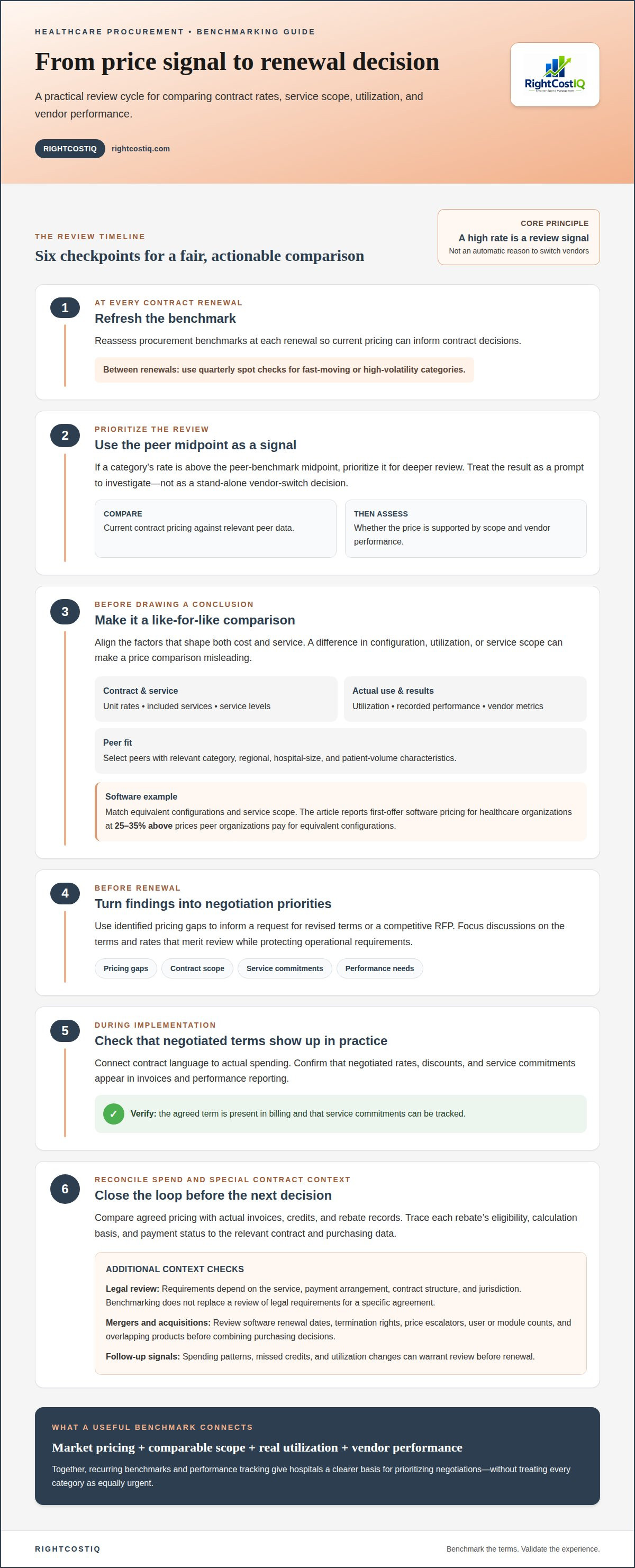
A low contract price is not proof of a strong deal. Healthcare vendor cost benchmarking is most useful when hospitals reassess procurement benchmarks at every contract renewal cycle, with quarterly spot checks for quick or high-volatility categories. A rate above the peer-benchmark midpoint signals a category for deeper review, not an automatic reason to switch vendors.
Healthcare vendor cost benchmarking can reveal pricing gaps, but comparisons based only on summary spending often miss important context. Hospitals also need to understand what services are included, how utilization affects the comparison, and whether vendor performance supports the price.
This article explains how purchased-services benchmarking can reveal savings opportunities, how to weigh cost against service quality, and how to use findings in negotiations and renewals. It also covers how peer selection and contract context shape a fair comparison, helping procurement decisions reflect both market pricing and operational requirements.
Key Takeaways
- Reassess contract benchmarks at renewal, and use quarterly spot checks for quick-moving or high-volatility categories.
- Prioritize categories priced above the peer-benchmark midpoint for deeper review, while accounting for vendor performance.
- Make comparisons more meaningful by selecting peers with relevant category, regional, size, and patient-volume characteristics.
- Balance price against service quality and utilization so negotiations protect operational needs, not just lower unit costs.
- Use purchased-services analysis to uncover opportunities beyond supply pricing, starting with the categories that account for the most spending.
Q1: How Often Should Hospitals Engage Professionals to Benchmark Their Procurement Contracts?
Hospitals should reassess procurement benchmarks at each contract renewal. Quarterly spot checks can help track fast-moving or volatile categories between renewals. If a category’s rate exceeds the peer-benchmark midpoint, prioritize it for deeper review. This approach links current pricing to contract decisions without treating every category as equally urgent.
A useful review compares contract pricing with vendor performance metrics, not price alone. For each category, analysts can align unit rates, included services, utilization, service levels, and recorded performance against comparable peer data. For example, a hospital comparing software contracts should match equivalent configurations and service scope. Healthcare organizations are reported to receive first-offer software pricing 25-35% above prices peer organizations pay for equivalent configurations. A like-for-like comparison makes that gap more meaningful.
Timing matters around negotiation and implementation. Before renewal, benchmarking can identify pricing gaps and inform a request for revised terms or a competitive RFP. During implementation, teams can track whether negotiated rates, discounts, and service commitments appear in invoices and performance reporting. Analytics should connect contract language to actual spending, so a negotiated improvement does not disappear through missed terms or inconsistent billing. A linked pricing analysis can help organize category comparisons for this review.
U.S. laws and regulations that affect vendor pricing depend on the service, payment arrangement, contract structure, and jurisdiction. Benchmarking compares market prices and terms; it does not replace a review of the legal requirements for a specific agreement. Penalties and price controls also require separate consideration: distinguish contractual remedies, such as service credits, from applicable legal restrictions. Map each provision to the relevant service, performance measure, and pricing term.
For mergers and acquisitions, include software contracts in diligence before combining purchasing decisions. Review renewal dates, termination rights, price escalators, user or module counts, and overlapping products. These details show whether the combined organization can consolidate terms or faces commitments that limit near-term changes. Compare equivalent configurations instead of assuming similarly named systems offer the same scope.
Contract and rebate spend analysis should reconcile agreed pricing with actual invoices, credits, and rebate records. Trace each rebate’s eligibility, calculation basis, and payment status to the relevant contract and purchasing data. This can reveal spending patterns, missed credits, or changes in utilization that warrant review before renewal. Recurring benchmarks and performance tracking together give hospitals a clearer basis for prioritizing negotiations.
Identifying savings opportunities across supply categories
Category-level analysis helps hospitals identify savings beyond visible unit-price differences. Start by ranking spending across supply, purchased-service, technology, and administrative categories. A hospital can begin with its highest-spending categories, then examine contract scope, utilization, and supplier terms. This focuses the review on expenses with meaningful budget impact instead of spreading analytics across every department.
Peer comparisons are useful only when the benchmark reflects the category and purchasing context. A medical supply comparison should account for product specifications, order volume, delivery requirements, and included services. A department buying different configurations or service levels may appear more expensive even if its comparable price is not higher. Regional market conditions, hospital size, and patient volume can also affect which peers offer a useful reference.
Vendor-specific benchmarks can identify negotiation opportunities, but they should be treated as directional evidence. Reported average potential savings on Oracle Health contracts is 27%. That figure is a prompt to assess contract scope, configuration, and current pricing, not a forecast for an individual hospital. Similar vendor names do not establish equivalent products or terms. Analysts should compare matching modules, users, service commitments, and contract duration before estimating potential savings.
Purchased services deserve a separate review from physical supplies. These expenses can include staffing, maintenance, software, and other outsourced services, each with different pricing drivers. Purchased services can account for up to 30 percent of a typical U.S. hospital’s total operating expenses and over 20% of a healthcare system’s annual expenditures. Reviewing large categories can therefore reveal savings opportunities outside medical and surgical supply purchasing.
For each selected category, a professional analysis can connect spend records with contract terms and vendor performance. It can identify fragmented purchasing, inconsistent rates, unused services, and price differences across departments. A supplier may offer favorable unit pricing while total expenses rise through add-on fees, unnecessary volume, or underused services. Separating these drivers helps distinguish a genuine cost gap from differences in scope or utilization.
Category analytics should translate findings into negotiation priorities: which terms need clarification, which rates merit discussion, and where performance must remain protected. Savings potential is strongest as a decision signal when the comparison accounts for specification, volume, and service quality. A category-level cost review can help organize those gaps into a focused sourcing agenda.
Balancing cost and service quality
Professionals compare prices only after aligning contract scope, utilization, and performance measures. They then assess whether a lower price maintains the service levels and patient outcomes the hospital needs. For example, a facilities contract with fewer included maintenance tasks is not directly comparable to a broader service agreement.
Traditional benchmarking focuses on cost. Integrated benchmarking pairs cost with utilization and other performance measures. This distinction matters because low spending can reflect reduced service use, changed scope, or more efficient delivery. A useful comparison identifies which explanation applies instead of treating a lower rate as proof of better value.
The CMS Innovation Center uses financial and quality performance benchmarks to assess whether its models maintain or improve care quality while reducing or not increasing spending. Its quality measures may assess treatment effectiveness, hospital-stay frequency and duration, emergency department visits, preventive screenings, and patient satisfaction reported in surveys. These measures illustrate how organizations can assess outcomes alongside financial performance.
For vendor contracts, the same principle means translating service obligations into measurable indicators before judging price. A hospital evaluating a service agreement might examine response performance, completion of contracted work, and continuity against the agreement’s requirements. Measures should fit the service. A metric with little connection to patient care or operational delivery adds noise rather than useful evidence.
Scope normalization is essential. Before comparing contract rates, align covered locations, service hours, included tasks, exclusions, and reporting obligations. If one vendor includes preventive maintenance while another charges separately, account for that difference. Then compare the adjusted scope alongside actual utilization and relevant quality measures. This prevents a narrower contract from appearing artificially competitive.
Performance trends add context to a single-period comparison. A category with stable pricing but declining service results may call for a different strategy from one with higher pricing and consistent delivery. Reviewers can examine the contract’s performance history alongside comparable benchmarks, separating recurring patterns from isolated events. This analysis supports focused negotiations on the terms driving the gap.
Cost and quality should appear together in decision materials. Show price position, scope alignment, utilization, and performance indicators side by side. If an organization considers a lower-cost alternative, it can identify which service commitments must remain intact and which terms need clarification. This grounds procurement strategy in measurable value, not price reduction alone.
Benchmark-informed negotiations and renewals
Benchmark findings are most valuable when they shape contract decisions before renewal. Rates considered reasonable in the past may no longer align with current market conditions. Hospitals can use updated comparisons to identify which terms warrant negotiation, which services need further analysis, and where clinical or operational requirements constrain changes. This turns benchmark insight into a sourcing strategy rather than a reference document filed after contracting.
Start negotiations with a like-for-like comparison of configuration, scope, pricing structure, and service commitments. A vendor’s list price or opening offer may not reflect what an equivalent arrangement costs. For example, separate software modules can have distinct fees, renewal terms, and usage assumptions. Identifying these components gives the hospital a clearer basis for comparing offers and framing requests.
For Microsoft Azure Health and M365 contracts, the reported average savings were 20%. AWS healthcare workload contracts showed 17%, while Epic EHR and MyChart contracts showed 19%. These benchmarks describe reported results, not an automatic outcome for every negotiation.
Contract structure can also affect total value. Healthcare organizations that separately negotiate compliance modules and core products are reported to achieve 20-30% better total contract value on similar configurations. Separate negotiation can make component pricing more visible and help teams assess whether each module meets a defined need. The comparison still needs to account for dependencies between modules and the services included in the overall agreement.
During a renewal or RFP, benchmark evidence can support specific requests: revised rates, clearer price protections, adjusted quantities, or terms that better match actual use. Market price trending and forecasting can add context when pricing conditions change. Procurement teams can compare proposed terms with current benchmarks and explain the basis for each negotiation position instead of making a general request for a discount.
After agreement, implementation controls help preserve negotiated value. Map final rates, discounts, product configurations, renewal dates, and service commitments to purchasing and invoice records. For an Epic renewal, for example, the contracted configuration and associated MyChart terms should align with what the organization buys and receives. This creates a practical audit trail and helps identify discrepancies before they carry into later spending cycles.
Healthcare purchased-services cost benchmarking
Purchased-services benchmarks help hospitals assess supplier pricing across services that do not fit traditional supply comparisons. The most useful reference is a like-for-like view of scope, utilization, and organization characteristics.
Costs by Category and Organization Size
Typical U.S. healthcare vendor costs vary by service category, contract scope, and organization size, so a single price range would be misleading. A hospital’s cost profile may include staffing, facilities maintenance, information technology, and administrative services. Health systems can also differ in locations, service volumes, and contract structures. These factors shape which peer reference supports a fair comparison.
For a staffing agreement, professionals examine covered roles, service hours, and locations. For maintenance, they compare included equipment, response obligations, and preventive work. For software, they align configurations, modules, and support scope. Organization size matters because purchasing volume and operating structure can change the relevant comparison group. A large system should not treat a small hospital’s contract as equivalent without adjusting for scope.
Category-level analysis also separates purchased services from supplies, clinical services, and other spending. This helps procurement teams identify which expenses reflect service requirements and which may reflect contract structure. Internal benchmarks can reveal differences between departments or facilities, while peer references show how comparable organizations structure similar arrangements.
Steps in Cost Benchmarking
A healthcare vendor cost benchmark is a structured comparison of contract spending and terms against relevant peer or internal references. It matters because hospitals need to understand whether a price difference reflects market conditions, service scope, utilization, or contract design.
Professionals begin by defining the category and decision, such as an upcoming renewal or sourcing review. They then organize contract and spend information by supplier, service, location, and period. For a facilities contract, distinguish sites and covered tasks rather than comparing total invoices alone.
Next, analysts normalize the comparison. They align scope, pricing units, service levels, and relevant organization characteristics, including region, size, and patient volume. Benchmarks based on unrelated peers can distort results, so peer selection must reflect the category and operating context. Traditional benchmarking may rely on summary reporting; integrated approaches can compare peer and internal performance in greater depth.
Analysts then interpret the variance instead of treating it as a savings target on its own. They assess whether a higher rate reflects added services, different utilization, or a contract term that warrants negotiation. The final analysis prioritizes findings, documents assumptions, and links each opportunity to a sourcing action, such as renewal discussions or an RFP.
For a focused review of purchased-services spending, request a cost diagnostic to identify priority categories and benchmark gaps.
RightCostIQ: Procurement Category Cost benchmarking and Analytics
RightCostIQ provides Procurement Category Cost benchmarking and Analytics to help hospitals assess category pricing, identify cost gaps, and prioritize sourcing decisions. Turn to this service when purchased-services data is fragmented, peer comparisons need normalization, or a renewal requires clear market insight. Procurement and Vendor Performance Tracking Service connects contract costs with vendor results, while Request For Proposal (RFP) Management and Negotiation Assistance supports competitive sourcing and contract discussions. Price Risk Management and Tracking Service can help monitor pricing exposure as conditions change. Together, these capabilities give procurement teams structured evidence to evaluate spending and plan negotiations, without treating a benchmark as a substitute for service requirements. Contact RightCostIQ to discuss your procurement benchmarking needs.
Make benchmarking part of procurement governance
The next step is to make contract intelligence useful between sourcing events, not just at renewal. A consistent view of pricing, scope, and supplier performance helps procurement leaders focus on important decisions and preserve context as contracts change. Healthcare vendor cost benchmarking supports this discipline when findings connect to clear owners, negotiation priorities, and ongoing performance reviews.
RightCostIQ’s Procurement Category Cost benchmarking and Analytics can inform category decisions, while its Procurement and Vendor Performance Tracking Service connects supplier results with contract oversight. For sourcing events requiring structured competition, Request For Proposal (RFP) Management and Negotiation Assistance supports the process from solicitation through negotiation. Each capability addresses a different point in the procurement cycle, helping teams turn benchmark insights into managed action.
Set the next review around a live category or upcoming contract decision, then align stakeholders on the evidence needed to move forward. Contact RightCostIQ to discuss benchmarking and define a focused starting point for your procurement priorities.
Frequently Asked Questions
Why Does Traditional Healthcare Cost Benchmarking Fall Short?
Traditional comparisons can obscure important differences when they rely on aggregated averages or inconsistent category labels. A hospital might group several services under one accounting code while a peer separates them, making the apparent comparison unreliable. A single snapshot can also miss contract changes or unusual purchasing periods. Professionals improve interpretation by reviewing underlying records and determining whether the benchmark represents a consistent, comparable set of transactions.
Can Smaller Hospitals Benefit From Benchmarking?
Yes. Smaller hospitals can use benchmarking to support focused decisions, even when their purchasing volume differs from larger systems. A review might prioritize an upcoming renewal or a category with fragmented purchasing rather than analyze every supplier at once. Professionals can interpret peer comparisons cautiously when the comparison group is limited, using the hospital’s own contract and purchasing history as additional context.
What Tools Do Professional Procurement Benchmarking Providers Use?
Professional providers may use spend analytics, contract records, invoice data, and structured comparison models. These tools help organize supplier names, align purchasing categories, and examine differences across contract periods. A dashboard can show rate changes or spending patterns, while detailed records help explain exceptions. What matters is whether the data can be traced to source documents and the comparisons reflect the service being evaluated.
What Is Healthcare Vendor Cost Benchmarking?
Healthcare vendor cost benchmarking compares a hospital’s vendor pricing with a relevant reference to assess how its purchasing terms align. The comparison may focus on a product, service, contract component, or spending category. A useful analysis interprets price in context, including the purchasing unit and supporting records. Its purpose is to inform procurement decisions, not to declare that one supplier or contract is automatically best.
Which Healthcare Vendor Categories Should Be Benchmarked?
Hospitals can benchmark categories with substantial spending, upcoming contract decisions, or unclear pricing patterns. Examples include medical and surgical supplies, purchased services, and software agreements. Categories spanning several departments may also warrant review when supplier terms or purchasing practices vary internally. The right starting point depends on the decision: a renewal review may focus on the expiring agreement, while a broader sourcing assessment may examine related categories.
What Data and Metrics Should Healthcare Organizations Provide to Benchmark Vendor Costs?
Useful inputs include executed contracts, amendments, invoices, purchase orders, supplier names, item or service descriptions, quantities, and purchasing periods. For service agreements, include scope details, locations, and performance records that clarify what the vendor delivers. Rebate and credit records can help reconcile contracted terms with actual spending. Consistent periods and category labels make analysis easier to interpret and reduce mismatches between records.
What Are the Best Sources Professional Providers Use for Healthcare Vendor Pricing Benchmarks?
Professionals can combine internal contract and invoice records with peer pricing references, supplier proposals, and prior sourcing results. Each source offers a different comparison: internal records reveal purchasing patterns, while proposals show terms available for a defined scope. A reliable benchmark identifies the source and context behind each comparison. Providers should distinguish direct observations from estimates so negotiation teams understand how much weight each reference can support.
How Can Professionals Use Benchmarking Data to Help Healthcare Organizations Negotiate Vendor Contracts?
Professionals use benchmark findings to set specific negotiation priorities, such as a rate adjustment, clearer billing terms, or a revised pricing structure. They can organize evidence by contract component and connect each request to relevant purchasing records. For example, if a proposal separates implementation fees from recurring charges, comparing those components can sharpen the discussion. An RFP can then communicate consistent requirements and make competing responses easier to evaluate.


