
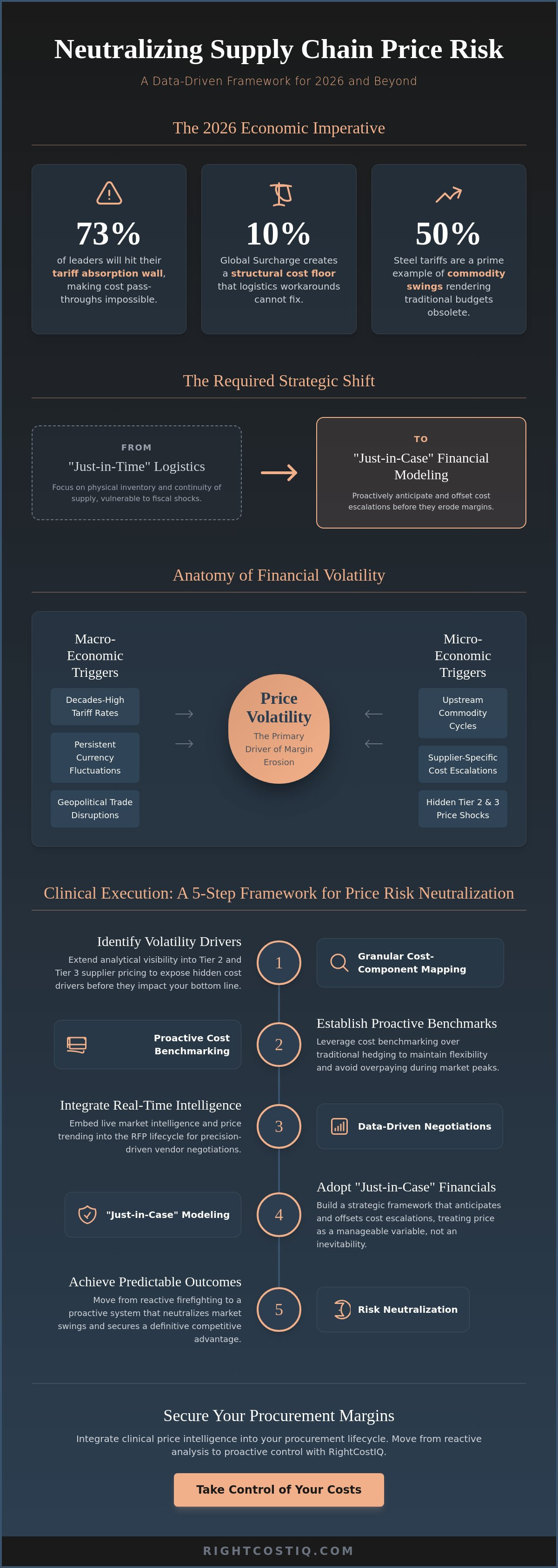
With 73% of supply chain leaders projected to hit their tariff absorption wall by the end of 2026, the capacity to pass through cost increases has effectively vanished. You're facing a convergence of a 10% global surcharge and steel tariffs sitting at 50%, which makes traditional budgeting obsolete. Effective supply chain price risk management is no longer a defensive posture; it's a clinical requirement for securing procurement margins against relentless commodity swings. You understand that inaccurate forecasting leads to immediate budget overruns and eroded competitive standing.
This framework details how to execute price risk mitigation with precision to neutralize market volatility and stabilize your financial architecture. We'll examine the integration of market price trending and aggressive RFP management to ensure your procurement outcomes remain predictable despite geopolitical trade disruptions. By leveraging real-time intelligence and cost benchmarking, you'll move from reactive firefighting to a proactive, data-driven system that secures a definitive competitive advantage.
Key Takeaways
- Shift from "just-in-time" to "just-in-case" financial modeling to protect procurement margins against 2026 trade volatility.
- Expose hidden cost drivers by extending analytical visibility into Tier 2 and Tier 3 supplier pricing structures.
- Execute a clinical five-step framework for supply chain price risk management to neutralize external market swings and stabilize budgets.
- Leverage proactive cost benchmarking over traditional hedging to maintain flexibility in high-volatility commodity environments.
- Integrate real-time market intelligence into the RFP lifecycle to achieve precision-driven outcomes during vendor negotiations.
The Economic Imperative: Defining Supply Chain Price Risk Management in 2026
Supply chain price risk management is the clinical identification and neutralization of financial volatility within the procurement lifecycle. While traditional supply chain risk management often focuses on physical logistics and continuity of supply, price risk management isolates the fiscal variables that threaten bottom-line stability. In 2026, price risk has emerged as the primary driver of margin erosion. It isn't enough to ensure a product arrives on time; procurement leaders must ensure it arrives at a cost that preserves the enterprise's financial integrity. This requires a fundamental shift from "just-in-time" logistics to "just-in-case" financial modeling. This modeling isn't about physical inventory buffers. It's about building a strategic framework that anticipates and offsets cost escalations before they manifest in quarterly earnings reports.
Operational disruption and structural price volatility are distinct threats. An operational disruption is a temporary break in the chain, such as a port strike or a localized weather event. Structural price volatility is a persistent financial pressure caused by shifting trade policies and market cycles. For instance, the 10% global surcharge implemented in February 2026 created a structural cost floor that simple logistics workarounds couldn't fix. Managing this requires a data-driven posture that treats price as a manageable variable rather than an external inevitability.
The Anatomy of Financial Volatility
Financial volatility in 2026 stems from a complex intersection of macro and microeconomic triggers. Macroeconomic factors include the highest effective tariff rates seen in decades and persistent currency fluctuations that complicate international vendor settlements. On a micro level, commodity cycles and supplier-specific cost escalations create granular pressure on specific categories. Identifying these triggers early is essential for survival. Effective market price trending acts as a sophisticated early-warning system. It allows procurement teams to detect subtle shifts in raw material costs or labor indices. By monitoring these trends, organizations can adjust their sourcing strategies before a supplier presents a formal price increase request.
The Cost of Reactive Procurement
Reactive procurement is a strategic liability. When organizations lack visibility into procurement category cost benchmarking, they inevitably overpay during market peaks. Surprise price hikes don't just impact individual departments; they trigger immediate margin compression that can devalue an entire fiscal year's performance. The transition to a data-driven risk posture is no longer optional. A lack of real-time market intelligence during vendor negotiations leaves procurement teams at a disadvantage. Without clinical precision in cost analysis, you're essentially gambling on market stability in an era defined by its absence. Strategic urgency dictates that firms integrate price risk management and tracking services to secure their financial resilience against a volatile global economy.
Analytical Architectures: Identifying the Drivers of Price Volatility
Modern supply chain price risk management requires a transition from aggregate spending views to granular cost-component mapping. You can't manage what you don't decompose. By utilizing procurement analytics to map the entire cost structure of key categories, organizations uncover the hidden drivers of volatility often buried in Tier 2 and Tier 3 supplier tiers. This depth is critical because price shocks rarely originate at the final assembly level. They're usually the result of upstream commodity fluctuations or geopolitical shifts affecting sub-tier components. To effectively manage supply chain risks, you must possess the technical infrastructure to track these movements in real time.
Integrating a Procurement and Vendor Performance Tracking Service allows for the clinical identification of price-to-value discrepancies. This system monitors key variables including contractual compliance versus actual invoice pricing and service level agreement (SLA) attainment relative to cost escalations. This data-driven approach ensures that negotiations are based on objective performance data rather than subjective relationship management. It's about maintaining a relentless focus on the bottom line.
Cost Benchmarking as a Diagnostic Tool
Establishing baseline market pricing for complex categories is the first step toward neutralization. Through clinical data analysis, procurement teams can identify outlier pricing that deviates from established market norms. This process involves comparing your internal contract rates against broader industry indices. Cost benchmarking serves as the foundational anchor of risk management by providing a fixed reference point in a fluctuating market. Organizations that utilize RightCostIQ for procurement category cost benchmarking gain the leverage needed to challenge unjustified supplier price hikes.
Forecasting Models and Market Intelligence
Predictive forecasting represents the next evolution of supply chain price risk management. By integrating AI-driven models into your procurement strategy, you move beyond historical reporting into proactive planning. These models utilize market price trending to identify the optimal window for launching major RFP cycles. The goal is to differentiate between temporary market spikes and long-term structural shifts. For example, the 25% tariff on Indian imports implemented in September 2025 represents a structural change requiring a long-term sourcing pivot, whereas a temporary container rate surge might only necessitate a short-term tactical response.
Strategic Mitigation: Reactive Hedging vs. Proactive Cost Benchmarking
Strategic mitigation requires a choice between external financial instruments and internal operational precision. Traditional financial hedging often functions as a reactive insurance policy; it fails to address the root cause of procurement inefficiency. In contrast, proactive supply chain price risk management focuses on strategic procurement optimization. This method leverages Procurement Category Cost benchmarking and Analytics to dismantle supplier pricing models and identify where margins are being unnecessarily sacrificed. It's a clinical defense of the corporate bottom line. You aren't just betting against the market. You're optimizing your internal cost architecture to withstand it.
Many executives ask if this level of analysis is too resource-intensive. The reality is that the cost of unmanaged price volatility far exceeds the investment in market intelligence. When you consider that 73% of supply chain leaders expect to reach their tariff absorption wall by the end of 2026, the "resource" argument collapses. You either invest in clinical execution now or pay the market's volatility tax later. Proactive benchmarking provides a more sustainable margin defense because it builds a permanent knowledge base that scales across all procurement categories.
The Pitfalls of Fixed-Price Agreements
Fixed-price contracts are often viewed as a safety net, yet they frequently become a financial anchor in high-volatility environments. If market prices drop due to a sudden tariff expiration, such as the projected Section 122 surcharge reduction in July 2026, you're trapped in an inflated rate. A clinical alternative is index-based pricing with strategic collars. This structure allows for price movement within a defined range, sharing risk equitably between the buyer and the vendor. It ensures that neither party is decimated by extreme market swings while maintaining a predictable cost ceiling for the enterprise.
Building Resilience Through Category Management
Effective category management procurement isolates specific price risks by treating each spend area as a distinct financial ecosystem. This approach allows procurement teams to apply specialized Price Risk Management and Tracking Services to high-volatility categories while automating the oversight of tail spend. Unmanaged tail spend often hides significant price exposure. By leveraging a Procurement and Vendor Performance Tracking Service, you can enforce price compliance across the entire supplier base. This ensures that the negotiated rates in your RFP outcomes are actually reflected in the final invoices, neutralizing the price creep common in unmonitored vendor relationships.
Clinical Execution: A Five-Step Framework for Price Risk Neutralization
Neutralizing financial exposure requires a methodical transition from reactive purchasing to a disciplined five-step framework. Successful supply chain price risk management relies on the clinical execution of data-driven strategies that anticipate market shifts before they impact the balance sheet. This process moves beyond general risk assessment by isolating price as the primary variable to be managed. Organizations must adopt this structured approach to maintain margin integrity in the face of 2026's aggressive tariff environment and the 10% global import surcharge.
- Step 1: Category Mapping and Exposure Identification. Audit all spend to identify categories most vulnerable to commodity swings or geopolitical surcharges.
- Step 2: Market Intelligence Integration and Forecasting. Embed real-time data feeds into the procurement workflow to predict future cost trajectories.
- Step 3: Strategic RFP Structuring with Risk-Aware Terms. Design solicitations that require vendors to provide transparent cost breakdowns and risk-sharing mechanisms.
- Step 4: Clinical Negotiation and Vendor Alignment. Use benchmarking data to challenge supplier assumptions and secure market-aligned pricing.
- Step 5: Continuous Monitoring and Performance Tracking. Track vendor compliance and market movements post-contract to ensure ongoing price optimization.
Mapping Exposure and Intelligence
The foundation of this framework is the precise identification of spend categories sensitive to market fluctuations. Not all categories carry equal risk. High-exposure areas like steel and aluminum, which saw tariffs increase to 50% in January 2026, require more intensive oversight than stable service categories. Establishing a definitive "Source of Truth" for market price trending data ensures that all procurement decisions are based on objective reality rather than supplier-led narratives. Real-time data integration is the mandatory catalyst for accurate forecasting in Step 2. By isolating these variables early, you create the strategic space needed to model various tariff and surcharge scenarios before they manifest as cost increases.
Executing the RFP and Negotiation
The RFP process acts as your primary defensive shield against unmanaged price hikes. By utilizing sophisticated RFP Management, you can structure solicitations that demand risk-sharing proposals from vendors. This shifts the conversation from a simple price quote to a structured financial partnership focused on mutual resilience. During the negotiation phase, your Procurement Category Cost benchmarking and Analytics serve as a powerful lever. You aren't just asking for a lower price; you're demanding alignment with verified market data. This clinical approach neutralizes supplier attempts to pass through excessive costs, ensuring your RFP outcomes remain precise and margin-positive. To secure these results for your organization, you can access our Price Risk Management and Tracking Service today.
RightCostIQ: Integrating Price Intelligence into the RFP Lifecycle
RightCostIQ transforms supply chain price risk management from a theoretical framework into a clinical operational process. By integrating high-fidelity intelligence into the RFP lifecycle, organizations neutralize volatility at the point of contract inception. This synergy between Procurement Category Cost benchmarking and Analytics and Request For Proposal (RFP) Management ensures that negotiation outcomes aren't just competitive; they're resilient. You don't just secure a lower price. You secure a protected margin. The era of accepting supplier-led price hikes is over. We provide the data to stop them.
The ROI of professional Negotiation Assistance is realized through the immediate identification of cost-avoidance opportunities. In an environment where the average effective tariff rate hit 11.0% in early 2026, clinical precision in vendor selection is the difference between profitability and deficit. RightCostIQ leverages real-time data to challenge supplier-side inflation narratives. We ensure every dollar spent aligns with actual market movements rather than opaque vendor projections. This turns procurement from a cost center into a strategic driver of financial growth. It's about maintaining a relentless focus on the bottom line.
The RightCostIQ Advantage: Precision Analytics
Proprietary Market Price Trending and Forecasting Services provide the foresight needed to time market entry with precision. We utilize clinical benchmarking to expose hidden savings within complex categories. This identifies where supplier margins have expanded at your expense. Our Procurement and Vendor Performance Tracking Service maintains this value over the long term. It doesn't just track delivery dates. It ensures absolute price compliance against negotiated indices. This prevents the price creep that often erodes contract value in unmonitored relationships. We act as the strategic architect for your procurement financial health.
Strategic Outcomes for the C-Suite
Predictable financial modeling is the ultimate deliverable for the CFO. By neutralizing price variance and eliminating tail spend leakage, procurement leaders provide the enterprise with a stable fiscal foundation. You can't control global container freight rates or the expiration of Section 122 surcharges. However, you can control your organization's response. RightCostIQ provides the technical leverage to turn market volatility into a competitive advantage. It's time to move beyond reactive sourcing. Adopt a data-driven risk posture to secure your 2026 margins. Optimize your procurement outcomes with RightCostIQ.
Neutralizing Volatility: The Path to Procurement Resilience
The transition from reactive firefighting to a clinical, data-driven posture is the only viable path for securing margins in 2026. You've seen how structural price volatility, fueled by aggressive tariffs and global surcharges, demands more than simple supplier diversification. It requires a sophisticated analytical architecture that decomposes costs and identifies risks at the sub-tier level. Integrating market intelligence into your RFP lifecycle transforms procurement from a defensive function into a primary driver of financial growth.
Implementing a rigorous supply chain price risk management framework ensures your organization maintains a definitive competitive advantage despite global economic shifts. By utilizing clinical procurement category cost benchmarking and expert RFP management, you eliminate the guesswork from vendor negotiations. We provide the specialized price risk management and tracking tools necessary to turn market uncertainty into a predictable variable. It's time to take control of your cost structures and protect your bottom line against unmanaged swings. Secure your margins with RightCostIQ's Price Risk Management Services. Your strategic resilience starts with data-led execution.
Frequently Asked Questions
What is the difference between supply chain risk and price risk?
Supply chain risk encompasses broad operational threats like logistics failures, port strikes, and continuity of supply. Price risk focuses exclusively on the clinical neutralization of financial volatility and margin erosion. While a port strike is an operational disruption, the 50% tariff increase on steel seen in early 2026 represents a structural price risk. Effective supply chain price risk management isolates these fiscal variables to protect the bottom line without necessarily altering physical logistics.
How often should procurement teams update their cost benchmarking data?
Procurement teams should update benchmarking data monthly for high-volatility categories and quarterly for stable spend areas. In the 2026 trade environment, where surcharges like the Section 122 global surcharge are subject to expiration or renewal, stagnant data becomes a financial liability. Regular updates ensure that your vendor negotiations remain grounded in current market price trending rather than outdated historical baselines, allowing for immediate tactical adjustments to sourcing strategies.
Can supply chain price risk management reduce actual procurement costs?
Yes, clinical price risk management identifies immediate cost-avoidance opportunities by exposing discrepancies between contract rates and market benchmarks. By utilizing supply chain price risk management and analytics, organizations can challenge unjustified supplier hikes and capture savings during market downturns. This process transforms procurement from a reactive cost center into a strategic architect of financial growth by ensuring every dollar spent aligns with verified market data.
What are the best tools for tracking market price trends in 2026?
The most effective tools in 2026 utilize AI-driven forecasting and real-time data integration to provide predictive market intelligence. Specialized services like RightCostIQ’s Market Price Trending and Forecasting Service offer the granular visibility required to anticipate commodity cycles. These platforms move beyond simple historical reporting by providing the actionable data necessary to time major RFP cycles and contract renewals with clinical precision.
How does RFP management help in mitigating price volatility?
RFP management mitigates volatility by embedding risk-sharing mechanisms and index-based pricing into the initial contract architecture. This prevents organizations from being locked into inflated fixed-price agreements during market corrections. Through expert negotiation assistance, procurement leaders can enforce "collars" that limit price movement. This ensures predictable cost structures and protects procurement margins regardless of sudden shifts in the global trade landscape.
Is price risk management only for large enterprise organizations?
Price risk management is a requirement for any organization where commodity or trade-related costs impact profitability. Mid-market firms often face higher vulnerability because they lack the massive volume leverage of global conglomerates. Implementing specialized price risk tracking allows these organizations to utilize data as a force multiplier during vendor negotiations. This levels the playing field by replacing volume-based leverage with clinical data-driven authority.
What role does vendor performance tracking play in financial risk?
Vendor performance tracking identifies "price creep" and ensures absolute compliance with negotiated contract terms. It serves as a clinical audit layer that verifies if invoice pricing matches the market-indexed rates secured during the RFP process. Without this oversight, organizations often lose their hard-won negotiation gains to unmonitored supplier surcharges and administrative errors. Tracking ensures that the financial resilience built during the sourcing phase is maintained throughout the contract lifecycle.
How can I integrate market forecasting into my existing procurement software?
Integration is typically achieved through API-led connections that feed external market intelligence directly into your existing ERP or P2P systems. This creates a seamless workflow where buyers view real-time price trends alongside their internal spend data. Professional services facilitate this technical bridge, ensuring that market forecasting becomes a functional component of your daily procurement operations. This allows your team to make data-driven decisions without leaving their primary software environment.


